Trepidation!

t

Dear Readers, Tuesday is a big day here in Bug Woman Towers – the tree surgeons that I’d booked for the spring, and who had to cancel because they were so far behind with their work, are now coming tomorrow, to do a fine pruning job on the whitebeam/hawthorn/mixed hedge. It has to be done, but I always find it really stressful – the trees will look as if they’ve been butchered, the squirrels will be thoroughly fed up, and the  birds will be confused. Plus there’s the perennial problem of finding two parking spaces outside the house for the van and the chipper – at the moment I have one, but I’ll be watching with great agitation to see if either of the cars on either side move. Thank heavens for the street Whatsapp group, that’s all I can say. Update – I now have two spaces, let’s hope some irate driver doesn’t move the bins.

There are several dreys in the Hawthorn, but they don’t look as if they’re used at present. And interestingly, most of the berries have been eaten already. At least we’re coming towards the end of the season.

So many leaves just waiting to drop!

I’ve also bitten the bullet, and am talking to someone to help me with the gardening – between the back, the leg and the heart it’s all been feeling a bit much, so I’ve found someone who seems sympathetic to the idea of a wildlife garden, and who will give me a hand. It’s hard sometimes to admit that you need help, but if the past few months have taught me anything, it’s that ‘independence’ is something of an illusion, and that we all need help sometimes. Let’s see how we get on!

“Hard Graft” at the Wellcome Collection

An Image from an exploration of ‘Death Alley’ along the Mississippi in Louisiana

Dear Readers, yesterday I made another foray into central London to see the current (free) exhibition at the Wellcome Collection, “Hard Graft“. It was a fascinating exploration of the ways in which work impacts the human body, and there was much to think about.

I didn’t have the stamina to spend as much time there as I would have liked, but I did sit for twenty minutes to watch the film in the photograph above. It explores an area along the Mississippi river in Louisiana which used to be known as ‘Cancer Alley’ (now ‘Death Alley’) and it describes how the land once used as sugar plantations is now a network of industrial sites, interspersed with small towns populated largely by black people, many of them the descendants of the slaves that used to live and die there. It shows how the plumes of toxic chemicals and particulates impact these small towns, and the images of the poisoned air that people are breathing in every day is horrifying. But people are fighting back on a number of fronts, and one of them is to identify the burial grounds of the slaves who died on the various plantations. When companies want to develop the land for industrial purposes, it’s surprising how often the archaeological companies that they employ ‘miss’ these graveyards, only for them to turn up when a less biased organisation is involved – even in Louisiana, it’s illegal to build over a graveyard. So a lot of work is going into identifying these burial sites, which were usually very close to the slave quarters, and where trees such as magnolias were often planted by those who were related to the deceased. If the sites can be found, at least any further industrial development can be halted, while efforts are being made to hold the existing facilities to account for their emissions.

The exhibition is split into three sections – ‘Plantation’, ‘Street’ (which features everything from sex workers to garbage disposal teams) and ‘Home’, about cleaners, piece work and other work done from the home. It has a strong emphasis on people coming together to fight injustice, and the importance of collective action. I highly recommend it, not least because it made me think about the impact of work on the body.

My mother was a ‘touch-typist’ who used to type up reports, manuscripts and other documents dictated by some boss-type chap (and it was always a chap) into a recording machine called a Dictaphone. Who remembers those? Back in the day, people didn’t do their own typing on their own laptop. No, they got someone else (usually a woman) to do it for them. One day Mum was musing about her life, and said something that’s stayed with me to this day.

“I just feel like part of a machine. I’ve got the ear phones in my ears (to listen to the recorded tape), my hands on the keyboard (Mum was once timed at 130 words per minute, and that was on a manual typewriter) and my feet on the pedals (that controlled how fast the tape went).

In fact, towards the end of her working life Mum developed carpal tunnel syndrome (CTS), but interestingly this only happened after the electric typewriter was introduced. On a manual typewriter, you used to have to stop to return the carriage at the end of every line, and so there were a variety of hand and arm movements. With an electric machine you could just keep going, and once the PC came in you didn’t even have to change the paper, so you were performing a small number of micromovements, just the sort of thing to irritate the median nerve, that runs through the tight corridors of the wrist joint.

Other people who suffer from carpal tunnel syndrome include people who work with machinery such as jack hammers or drills. It is extremely painful and debilitating, but when one of Mum’s colleagues asked for time off for her CTS she was accused of being neurotic, and was managed out of the organisation. This was back in the early 1990s. Would it still happen now? I’d like to think not, but I’m not so sure.

The exhibition also made me think  about the implications of increasing the retirement age. If even sitting in an office can cause something as damaging as CTS (not to mention back pain and all the other joint problems that all that sitting can generate), how about people who are builders, or garbage collectors, gardeners or scaffolders? What happens if  you work outside in all weathers or have to do a lot of heavy lifting or other physically demanding labour as you grow older? Some people will stay as fit as a fiddle, but how about if you have arthritis or one of the other ailments that happen as approach retirement age? Clearly we have a demographic problem in the UK, as in the rest of the Western World, but it does seem particularly harsh that those who are often paid the least, and have the least chance to retire early, are the ones who end up suffering the most.

Rant over! If you’re in London, the exhibition is well worth a look, and there’s a fine café and bookshop too.


More Octopus Shenanigans

Day Octopus (Octopus cyanea) Photo by By Ahmed Abdul Rahman – Template:Mwn, CC BY-SA 4.0, https://commons.wikimedia.org/w/index.php?curid=34663228

Dear Readers, the more I find out about octopuses, the more amazed I am at their intelligence and adaptability. They can also be surprisingly truculent creatures – who can forget the Australian female octopuses who regularly throw silt at male octopuses who are overly amorous? In this week’s New Scientist, there’s an article about Day Octopuses in the Indo-Pacific, who hunt alongside shoals of fish.

The ‘packs’ normally  consist of a single Day Octopus and a small shoal of mixed fish. If a fish makes a direct, urgent movement towards a particular location the octopus will often get involved – its tentacles mean that it can flush small creatures from interstices within rocks or coral, so the fish and the octopus get something to eat. Furthermore, if a fish finds something that it can’t reach and thinks that the octopus hasn’t noticed, it swims backwards and forwards in front of the octopus to get its attention.

But the octopus has no time for freeloaders. The scientist studying the octopus/fish ‘packs’, Eduardo Sampaio, has noticed that the octopus will ‘punch’ fish who are just hanging around rather than helping to find food. Furthermore, of the six species of fish most involved in hunting with the octopus, the Blue Goatfish (Parupeneus cyclostomus) was the most helpful, actively looking for food and signalling when it was found, while the Blacktip Grouper (Epinephelus fasciatus) was something of a slacker, and would just take advantage of the hard work of the octopus and the other fish. Small wonder, then, that the octopuses were only seen to ‘punch’ a Blue Goatfish three times, as compared to walloping the Blacktip Groupers twenty-seven times.

There is a brilliant film of all this happening here – notice how the octopus goes black (usually a sign of annoyance) before punching the fish.

I can think of a few other interactions between different animal species when it comes to food – ravens will signal to wolves and wolverines if there is a carcass that they can’t break into, and the honeyguide (bird) will work with humans and honey badgers if it finds a bees’ nest that it can’t access on its own. I find these examples of cross-species cooperation fascinating, and I’m sure there are many, many more in the sea that no one has documented.

You can read the New Scientist article here, and the whole research paper is here.

Day Octopus (Octopus cyanea) Photo by By Pauline Walsh Jacobson – https://www.inaturalist.org/photos/251606691, CC BY 4.0, https://commons.wikimedia.org/w/index.php?curid=131674208

Spider Stamps!

Dear Readers, I don’t usually succumb to the blandishments of the Royal Mail, but honestly, who could resist these stamps? They’re by one of my very favourite natural history illustrators, Richard Lewington. You might know Lewington through his illustrations for ‘Guide to Garden Wildlife‘….

or the Pocket Guide to Bumblebees….

or the Field Guide to Moths…

How on earth is he so prolific? His illustrations in the Moths book show the smallest gradation of difference between the species. Such precision! And the illustrations manage to be both accurate and beautiful, a true reflection of each species. And in the case of the moths, the illustrations are also life-sized.

But back to the spider stamps. I’ve seen and written about several of these species: the Candy-striped Spider was spotted on the Hemp Agrimony a few years ago…

The Zebra Jumping Spider is a regular favourite….

I did a post about the Cucumber Spider back in 2018…

And I wrote about the Nursery Web spiders that I found in Barnwood a few years ago.

How I would love to see some of the others, though! In particular the Wasp Spider, who is advancing north as climate change makes the environment more suitable for it. And what a spectacular arachnid it is! Its web contains a zigzag band of silk, which I think makes it unique in the UK, and it lives mainly on grasshoppers.

And I wouldn’t mind seeing a Ladybird Spider either – it’s the sole member of the Velvet Spider family, and was thought to be extinct until it was rediscovered in 2002. It’s extremely rare, and fully protected in law, so I would be very lucky to see one, though as it does mainly live in a single site in Dorset at least I am sometimes in the right part of the country.

So, what a delight these stamps are! If you’re a spider lover, you can treat yourself to a set here, And if you fancy buying a Richard Lewington print or even an original, there are some for sale here. Well, Christmas is coming, unbelievable as it seems…..

Signed Off!

Dear Readers, over the past three months I have started to feel as if Whittington Hospital’s Orthopaedic Department was my second home. I’ve grown to recognise the staff, to feel comfortable with the routine (check in, up to the third floor for an X-ray, down to the first floor again to see a doctor, make another appointment for a few weeks’ time). Today, though, was my last visit (unless something goes wrong) and I found it surprisingly moving.

It’s true that healing (physical or spiritual or mental) isn’t a constant upward line, with improvements every single day – if I walk too much on Tuesday I can be sitting on the sofa with an ice-pack on Wednesday. But over time, the line is definitely on the right trajectory. I have been walking about without a crutch at home for weeks, but when I’m outside I’ve still been using one. Today, I decided that as I was getting a cab to the hospital, I would leave it at home. There’s something about being indoors on a smooth surface that makes everything feel more manageable.

As usual, the X-ray technician let me have a look at my X-ray. I don’t have a photo of it yet, but there was a clear ‘bump’ over the fracture where the bone is healing and forming a callus. Hopefully I can persuade the physiotherapist to take a photo so I can show you. It’s quite something to be able to actually have a time lapse sequence of your body healing. And the X-ray technicians are always surprised that someone is interested, and happy (usually) to share their expertise with you.

The doctor was very pleased with my mobility, not quite so pleased with the limp, but happy to discharge me. She said that if there were any problems going forward I could just come to the clinic, and if the physio was worried she would refer me herself.

I feel  a little strange now. I’m clearly not ‘back to normal’, whatever that is, but I do have a new spring in my step (not too much, though, one has to be sensible). And so I caught the bus home, rather than getting a cab, and found that people sprang up to give me their seat when they saw how I was walking. I can’t yet go upstairs on the bus, but at least I feel a little more independent. And how far I’ve come, from being completely dependent on my husband for everything to being able to get on a bus! I feel quite elated, and very humble. What a wonder the NHS is, and how grateful I am for all my friends, near and far, those I’ve known in person for years and those I’ve never met. Thank you so much to you all.

Craneflies Revisited

Dear Readers, it’s that time of year when strange creatures move into the house. If it’s not the spiders it’s the craneflies (daddy-long-legs here in the UK), flying around erratically and crashing into walls/light-fittings/slow-moving humans.  In my original piece below, I write about my childhood fear of these utterly harmless, short-lived insects, and I’m pleased to report that I’m much less bothered by them now – it’s amazing how a little knowledge can turn something from frightening to fascinating, or at least that’s what I find. And it’s only for a few weeks, after all. The first frosts will kill them all off, but before that they’re food to all manner of autumn migrant birds and other predators.

And incidentally, for my readers in other parts of the world, here are some other creatures that you might know as ‘daddy-long-legs’ but are called other things in the UK (though there might also be regional variations here, let me know!). Thank heavens for scientific binomial names, that’s all I can say. They may not trip off the tongue ( at first) but at least everyone knows what we’re on about.

First up, the harvestman. These are arachnids but not spiders, and used to be seen all over the walls of our outside toilet when I was a child in Stratford. Notice how their bodies don’t have the distinct segments that spiders have. Don’t ask me why the photo is green, I must have been having a camera-manipulation failure.

Harvestman (Phalangium opilia)

And here is a cellar spider, also a ‘daddy-long-legs’ candidate in some places. These little chaps vibrate up and down at tremendous speed if disturbed, and are voracious hunters of other spiders, to such an extent that if you have cellar spiders in your shed, as I do, you’re unlikely to have any other species.

Cellar spider (Pholcus phalangoides)

Anyhow, back to the ‘actual’ daddy-long-legs, and here’s what I had to say back in autumn 2021.

Dear Readers, I like to think of myself as pretty immune to fear when it comes to insects, though obviously I have a healthy respect for those that can bite and sting and will give them the space that they need. But as a child I had a completely irrational terror of the common-or-garden cranefly, or daddy-long-legs as they’re known in the UK. There’s something about the way that they fly so erratically that still gives me the shivers, though I’m much more under control than I used to be. After all, these creatures are harmless and, once hatched, have vanishingly short lives. For me they are the quintessential sign of autumn, as they bask in the sunshine or search for places to lay their eggs. Mum and Dad’s bungalow walls in Dorset were often covered in them, and it was a rare evening when a daddy-long-legs didn’t fly in and bash itself half to death against the ceiling light.

These are a very ancient type of fly: they were probably bumbling around 245 million years ago, and there are over 15,000 species of cranefly, in 500 genera. I was delighted to hear that scientists describe them as ‘deciduous’, not because they lose their leaves easily but because their legs detach very easily from their bodies, presumably as a way to thwart predators. In my more unenlightened days I would sometimes attempt to swat craneflies, and was always horrified at how easily their legs would come off. Furthermore, sometimes I would assume that the insect was dead only to hear it rustling some hours later, finally lifting off out of the wastepaper basket where its supposed corpse had been deposited and flying around the room like some zombie invertebrate. These days, I will carefully catch an errant cranefly in a glass and take it outside, which is much kinder. Mostly craneflies cannot feed as adults, and are really just waiting to mate, lay their eggs and die. I am pretty sure that the one in the photo is a gravid female.

While most baby animals have a kind of charm, it’s hard to find find anything cute about a larval cranefly, or leatherjacket. In many of those 15,000 species, the larva is a detritivore, helping to tidy up rotting vegetation. Alas, the commonest UK craneflies (Tipula sp.) include some species where the larvae feed on the roots of living plants – you will sometimes dig up a leatherjacket when trying to sort out a lawn, for example. Fortunately, the larvae are also a juicy snack for many birds, including crows, magpies, jackdaws and especially rooks. There was one famous incident in 1935 when there were so many leatherjackets under the wicket at Lords cricket ground that the groundstaff were tasked with digging them up and burning them (surely putting them on a bird table would have been a more ecological way to deal with the situation, but these were less enlightened times). Our old friend Wikipedia notes that ‘the pitch took unaccustomed spin for the rest of the season’.

This was clearly a problem across the country in the mid 1930s, and for your delectation, here is a 1936 article from The Guardian, which is a pure delight. As a sample, here is a description of a leatherjacket from the piece in question:

‘a horrible thing like a midget concertina, more or less the same at both ends, without any legs‘.

I have no idea what Paris Green is, but I do like the idea of turning over the soil to expose the grubs to their natural enemies.

Leatherjacket (Photo by Rasbak, CC BY-SA 3.0 <https://creativecommons.org/licenses/by-sa/3.0>, via Wikimedia Commons)

I really do want to work on my attitude to craneflies, though. Their lives are short, and they can’t help having detachable legs and little aeronautical skill. Their heads look rather like those of miniature carousel horses, and I find that that helps a bit, though you could argue that it would be a roundabout from hell.

Head of a cranefly (Photo by By Thomas Shahan – Crane Fly – (Tipula), CC BY 2.0, https://commons.wikimedia.org/w/index.php?curid=8998257)

However, the largest cranefly in the world was recently discovered in China, and has the scientific name Holurusia mikado. It has a wingspan of about 8 centimetes, but goodness only knows how long the legs are. ‘Daddy-long-legs’ indeed!

Horusia mikado, the world’s largest cranefly (Photo from https://www.chinadailyhk.com/articles/38/140/76/1524561317187.html)

Sadly, many newspapers recorded the species as a mosquito, even though the insect barely feeds, and only eats nectar when it does. Poor cranefly! I can feel my empathy winning out over fear, as it so often does. It can’t be a lot of fun being a cranefly. To end, here’s a rather sad summing up of the life of the daddy-long-legs, written by Craig Brown at the height of an ‘explosion’ of craneflies in 2006, and included in ‘Bugs Britannica’ by Peter Marren and Richard Mabey.

It is, I suppose, this sense of their utter uselessness that makes us pity them, and perhaps even, in our more downhearted moments, identify with them. Their life is all such an effort – and to what purpose?….Swarms of male daddy longlegs dance around like drunken morons on the lookout for lady friends. Copulation sounds like a grim affair for both parties. ‘The male genitalia include a pair of claspers which grip the female genital valves’, says one encyclopedia, ‘but in order to do so the male’s abdomen has to be twisted through 180 degrees’. Their only pleasure in life seems to be cleaning their legs, which they do obsessively after each meal, pulling them one at a time through their jaws. After all this, they bluster into a light-bulb, have a pot-shot taken at them, lose half their legs, crawl around for a bit, lose the other half, and then die. It’s not a life to be envied, I think, as I reach for the dustpan and brush”.


Wednesday Weed – Yew Revisited

Dear Readers, it’s always fun to visit an old friend, so I jumped at the chance to go with my human friend L to visit the Totteridge Yew, the oldest tree in London (at approximately 2000 years old). I’ve written about in detail below, but my trip today was in particular to look at an interesting gall that seems to have developed since I last visited.

If you look closely at the photograph above, you’ll see what look like green dahlias growing at the end of some of the branches, in amongst the perfectly normal red ‘fruit’ (known as arils). These ‘dahlias’ are caused by a tiny midge, known as the Yew Artichoke gall fly (Taxomyia taxi). In year one, the midge lays an egg on the bud of the tree, which develops into a bright orange larva, which then lives in the gall for two whole years before emerging as an adult fly. Like all galls, the ‘artichoke’ is a result of chemical signals secreted by the insect, which ‘persuade’ the yew to produce the protective structure. When the fly leaves, the galls go brown – you can see one or two in the photo above.

In spite of the pretty heavy infestation, the Totteridge Yew is overall looking extremely healthy – the galls are unsightly, but don’t appear to do permanent damage to the tree. And in its two thousand years, I imagine that the tree has had to contend with much worse threats. It’s certainly covered in

And so, here is a piece that I wrote about the tree back in 2014. Has it really been ten years since I was last here? Goodness, how the time goes….and if you read down to the end, you’ll see that my basic manifesto hasn’t changed.

The Totteridge Yew

The Totteridge Yew (Taxus baccata)

I have always felt a little melancholy at New Year. Maybe it’s because I’m an introvert, and I no longer drink alcohol, both of which make me uneasy in situations of forced jollity and large crowds. Or maybe it’s because January feels more like a time for staying in bed, preferably with an excellent novel and a bowl of syrup pudding and custard, than a time for taking up jogging and eating kale. I feel a little out of step with the current need to be happy and shiny and full of vim on all occasions, and it’s difficult to escape a sneaking suspicion that I am some kind of alien as I watch the end-of-year shenanigans unfold.

So to give myself some perspective I went to see the oldest living thing in London with my long-suffering husband, John. This magnificent Yew tree lives in St Andrew’s churchyard in Totteridge, a twenty-minute bus ride from East Finchley. It has seen at least two thousand New Year’s days come and go, and is still full of fresh growth and vigor. To ensure its health, a team from Kew Gardens visited some thirty years ago and did a little judicious pruning and shoring up of the centre of the plant, which invariably becomes hollow as the plant ages.  The trunk is over twenty-six feet in circumference, and the wood is remarkable. In some places, it looks almost as if it is encrusted with sea creatures.
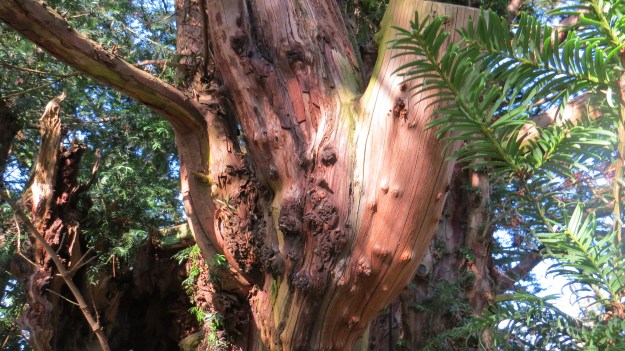
IMG_0935In others, there are little interstices which form homes for spiders and other invertebrates.

IMG_0926IMG_0925IMG_0924

Yew is often found in churchyards. In some cases, it was deliberately planted to provide wood for longbows, but in this and many other cases, the tree long predates the church (there has been some kind of ecclesiastical building here since about 1250). It is very likely that the church was built on a site that was already sacred to the people of the area, and that the tree, then a stripling of just over a thousand years old, would have been locally important as a site for ritual and for meetings. Later, it was a site for the gathering of the Hundred, the medieval equivalent of the Magistrate’s court. In 1722, a baby was found under the tree, and was named ‘Henry Totteridge’ and made a ward of the parish.

IMG_0919

Part of the reason for the longevity of Yew is that it is very slow-growing, and some scientists believe that the trees could reach ages of four to five thousand years. The Totteridge Yew is one of ten trees in the UK that date back to before the tenth century. Yew is very resistant to the fungal diseases which can cause the death of other trees by infecting the spot where a branch has dropped off. The tree can also regenerate from cut surfaces and from the base of the trunk even when it is of advanced years.

Yew berry (By Didier Descouens (Own work) [CC BY-SA 3.0 (http://creativecommons.org/licenses/by-sa/3.0)], via Wikimedia Commons)

Yew berry (By Didier Descouens (Own work) [CC BY-SA 3.0 (http://creativecommons.org/licenses/by-sa/3.0)], via Wikimedia Commons)

Yew has a long association with pagan rites and beliefs, perhaps because, like Holly, it is evergreen, long-lived and bears berries. The oldest wooden artifact ever found in Europe, a 450,000 year-old spearhead found in Clacton-on-Sea, is made of Yew.   All parts of the Yew are poisonous, except for the red flesh on the berry. A chief of the ancient Celtic tribe the Eburones (the ancient word for Yew was Eburos) killed himself by ingesting a toxin from the Yew tree rather than submitting to the Romans. It is known to be poisonous to horses, and the foliage, in hot weather, can produce a gas which is said to cause hallucinations. This same chemical, however, can be used to produce a drug for use in breast cancer, and for a while pharmaceutical companies were traveling the world, looking for substantial Yew forests to buy and destroy. What is new to science is often long-known by local peoples, however, and Yew has long been used by Himalayan people as a treatment for breast and ovarian cancer.

IMG_0932

This is not the first time that Yew has been subject to a threat of over-harvesting. Its wood is perfect for the making of longbows, and in the fifteenth century compulsory longbow practice for all adult males was introduced. This depleted the supplies of these slow-growing trees so profoundly that Richard III introduced a ‘tax’, insisting that every ship bringing goods to England had to include ten bowstaves for every tun of goods. During the sixteenth century the supply of Yew dwindled to such an extent that there was none to be had in Bavaria or Austria. The habit of planting Yew trees in churchyards to ensure future demand may have begun during this time.

Yew trees have a dark, sombre aspect to them and yet, as one of our few native conifers, they provide some greenery when the other leaves have fallen. Their red berries provide a useful source of food for the birds, and I have often watched Goldcrests working their way through the needles with their needle-sharp bills, searching for any hibernating insects or badly-hidden cocoons. I shall be keeping my eyes and ears open in future for the high-pitched piping calls of these birds. Goldcrests are the smallest birds in the UK, with each one weighing less than a two-pence piece.

Goldcrest (By Missy Osborn from New Forest, England (GoldCrest Uploaded by Snowmanradio) [CC BY-SA 2.0 (http://creativecommons.org/licenses/by-sa/2.0)], via Wikimedia Commons)

Goldcrest (By Missy Osborn from New Forest, England (GoldCrest Uploaded by Snowmanradio) [CC BY-SA 2.0 (http://creativecommons.org/licenses/by-sa/2.0)], via Wikimedia Commons)

There is something about spending time outdoors that soothes the soul, and this is particularly true, I find, when I am in the company of a tree of such remarkable character as the Totteridge Yew. It has experienced so much in its long life that my mind is fairly boggled when I think about it. It was already a thousand years old when the Normans came with their stone masonry and castle-building and taste for wine. How many babies have been borne past it in their mother’s arms for Christening, how many young couples have passed under its branches on their wedding day, how many sombre coffins have been carried under the lych-gate to the freshly-dug graves that surround it? Once, people came up to the church on foot or in horse-drawn carts, where now they swoosh past in cars. If only it could tell me what it has seen. As I go, I rest my hand for a moment on that smooth, rose-pink bark, as I suspect so many have done before me. I feel a sense of calm descend, as if I have been holding my breath for a week, and have finally let it out.

Dear Readers, I am occasionally castigated by your good selves for designating a particular plant as a ‘weed’. People have been roused to fury by my inclusion of Feverfew and Yarrow, Holly and Ivy as ‘weeds’, and I understand how for many people (including me) these plants are helpmates and sources of wonder rather than problematic. You can imagine, then, how nervous I am about including that most venerable of plants, the Yew tree, as a ‘Wednesday Weed’, let alone the oldest Yew in London. However, my point is this: no plant is quintessentially a ‘weed’ – this is a purely human label. There is not a single plant that I have included in this series, from the fecund  Duckweed to this week’s remarkable conifer, that doesn’t have much to fascinate and amaze the keen observer. Our urge to classify the natural world into ‘good’ and ‘bad’, ‘useful’ and ‘useless’ is what got us into the mess that we’re currently in in the first place. We need to understand the connections between things, even the most commonplace of ‘weeds’, in order to make sensible decisions about everything from the plants in our gardens to the future of the planet. Every week, I learn more about my local environment, but I have also glimpsed the limitless depths that I have yet to understand.  This blog has made me humble, which I have grown to think is the only sensible reaction to the complexity and beauty of the natural world.

Adriaen Coorte – The Still Life Painter’s Real Subject

Still Life with Asparagus (Adriaen Coorte, 1697)

Dear Readers, the art of ‘still life’ was surely at its most extraordinary during the Dutch Golden Age, an era that I’ve thoroughly enjoyed learning about from Benjamin Moser’s extraordinary book ‘The Upside World – Meetings with the Dutch Masters’. Earlier this week, I did a post on the animal painter Paulus Potter, but I couldn’t leave the subject without a quick look at the work of Adriaen Coorte (roughly 1697 – 1707). Still Life as a genre demands a kind of calm contemplation – in the book, Moser makes an interesting comparison with the contemporaneous Japanese poet Bashō, whose haikus demand a similar level of stillness. Take this one, for example…

A field of cotton–
as if the moon
had flowered.

or this one…

Awake at night–
the sound of the water jar
cracking in the cold.

For both the painter and the poet, I sense a need to capture a precise moment in time, perfectly. Moser describes how Coorte

“..fiddled about with what looks like the same bunch of asparagus – zooming in and out, toying with the lighting, adding, and then removind, a few currants; now trying them in combination with an artichoke, now with a bunch of strawberries – for no less than eighteen years”. 

Still Life with Asparagus and Red Currants (Adriaen Coorte, 1696)

Still life with asparagus, a spray of gooseberries and a bowl of strawberries
(Adriaen Coorte, 1698)

We know so little about the artist, except what he’s left us in his paintings. What do they tell us? The man was a perfectionist, for sure, struggling again and again to get his pictures right. He was an observer of the fall of light on the most ordinary of objects – a peach, a grape, a wooden bowl.  His masterpiece, described as “the Mona Lisa of the late seventeenth century Dutch still-life art” by art historian Laurens-Jan Bols, is the picture below, ‘Three Medlars with a Butterfly’ (1705)

“Three Medlars with a Butterfly” (Adriaen Coorte, 1705)

Moser describes the painting thus.

“It is hard to say exactly what makes this painting so perfect. A centimetre higher and the butterfly would seem detached from the rest of the scene, unrelated to the medlars, floating past them irrelevantly. Half an inch lower, it would be crashing in to them. As Coorte has placed it, the butterfly is wafting gently toward the fruit, enhancing, not disturbing, the tranquillity of the scene”.

As I look at these paintings, I find myself both mesmerised by their stillness, and held in a place beyond rational thought. They fill me with both melancholy at the inevitable passing of time, and a sense of wonder at how perfect a butterfly, a stalk of asparagus or a medlar can be for just a few moments. In the pictures below I can almost smell the strawberries, feel the furriness of the peaches, even as some of the strawberries are starting to rot.

Still Life with Wild Strawberries (Adriaen Coorte, 1696)

Three Peaches and a Butterfly (Adriaen Coorte, 1693-95)

Many still life painters incorporated a ‘memento mori’ into their works, such as a spider catching a fly or a lizard hunting a butterfly. Coorte was much more subtle than this: he allows us to feel what we feel without directing us. Moser concludes his book with this statement:

Adriaen Coorte, like Bashō, sought ‘a vision of eternity in the things that are, by their own nature, destined to perish”.

Maybe that’s what makes these painting both glorious and melancholy. What a feast.

“Still Life with Shells” (Adriaen Coorte, 1697)

Even the Most Unpromising Garden….

Dear Readers, today I was out for a walk to the Farmers’ Market, and to the accompanying Craft Exhibition – I found someone who might be able to re-upholster our armchair (one arm was shredded by my late cat Willow, bless her) and there were lots of lovely stalls. I always feel bad at these events, though – I don’t really need any more ceramics/painted tiles/cushions and my ears aren’t pierced (or to be exact they have been pierced at least three times, but the holes always close up) so the lovely earrings on sale are surplus to requirements. I feel for all the craftspeople looking so hopeful as I drift past, admiring their work but knowing that I’m not going to buy any of it. I do hope that they all find enough customers to make their time and effort worthwhile – as someone who makes things herself, I know the amount of hard work that goes into creating beautiful things.

Anyhow, after marching up Summerlee Avenue on the way home, I was stopped in my tracks by the garden in the photo above. It’s on Fortis Green, a very busy road with a very narrow pavement, so I usually don’t linger. But just look at this display of Japanese Anemones! This is a plant that although supposedly good for ‘woodland gardens’ and also described as ‘a bit of a thug’ has never actually taken to my plot – maybe it’s a bit too dry? But look at it here.

Front gardens are difficult to manage on this road – sometimes these big houses are divided into flats, and are sometimes the flats are rented, so there isn’t the incentive to make a garden (though some people still do). Nonetheless, in spite of the stony soil, and the fact that there’s nowhere to put the wheelie bins except bang slap in the middle of the garden, someone has created some beauty here, and the bees were buzzing around in gratitude.

Along the path there are some more Japanese Anemones, and some asters/Michaelmas daisies, also a favourite with bees at this time of year. I’m not sure if the planting is down to the current residents or if the garden has just been inherited, but I hope it cheers the people who live here up as much as it lifted my spirits. It’s usually at this point that my leg really starts to ache, but I left with a most unexpected spring in my step.

And then  I spotted this. The bollard on the corner of Lincoln Road, previously so impressively upright, is at a 45 degree angle yet again. I’d love to know what happens – is it large vehicles backing up? It can be difficult to pull out of these roads into Durham Road (which runs along the bottom of the County Roads). What is the bollard meant to do, I wonder? It clearly isn’t able to look after itself.

Below, you can see the Lincoln Road bollard in happier days (November 2022).

Still, it’s been a great weekend, with two expeditions and a real sense of the change of the seasons. Progress is not a steady curve, but the overall arc is definitely towards greater mobility. And I am really enjoying my first Open University course module – it’s on speciation, so I expect there will be a few thoughts on things scientific later in the week. In the meantime, here’s a poem by Clive James, written five years before his death in 2019. There is something very wise about it, and peaceful. See what you think.

Sentenced to Life (Clive James, 2014)

Sentenced to life, I sleep face-up as though
Ice-bound, lest I should cough the night away,
And when I walk the mile to town, I show
The right technique for wading through deep clay.
A sad man, sorrier than he can say.

But surely not so guilty he should die
Each day from knowing that his race is run:
My sin was to be faithless. I would lie
As if I could be true to everyone
At once, and all the damage that was done

Was in the name of love, or so I thought.
I might have met my death believing this,
But no, there was a lesson to be taught.
Now, not just old, but ill, with much amiss,
I see things with a whole new emphasis.

My daughter’s garden has a goldfish pool
With six fish, each a little finger long.
I stand and watch them following their rule
Of never touching, never going wrong:
Trajectories as perfect as plain song.

Once, I would not have noticed; nor have known
The name for Japanese anemones,
So pale, so frail. But now I catch the tone
Of leaves. No birds can touch down in the trees
Without my seeing them. I count the bees.

Even my memories are clearly seen:
Whence comes the answer if I’m told I must
Be aching for my homeland. Had I been
Dulled in the brain to match my lungs of dust
There’d be no recollection I could trust.

Yet I, despite my guilt, despite my grief,
Watch the Pacific sunset, heaven sent,
In glowing colours and in sharp relief,
Painting the white clouds when the day is spent,
As if it were my will and testament –

As if my first impressions were my last,
And time had only made them more defined,
Now I am weak. The sky is overcast
Here in the English autumn, but my mind
Basks in the light I never left behind.


Making a Virtue of Necessity

Dear Readers, when I broke my leg I was told that I should have ‘full mobility’ three months after the accident. Well, I am most likely being signed off by the Orthopaedic Department at the Whittington on Thursday, and I can certainly walk around, get on the tube and the bus and go up and down stairs if I’m careful and take my time. However, I still limp, and am walking at about half speed compared to my previous pace, so I would say that there’s a way to go before I’m back to my pre-accident levels. Nonetheless, today I decided that if I was going to need a walking stick for a while I was going to purchase a classy one, and so we headed to Central London for the first time in three months (the Angel doesn’t quite count). We had two aims: to visit the London Review of Books bookshop, because it’s my husband’s birthday in a few weeks, and to buy a walking stick at James Smith and Sons.

Photo by PLamacraft, CC BY-SA 3.0 <https://creativecommons.org/licenses/by-sa/3.0>, via Wikimedia Commons

I love the LRB Bookshop! It is impossible to visit it without walking out with something exciting. Today, although I was meant to be shopping for John I also came out with David Spiegelhalter’s new book The Art of Uncertainty and How Migration Really Works by Hein de Haas, which was recommended by New Scientist no less. I have very few vices (with the possible exception of cake) but buying books seems to be one of them. Now, if I could arrange to live to about two hundred years old I might actually stand a chance of reading them all.

Having laden John down with my books and his ‘surprise’ birthday books which he chose himself and will hopefully have forgotten by the Big Day, we headed to James Smith and Sons. Better known as ‘that Umbrella Shop’, the shop itself has been around since 1830, with its current premises dating to 1865. I was tempted to pick up a Dagger Cane or a Sword Stick as advertised in the window, but in the end I settled for a very fine walking stick and a folding walking stick for travelling. The gentleman who served me checked that it was the right height – they saw a bit off of the bottom of the cane and fit a non-stick ferrule so that it’s in full working order. He also checked out a variety of folding canes – I’d been tempted to buy a fancy one online, but thank heavens i didn’t as it would have been too short. In the end I decided to go for utility over a pretty floral pattern.

The main walking stick is beechwood, with what’s known as a Derby handle, and it’s been ‘scorched’ to a dark red and ‘rattaned’ which means that it has a pattern on the lower bit. Just the thing for clearing a path through the crowds of Oxford Street!

And my folding stick is a black folding Derby, actually meant for ‘gentlemen’, but then I am nearly six feet tall so I need something substantial. I can pack this away in my rucksack if I’m catching a plane (which I hope to be doing in about six weeks) so it’s perfect.

I must say that the staff in the shop have the patience of saints. Lots of people seemed to be coming in just to take photographs or even film inside the Victorian interior. I think they were glad to just have an actual customer. And to be honest, the prices were not ridiculous – walking sticks started at about £30 and umbrellas start at £40, so although you can pick these up for much cheaper than this, these come with a lifetime guarantee. So if you’re looking for excellent service and something special for yourself, or as a gift, I would really recommend James Smith and Sons. If we don’t buy from unique shops like these, we’ll lose them.

James Smith and Sons – Interior (Photo by Edwardx, CC BY-SA 4.0 <https://creativecommons.org/licenses/by-sa/4.0>, via Wikimedia Commons)