Wednesday Weed – Love-Lies-Bleeding Revisited

Amaranth, but which one?

Dear Readers, since I’ve been doing my slow hobble around the County Roads here in East Finchley, I’ve found myself noticing a ‘new weed on the block’. This plant is cropping up in the gutter all along Huntingdon Road, and I’m pretty sure that it’s some species of amaranth. But how come it’s here? It’s true that there was some rather lovely decorative Love Lies Bleeding, another Amaranth species, on the other side of the road a few years ago, but this isn’t the same species, and I can’t see it growing anywhere else.

One possibility is that it’s blown in with some wild bird seed – it’s a popular filler in the cheaper brands, and it clearly wouldn’t take much for it to set up shop. However, in ‘Alien Plants’, Clive Stace and Michael Crawley point out that Amaranth species have come to the UK in a wide variety of ways, including being mixed with seeds for oil production (such as soybeans and rape), and as human food in the form of callaloo, which is often grown on allotments.

Furthermore, on my Wild Flower Identification Facebook group, someone mentioned that they think that the Amaranth seeds are brought in with the sand used for new paving. And what has happened to this part of the road? The whole pavement was dug up a few months ago to put in  some new EV chargers. Could this be the answer?

I’m not sure what species ‘my’ amaranth is, but I shall certainly be keeping an eye on it. And for more on this fascinating crop, have a look below..

Love-lies-bleeding (Amaranthus caudatus)

Dear Readers, I do love a display of a single species of plant, especially when it is as striking as this one. I love it even more when it’s only a thirty-second walk from my house! As we move towards autumn, it becomes harder and harder to find ‘weeds’ that I haven’t covered yet, but this stunning annual more than makes up for it. I suspect that the plants are a mixture of ‘typical’ Love-lies-bleeding, with the deep red tassels, and Amaranthus caudatus var. viridis, for the green tassels.

This splendid plant comes originally from the Andes, where it is known as Kiwicha. Some amaranth species have naturalised in parts of the UK, where they are believed to have been introduced in grain crops or in pet food. However, the plant has played a important role in human nutrition: it is believed that the seeds from the amaranth plant accounted for up to 80% of the protein needs of the indigenous peoples of Mexico and Central America before the Spanish conquest. Even today, the grains are toasted and mixed with chocolate, honey or molasses to make a drink called Allegria, which means ‘joy’ (and very joyful it sounds too). Skull shapes are made with amaranth grain and honey for the Day of the Dead celebrations in Mexico.

Photo One By Abbie yang - Own work, CC BY-SA 3.0, https://commons.wikimedia.org/w/index.php?curid=22558877

Photo One

The leaves and stems have been used extensively in many parts of the world, from India to West Africa to the Caribbean, where Amaranthus tricolor is known as Callaloo. In the Yoruba language, it is known as shoko, which is a shortened form of shokoyokoto (meaning ‘make the husband fat’) or arowo jeja (meaning ‘we have money left over for fish’). Amaranths are highly nutritious plants: the seeds contain up to 14% protein, while the leaves are a rich source of Vitamins A and C. Like many staple foods, it has kept populations going for millenia.

Photo Two By Xufanc - Own work, CC BY-SA 3.0, https://commons.wikimedia.org/w/index.php?curid=10608050

A traditional Southern Kerala Thoran made with Chora (amaranth) leaves (Photo Two)

As you might expect from those red flower heads, the plant contains a high concentration of betacyanins, which can be used as a dye. One variety is actually called ‘Hopi Red Dye’, after the Hopi tradition of creating red corn bread using the amaranth to colour it. If you have a garden full of love-lies-bleeding and wanted to have a bash at some dyeing, there is a lovely article here to send you on your way.

Incidentally, the food colouring called Amaranth was banned as a carcinogen in the US in 1976, but is still used to colour Maraschino cherries in the UK. It is named for the colour of the chemical but is not actually extracted from the plant, so we can breathe easy on that score.

Photo Three from https://lifewaysnorthamerica.org/living-arts-weekly-natural-dyeing/#:~:text=Use%20a%20solar%20dyeing%20process,sunny%20spot%20for%20a%20week.

Wool dyed with amaranth (PhotoThree)

The flowers on Love-lies-bleeding look so much like the millet that I used to feed to my budgerigar when I was a child that I’d be interested to know if any of you have grown members of this family and have noticed any bird activity.

The name ‘amaranth’ comes from the Greek for ‘not fading’ – it has long been a symbol of immortality, as in this translation of Aesop’s fable:

A Rose and an Amaranth blossomed side by side in a garden,
and the Amaranth said to her neighbour,
“How I envy you your beauty and your sweet scent!
No wonder you are such a universal favourite.”
But the Rose replied with a shade of sadness in her voice,
“Ah, my dear friend, I bloom but for a time:
my petals soon wither and fall, and then I die.
But your flowers never fade, even if they are cut;
for they are everlasting.”

Indeed, the mythological ‘Amaranth’ appears in the poetry of Milton, Shelley, Tennyson and others as a symbol of everlasting life, though I doubt that these poets would ever have seen a love-lies-bleeding.

In the Victorian language of flowers, the plant came to stand for ‘hopeless, undying love’.

Green love-lies-bleeding

And now a poem, and by William Wordsworth no less (I was tempted by Algernon Swinburne but it was a bit too florid even for me). Wordsworth comments that:

How touching and beautiful were, in most instances, the names they gave to our indigenous flowers, or any other they were familiarly acquainted with! — Every month for many years have we been importing plants and flowers from all quarters of the globe, many of which are spread through our gardens, and some, perhaps, likely to be met with on the few Commons which we have left. Will their botanical names ever be displaced by plain English appellations, which will bring them home to our hearts by connection with our joys and sorrows?

And I think he has a point. At what point will Buddleia, for example, get a ‘proper’ vernacular name (though it’s true that many people know it as Butterfly Bush). It seems that a plant hasn’t really ‘made it’ until it has a nickname. Maybe we could make some up.

Love Lies Bleeding

by William Wordsworth

You call it, Love lies bleeding, — so you may,
Though the red Flower, not prostrate, only droops,
As we have seen it here from day to day,
From month to month, life passing not away:
A flower how rich in sadness! Even thus stoops,
(Sentient by Grecian sculpture’s marvellous power)
Thus leans, with hanging brow and body bent
Earthward in uncomplaining languishment
The dying Gladiator. So, sad Flower!
(‘T is Fancy guides me willing to be led,
Though by a slender thread,)
So drooped Adonis bathed in sanguine dew
Of his death-wound, when he from innocent air
The gentlest breath of resignation drew;
While Venus in a passion of despair
Rent, weeping over him, her golden hair
Spangled with drops of that celestial shower.
She suffered, as Immortals sometimes do;
But pangs more lasting far, that Lover knew
Who first, weighed down by scorn, in some lone bower
Did press this semblance of unpitied smart
Into the service of his constant heart,
His own dejection, downcast Flower! could share
With thine, and gave the mournful name which thou wilt ever bear.

Photo Credits

Photo One By Abbie yang – Own work, CC BY-SA 3.0, https://commons.wikimedia.org/w/index.php?curid=22558877

Photo Two By Xufanc – Own work, CC BY-SA 3.0, https://commons.wikimedia.org/w/index.php?curid=10608050

Photo Three from https://lifewaysnorthamerica.org/living-arts-weekly-natural-dyeing/#:~:text=Use%20a%20solar%20dyeing%20process,sunny%20spot%20for%20a%20week.


Mission Aborted And a Miscellany

Dear Readers, today we’d planned to walk down to Cherry Tree Wood to have a coffee in the café and then hobble back uphill and home. Alas, I was about a third of the way there when I realised that this was probably too ambitious. Discretion is the better part of valour in these situations (cliché alert!) and so we wandered down Lincoln Road and back to Coffee Bank for a Flat White instead.

It always feels a little sad not to be able to achieve a target, but it seems pointless to overstretch myself today, only to be confined to the sofa tomorrow. Slow but steady seems more sensible. In good news, since I’ve been walking with one crutch I’m sure I’m limping less and my back is much less painful, both of which will be important in the longer term.

So, what else is going on? Today I am seeing lots of Large and Small White butterflies tussling in the front garden close to the buddleia – whether this is defensive or mating behaviour I’m not sure, but I am rather enjoying the sight of them circling one another in frantic circles from the office window. I have not seen a single Vanessid though (Red Admiral, Peacock, Painted Lady, etc). Looking back to July 2023, there was an abundance of these creatures, and a Hummingbird Hawk moth. Are you seeing these butterflies and moths where you are?

In other news, I am thoroughly enjoying Tim Blackburn’s book ‘The Jewel Box’ – he takes the moth species that he finds in his moth trap (which is on his balcony in Camden) and uses them to illustrate various ecological points. It’s great revision for me for my next Open University module, which is a Level Three biology course, but also full of great stories.

He tells the story of the Gypsy Moth, imported to the USA in 1868 by Mr Léopold Trouvelet. He was researching moths that could be of use in the silk industry, but unfortunately some of the eggs or caterpillars were blown out of an open window and escaped. Twenty years later, there was an outbreak of Gypsy Moth caterpillars of such severity that one neighbour related that

“In the evening you could hear the caterpillars eating the trees. It sounded like the clipping of scissors”.

Blackburn uses the outbreak to illustrate phenomena such as exponential growth and the statistical analysis of populations, but in such a lively way that you hardly notice that he’s sneaked in a few equations (I love an equation, but then I’m probably in the minority).

Interestingly, in the UK the Gypsy Moth was known from only one small population in the Fens, which disappeared when its breeding sites were cleared and drained. Today, you’d have to travel to the Channel Islands to find a small population, though whether, like the Jersey Tiger, it will reappear is anyone’s guess. The Gypsy Moths that lived in the Fens fed only on bog myrtle and creeping willow, but  the moths in the US and mainland Europe have much broader tastes, and can still sometimes be a problem. In fact, I found some pupal cases in Creemore in Ontario on a visit to Canada a few years ago, and I realise that I wrote about this moth extensively then. What a story!

Female Gypsy/Spongy moth (Lymantria dispar) Photo by By Opuntia – Own work, CC BY-SA 3.0, https://commons.wikimedia.org/w/index.php?curid=2580261

Does anyone else have recommended reading? Is there anything I should take a look at, or have we all been enjoying the last days of the summer (if we’re in the Northern Hemisphere?) Let me know!

New Scientist – Coffee is Good For You!

Latte and Black Coffee (Photo Bex Walton, CC BY 2.0 <https://creativecommons.org/licenses/by/2.0&gt;, via Wikimedia Commons)

Dear Readers, today was another tiny milestone in the story of my fractured leg – I managed to walk to the bus stop, get onto a bus, travel to Muswell Hill, stop for a coffee in Sable D’Or   and then get back on the bus and go home. Yay! Apart from trips to the hospital, it’s the furthest away from home I’ve been since the end of June, and what a joy it was to see that Muswell Hill High Street was still there, getting on with selling stuff even though I wasn’t there. I think part of me thinks that if I’m not around to see things they no longer exist, even though the rest of me knows that that’s ridiculous. Is it just me, I wonder? I don’t know how Obergurgl is going to cope without me being able to go on holiday there this year, for example.

Anyhow, I had a very nice Flat White, and according to New Scientist this week, this should be considered a healthy option, at least as far as the coffee part was concerned. A recent raft of studies have shown that two to three cups of coffee per day show a whole range of health benefits. An Australian study that tracked 380,000 people for ten years showed that coffee drinkers had a lower risk of developing coronary heart disease, heart failure or arrhythmias, with decaf drinkers showing similar results for everything except arrhythmia. It’s thought that although caffeine is part of the answer to why coffee seems to be heart-protective, something more complicated is going on.

Tim Spector of Kings College London points out that there is a particular bacteria in the microbiome, known as Lawsonibacter, that feeds solely on coffee. When it feeds on the polyphenols and fibre in the coffee, the bacteria releases short-chain fatty acids which are anti-inflammatory, and calm the immune system. This could account not only for the better heart health of coffee drinkers, but also for lower rates of Parkinson’s disease, diabetes, obesity and allergies, all of which are thought to be aggravated by inflammation. There may even be a link between inflammation and depression, and the improved mood and increased mental acuity that follows a dose of caffeine has been well documented.

All in all, it’s good news for coffee drinkers, but caffeine alone, as ingested in energy drinks, has none of the health benefits of coffee itself, and, because they are often full of sugar and other legal stimulants (such as guarana and taurine) they are positively bad for you, especially for young people (in the UK there may soon be legislation to limit the sale of such drinks to young people). Overdosing on the caffeine in energy drinks can cause heart palpitations, anxiety attacks, and obesity and diabetes in the longer term. Better to stick to the espresso I think.

And for you tea drinkers out there, it appears that while coffee is healthier than the black tea that most of us drink, green tea, which is also rich in polyphenols (though doesn’t have the associated bacteria) is a great alternative, with similar health benefits, though in my experience not quite the same caffeine ‘kick’.

Where Have All the Blackbirds Gone?

Blackbird (Turdus merula)

Dear Readers, every year at about this time, people start to comment on how, after all the hubbub of spring and early summer, their gardens seem empty of birds. I’ve written before about how a combination of birds laying low for their annual moult and the availability of other food means that many of the usual inhabitants of our gardens have gone missing in action, but something rather more worrying appears to be happening to our blackbirds.

Since 2020, blackbird numbers in London appear to have been declining. On an anecdotal level, my garden used to host one resident pair of blackbirds in the summer, with many more in the winter. This year, I have only heard a single male singing for a week or so. At the British Trust for Ornithology (BTO) they are linking the decline to Usutu virus. This is a mosquito-borne virus that is often fatal to blackbirds, and is prevalent across the Channel. For the past few years the disease has been found in London birds, and there are fears that it could be spreading across the south-east. The spread is linked to climate change (sigh) which is favouring the survival and breeding success of the mosquitoes that carry the virus. Affected birds die from damage to the liver and spleen, and from neurological symptoms. There is currently no treatment or cure.

Usutu virus can be spread to humans by mosquitoes, although so far it has been found to be asymptomatic, except in a single case of an immunocompromised person who developed encephalitis. However, scientists have long been worried that other, more harmful mosquito-borne viruses may become more frequent due to warming conditions, and so they have been collecting data on blackbirds in gardens – the survey has been running since May but it doesn’t end until October, so there’s still time to get involved if you’re interested.

Usutu virus originated in South Africa, but has been heading north ever since. In 2001 it was discovered in Vienna, where it started to kill blackbirds. By 2003 it was in Slovakia and Hungary. By 2016 it was found in Belgium, France, the Netherlands and Germany, with the virus causing a  significant decline in the blackbird population as it passed through. Usutu does infect other passerine birds, such as sparrows, robins and starlings, but it seems to be particularly lethal in blackbirds in the UK,  although other parts of Europe magpies, jays and hooded crows have also been badly affected. Like most viruses, Usutu is likely to mutate in ways that might make it more or less lethal and infectious.

Culex pipiens, the mosquito that carries Usutu virus (amongst others) Photo By Alvesgaspar – Own work, CC BY-SA 3.0, https://commons.wikimedia.org/w/index.php?curid=2763025

Usutu virus is in the same family of viruses as West Nile virus, another mosquito-borne virus that uses birds as a amplifier/reservoir species (i.e. one where the virus breeds, and which can be used as a source of further infection if a mosquito bites an infected animal). Fortunately for humans, Usutu is nothing like as damaging, but it does flag up the need for constant surveillance – one reason that Usutu was picked up was because there is regular monitoring for West Nile virus in the UK. Public health scientists are constantly on the hunt for which new-to-us viruses might be heading in the direction of the UK, and I imagine it’s a constant battle – it’s not just organisms that harm us directly, but also those that affect crops, livestock and the environment as a whole. It will be fascinating to see what other viruses put in an appearance. We live in interesting times, for sure.


Getting A Bone Scan at the Royal Free

DEXA scanner (the person is not me!) Photo by By Nick Smith photography – ALSPAC web site, CC BY-SA 3.0, https://commons.wikimedia.org/w/index.php?curid=26389366

Dear Readers, yesterday I had a break from the Whittington Hospital and went instead to the Royal Free for a bone scan. It’s a bit more of a pain to get to (there’s Hampstead Heath between us and the hospital, so there are a lot of single lane, narrow roads to navigate) and the hospital itself is a bit busier and more rambunctious, but it was also lovely to drive past all that greenery, and to note that the horse chestnuts look even more raggedy than usual this year.

Anyhow, I have never had a bone density scan before, and so I was intrigued. What the hell is going on? I knew it was some kind of X-ray, but noticed that the technician didn’t hide herself away behind a screen while it was all going on. When I was told that it was finished, she showed me that scans of my spine and pelvis that had been done, and kindly let me know that my scores were all normal. So I don’t have osteoporosis! Yay! My orthopaedic surgeon was right when he said that I had a ‘high energy fracture’, i.e. one that was caused by sufficient force to give anybody a broken bone.

Did someone say ‘Hi-NRG?’

‘Smalltown Boy’ by Bronski Beat

‘You Spin Me Round (Like a Record) by Dead or Alive

Never Can Say Goodbye by the Communards

And if you’re dancing in the kitchen, please be aware of trip hazards :-).

On returning home, I did a bit of research, and here’s what I found out. A DEXA or DXA scan (Dual-energy X-ray Absorptiometry) is performed by using two different X-rays with different energy levels which are aimed at the patient’s bones. Soft tissue and bone reduce the amount of the X-ray passing through the body, but at different amounts – when you get a normal X-ray, the soft tissue is filtered out, leaving only the bones. You could compare it to the way that sunglasses filter out most of the sunlight entering your eyes, or the way that earphones filter out sound. This is known as ‘attenuation’.

However, to look at the actual density of your bones, you need the two different X-rays – with one X-ray you won’t be able to tell how much was filtered out by your soft tissue, and how much by the bone. The two X-rays enable you to calculate and subtract how much of the attenuation was due to flesh and internal organs, so that what remains indicates how much of the X-rays was absorbed by the bone. This relates directly to your bone density.

At the end of the process, you get two scores. The T score compares your bone mineral density score with that of a young adult of the same gender at peak bone density. -1.0 is normal, anything over -2.5 indicates osteoporosis. The Z score compares your bone mineral density with that of a person of the same gender of a similar age and weight. Both of mine were in the normal range, which is a great relief, particularly as I have lower back problems which I was worried were getting worse with age. As it is, I think it’s probably just because of my limp and the reduction in my core muscle strength, both of which I can do something about.

So, if you’re scheduled for a DEXA scan, I would definitely go for it – it’s non-invasive, takes about ten minutes, and if there are problems you’re better off knowing about them now. It’s true that the DEXA scans don’t necessarily correct for some variables (such as the size of the bone that they’re looking at) but they are widely considered to be a pretty accurate measure of bone mineral content, so worth doing for sure.

Incidentally, the technician was very keen on Vitamin D as a supplement, as was the orthopaedic surgeon – he was suggesting 2000 μg per day. Anything above 4000 μg per day is considered to be problematic, so this is well within the safe limits. It’s supposedly especially important for calcium metabolism and bone healing.


The Tree of the Year 2024

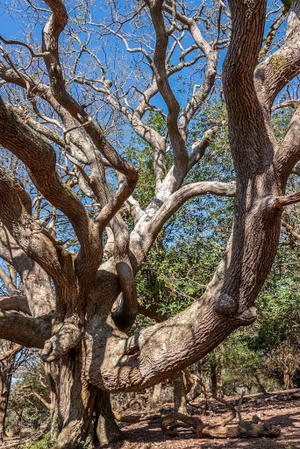
The Elephant Oak, New Forest (Photo by Clare Sheppard/Woodland Trust) – People’s Choice for this year!

Dear Readers, it’s that time of year again. The Woodland Trust have published their list of the twelve nominees for the Tree of the Year, and this time all the trees chosen are oaks. I do love an oak! You can see all twelve nominees here, and can vote for your favourite, but here are a couple that I rather fancy.

At the top of the page is the Elephant Oak from the New Forest. This isn’t the oldest, or the widest, or the tallest oak tree on the list, but it is the People’s Favourite, and it’s certainly a stunning tree.

Then there is the Marton Oak, from Marton, Cheshire. With a girth of over fourteen metres, it looks as if it’s three trees, but is in fact just one gigantic oak. It’s probably about 1200 years old.

The Marton Oak (Photo by By Hypercolius – Own work, CC BY-SA 4.0, https://commons.wikimedia.org/w/index.php?curid=123655510)

Next up is the Tea Party Oak, which stands in the Ickworth Estate in Bury St Edmunds in Suffolk. This magnificent tree got its name from the tea parties organised for children by the Marquess and Marchioness of Bristol who owned Ickworth until 1998, when the estate fell under the care of the National Trust. Over 300 species of animal, including bats, rely on the tree for food and shelter.

And how about this one, the Skipinnish Oak? It is growing in the middle of a conifer plantation, but looks as if it’s a temperate rainforest habitat all on its own. The tree is named after a Scottish traditional music band – one of the members, Andrew Stevenson, is said to have ‘discovered’ the tree, hidden away as it was. Apparently you still need to clamber over a seven-foot tall deer fence in order to view it. I think it might be my favourite.

The Skipinnish Oak (Photo by Gus Routledge)

And finally, here’s the Bowthorpe Oak. With a girth of 13.38 metres, and an age of over a thousand years, this tree has seen it all. Apparently three dozen people managed to stand inside it, and the interior of the tree contains ancient graffiti from previous visitors. It is now protected from such nonsense, and stands in Bowthorpe Park Farm, near Bourne in Lincolnshire. You can arrange a private tour if you fancy a look!

The Bowthorpe Oak (Photo by By Robin Jones, CC BY-SA 2.0, https://commons.wikimedia.org/w/index.php?curid=83507146)

So don’t forget to have a look at the other nominees, and to vote!

Tree of the Year 2024


The Joys of Cliché

Dear Readers, one of the joys of the cliché is that although it might be ‘a saying, idea, or element of an artistic work that has become overused to the point of losing its original meaning or effect’ (thank you, Wikipedia), we continue to use them because there is often an important kernel of truth at their heart. I’ve been thinking about this with regard to the fine collection of sayings that I’ve amassed  which help in hard times (thanks to those of you who commented on a recent post).

Some relate clearly to the way that, however tough things are now, the future will be different. I love the way that they enable us to look up from our current situation and gaze down the corridor of time.

“This, too, shall pass”

“One day, this will be a distant memory”

Then there are the ones that help to put things into perspective, such as “It’s not the end of the world”. As with so many of these sayings, though, it really depends on who is saying it. If I’m saying it to myself, or to a group of people who are in the same situation, it can give us a chance to look at things more holistically, and can be strangely comforting. After all, most things really aren’t the end of the world.  It can feel very dismissive if uttered by someone who isn’t in the situation, however, and I think there’s a lesson there – context is everything, and also intention. Is the person intending to be comforting, or are they just saying that you’re making a lot of fuss about nothing?

And then there is the constant search to  provide a reason for what’s happened. I was amazed to find myself, as I sat on the stairs of East Finchley Station clutching my fractured leg, thinking that at least the fall had happened close to home, rather than half way up a mountain in Austria. What kind of whacky thinking is that? Was there someone ‘up there’ who resolved that I needed to fracture my leg but  decided to be kind and make sure it happened within reach of a teaching hospital in North London? I am full of gratitude for how everything to do with my accident has been handled, and so full of love for everyone who helped, but on balance (see what I did there) I’d rather have remained vertical with my tibia intact.

And then there are two clichés that I find problematic. In relation to the ‘search for meaning’ there’s ‘Everything happens for a reason’. I understand that if your belief system includes an all-knowing being, or the idea of an overarching plan where everything is already ordained this can be true, but it can seem very harsh, especially in worse cases than mine (though when someone said it to me after I’d had a miscarriage I would cheerfully have punched them on the nose.) Sometimes, terrible things happen to people who absolutely don’t deserve it, and for no fathomable reason. I know that sometimes things work out for the best as a result of what appears to be a setback at the time, but again, I think that context and intention are important.

Finally, my personal bugbear is ‘That which doesn’t kill me, makes me stronger’. The saying comes from Friedrich Nietzsche’s Twilight of the Gods, and I always imagine a superhuman colossus, towering over us mere mortals. For some people, maybe the saying is true, but that which doesn’t kill me may also make me hypervigilant or traumatised for the rest of my life. It might turn me from a brave, outgoing individual into someone more hesitant to take risks. It might cause permanent damage to my body or psyche. We might be grateful to have survived, and pleased that we have rebuilt our lives, but are we the same as if we hadn’t gone through the injury in the first place? I can well understand that for some people this has become a defiant personal mantra, but to me the saying has the taste of denial and dismissal.

And finally, a poem. I’m not quite sure how this is related to what we’ve been considering, but I am absolutely sure that it is. See what you think! I love the last few lines…

“Your Luck Is About To Change”

By Susan Elizabeth Howe
(A fortune cookie)

Ominous inscrutable Chinese news
to get just before Christmas,
considering my reasonable health,
marriage spicy as moo-goo-gai-pan,
career running like a not-too-old Chevrolet.
Not bad, considering what can go wrong:
the bony finger of Uncle Sam
might point out my husband,
my own national guard,
and set him in Afghanistan;
my boss could take a personal interest;
the pain in my left knee could spread to my right.
Still, as the old year tips into the new,
I insist on the infant hope, gooing and kicking
his legs in the air. I won’t give in
to the dark, the sub-zero weather, the fog,
or even the neighbors’ Nativity.
Their four-year-old has arranged
his whole legion of dinosaurs
so they, too, worship the child,
joining the cow and sheep. Or else,
ultimate mortals, they’ve come to eat
ox and camel, Mary and Joseph,
then savor the newborn babe.

At The Physiotherapist

My leg post-fracture, pre-cast/titanium rod

Dear Readers, apologies to anybody who doesn’t appreciate a fracture X ray while they’re enjoying their morning coffee, but today my physiotherapist shared the photographs of my actual leg with me, and I was so excited that I thought I’d share them with you. Above is my leg post my tumble down the stairs at East Finchley Station. What a spectacular fracture that is! You can see why it’s called a spiral fracture, it looks like an Escher drawing.

The fracture once it had been ‘set’ in a cast

Once I was in the Accident and Emergency Department, I underwent the joys of traction (basically a hunky doctor grabbing hold of your leg and trying to put your tibia back together, while someone else wraps your leg in plaster-soaked bandage). Thank goodness for morphine, that’s all I can say.

And finally, here’s the leg complete with titanium rod and nail. Honestly, what a miracle this is. I can hardly believe that it’s my limb.

Anyway, back to my physio appointment. I’d been sent off from Orthopaedics with the announcement that I was now fully weight-bearing, but to rest if my leg got ‘too painful’, so I had questions. The Physio, L, watched me walk down the corridor.

“You do know that you’re limping?” she asked.

Yep, I absolutely did.

“You should use one crutch on your good side, so that you can even out the weight distribution for a bit and allow that leg to get stronger”, she said.

Hallelujah! That makes a lot of sense to me. While my leg is technically strong enough for me to use all the time, I think it needs a tiny bit more support while I’m out and about. She also said that my target 3000 steps per day seemed ‘quite a lot’ at this point.

So I have balance exercises, and strength exercises, and another appointment for in three weeks time. I am a happy bunny, but hopefully I won’t feel like Hopalong Cassidy for much longer.

What I’m Reading – “Why Didn’t You Just Do What You Were Told” by Jenny Diski

Dear Readers, I have just finished a collection of essays by Jenny Diski, who died back in 2016 of inoperable lung cancer. What a loss to the world she was! All of the pieces in ‘Why Didn’t You Just Do What You Were Told’ were published in the London Review of Books: this publication is one of the last UK champions of the long-form essay, which gives a writer the chance to really engage with their subject. And what subjects they were! She writes about biographies of Jeffrey Dahmer, Richard Branson and Howard Hughes. She gets stuck into a book about Jewish seafarers. She eviscerates Piers Morgan (not literally). She is never predictable, and she makes me laugh even on the darkest of subjects – the last piece in the collection, ‘A Diagnosis’, is about learning about her cancer. When she hears that she has ‘two or three years to live’, she makes a comment about ‘Breaking Bad’. which goes down like a lead balloon. At the time, she thinks that the doctor isn’t familiar with US TV shows, but later realises that probably every one who gets the diagnosis says something similar.

Of all her pieces though, I most admire ‘A Feeling For Ice’. She describes how she has always enjoyed white as a colour, the blankness of an all-white room, and decides to head off to Antarctica. But what is astonishing is the way that she interleaves her journey with an account of her childhood, with her charming conman father, and her mentally-ill, abusive mother. We grow to see how the love of nothingness might have its roots in such a traumatic childhood, but this is not a misery memoir – I was gripped by how Diski tries to piece together her memories, to work things out, to track the way that she got from where she was to where she is now. She had many gifts, but the way that she transitions between different times, places and subjects without ever losing her reader  is a real skill.

I was at an ‘audience’ with Jenny Diski once, at the LRB bookshop. From memory, it was about her book ‘Skating to Antarctica’, which tackles the subject of ‘A Feeling For Ice’ in more depth. She was a small, neat, rather nervous woman, who looked as if she couldn’t wait to go outside for a cigarette, and yet when she started to talk she was absolutely fearless. I left the talk with the feeling that she was absolutely her own woman, and that she would say what seemed true to her without any compunction. She is funny, too. In her book “What I Don’t Know About Animals”, she describes how her cat was forever in her writing room wanting to go out, or outside her writing room wanting to come in (a situation that any of us cat ladies can sympathise with, I’m sure). She decides to get a friend to install a cat flap in her office door, so that the cat will stop pestering her when she’s trying to work.

I showed her (the cat) how it worked. I pushed her through. I pushed her back the other way. I showed her how independence worked, though down in the kitchen she knew exactly how it worked. Now that she could get on with her life as she wished, would she leave me alone to get on with mine?……

Bunty now sits in front of the cat flap and turns to stare at me on the sofa, waiting for me to open the door. When I open the door to leave the room, she races to get through it in the regular human way. Eventually, if I hold out against her baleful stare, though it might be an hour, she will laboriously go through the flap. In some way, it has worked. But the sight of a cat that comes and goes with no problem through the garden cat flap sitting, determinedly, in front of the one in my study drives me crazy. 

‘Go! Go on!’ I cry. And she looks at me. ” (What I Don’t Know About Animals, Jenny Diski, 2010). 

In short, I would recommend anything written by Jenny Diski. There are lots of her essays available on the LRB site, but honestly, any of her non-fiction work is worth a shot. I’m not familiar with her novels, though they sound satisfyingly strange to me. What a loss she was, with her acute observation, beautiful sentences and unique take on everything and everyone. If you haven’t read her before, do give it a shot. You won’t be disappointed.

Goings on in the Garden – Late August

Female Hornet Mimic Hoverfly (Volucella zonaria)

Dear Readers, is there anything nicer than sitting in the garden swathed in blankets like some Victorian lady in a bathchair, while your husband gets stuck into the brambles and the duckweed? Admittedly there is some frustration at not being able to help out, but only a tiny bit, as I can now hobble around and take photographs of my beloved invertebrates for your delectation.

Now the photo above shows one of two hornet-mimic hoverflies that are currently zipping around the southern UK, and I must confess that I think I’ve been getting the species wrong on occasion. The one above is Volucella zonaria,  the larger of the two species – if you look closely, you can see that there is a subtle gradation of colour on the abdomen. The first segment is chestnut-coloured, the second one is gold, and the last one is a cream colour. This is the UK’s largest hoverfly (15.5 – 19 mm).

Volucella inanis (female)

This one is the ‘other’ hornet-mimic hoverfly, Volucella inanis. You can see that the first segment is the same colour as the rest of the abdomen. I rather suspect that I’ve been misnaming some of these hoverflies in previous posts, but then there’s always something new to learn! These flies are about half a centimetre smaller than Volucella zonaria, but it’s always difficult to judge when they’re buzzing about. What is notable about both species is the way that they seem like little yellow/orange blips as they zoom about, making them the sort of insect that I always leap (or currently hobble) towards.

Anyway, what else is going on? My poor husband is cutting back what he describes as a ‘bramble’, and only later do I realise that it’s a rambling rose. Oh well, they’re in the same family and both are prickly, so it’s an easy mistake to make. I see the leaf-cutter bees have been busy too…

And I’m seeing quite a few of these little guys – one pinged in through the office window last week (which is on the first floor, so quite a jump) and then pinged back out again with a little persuasion. Such a delicate little creature!

Southern Oak Bush-Cricket (Meconema meridionalie)

This is a Southern  Oak Bush-Cricket. I have absolutely no oak in the garden, so I’m a little confused about where these insects have come from – they first appeared in the UK in 2001 but they certainly appear to be branching out. Excitingly, it is apparently a predator of the Horse-Chestnut Leaf Miner, and we could definitely do with something to eat some of them.

Horse Chestnut leaves looking the worst for wear.

The Southern Oak Bush-Cricket has certainly been increasing in numbers in the UK – look at the data by decade below. Wouldn’t it be interesting if, as species such as the Horse Chestnut Leaf Miner make themselves at home in the UK as temperatures increase, their predators follow?

And so, it was a nice couple of hours watching someone else work, and considering how overgrown the whole place has gotten. It really does need some tidying (not much, but a bit), and some pruning. I shall just have to be patient, and sort out the tree surgeon for the autumn. At least the wildlife is having a great time.

Honeybee on Hylotelephium (or Sedum as it used to be!)