2023 – The Kindness of Strangers

Dear Readers, sometimes it’s the little things that really make an impression, as with this incident. Writing a daily blog really helps me to notice things like this.

Dear Readers, why, you might ask, is the blog featuring a rather unassuming-looking sandwich bar today? Well, I am in Dorchester, and it’s always hard – Dorset has so many memories of when Mum and Dad were alive. When I travel through Moreton station, I can almost see the pair of them standing on the platform waiting for my train to arrive, Dad would be in his zip-up jacket, Mum in some combination of bright fuchsia and turquoise and both of  them would be wearing  those photochromatic spectacles that go dark at the first sign of sunshine. They always reminded me of a pair of mature and successful bank robbers taking a break from Marbella. And now, no one waits for me at the station, and yet I always find myself looking for them, or for some trace of them.

So, by the time I get to the next station along, Dorchester South, I am often a little downhearted. And then there’s the walk past the care home where Mum and Dad spent their last months. I always pause to look up at the window on the third floor which was Dad’s room, as if I expect him to be watching for me, or at least for my bright red coat. Towards the end, I think he recognised the coat more than he did me, but I take comfort that he always knew that I was someone who was special to him for some reason, and someone who cared about him.

Today, I jumped on the train before I had a chance to buy any lunch, and all this remembering had made me hungry, so I stopped at the Pic-Nick sandwich bar. It’s tiny, really just a counter and a space to wait, but the man working there made me a massive ham and mustard roll (for some reason my vegetarianism goes right out of the window here). And then, he asked me if I wanted any salad.

“No thank you”, I said. I always feel as if I need all the carbohydrates and fat that I can get.

And he hesitated, and then he said “Oh, go on, have some iceberg lettuce at least, it’s good for you, and we all need the vitamins. It’s not any extra”.

And I thought, you know what, I do need the vitamins. I never thought of myself as being a disordered eater, but just lately I do wonder. It’s as if I can make the effort to make healthy meals for other people, but when it’s just me I don’t bother.

He was waiting for me to make a decision.

“Yes, please”, I said, and he looked so delighted that I felt as I’d done him a favour, instead of the other way round.

Why should a complete stranger care about someone else’s health? And care enough to risk a rebuff? What a lovely man. And it was the most delicious roll that I’ve had in a long time (and a lot cheaper than the equivalent would have been in London).

And so, if you are ever in Dorchester and looking for a sandwich, I can recommend the Pic-Nick on Allington Street, just round the corner from the Tutankhamun exhibition and the art shop. And if I was you I would definitely include some salad, because we all need some more vitamins.


2022 – Wednesday Weed – Gooseberry

Dear Readers, I have no idea how I managed to get to 2022 without mentioning a Wednesday Weed – I’ve been writing them right from the very beginning, and it’s introduced me to many local plants that I had not previously made the acquaintance of. However, it’s easy to run out of plants, especially in the winter months, and so my attention has moved to anything that grows – ornamental plants, street trees, and favourite foods. The poem at the end  is a corker. Do have a look!

Dear Readers, it’s the short gooseberry season again, and yesterday I got  carried away and purchased not only some ordinary green  ones, but some of these rather fine red ones too. Personally I like the way that their lip-puckering sourness can be tempered with sugar and cream, and find it a perfect foil to something fatty like mackerel.  However, like liver, rhubarb and brussel sprouts it’s one of those foods that definitely splits the crowd.

Gooseberries are a member of the currant family, and have been in the UK since at least the 13th century, though they weren’t recorded in the wild until 1763. Their Latin name, Ribes uva-crispa, literally means ‘curved grape’, and they are very grape-like, apart from those prickly hairs. The name ‘goose berry’ is harder to fathom, though having seen geese munching on blackberries at Walthamstow Wetlands last week it wouldn’t surprise me if waterfowl sometimes found them a tasty snack. Some people believe that the ‘goose’ is a corruption of the word ‘groseille’ from the French word for currant, but the Oxford English Dictionary is firmly on the side of a goose being a goose. In some parts of the UK they’re known as ‘goosegogs’.

Now, how about the folkloric story that babies are found under a gooseberry bush? Charming as this is (and much easier than going through all that labour business as any mother will tell you), in the 19th century ‘gooseberry bush’ was apparently slang for pubic hair – I suspect that the hairiness of the berries probably contributed to the phrase.

I have looked in vain for the origin of the phrase ‘playing gooseberry’ (i.e accompanying a courting couple in the role of chaperone or general spoilsport). It’s first recorded in 1837, and the explanation given then is that the third party would have been ‘innocently’ involved in some other occupation (such as picking gooseberries) whilst the couple talked, while all the time taking note of everything that was said. Another interpretation is that the third party deliberately took themselves off so that the couple could be together. In all of this, the role of the poor gooseberry plant is rather obscure, but such is language – for some reason, phrases stick and their original meaning is lost in the fog. Suffice to say that when I was growing up, being a ‘gooseberry’ was considered to be being an unwanted hanger-on. Do let me know if you have or had an alternative meaning for the phrase! It all makes my head spin a little.

I also like the story from the Plant Lore website of a Dorset grandmother who used the phrase ‘may the skin of a gooseberry cover all of your enemies’. Indeed, and what a picture that conjures up! The same page describes how a cure for a stye (boil) on the eyelid was to prick it every day with the prickle from a gooseberry.  Apparently an alternative cure was to have a widow touch the stye with her gold wedding ring, which must have taken a bit of persuading.

The flowers of the gooseberry are rather unusual, purplish-brown in colour and, to my eye at least, rather alien-looking.

Photo One by By User:Ridinghag - photo made by myself, Public Domain, https://en.wikipedia.org/w/index.php?curid=26741565

Photo One

Originally, gooseberries come from the area to the east of France right the way through to the Himalayas and India. It’s unclear whether the Romans ever ate them, but they do seem to have had a reputation for medicinal value, with the juice being used to treat fever – one alternative English name is ‘Fea-berry’. In the wonderful ‘Modern Herbal’ by Mrs Grieves, she describes gooseberry juice as

sub-acid and is corrective of putrescent foods, such as mackerel or goose‘.

The leaves were thought to be a treatment for ‘gravel’ (presumably gallstones), and an infusion was thought to be useful to alleviate period pain.

The gooseberries found wild in the UK are probably the descendants of those grown for food or medicine, and are largely bird-sown, with thrushes not seeming to mind the sourness of the fruit. I wonder if birds, like cats, have no way of detecting sweetness? I shall have to investigate. Clearly they can distinguish colour, as they normally prefer ripe fruit, but I wonder if that’s because of its nutritional value rather than its taste?

Anyhow, birds are not the only creatures who like gooseberries: in North America, bears eat the berries (clearly they have a sweet tooth), and foxes, raccoons and coyotes browse the foliage. Amongst the smaller animals, in the UK the caterpillars of the magpie moth, comma butterfly and v-moth feed on the foliage.

Photo Two by Charles J. Sharp, CC BY-SA 4.0 <https://creativecommons.org/licenses/by-sa/4.0>, via Wikimedia Commons

Magpie moth (Abraxas grossuliata) (Photo Two)

Photo Three by Ben Sale from UK, CC BY 2.0 <https://creativecommons.org/licenses/by/2.0>, via Wikimedia Commons

The V-Moth (Macaria wauaria (Photo Three)

Photo Four by Charles J. Sharp, CC BY-SA 4.0 <https://creativecommons.org/licenses/by-sa/4.0>, via Wikimedia Commons

Comma butterfly (Polygonia c-album) showing the ‘comma’ on its underwing (Photo Four)

Gooseberries are also greatly loved by the larvae of the gooseberry sawfly (Nematus ribesii), who are voracious little devils, and who are reputed to be able to strip a gooseberry bush of its foliage in a matter of days. Sawflies are not actually flies, but a member of the wasp, ant and bee family (Hymenoptera), and many adult sawflies are useful either as pollinators or as predators on other caterpillars in the garden. Sadly, this might be small comfort to someone whose gooseberry bush (not a euphemism) has been stripped by eager little sawfly larvae.

Photo Five by By I, Karon ind, CC BY-SA 3.0, https://commons.wikimedia.org/w/index.php?curid=2287476

Gooseberry sawfly larvae (Nematus ribesii) (Photo Five)

Now, if your gooseberries have survived, what do you do with them? The traditional uses are of course crumbles, jam, or a chutney-ish preserve to eat with cheese or the aforementioned mackerel (in French, gooseberries are groseille à maquereau or mackerel berries). I am spoilt for choice on recipes, but here is one for gooseberry, turmeric and frangipane tart that uses fresh turmeric (should you stumble across some), and here is a rather more accessible recipe for gooseberry crumble cake. And how about gooseberry and elderflower trifle? Very tasty.

And whoa, how about this for a poem! Simon Armitage, Poet Laureate of the UK, tells quite the story here. How many strange directions this takes! The commentary for the poet mentions that he is widely seen as the inheritor of Philip Larkin’s ‘Dark Wit’ . See what you think.

Gooseberry Season
Simon Armitage – 1963-

Which reminds me. He appeared
at noon, asking for water. He’d walked from town
after losing his job, leaving me a note for his wife and his brother
and locking his dog in the coal bunker.
We made him a bed

and he slept till Monday.
A week went by and he hung up his coat.
Then a month, and not a stroke of work, a word of thanks,
a farthing of rent or a sign of him leaving.
One evening he mentioned a recipe

for smooth, seedless gooseberry sorbet
but by then I was tired of him: taking pocket money
from my boy at cards, sucking up to my wife and on his last night
sizing up my daughter. He was smoking my pipe
as we stirred his supper.

Where does the hand become the wrist?
Where does the neck become the shoulder? The watershed
and then the weight, whatever turns up and tips us over that
razor’s edge
between something and nothing, between
one and the other.

I could have told him this
but didn’t bother. We ran him a bath
and held him under, dried him off and dressed him
and loaded him into the back of the pick-up.
Then we drove without headlights

to the county boundary,
dropped the tailgate, and after my boy
had been through his pockets we dragged him like a mattress
across the meadow and on the count of four
threw him over the border.

This is not general knowledge, except
in gooseberry season, which reminds me, and at the table
I have been known to raise an eyebrow, or scoop the sorbet
into five equal portions, for the hell of it.
I mention this for a good reason.

Photo Credits

Photo One by By User:Ridinghag – photo made by myself, Public Domain, https://en.wikipedia.org/w/index.php?curid=26741565

Photo Two by Charles J. Sharp, CC BY-SA 4.0 <https://creativecommons.org/licenses/by-sa/4.0>, via Wikimedia Commons

Photo Three by Ben Sale from UK, CC BY 2.0 <https://creativecommons.org/licenses/by/2.0>, via Wikimedia Commons

Photo Four by Charles J. Sharp, CC BY-SA 4.0 <https://creativecommons.org/licenses/by-sa/4.0>, via Wikimedia Commons

Photo Five by By I, Karon ind, CC BY-SA 3.0, https://commons.wikimedia.org/w/index.php?curid=2287476

2021 – R.I.P Bailey, King of the Cats

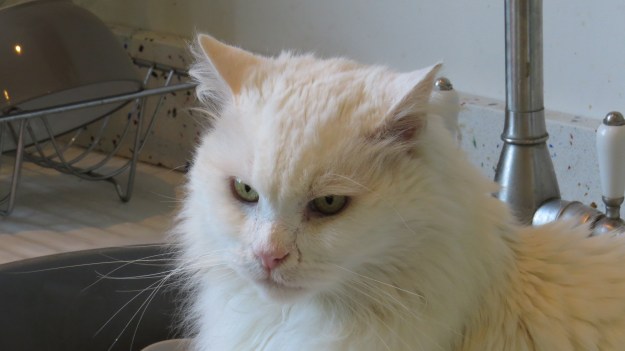
Bailey, the world’s most magnificent cat in 2017

Dear Readers, when I say that a community is about more than just people, I often think of Bailey, who visited our garden regularly from when we moved in in 2010 to when he passed away in 2021. What a magnificent creature he was! And he seemed to bring the community together in a whole range of creative ways. We miss him still….

Dear Readers, a few nights ago Bailey, the King of the Cats, went to sleep for the last time at the fine old age of nineteen years. He has been so much part of our life, and of the lives of many people who lived in the County Roads, that I wanted to pay tribute to him here.

I first met Bailey before we even moved to East Finchley. We were standing on the patio of what was to become our new home when we heard a loud and persistent miaowing issuing from the bushes. Up strode Bailey. He bobbed up for a head scritch, rolled on his back and then marched up to the back door, demanding to be let in. As it  wasn’t yet our house, we decided that this probably wasn’t the best idea, but once we were living there he became a regular visitor.

On one occasion I heard the voice of Bailey’s owner, followed by an all-too familiar wailing.

“Bailey! Come down from there. Don’t make a show of yourself”.

And there was Bailey standing on top of the ten-foot fence at the end of the side return. He had gotten up there, but seemed not to have worked out how he was going to get down. We humans stood and considered what to do. I tried standing on a chair but it wasn’t quite high enough. Fortunately at that point my six foot three inch tall husband arrived home from work, fetched a stepladder and rescued him. Carrying Bailey up the road to his actual house became part of our weekly routine. I think he regarded us as some kind of taxi service for when he was too tired to walk the last hundred yards home.

We soon made friends with Bailey’s actual family (or ‘subjects’ as I’m sure he thought of them). We were in regular contact, as Bailey developed a habit of wandering off. We never fed him, but other people did, and locating him became quite a problem. I am convinced that Bailey never thought of himself as a cat, but as a small furry human being. He would make himself at home on the armchair and watch benignly as I worked. He also loved sitting in the sink, normally (but not always) when there was nothing in it. We learned that what he loved was to drink from a running tap.

Bailey trying to get us to turn the tap on by telepathy.

Finally!

You would not believe that in these photos Bailey was already fifteen years old. He retained his elegant good looks for most of his life, and he was such a popular character on the street that everyone seemed to know his name. Well, you couldn’t really miss an extremely vocal pure-white cat who simply demanded to know who you were and what you could do for him. I had the sense that Bailey always knew what he wanted, and a bit more besides. We found we had a lot in common with Bailey’s owners, and we would probably never have found out how much if Bailey hadn’t ‘introduced’ us. He always seemed preternaturally wise to me.

As the years wore on, Bailey got a bit slower and a bit stiffer, like most of us, but he was still a regular visitor to the garden. The birds never bothered about him, and I never saw him try to catch anything. Other cats scattered at a glance. He would sometimes pay a visit to the garden ‘waterhole’ for all the world like a domestic lion.

Bailey drinking from the pond

He’d always march straight up to the back door and yowl to be let in. If he caught your eye from an upstairs window he would re-double his efforts.

Let me in!

In April this year he paid a visit to the garden. He was clearly a very elderly gentleman, and yet he still announced himself in the usual way,

He was very wobbly on his legs and so we called his ‘Dad’ who came to carry him home. It is so sad to see an animal towards the end of his days, and yet Bailey was a cat who defied pity; he was still the same regal cat that he’d been when we first met him eleven years ago. He loved people, was never happier than when he was plonked down in a patch of sunshine, and seemed to be of the opinion that everything had worked out for the best. He was, as Samuel Johnson said of his beloved cat Hodge, a very fine cat indeed.

R.I.P Bailey. The street is quieter, and much sadder, without you.


2020 – How Are We Doing?

Waterlily in frog pond, Tabin Wildlife Reserve, Borneo

And then there was that pandemic thing….it’s funny reading this now, with so much still to come on both a personal and a universal level. I started writing the blog daily at this point, and to my astonishment I haven’t missed a day since. 

Dear Readers, it has been a remarkable few weeks. On Friday 13th March I headed off for my big 60th birthday trip to Borneo, something that I’d been planning for over a year. At the time there were no travel advisories for Malaysia, and the main problems with Covid-19 seemed to be in China (where it was seemingly coming under control), Italy (in lockdown) and South Korea. Malaysia had a small number of cases, and Singapore, where we were heading to at the end of the trip, had the best results of any country in containing the disease. However, for the past ten days it has felt as if we are surfing just ahead of a huge wave. Singapore was closed, so that part of the trip was cancelled. Malaysia announced a lockdown, so no new tourists arrived. We were the last visitors at each place that we stayed, and the staff and guides at the lodges had no idea when they’d be able to work again after we left. Our plane home, on Sunday night, was packed with people who’d gotten stuck all over Asia. Out of 60 planes leaving from Kota Kinabalu, 56 were cancelled. I am so grateful and lucky to be home, and am also full of sadness, both for the beautiful but benighted country that I visited, and for the terrible effects of this virus. And don’t get me started on the inadequate responses of our own government.

So, I have lots of things to share with you, and I will start a daily blog from Thursday so that I can take you all with me on my Borneo adventure (minus the mosquito bites). But first, I wanted to check in with you and see how you are all doing. I know that different places are in different degrees of lockdown, but here in the UK all non-essential shops are closed along with schools, churches, and other meeting places. Physical distancing is supposed to be observed, with a 2 metre gap between people who don’t live together when in public spaces. You can go out to exercise once a day (and I’ve already had a brisk walk around Coldfall Wood, where most people seem to have got the message about keeping their distance). The police now have powers to enforce the closures and physical distancing but it will be interesting to see how that goes. The measures are supposed to be reviewed in three weeks, but realistically I expect this to last for a good few months at least. I am able to work from home, which is great, and for me I think that the key will be to get into a routine – it would be so easy to disappear into a black hole of online Covid-19 news and general nonsense. I recognise, again, how lucky I am in so many ways: I am in good health, my husband is also my best friend so we won’t be throwing things at one another as the weeks go on, and it’s easy to get to the local shops that are open for food. I am joining one of the local voluntary support groups so that I can help with shopping or picking up medications for people who are totally self-isolating, and that will help me feel connected. Plus, the garden is full of birds and the fritillaries are in bloom, so nature, as always, helps to make me feel grounded.

Bornean Daddy Long Legs spider

My biggest worry is Dad. His nursing home has been in lockdown for several weeks now, with no visitors allowed. On Sunday he developed a chest infection and was admitted to the local hospital. He is now improving, but has to await the results of a COVID-19 test, which is taking two days. This seems like a very long time to wait for test results – if Dad is getting better I suspect he doesn’t have the virus, and therefore is blocking a bed for someone who is much sicker than him. Plus, his dementia makes him extremely distressed in unfamiliar surroundings, and visitors are strictly limited. Fortunately his favourite carer from the home is going to see if there’s any way that she can get in to see him today, which will help, and hopefully he’ll test clear and be out on Wednesday. These situations always make me feel helpless, and it’s even worse when I can’t get down to see him myself.

Pig-tailed macaques in Sukau, Borneo

So, I would love to know how you’re holding up under the strain of the current situation. It’s an anxiety-provoking time for us all, and we will need one another more than ever. How are you spending your time? Are you, like me, looking at the clutter and deciding that this might be the time to make life a bit simpler? Are you able to get out into the garden or into nature? What hobbies or pastimes calm your nerves? And do you have any advice for the rest of us? We are living through a historic time, and there will be lessons to be learned that will resonate through the years to come. How we look after ourselves and one another may give us valuable information about the kind of world that we want to live in going forward.

Spiders Web, Sukau, Borneo


2019 – On Mother’s Day

Dear Readers, my mother died in December 2018, and I was visited by this heron on my first Mothers’ Day without her. At this point my Dad was still alive and was living in a nursing home in Dorset. I think my feelings about having a major predator in the garden were shared by lots of people. 

On the first Mothers’ Day since Mum died, I wander around the house like a ghost, unable to settle to anything. I would always ring Mum to see if she liked whatever pretty thing I had sent her, and to see if the Mother’s Day card had hit the spot. Everywhere I look  there are signs of happy families, complete with live mothers. We can’t get into our usual place for Sunday breakfast because it is completely full up from 8 a.m. Muswell Hill is full of young people carrying bunches of flowers.

I have joined yet another ‘club’, the ‘Problematic Mother’s Day’ club. For those who have lost their mothers, those who wanted to be mothers and weren’t able to, those who had abusive or alcoholic or troubled mothers, today, like Christmas, throws up the contrast between what things are ‘supposed’ to be like, and how they actually are. Real life is messier, infinitely more complicated. This year, Mother’s Day is about gritting my teeth and getting through, one hour at a time.

I do still have one parent alive though, and so I  ring the nursing home to see how Dad is  getting on.

‘I’m on a boat’, he says. ‘I’ll be gone for forty days’.

‘Where are you going, Dad?’ I ask. I’ve learnt that it’s easier for everyone if I join Dad in Dadland rather than attempting to drag him into the ‘real’ world, where he has dementia and his wife of 61 years is dead.

‘Northern China’, he says, emphatically.

‘You’ve not been there before, have you? It will be an adventure. I hope the food is good!’

I’m not sure if Dad is remembering the business trips that he used to take, or the cruises he went on with Mum, or if this is a metaphor for another journey that he’s taking. But I am sure that it could be all three explanations at once.

‘And I’ve done a picture of a rabbit with a bird on its head’.

‘That sounds fun Dad, I know you like painting and drawing’.

‘It’s with crayons’.

‘Well, they’re a bit less messy’.

Dad laughs. There’s a pause.

‘I haven’t been able to talk to Mum. I ring and ring, but she never answers’.

I wonder if he has actually been ringing the house and getting Mum’s voice on the answerphone. He is convinced that she is cross with him because one of the ‘young’ female carers at the home ( a very nice lady in her fifties) helped him to have a shower. He went to the funeral, and was in the room when Mum died, but he doesn’t remember.

‘She’s away at the moment Dad’, I say, ‘But she loves you and she knows that you love her’.

‘That’s all right then,’ he says. ‘But I have to go now’.

‘Love you Dad’.

‘Love you n’all’.

It’s as if, in his dementia, Dad is returned to some earlier version of himself – more placid, less anxious. His calls to my brother have gone from 43 in one day to once or twice a week. I am not sure if this peacefulness will last, or if it presages a movement to another stage in the progression of the disease, but I am grateful for his equanimity. Somewhere inside this frail, vulnerable man there is still my Dad, and I feel such tenderness for him.

I walk to the bedroom and look out of the window. There is something totally unexpected in the garden.

A grey heron is in the pond, and, as I watch, s/he spots the rounded head of a frog. Once the bird is locked on target, there is no escape. The heron darts forward, squashes the frog between the blades of its bill and waits, as if uncertain what to do. The frog wriggles, and the heron dunks it into the water, once, twice. And then the bird throws back its head and, in a series of gulps, swallows the frog alive.

I don’t know what to do. I feel protective towards the frogs, but the heron needs to eat too. The frogs have bred and there is spawn in the pond, so from a scientific point of view there is no need to be sentimental. But still. I have been away in Canada for two weeks, and I suspect that the heron got used to visiting when things when quiet. The pond must have had a hundred frogs in it when we left. Hopefully some of them quit the water once the breeding was over, because on today’s evidence the heron could happily have eaten the lot.

What a magnificent creature, though. It is such a privilege to have a visit from a top predator. Close up, I can see the way that those yellow eyes point slightly forward to look down the stiletto of the beak, and the way that the mouth extends back beyond the bill, enabling an enormous gape. The plume of black feathers at the back of the head show that this is an adult bird, perhaps already getting ready for breeding. S/he leans forward, having spotted yet another frog, and I decide that I’ll intervene. I unlock the back door and open it, but it isn’t until I’m outside on the patio that the bird reluctantly flaps those enormous wings and takes off, to survey me from the roof opposite.

I know that I won’t deter the bird for long – after all, I will leave the house, and the heron will be back. But there has been so much loss in my life in the past few months that I feel as if I have to do something. The delicate bodies of the frogs seem no match for that rapier-bill and there is something unfair about the contest in this little pond that riles me. We are all small, soft-bodied creatures, and death will come for us and for everyone that we love with its cold, implacable gaze, but that doesn’t mean we shouldn’t sometimes throw sand in its face. I am so lucky to have the graceful presence of the heron in my garden, but today, I want to tip the balance just a little in favour of the defenceless.


2018 – Bugwoman on Location – News from Milborne St Andrew

Dear Readers, I had been doing occasional posts from Milborne St Andrew in Dorset, where my parents were living, for a couple of years, but this post really marked a turning point, though I didn’t know it at the time. By October 2018 both Mum and Dad were in a care home in Dorchester, and on 18th December 2018 Mum died. This post reminds me of what a solace nature was then, and still is today. 

Dear Readers, last week I reported that my Dad had been in hospital for over a fortnight while I was on holiday. This week I rushed down to Milborne St Andrew, and Dad was at home.

The good news is that his ‘chest infection’ (actually pneumonia) is much better.

The bad news is that Dad isn’t really clear who anyone is, can’t find his way around the house, and thinks that his home is a new place that closely resembles where he used to live.

Sample conversation:

Dad: ‘That tree looks exactly the same as the one that was outside the old house’.

Mum: ‘What old house?’

Dad: silence

Mum: ‘This is the house we’ve lived in for 16 years, love. It’s the same tree’.

Dad: ‘If you say so’.

We call out the GP, who does a memory test on Dad. Dad does much better than we expect, but still badly enough to be referred to the Memory Clinic for a diagnosis. The doctor thinks that it’s not ‘classic’ dementia but a form of confusion brought on by the effect of not getting enough oxygen to the brain over a long period of time (because of the COPD) exacerbated by his recent pneumonia. COPD is the gift that just keeps on giving, and one lesser known effect is brain damage.

The doctor doesn’t think it’s going to get any better. The unstated conclusion that I’ve come to is that it will probably get worse. There might be peaks and troughs, and Dad might gradually come to feel more confident and relaxed in his own surroundings, so I’m not catastrophising, but it’s clear that things will need to change.

The doctor thinks that the options are residential care or a live-in carer. Mum doesn’t want either, but isn’t physically strong enough to cope with Dad if he needs help getting dressed or going to the toilet. Mum and Dad have always said that they want to be together in their own home if at all possible. So we’re going to investigate the live-in carer option. We are lucky that, as a family, we can scrape together the resources to even start to consider this.

I spend ten minutes in the garden, watching the bees riding the lavender as if each sprig was a bucking bronco.

We are lucky that Dad is such a stoical man – he takes each explanation of what’s going on with a surprised and suspicious scepticism, but is happy to sit in his recliner and take things as they come.  He is eating next to nothing, but can be tempted with creme caramel or anything with custard. There are long periods in the day when Mum and Dad are both snoozing peacefully away and I can get on with cooking and organising, or sitting in the garden with my camera. So often nature comes to the rescue. I am watching the bees and butterflies on  the buddleia when it occurs to me that one of these things is not like the others.

Hoverfly, possibly Eristalis pertinax

I think that this might be a drone fly, a type of hoverfly that looks superficially like a honeybee and probably gets some protection as a result. The eyes give it away, though – that line between them is indicative of a fly, not a bee. And for just a few minutes I’m immersed in something that isn’t care rotas or sorting out medication.

And then there’s a call from the living room and it’s back to that other real world, the one where people I love get sick and confused and cantankerous and infuriating.

I am stressed beyond anything I’ve known previously – I feel myself floating above some situations as if it’s not me at all. The first time I actually spoke the ‘Dementia’ word out loud I ended up crying all over the shop assistant in my local greengrocer. And yet, I also feel my heart opening. As I left on Friday I looked at Dad, with his hair all over the place like Sid Vicious, and felt such an overwhelming tenderness for him that all I could do was kiss him on the top of his head and tell him how much I loved him.

‘Love you n’all’ he said.

And I know that, whatever happens, he always will.


2017 – Twenty-Six Ways of Looking at a Rainy Day

Dear Readers, I had so much fun with this piece. One of the delights of writing the blog has been that, much like owning a dog, it forces me to stop and (preferably) go outside at least once per day. See what you think. 

Dear Readers, I had great plans for the blog today, but the deluge started. As I sat in Costa Coffee and looked out at grey skies and slick pavements, I felt a bit down and hopeless. But then, I started to notice the effect that the rain had on everything, and so, with apologies to Wallace Stevens and his poem ‘Thirteen Ways of Looking at a Blackbird’, I’ve found 26 ways of looking at a rainy day.

1.Grey skies and rain make all the colours look brighter. The reds of the buses and the yellow of the AA van are almost startling. The traffic cones that Affinity Water have put along our road (lead water pipes have been discovered, oh joy) positively pop with brightness.

2. Raindrops form a constantly changing geometric pattern of interlacing circles and bubbles and tiny explosions.

3. Rain really highlights the terrain, the slopes and ridges and the long down-hill towards the tube station

4. The rain also highlights the places where vehicles have parked on the pavement, breaking the paving stones and creating the ideal home for miniature ponds and lakes.

5.People walk faster, but give one another little smiles and eye-rolls. ‘British summer, eh’. You can never go wrong with the weather. A month and a bit ago, we were all moaning about the heat. Today, I have the heating on. In August.

6.You can hear the shape of things by listening to the rain. I remember a radio programme where a chap who was blind said that he loved the rain, because he could ‘see’ the shape of the bushes and trees in the garden. I shall have to try that out, but I love the sounds of tyres in the rain, and the rain on the roof and the windowlights. In Cherry Tree Wood, you could hear the raindrops hitting the leaves.

7.Rain brings up all the smells – there is a word, ‘petrichor’ for earth after rain.  And I wish I could share the smell of these roses with you.

8. The rain brings out all the colours of the bark on the plane trees on the High Road, and the ornamental trees on the County Roads.

9. The rain paints the trees and houses, making it clear exactly where it falls.

10. The rain emphasises out the muscularity of the trunks of the hornbeam trees.

11. I love that some people ignore the rain, and go running anyway. In fact, when I used to run I loved the wet days most of all, the splashing through puddles and the splat of my footsteps, and the fact that I got soaking wet but was going to have a shower anyway.

12. In Taxi Driver, Robert De Niro talks about the way that the rain ‘washes all the scum off the streets’. He was talking metaphorically, but it does clean our streets up for sure. Look at how clean and new the nettles look after their bath.

13. I love that you can sometimes get a perfect reflection in a raindrop.

14. Reflections on a wet pavement are a whole other area of interest. Each car has its own upside-down double attached to its wheels. The awning at Tony’s Continental (the best greengrocer on the High Street in my opinion) looks even more splendid when reflected on wet paving stones.

15. The reflection of traffic lights on a wet surface blurs them romantically.

17. Where do the insects hide during the rain? A big raindrop can knock a butterfly off course or disrupt the busyness of a bee. As the rain (briefly) eased, all kinds of insects reappeared.

17.The rain doesn’t put the birds off, that’s for sure – the starlings bathe, and the crows are still looking for chips in the gutter outside the Kentucky Fried Chicken. I should tell them that their dietary habits are cannibalistic, but I doubt that they’d listen.

18.Some people have wonderful rainwear, like the lady completely encased in a yellow poncho who just popped into Costa Coffee. Practical and bright.

19.You see more grown-ups in Wellington Boots, and that’s not a bad thing. It always makes me think of the seaside.

20.Generally, people drive more slowly and carefully, as if suddenly aware that they are piloting a ton of metal through a world filled with creatures made of flesh and bone.

21 .My water butts will be full, ready for this ‘drought’ that we’re supposed to be having.

22. Leaves are both waterproof, and designed for rain to run off and fall where it’s needed, the soil beneath the plant.

23. The rain brings out the snails. And I have a great fondness for snails, in spite of their bad behaviour.

24. Walking in the rain when you don’t have to feels a bit anarchistic, but (whisper it) it can be fun. Children know this, we seem to have forgotten it. Best save any puddle-jumping for a quiet spot, though. I get enough funny looks as it is.

25. People walk closer together, sharing umbrellas, holding one another’s arms. We could all do with walking a bit closer together.

26. Tomorrow is meant to be dry and sunny. Let’s make the most of the rain while it’s here.

2016 – Flâneuse-ing on the County Roads

IMG_7356

Dear Readers, after two years of finding things to write about for the blog I had discovered that all I had to do was take myself off for a walk around the County Roads here in East Finchley and there would always be something to see. I would invariably come back with a spring in my step and a conversation to report. I think this was the first of many such adventures. 

Dear Readers, for many years I have been intrigued by the idea of the Flâneur. This was a 19th century French character, invariably male, who would wander around a city wearing a top-hat and carrying a cane, and was described as a ‘connoisseur of the street’. He would get into all kinds of adventures and encounters, and would have a thoroughly interesting time. However for women, it was somewhat different.  In her new book ‘Flâneuse – the (Feminine) Art of Walking in Cities’, Lauren Elkin records how women doing exactly the same thing as the Flâneur could be subject to harassment and suspicion, and were sometimes accosted or even arrested. Nonetheless, I strolled forth intrepidly (though without top-hat and cane) to explore the County Roads here in East Finchley.

The County Roads are a set of six roads, built at the turn of the twentieth century, and they are all named after old English counties: Lincoln, Leicester, Huntingdon, Bedford, Hertford and Durham. They are a jumble of different Victorian/Edwardian styles, and vary from the ornate to the simple, from the grand to the (relatively) humble. What they all have, however, are front gardens, and for a naturalist like myself, that’s good enough. Who knows what I might see? I was especially intrigued to see how the pollinators were getting on, and what was attracting their interest.

My first step was right outside my front door, to admire my giant buddleia. It is true that it needs yet another prune, but I’m reluctant to get rid of those enormous racemes of flowers just yet. Plus, the more I hack at it, the larger it grows. Yesterday afternoon, it largely attracted honeybees.

IMG_7353Onwards! I head down to the High Road and, as if for the first time, notice what a strange shape the London Plane trees are after their pollarding. Each one appears to be trying to accommodate the buildings around it. Apart from the peculiar topiary effect, however, they are looking very healthy at the moment, though we could do with some rain – my water butt has run dry for the first time since we installed it five years ago. Every night the clouds gather and then dissipate away over Muswell Hill. Who knows what we have done to anger the gods.IMG_7362IMG_7385If bumblebees could vote with their many little hooked feet, I’m sure they would put their crosses down for lavender. The County Roads are very obliging in this respect, and there is a fine patch at All Saint’s Church on Durham Road, while many individual houses have handsome stands of the plant.

IMG_7373IMG_7374Although modern roses are not a favourite, the ones that are closer to the wild type attact some attention.

IMG_7371On another note, the bollard on the corner of Leicester Road is still not fixed (or maybe was fixed and got walloped again). Is there a gremlin here that attracts collisions?

IMG_7379

Lesser-spotted bollard

Alongside some very splendid cultivated sweet peas, there are some stands of a wild cousin, Broad-leaved Everlasting Peas (Lathyrus latifolius), and very pretty it is too.

IMG_7382

Broad-leaved everlasting pea (Lathyrus latifolius)

I stop to congratulate a man who is two-thirds of the way up a ladder, re-painting some of his plasterwork cornice. He nearly falls off with shock, but recovers himself to say how much he loves these old buildings and the little details that make them different from one another. I couldn’t agree more.

Someone is having much more luck with Nepeta (Cat Mint) than I did. I planted mine in a pot, and came downstairs to find that I had apparently grown a cat, though it just turned out to be some stoned feline who had crushed it in his frenzy, and who gazed at me with a demented expression.

IMG_7386

Honeybee on catmint (Nepeta).

It's no good trying to look innocent.

Evil cat-mint destroyer in pot.

Evil cat-mint destroyer

It’s no good trying to look innocent, though you are a very fine cat indeed.

I stopped to view a particularly wildlife-friendly garden that met with full Bugwoman approval. It had verbena and nicotiana (for the moths), some sedum just ready to come into flower, an interesting yellow vetch and all manner of other delights. I stopped to photograph it when, dear reader, I was finally accosted, by a lovely lady with a bunch of lavender from her allotment in her hand. She asked me if I was Bugwoman, and so of course I could not demur. Then another lovely lady approached, and I was introduced to her too. My cover was blown! Maybe I should create a Bugwoman costume, perhaps with dangly antennae and wings, though it might be difficult to handle the camera with extra legs.

IMG_7391

Sedum – a great plant for autumn pollinators

IMG_7390

Verbena bonariensis and nicotiana, amongst other pollinator-friendly delights

IMG_7389

Honeybee on Verbena boniarensis, a great bee and butterfly plant

Now, East Finchley readers, have you noticed our magnificent pigeons? We have our fair share of the normal blue-grey birds, and very fine they are too. But we have more than our share of birds which are partially white, and also ones that have a pinky-grey colouration, which is known as ‘red’ in the trade, I think. Huntingdon Road has its own resident pair of red birds, which I fear is due to the Kentucky Fried Chicken on the corner, and concomitant rubbish which is strewn at that end of the street (in spite of the litter bin). (Don’t get me started).

IMG_7426

A red pigeon about to indulge in KFC chips

IMG_7393

One of many pied pigeons in East Finchley

As I loop up towards the corner of Bedford and Durham Road, I stop to look at the fennel growing in one of the gardens. All of the umbellifers (plants with flat, multi-flowered blooms like Cow Parsley and Hog Weed) are pollinated by insects smaller than bumblebees: all kinds of flies, wasps, honeybees and beetles. It is thought that flies, in particular, are not so skilled at pollination, and don’t have the ability to cope with the complicated flowers that bumblebees do, so they tend to prefer single flowers, and lots of them.

IMG_7405

Little and Large….

IMG_7413

Ichneumon wasp on fennel

And some surprisingly complicated flowers can be ‘cracked’ by bumblebees, who really are the brains of the pollinator world. It’s been shown that, given sufficient incentive, they can tell the difference between human faces, so a passion flower is easy-peasy.

IMG_7417

Bumblebee on passionflower

As I make my last turn around the County Roads, the sound of cawing alerts me to the fact that the crow family have reproduced successfully again. Earlier, one of the parent birds was trying to persuade a fledgling to come down and eat a suspiciously new-looking slice of bread that they had filched. By the time I returned, the adult was watching as the youngster pecked about in the gutter of a nearby house, looking for food.

Parent crow

Parent crow

Fledgling

Fledgling

Dear Readers, I had a very fine walk around the County Roads, and I wasn’t arrested once. Even in a built-up area there is lots to see and enjoy. I would like to leave you with a brief clip of the bees feeding on a particularly lovely patch of lavender, where the heat of the sun was bringing up the scent, and the lazy droning of the insects (only partially obliterated by a plane heading home to Heathrow) made me wish that I had brought a deckchair with me. I hope that you enjoy it as much as I did. There is so much more ‘nature’ in a city than people often think.


2015 – A Work in Progress

Me aged about four with my nan.

Me aged about four with my nan.

Dear Readers, this is my ‘Year Two’ post, from 2015. I think this is the first time that I wrote in any detail about my garden, and it’s interesting to me to see how it’s changed – the evergreen clematis has gone, and it occurs to me that I could plant something similar to gussy-up my lilac when it’s gone over. And I think I need some more Bowle’s Mauve, I’d forgotten how useful it is. Everyone was so helpful with their comments and suggestions following this post, and it gave me more confidence to write about the personal. 

Dear Readers, I grew up in Stratford, in East London. Five of us crammed into a two-bedroom house with an outside toilet, no bathroom, and a pocket handkerchief-sized garden. And yet, it was that little garden which first triggered my interest in insects. I spent hours digging in the dirt with spoons that I’d smuggled from the cutlery drawer. I reared woolly bear caterpillars in a plastic box, tried to create woodlouse habitats under concrete slabs and marked the backs of passing ants with watercolours from my paintbox. I was a permanently messy child, with scuffed knees and dirty fingernails, in spite of the attempts by my mum and nan to keep me more or less lady-like. In a way, I was a pioneer of wildlife gardening before the term had even been invented, because the more invertebrates there were in the garden, the better I liked it. Once, I rescued some milky, sticky eggs that I found and put them into the damp course under the living room window. When we were suddenly inundated by enormous yellow slugs a few weeks later, I kept very quiet.

As I grew up, I didn’t have much access to a garden. I was in student digs, and then in a variety of rented accommodation. Some people seemed able to create a floral paradise wherever they were, but not me. I was always on the move, always too easily distracted. A bout of serious depression in my thirties didn’t help. For a while, I had a few pots on a first floor balcony and got most of my access to nature from the community garden down the road.  And then, in my fifties, we moved into our house in East Finchley, and things started to change. For the first time, I could settle down, with a garden of my own. It felt safe, finally, to become a gardener.

My garden in May

My garden in May

When we moved in, our house had a very typical family garden – rectangular lawn, patio, shed. But I wanted so much to turn it into something that was friendlier for wildlife. We don’t have children, and so there was no need for somewhere to play football or badminton. We decided that, as this is the kind of thing that we would only do once, we would get someone to help us with the design of the garden, and with the heavy work of digging out a pond to replace all the grass. I figured that if the garden had ‘good bones’ it would be more difficult for me to mess it up. I am still a novice, trying things out, messing things up, forgetting to do things and doing them at the wrong time. But, thankfully, nature is very forgiving.

View of the left-hand side of the garden, with white lilac, hawthorn and whitebeam

View of the left-hand side of the garden, with white lilac, hawthorn and whitebeam

The plants on the left hand side of the photo above were already there when I moved in –  white-flowering lilac, hawthorn and  whitebeam. How lucky I am to have some mature trees! However, the garden is north-facing, and as the trees grow, the area underneath becomes increasingly shady. In particular, the lilac has turned into a monster, almost a small glade of trees in its own right. It has an evergreen, white clematis scrambling through it, which provides some sustenance for early Bumblebee queens, but I’m sure I could do more. Does anyone have any experience of renovating such an august shrub? I know that if I’m going to try to help it renew itself, it needs to be right after flowering, so I’d better get a move on.

The hawthorn is in full flower at the moment

The hawthorn is in full flower at the moment

The hawthorn is attracting a mass of insects and small birds, who spend best part of the day pecking through the flowers for caterpillars.

Bowles Mauve - perennial wallflower

Bowles Mauve – perennial wallflower

One of the plants that works hardest in the garden is the Bowles Mauve perennial wallflower. I put it in over three years ago. In all that time, there hasn’t been a day when there hasn’t been at least a few flowers on it. Bees of all kinds seem to love it, it needs no care, and my only fear is that at some point it will run out of steam. In the meantime, I appreciate its generosity every day when I look out of my kitchen window.

The pond.

The pond, complete with self-sown Greater Willow Herb

The pond is the single most interesting thing in the garden. Frogs lay their eggs in it, dragonflies and damselflies hover over it, water boatmen swim in it and everything drinks from it, from foxes to blackbirds to dunnocks to a wide range of neighbourhood cats. There is always something going on. It has reached a stage now where, provided we remove most of the leaves and excess water plants in the autumn, it is self-maintaining. If you have any space at all, even a balcony with room for a bucket, I would recommend putting in some water. You will be amazed what turns up.

Another picture of the pond. Can you tell I'm in love?

Another picture of the pond. Can you tell I’m in love?

I also have a lot of bird feeders – 2 for seed, 2 for suet, 2 for nyger, and a bird table that looks as if it was cobbled together by Heath Robinson. They’ve been very useful for attracting the birds into the garden, but I’m pleased to see that they spend a lot of time foraging for natural food in the trees and shrubs at this time of year.

IMG_2442

My Heath Robinson bird table.

My Heath Robinson bird table in front of the rampant lilac bush and the Bowles Mauve.

I’ve also managed to squeeze in a mixed hedge – yew, beech, hazel, hawthorn and spindle.I’ve been cutting this back in the autumn to encourage it to get thicker, but I think it will be a while before it gets thick enough for anybody to nest in it. Again, it does much better in the part of the garden where it is not under the whitebeam. The poor spindle is nearly always eaten half to death by aphids, particularly (you guessed it) in the darker part of the garden.

The hedge, looking back to the house.

The hedge, looking back to the house.

As you might expect, I am unfazed by weeds. I have a wide variety, from the usual nettles and dandelions to comfrey, Mexican fleabane, pendulous sedge, herb bennet, yellow corydalis, green alkanet, forget-me-knot, and elecampane. I have a huge stand of Greater Willowherb which is so good for the bees that I can’t help letting it get bigger every year. I have bramble and bindweed trying to find their way in from the back of the garden, and I do confess to encouraging these to curb their ambitions with a pair of secateurs. What intrigues me is that many of these plants can be found locally, in the wood or the cemetery, and I wonder how unique the mixture of ‘weeds’ is to any particular locality. Certainly, if something grows wild nearby, it is more likely to turn up. I have a view that, if not too ‘over-managed’, our gardens can become extensions of nearby habitat, rather than completely different ones. It makes sense to support the wildlife that is already living in an area, rather than asking it to adapt to a completely new set of plants.

I also have an eight-foot tall volunteer cherry tree, courtesy of the one next door. My garden is becoming a forest.

The 'volunteer' cherry tree.

The ‘volunteer’ cherry tree.

Of course, not everything in the garden is rosy. Especially the poor Rosa rugosa which I planted underneath the whitebeam in a moment of madness. It reaches out with its poor attenuated stems for the sunlight and produces, oh, maybe three flowers a year. If I was a bit more confident about it surviving, I would move it, but now is obviously not the time.

One of the few flowers on my poor rose bush

One of the few flowers on my poor rose bush

I am so lucky to have a garden again, and believe me, I am grateful every day that I have a chance to enjoy it. . There is always something going on, some new creature appearing or an unidentified plant popping up. But every garden is a work in progress. If you are also lucky enough to have a garden, what things have you tried that have helped your local wildlife? Do you have any advice on north-facing gardens, or working with heavy clay soil? If you don’t have a garden, have you tried containers, or guerilla gardening? Or what have you observed in your local park? I would love to know what your number one plant for pollinators is, for example, or if you’ve had any success with bug-hotels or nestboxes. I truly believe that observant gardeners and dog-walkers and runners and allotment-holders have a deep pool of knowledge that should be tapped for the benefit of our wildlife, and that we have so much to learn from one another.

Blackbird in the rain ...

Blackbird in the rain …


2014 – Bug Woman Is Ten Years Old!

Blog Post One 002

Dear Readers, ten years ago, on 15th February 2014, I summoned up my courage and clicked on the ‘Publish’ button on my first ever blog post. What a lot has happened since! I’m now an elderly orphan, having lost Mum in 2018 and Dad in 2020, but I’m also a youthful retiree, having given up work in September last year. We’ve been through a pandemic, Brexit has happened, we’ve had five prime ministers, the US has had Trump, the wheels are falling off the wagon all over the rest of the world, climate change continues apace, and some days I just want to switch off the wifi and retreat into a good book. 

And yet. 

I meet so many people who are interested in the natural world and concerned about what’s going on in their local communities, and who are doing whatever they can to right wrongs and to do their bit. I see people doing their best with their resources, be they time or money or energy or all three, to make things better. A friend recently told me about an interview with Carl Safina, an American conservationist and writer, who was asked, in hushed tones, whether he was optimistic or pessimistic about the state of the environment.

“That’s a question for people sitting in the bleachers”, he said. “I just want to know that I’m in the game”.

And amen to that. If I’ve learned one thing from writing this blog for the past ten years, it’s that action, however small, is the cure for despair. 

And so, for the next ten days, I’m going to reprint my favourite post from each of the last ten years. Here’s my first ever post. And thanks, eternally, to The Gentle Author, who’s blog course gave me the courage to launch. Have a look at the Spitalfields Life blog. It is a wonder. 

2014

When I got off the tube train at East Finchley Station this afternoon, I noticed a small, hunched shape on the platform. As I bent over for a closer look, I realised that it was a bumblebee, lying motionless on her back. As everybody else piled past on their way home, I wondered what to do. I couldn’t bear to think of people treading on her. What if she was still alive? So I picked her up and rested her in the palm of my hand. She looked substantial, but her weight barely registered. And then she moved, one of her legs groping into the air as if looking for something, anything to cling on to.

My bumblebee is a Queen, who has come out of hibernation too early because the weather has been so unseasonably mild. She has been unable to find any flowers to feed from, and has used up her last energy searching the desert of the station platforms for something to eat.

I cradle her in my hand all the way home. Once there, I put her onto a plate, and position her so that she can drink from a spoon filled with sugar-water, the closest substitute for nectar that I can make. I watch as her leg twitches, but gradually the movement becomes weaker. I fear that there is no hope for her.

The bee will not be the only creature to die – she has some ‘hangers-on’. I count four mites crawling through her fur, each the size and shape of a flaxseed. That’s a heavy burden for an insect to be flying around with. The mites live in bumblebee nests, and will attach themselves to the young queens, like this one. When an infested bumblebee lands on a flower, some of the mites will get off and wait for another bee to latch onto, as if changing buses. However, without the bee the mites won’t survive either.

Looking at the bumblebee closely, in a way that she would never allow if she was healthy, is both a privilege and a kind of impertinence. I notice, as I never did before, that her wings are like smoked glass, the ridged veins standing out and catching the light from my angle-poise lamp.  Her eyes are black, like twin coals in her alien face. She has little hooks on the end of each leg, rather than feet. There are bands of dirty yellow fur behind her wings but just behind her head there is the faintest shadow of gold, only discernible from a very particular angle.

As I watch, she is curling up, her antennae covering her face, her legs crumpled under her. I will leave her for a while, but I am sure that she is dead.

The other casualties, apart from the bee herself and her little team of parasites, are the eggs that she carries. She will have mated once last summer, when she first emerged from the nest as a fresh young queen. I imagine her flying to meet the male bees at the top of the lime trees where they leave their pheromones, a kind of sexual perfume, so that she can find them. Inside her will be the first of her fertilised eggs that, if things had been different, would have hatched into the first workers to support her nest. From this one female up to four hundred and fifty bumblebees would have been born, going on to pollinate countless thousands of plants. When any creature dies, however humble, however common, there is a ripple effect that spreads much wider than that little death.