Wednesday Weed – Viper’s Bugloss Updated

Dear Readers, my trot around East Finchley on Sundary reminded me of how much I love Viper’s Bugloss – so prickly, so blue, and such a magnet for bees! And so I wanted to resurrect this post, partly because it reminds me of the first time I noticed the plant.  I was taking a walk around Milborne St Andrew to clear my head after a difficult few days looking after my parents, who were seriously ailing by this point, and I remember how, on spotting this plant, all my worries fell away, just for a few moments. It’s strange how the sight of a ‘new’ flower, or a bird doing something unusual, or an interesting insect, can completely take me out of my head and plop me back into being part of the living world. And so I wanted to share this with you again, in the hope that if you’re having a hard time, it can act as a reminder of all the extraordinary life that’s going on right outside your front door. Take a walk, if you’re able, or at least open the window and stand there, breathing, for a few minutes. Sending all of you who need it a big hug.

And of course, there is a poem. There’s much to love about this work by Stacie Cassarino (for me at least), but is it too much? And what the hell is an isopleth? Readers, it is A broad term for any line on a weather map connecting points with equal values of a particular atmospheric variable’. So now you know. Let me know what you think! I am half in love with it, but not completely.

Summer Solstice
BY STACIE CASSARINO

I wanted to see where beauty comes from
without you in the world, hauling my heart
across sixty acres of northeast meadow,
my pockets filling with flowers.
Then I remembered,
it’s you I miss in the brightness
and body of every living name:
rattlebox, yarrow, wild vetch.
You are the green wonder of June,
root and quasar, the thirst for salt.
When I finally understand that people fail
at love, what is left but cinquefoil, thistle,
the paper wings of the dragonfly
aeroplaning the soul with a sudden blue hilarity?
If I get the story right, desire is continuous,
equatorial. There is still so much
I want to know: what you believe
can never be removed from us,
what you dreamed on Walnut Street
in the unanswerable dark of your childhood,
learning pleasure on your own.
Tell me our story: are we impetuous,
are we kind to each other, do we surrender
to what the mind cannot think past?
Where is the evidence I will learn
to be good at loving?
The black dog orbits the horseshoe pond
for treefrogs in their plangent emergencies.
There are violet hills,
there is the covenant of duskbirds.
The moon comes over the mountain
like a big peach, and I want to tell you
what I couldn’t say the night we rushed
North, how I love the seriousness of your fingers
and the way you go into yourself,
calling my half-name like a secret.
I stand between taproot and treespire.
Here is the compass rose
to help me live through this.
Here are twelve ways of knowing
what blooms even in the blindness
of such longing. Yellow oxeye,
viper’s bugloss with its set of pink arms
pleading do not forget me.
We hunger for eloquence.
We measure the isopleths.
I am visiting my life with reckless plenitude.
The air is fragrant with tiny strawberries.
Fireflies turn on their electric wills:
an effulgence. Let me come back
whole, let me remember how to touch you
before it is too late.


Viper’s Bugloss (Echium vulgare) by the stream in Milborne St Andrew

Dear Readers, nothing delights me more than finding a plant that my guide describes as ‘common’ but which I have never seen before, and so it is with Viper’s Bugloss. What a fantastic plant it is, with its furry flowers and purple stamen and hairy stems. There is something rather Harry Potter-ish about it, and it looks far too exotic to be a UK native, even though it is.

I found this one growing from a crevice in a wall above the stream in Milborne St Andrew,  and it does seem to have a liking for chalky soils such as those in parts of Dorset. It is a member of the Borage family, and is much loved by pollinators. The name ‘bugloss’ comes from the Greek for ‘ox-tongued’ and refers to the rough texture of the plant. The ‘viper’ bit comes from the way the stamen resemble a snake’s tongue, from the look of the seed head, and from the belief that the plant could cure snakebite (probably another manifestation of the ‘Doctrine of Signatures’, whereby it was believed that God had designed the appearance of a plant to indicate what it could be used for).

Photo One by By D. Gordon E. Robertson - Own work, CC BY-SA 3.0, https://commons.wikimedia.org/w/index.php?curid=10222992

Viper’s Bugloss flower (Photo One)

Viper’s Bugloss is native to Europe and temperate Asia, and has been introduced to North America, where it is sometimes known as ‘blueweed’ and has become invasive in some parts of the continent.

Photo Two by By Lubiesque [CC BY-SA 3.0 (https://creativecommons.org/licenses/by-sa/3.0)], from Wikimedia Commons

Viper’s Bugloss alongside a road in Montreal (Photo Two)

The plant contains alkaloids, which are poisonous, although there are no known cases of humans suffering from eating it. Because of its long taproot it can be difficult to remove from pasture, and in 2006 a paper suggested that bulls in Spain died as a result of munching on viper’s bugloss and common ragwort. However, while ragwort gets a very bad press, viper’s bugloss is generally tolerated. I sometimes wonder how and why we get these bees in our bonnets about particular plants whilst ignoring others that, it could be argued, are equally ‘dangerous’. Could the popular press have something to do with it, I ask myself (sarcastically)?

In Australia, a closely related plant (purple viper’s bugloss or Echium plantagineum) is known as ‘Patterson’s Curse’, because it is said to have escaped from the garden of a Mrs. Patterson. After a bushfire in Canberra destroyed all the other pasture, 40 horses are said to have eaten the bugloss and suffered liver failure, resulting in them having to be destroyed.

Photo Three by By Harry Rose from South West Rocks, Australia (Echium plantagineum plant1) [CC BY 2.0 (https://creativecommons.org/licenses/by/2.0)], via Wikimedia Commons

Purple viper’s bugloss (Echium planagineum) in South West Rocks, Australia (Photo Three)

Viper’s bugloss is such a stunner (in my eyes anyhow) that a number of cultivars have been developed, such as ‘Blue Bedder’ which can be bought from the Royal Horticultural Society shop should you be so inclined. As usual, I rather prefer the species plant, and I suspect that it might be more attractive to pollinators in its original state as well. Why would you want to breed out those bright red stamens? I think we should be told…

Incidentally, you can see here how the buds start off pink and turn blue when the plant is ready to be pollinated, like so many members of the borage family.

Photo Four by https://www.rhs.org.uk/Plants/139228/Echium-vulgare-Blue-Bedder/Details

Viper’s bugloss variety ‘Blue Bedder’ (Photo Four)

In addition to treating snake bite, the plant is said to be useful for ameliorating fevers, headaches and inflammation, with the best parts of the plant being the leaves that grow close to the ground, directly from the root.

A herbalist named Parkinson noted that

‘the water distilled in glasses or the roote itself taken is good against the passions and tremblings of the heart as also against swoonings, sadness and melancholy.’

which sounds like a good thing. As with all plants, and particularly ones that are known to be poisonous, I would suggest a good degree of circumspection however. Remember those horses in Canberra.

I am off to Austria next week, and I note that in the Tyrol, people were warned against consuming viper’s bugloss because it was said to stimulate sexual desire. Presumably all that fresh mountain air and yodelling was aphrodisiac enough, not to mention the lederhosen.

Many species of bees love viper’s bugloss, including the rather splendid red-tailed bumblebee (Bombus lapidarius)

Red-tailed bumblebee queen (Bombus lapidarius) (Public Domain)

It is also a favourite foodplant of the migratory Painted Lady butterfly (Vanessa cardui). These insects come out of their chrysalises in the Atlas Mountains of North Africa before heading north and east to find foodplants for their caterpillars. Fortunately the caterpillars have wide-ranging tastes, from thistles to mallows, but they also love viper’s bugloss. In years when there are not many foodplants close to home, or if a large number of adults have hatched and survived, there may be extraordinary irruptions of the adults in the UK as they arrive en masse: I remember seeing over thirty in one small patch of community garden one morning a few years ago. All the more reason for growing lots of plants for butterflies and bees! The butterflies also have a love for viper’s bugloss as a nectar plant, so it helps both caterpillars and adults.

Painted Lady (Vanessa cardui) (Public Domain)

And as if that wasn’t reason enough to welcome viper’s bugloss to your garden if you get a chance, looky here….

Photo Five by By spacebirdy(also known as geimfyglið (:> )=| made with Sternenlaus-spirit) [CC BY-SA 3.0 (https://creativecommons.org/licenses/by-sa/3.0) or FAL], from Wikimedia Commons

Hummingbird hawk moth (Macroglossum stellatarum) feeding from viper’s bugloss (Photo Five)

Perhaps the most exciting insect find of all, however, is not particularly spectacular to look at, but is a sign of how our flora and fauna are likely to change with the climate. The viper’s bugloss mason bee (Hoplitis adunca) is a brand new species in the UK and is currently found at only one site, the Greenwich Peninsula Ecology Park in London. It strongly prefers species in the Echium genus to any other plants and, while it makes its tiny nest in every thing from empty snail shells to old beetle tunnels, at the park it was found nesting in an artificial ‘bee hotel’. Which just goes to show that if you provide lots of habitat in your garden, you never know what will turn up. It also points up the importance of ‘brownfield’ style sites for insects – many prefer these areas, even though they look uninviting to us, because they mimic the Mediterranean conditions of dry, poor soil and exposed, hot places to warm up that these insects are used to.

Photo Six by Thomas Roppenecker at https://www.flickr.com/photos/roppenecker/27613303396

Viper’s bugloss mason bee (Hoplitis adunca) (Photo Six)

I am reminded of the amazing book ‘Wildlife of a Garden – A Thirty Year Study’ by Jennifer Owen, who was a hoverfly specialist and who discovered several species that were completely new to science in her Leicestershire back garden. This was before the current (much welcomed) advent of ‘wildlife gardening’ – she had, by her own description, a very ‘ordinary’ garden with a lawn and flower beds and somewhere to dry clothes, and yet, because she paid attention and recorded the visitors that she had, she was able to list  2673 species of plants and animals. I wonder what the counts for our gardens would be? So many creatures, especially the tiny ones, escape our notice altogether, and that’s without all the ones who whistle through when we aren’t looking. We are surrounded by wonders, and I for one only notice a tiny proportion of them.

Photo Credits

Photo One by By D. Gordon E. Robertson – Own work, CC BY-SA 3.0, https://commons.wikimedia.org/w/index.php?curid=10222992

Photo Two by By Lubiesque [CC BY-SA 3.0 (https://creativecommons.org/licenses/by-sa/3.0)], from Wikimedia Commons

Photo Three by By Harry Rose from South West Rocks, Australia (Echium plantagineum plant1) [CC BY 2.0 (https://creativecommons.org/licenses/by/2.0)], via Wikimedia Commons

Photo Four from https://www.rhs.org.uk/Plants/139228/Echium-vulgare-Blue-Bedder/Details

Photo Five by By spacebirdy(also known as geimfyglið (:> )=| made with Sternenlaus-spirit) [CC BY-SA 3.0 (https://creativecommons.org/licenses/by-sa/3.0) or FAL], from Wikimedia Commons

Photo Six by Thomas Roppenecker at https://www.flickr.com/photos/roppenecker/27613303396


Strange New Habitats

Dear Readers, it has been ‘pretty busy’ at work today – I have exactly 6 working days left until I retire, and as usual I keep thinking of things that I absolutely have to do before I leave. But for a few minutes I did look out of the window and admire the scaffolding next door. It’s surprising how quickly something like a scaffold can become something to be utilised by the local wildlife: the magpies often hang out, squawking, on the scaffolding poles, and when we had a scaffold around our house a sparrowhawk used to sit on it, surveying the garden for prey.

But for today, it was largely spiders’ webs that caught my eye. They aren’t so clear in the photo above, but have a look at the film below. Enjoy!

I wonder how long it would be before the scaffolding was covered in vines? Maybe a little bit of soil would develop at the junctions between the poles, and I’m sure all sorts of things could live on the boards. It could be like the Hanging Gardens of Babylon given a year and minimal interference. But alas, the scaffolders will be coming to take them down in a week or so, and so I’ll never know what could have happened. On the other hand, it will be nice to get a bit more light into the house, the ones at the back have made our dining room feel like an abyss of doom, and that’s never a good thing, especially with the nights drawing in.

And now, back to the grind! But not for much longer!

A Sunday Stroll Around East Finchley

Viper’s Bugloss (Echium vulgare) outside the Monkey Puzzle nursery

Dear Readers, what a pleasure it was to go for a walk around East Finchley on this sunny Sunday afternoon. I’d thought that summer was pretty much over, but for the next few days it appears to have returned, and so we went for a wander through Cherry Tree Wood and back home, just to see what was happening. First up, there are some great plants in the grassy area outside the Monkey Puzzle nursery, right opposite East Finchley Station. This Viper’s Bugloss was doing very nicely, and various late bees were enjoying it greatly.

Ribbed Melilot (Melilotus officinalis)

The Ribbed Melilot, a member of the pea and vetch family, was also doing very nicely.

Common carder bee enjoying the Iceland poppies.

I thought at first that these were Welsh poppies, but on closer inspection I think they might be Iceland poppies (Papaver nudicaule), and  very pretty they are too, in their yellow and orange shades.

Then we headed into Cherry Tree Wood, which was busy with families playing football and badminton  and basketball and tennis. The woods themselves are a shady haven.

There are still a few Speckled Wood butterflies about.

A nice flower border has been planted up in front of the gents toilets. Hopefully this will deter at least some of the graffiti that appears with monotonous regularity.

And the mosaics on the ladies toilet have been completed, and very nice they look too. They each feature an image of something that can be seen in  Cherry Tree Wood, from the apple and pear in the top row (they’ve been planted in the orchard) to the Archer himself, whose statue can be seen at East Finchley station. Well done to Debbie Singer, who made the whole thing, which took over a year. You can read more about it in this month’s community newspaper, The Archer, here.

And here’s the orchard, doing very nicely, thank you. Apparently you only need five trees for an orchard, which is an incentive to plant some fruit trees if ever I heard one.

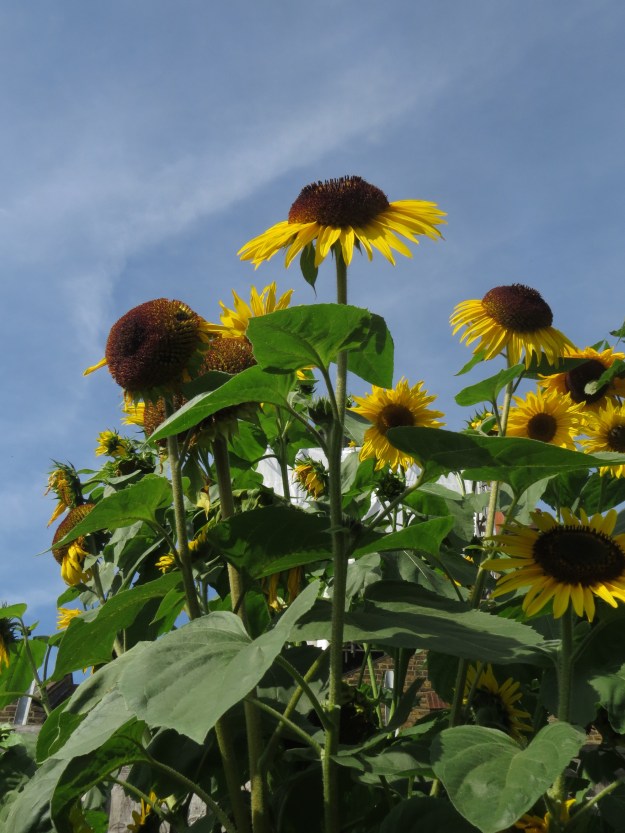
And then finally it’s home via the unadopted road. It’s always interesting to see what’s going on here, and today I was rewarded by a patch of sunflowers of different varieties.

How splendid they look against the blue sky, and how popular most of the flowers were with bees! Later, if the flowerheads are allowed to stay, they may well attract finches and other small birds, but for now it’s mainly all manner of pollinators.

However, it’s interesting to see that one variety of sunflower alone didn’t seem to have any bees at all.

And it’s easy to see why – there’s no obvious pollen in the midst of all of those petals. It’s always worth bearing in mind that even plants that are normally irresistible to bees, butterflies and hoverflies may not be attractive to them if they’re double-flowered – sometimes they simply don’t produce the nectar or pollen required, or sometimes the flowers are just too complex for the insects to navigate. Still, in a patch of plants that punches so far above its weight in terms of of pollinator value I think it’s absolutely fine to grow something whimsical, just for the sake of those fluffball flowers. After all, gardens have to be places where humans can be happy too, and there’s no reason at all why a wildlife garden can’t be a sanctuary for people, and a pleasure to be in.

What Do Plants Get Up To At Night?

Spider plant at East Finchley Station

Dear Readers, there was a very interesting article in New Scientist last week, addressing something that attained the status of holy writ when I was growing up, and I wondered if any of you remembered something similar. I was told that it was very bad to have plants, whether in pots or vases, in bedrooms at night, because of all the carbon dioxide that they emitted. Furthermore, flowers taken to hospital patients were said to be removed from the wards at night for the same reason.

At the time, I didn’t give it much thought – my O-Level biology taught me that plants take in CO2 during the day through photosynthesis, but at night they breathed it out via respiration, just like any living thing, so it all seemed reasonable. But my science degree this year got me thinking that there was something wrong with the argument, and James Wong’s article explained exactly why.

I occasionally indulge in cut flowers, but should they ever be in the bedroom?

First up, how much carbon dioxide do houseplants emit at night, compared to what they absorb during the day? Some scientists in Turkey popped some ficus and yucca into sealed boxes, and discovered that they absorb 6 to 8 times more CO2 during the day than they release at night. At night, a large ficus plant increased the CO2 content in the box by only 351 parts per million, well within the healthy range for any humans who happened to be locked in a sealed box with a houseplant.

Secondly, for those of us who share our bedrooms with other humans (or indeed other animals such as dogs or cats), we should maybe consider how much carbon dioxide they’re emitting. A single human breath emits 40,000 parts per million of carbon dioxide, which is more than ten times more than a ficus emits in eight hours overnight. As Wong says, if we’re concerned about CO2 maybe we should turf out our partners rather than our plants.

And finally, we don’t live in hermetically-sealed boxes (unless you live in a Passivehaus, which is about the closest that we come to such a thing, though these do have mechanical ventilation so it’s not a very close comparison). Indoor air is moved about by draughts, through leaky windows and opened doors, and even by the movement of humans around the house. The carbon dioxide produced by a plant overnight is not going to stay in the bedroom, but will dissipate under the doors, through the windows, up the chimney and even through the brickwork or floorboards if you live in a Victorian end of terrace like I do.

So, this is another tale that has little basis in actual scientific fact. Hospitals in the UK ban plants on the wards these days for a very different reason – the nursing staff are too hard-pressed to look after a pot plant, the water that cut plants stand in can become foul very quickly, and frankly there’s very little room for such things in the average NHS ward. But for me, there’s another reason for not having houseplants in the bedroom – pretty much every horizontal surface is covered in books. It was a tough call, but us bibliophiles have to make tough choices sometimes.

Flâneuse – Women Walk the City by Lauren Elkin

Dear Readers, maybe it’s because I’m just about to retire (did I mention that I’m retiring?) but I found this book irresistible. On the face of it, it’s a history of women walking in the city, intertwined with Elkin’s own memories of Paris, New York, Tokyo, Venice and London at various points in her life, and that might be intriguing enough – amongst the cast are Martha Gellhorn, Georges Sand, Virginia Woolf, Sophie Calle and Jean Rhys. But for me, so much of what she says echoes my own experiences of walking, and observing, and noticing. She begins by describing her feelings on being young and living in Paris for the first time.

“Every turn I made was a reminder that  the day was mine and I didn’t have to be anywhere I didn’t want to be. I had an astonishing immunity to responsibility, because I had no ambitions at all beyond doing only that which I found interesting”.

And what a wonderful feeling that is! I remember wandering in various cities but most particularly London, not worrying about getting lost, antennae twitching (well I am Bug Woman) for the next interesting sight. Since I’ve been doing the blog, every front garden or patch of ‘weeds’ has become a source of fascination. Even walking around the block can bring forth wonders.

On we go.

“Walking is mapping with your feet. It helps you piece a city together, connecting up neighbourhoods that might otherwise have remained discrete entities, different planets bound to each other, sustained yet remote. I like seeing how in fact they blend into one another, I like noticing the boundaries between them. Walking helps me feel at home.”

And if you wander in a city for any length of time, and if you keep your eyes open, you can’t help but notice that not everyone is lucky. Elkin notes that she sees things in Paris that she’s never seen in New York (though I think you would see sights like this in New York for sure now), and the same is true of London, right now.

Beggars (Roma I was told) who knelt rigidly in the street, heads bowed, holding signs asking for money, some with children, some with dogs: homeless people living in tents, under stairways, under arches. Every quaint Parisian nook had its corresponding misery. I turned off my New York apathy and gave what I could. Learning to see meant not being able to look away: to walk the streets of Paris was to walk the thin line of fate that divided us from each other”.

I love that last sentence. Do you ever read something, and think that if the author never wrote another word, that would be enough?

Fortunately Elkin carries on. She describes leaving the city of New York to move to suburban Long Island. Suffice it to say that she finds it problematic, and, in the era where we’re coming to realise that separating the places where we live, work, shop and spend our leisure time, her comments (the book was written in 2017) seem particularly apposite. Here she is on the history of suburbia:

It is a story about breaking away from the collective in all its variety to dwell amongst similar people.

If suburbanites are buffered from encounters with the strange and different by their cars and their single-family houses, this is in part a result of zoning laws which divide towns up into single-use enclaves. Residential, commercial and industrial areas are kept strictly apart, which demands that you drive everywhere as your orbit between work, home, shopping and leisure becomes ever wider. Originally bedroom communities clustered around railway stations with easy access to the cities on which they depended, the suburbs in time became autonomous, spreading away from their city centres. This was mainly the fault of the automobile, which became the pre-eminent way of getting around in the second half of the twentieth century, causing an intricate system of motorways to loop and lace through the landscape, connecting each town to all the others, blurring them into a sprawling mass of units with no easy means of getting from one to the other on foot”.

And while Elkin is writing about America, it’s true to say that many areas in the UK are similarly homogenous and difficult to live in if you don’t have a car.

And she wonders what this means for women:

I became suspicious of an entirely vehicle-based culture: a culture that does not walk is bad for women. It makes a kind of authoritarian sense: a woman who doesn’t wonder – what it all adds up to, what her needs are, if they’re being met – won’t wander off from the family”.

And it makes me think of all the ways in which walking alone as a woman is viewed as a dangerous occupation (and sometimes can be actually dangerous) – I think of the tales of Charles Dickens or Handel prowling the streets of London while composing a book or indeed the whole of The Messiah, while the only women out and about would have been the unhoused or those who needed to be out to make a living. Yet Elkin gives us some fine examples of women who did it anyway. Their stories are different, but each one is fascinating; Georges Sand observing the Parisian upheavals of the 19th Century, Sophie Calle following strangers through the streets of Venice, or my personal favourite, Martha Gellhorn in Madrid, observing the Spanish Civil War which was going on just down the street from where she was living. When we talk about ‘the flâneur’ we picture a man, probably a dandy, probably with a walking stick and a book in his pocket, possibly with a monocle (or maybe that’s my fantasy). We see him sitting in a café, probably in Paris, leading forth or scribbling in a notebook. But all the time there were women walking, and noticing, and exploring the city.

There is so much of interest in this book. I can’t wait to strap on my walking boots and get out there, to remind myself of why I love London so much. I can’t do better than finish with Elkin’s statement about walking in the city. You might almost call it a manifesto.

Let me walk. Let me go at my own pace. Let me feel life as it moves through me and around me. Give me drama. Give me unexpected curvilinear corners. Give me unsettling churches and beautiful storefronts and parks I can lie down in. 

The city turns you on, gets you going, moving, thinking, wanting, engaging. The city is life itself.”


The Gall!

Dear Readers, I was shooting the breeze with a few friends while leaning on this fence next to Coldfall Wood when I noticed two things. First up, just look at all those oak seedlings! Some trees were felled here earlier this year (long story and a sad one), but all these little trees have sprung up. It makes me think that the density of planting in the Tiny Forest movement really does mimic what happens naturally when a tree falls – everything germinates in the unexpected light and heads towards the sun in a great botanical race.

Secondly, though, what are those lovely little orange things in the middle of the patch?

Well, I do believe that these are oak marble galls, and they have a very interesting story. First up, these structures are the homes of the larvae of a tiny wasp Andricus kollari, who lays its eggs on the bud of a pedunculate oak (one of our two native species) . When the larvae begins to feed, the oak itself produces this ‘gall’ instead of a bud, as a result of interaction with the chemicals produced by the larvae. Each gall protects one larva, although the wasp doesn’t always have things its own way – various parasites may also move in. However, in August the adult insects leave, and the galls fall from the tree., as in the photo above.

An Andricus wasp (Photo By Dl sh ad – Own work, CC BY-SA 4.0, https://commons.wikimedia.org/w/index.php?curid=55391400)

All the wasps that emerge from the marble galls are asexual females – they are carrying self-fertilised eggs. In the spring, they seek out a different kind of oak, a turkey oak (which is a non-native tree) and lays their eggs on the buds. The developing larvae give rise to a completely different kind of gall, which looks like a kind of pale banana.

Andricus kollari sexual generation galls nestling in turkey oak bud (Photo by M Chinery from https://www.britishplantgallsociety.org/cynipid/)

These galls mature in March, and when the wasps emerge they are the ‘sexual generation’ – the males and females who emerge mate, and the females head off to find the bud of a pedunculate oak in order to lay their eggs, and for the circle to start all over again.

Although the wasps clearly make the buds that they use for their larvae unviable, they actually cause very little damage to trees, and often prefer trees that are already in decline. Which is just as well, as these tiny insects were deliberately introduced to the UK early in the 19th Century, because the galls were thought to be a useful source of tannin for dyeing and tanning – before this, the East India Company had a licence to import galls from other parts of the world, especially Syria which was the home of the Aleppo gall. As the turkey oak was introduced to the UK in 1735, the wasp already had everything that it needed for a complete life cycle (and I shall be paying more attention to the few turkey oaks in Coldfall Wood in the spring to see if I can see any galls). However, the marble oak gall produces only 17% by weight of tannin, while the Aleppo gall has 4 times as much, so I suspect the industry was short-lived. However, oak galls have been a source of ink for millenia – the Dead Sea Scrolls contain traces of oak gall ink. Sadly, the ink does not last, and over time it discolours and can damage the paper that it was written on.

Nonetheless, the galls have provided food for all manner of creatures – woodpeckers, bank voles and field mice  will crack the galls open in the search for larvae, and lots of small insects will make their homes in the galls (these are known as inquilines – how I love a new word!). And then numerous wasps will parasitize the larvae of the gall wasp. One gall, of a larger kind known as an oak apple, was kept in a container to see what would hatch out, and no fewer than 12 insects popped out!

Oak marble gall that’s been predated by a bird

And look, I have found you a poem, and a beautiful one at that. ‘Gall’ is by Catriona O’Reilly, an Irish poet now living in the UK. See what you think.

GALL

Those from Aleppo were bitterest,
yielding the vividest ink. More permanent
than lampblack or bistre, and at first pale grey,
it darkened, upon exposure,
to the exact shade of rain-pregnant clouds,
since somewhere in the prehistory of ink
is reproduction: a gall-wasp’s nursery,
deliberate worm at the oak apple’s heart.
We knew the recipe by heart for centuries:
we unlettered, tongueless, with hair of ash,
the slattern at the pestle, the bad daughter.
But all who made marks on parchment or paper
dipped their pens in gall, in vitriol; even
the mildest of words like mellow fruitfulness,
of supplication like all I endeavour end
decay equally in time with bare, barren, sterile;
the pages corroding along all their script
like a trail of ash (there is beauty in this)
as the apple of Sodom, the gall, turned
in the hand from gold into ashes and smoke.

Old Bugwoman’s Almanac – September Updated

And here we are again! I have my textbooks for my Environmental Science module that starts in a few weeks, the nights are drawing in and the year is speeding on apace. Let’s see what September has in store for us all….

Dear Readers, September is probably my favourite month of the year – it feels much more like the start of something than January does, probably because it’s the start of the school year, and because both I and my parents got married in September. It’s that point of the year upon which everything starts to turn, as we move past the Equinox and into autumn proper. And as the clamour of spring and the relative peace of summer pass, there’s a sense of gathering in and of preparation that suits my character somehow.

Things to Do

  • The Open House Festival is from Wednesday 6th to Sunday 17th September 2023, and while this might not appear to have much to do with nature, it’s a chance to look at some of the most interesting buildings in London, and there are lots of examples of sustainable development, in both new buildings and old ones. Open City run tours throughout the year too, which are well worth attending if you’re interested in the architecture of London.
  • The British Science Association will be holding its festival from Thursday 7th to Sunday 10th September 2023, and is at the University of Exeter this year. It’s Europe’s longest running science festival, and sounds like a lot of fun, for science nerds and the mildly-interested alike.
  • RHS’s Rosemoor Gardens at Torrington in Devon have a course on ‘Late Summer Evening Light – Flower and Close-up Photography‘ on Friday 8th September, which sounds really interesting. It’s all happening in the West Country this year!
  • And here’s a shout-out for the London Natural History Society library, housed at the Natural History Museum, and open multiple times every month – members can browse the books, borrow them, explore the Natural History Museum’s wildlife garden, and socialise with others who are interested in natural history. If you’re in London, joining the LNHS really is a no-brainer – there’s so much knowledge, so much going on, and so much help at hand for the amateur naturalist. The library timetable for September (and the rest of the year) is here, and details of how to join are here.

Plants for Pollinators

  • For bees, the RHS is recommending salvia, especially Amistad with its velvety purple flowers – the deep tubular shape of the blooms is best suited to long-tongued bumblebees such as the garden bumblebee (Bombus hortorum) but many cheeky bees from other species will bite a hole in the base of the flower to get to the nectar.

Salvia ‘Amistad’ – Photo by Krzysztof Ziarnek, Kenraiz

  • Other flowers recommended for bees include our old friend Verbena bonariensis (also good for butterflies as we know), single-flowered dahlias (a bit ‘hit-and-miss’ in my garden) and Ceratostigma plumaginoides, otherwise known as blue-flowered leadwort, and a very striking plant with bright blue flowers against foliage that goes red as it matures.

Blue-flowered leadwood (Ceratostigma plumbaginoides). Photo by Wouter Hagens

  • I am a bit surprised to find no mention of sedum (or Hylotelephium as some species are now known). In my experience it’s a great plant for hoverflies, butterflies, moths and bees during September when other plants are on the wane. Those prairie specialists Rudbeckia and Echinacea are also popular with our six-legged friends right into the autumn.
  • Michaelmas daisies are also coming into flower now, and again are popular with hoverflies and all manner of other small pollinators.

  • And this is about the earliest time that you can get stuck into the bulb planting. Every year I do some, and every year I forget what on earth I’ve planted until it comes up, which is a lovely surprise.

Bird Behaviour

  • There should be a bit more activity in the garden now, as moulting adult birds start to move about again, and everyone realises that winter is on the way.
  • The first of the birds moving south may turn up in the garden – willow warblers are often seen briefly at this time of year, along with any blackcaps who have decided to migrate rather than stay put. Chiffchaffs will also be leaving, but good luck with telling the difference between them and the willow warblers, unless they call and tell you their name.
  • You may see swallows and house martins massing and chattering, getting ready to leave for Africa. By the end of the month, only the most tardy of our summer visitors will remain.
  • Robins may well be the only birds singing, as they hold territories for the whole year – a pair of robins might combine their territory during the breeding season but will knock ten bells out of one another once that truce is over.
  • September is a peak time for little rodents, and so it’s also a peak time for the birds that prey on them, such as kestrels and owls. Kestrels hold a territory for the whole year too, but young birds will be trying to find a patch for themselves, and can often be seen close to the coast.

Kestrel in St Pancras and Islington Cemetery

  • Jays are beginning to gather acorns and cache them for the winter – they can be exceptionally noisy and feisty with one another at this time of year.

Jay, also in St Pancras and Islington Cemetery

Plants in Flower

  • All the pollinator plants mentioned above plus canna lilies, autumn crocuses, crocosmia (or montbretia as my Dad used to call them), cyclamen, white bryony, bittersweet, our old friends Himalayan balsam and Japanese knotweed, yarrow and red, white and henbit deadnettle, hops and vervain and evening primrose.

Canna lily

Other Things to Watch/Listen Out For

  • Wasps! Their nests are breaking up and the workers, having provided protein for the larvae all summer are now drawn to sugar. You’ll find them all over the windfall apples and the ivy flowers in a month’s time, but for now they can be seen foraging like any normal pollinator.
  • Spiders! A healthy garden should be full of webs as the orb web spiders get big enough to notice.
  • Harvestmen and craneflies – harvestmen are likely to be minding their own business on walls everywhere, while craneflies are starting to emerge from lawns everywhere, providing a late summer bonanza for birds and bats
  • September can be surprisingly good for dragonflies too – the common darter in the photo below turned up in the middle of September 2020. The males are red, the females are golden, and they are completely unperturbed by humans – I remember one using my arm as a perch for about twenty minutes a few years ago. I have rarely felt so useful.

Common darter

  • While there are still dragonflies about, keep your eyes open for the hobby (Falco subbuteo) – it is a summer migrant but it specialises in catching dragonflies on the wing. I caught the slightest glimpse of one in St Pancras and Islington Cemetery in autumn 2020, and have been watching out for them ever since.

Hobby (Falco subbuteo) Photo by Rodrigo de Almeida

  • This is probably the noisiest time for foxes, surpassing even the carry-on of the breeding season – in my garden it regularly sounds as if the young adults, just leaving their home territories and trying to establish their own, are murdering one another.
  • The first of the autumn fungi will be putting in an appearance – I have made it my personal mission to see if I can see a parrot waxcap this year. Let’s see how I get on!

Parrot waxcap (Photo by Stu’s Images)

  • The full moon is on 29th September, and is known as the Harvest Moon – this year it will also be a supermoon (i.e. appearing especially large and bright)

Holidays and Celebrations

  • 7th September – Krishna Janmashtami (Krishna’s birthday) (Hindu)
  • 15th September – Rosh Hashanah – Jewish New Year – begins at sundown
  • 18th September – Ganesh Chaturthi (Ganesh’s birthday) (Hindu)
  • 23rd September – Autumn Equinox (day and night is of equal length) and the Pagan festival of Mabon
  • 24th September – Yom Kippur – Day of Atonement (Jewish) begins at sundown
  • 27th September – Prophet Muhammad’s birthday begins on sighting of the crescent moon
  • 29th September – Michaelmas Day (Christian/Pagan). It’s one of the quarter days of the Christian church, and also the day when harvest needed by tradition to be completed. Old Michaelmas Day isn’t until October, but traditionally that’s the day when the devil spits on the blackberries, making them inedible. You have been warned.

Blackberries at Walthamstow Wetlands


Wednesday Weed – Horseradish Revisited

Horseradish in flower

Dear Readers, back in 2020 I noticed how the top end of St Pancras and Islington Cemetery was a positive hotbed for horseradish (see what I did there?) but today I was confused by a mass of white flowers nearby. It took me a few minutes to realise that I was looking at the pungent blooms of the horseradish, looking rather pretty I thought. The grave in the photo below seems to be the epicentre of the horseradish invasion, and I always wondered why – was it just coincidence? Was the person buried there particularly fond of the stuff? Is there a cultural connection? Alas, I shall never know, but this is a most august plant (not just because it’s August), with a fine history spanning millennia. It might just be a humble member of the cabbage family, but the horseradish deserves our respect. Read on to find out why….

IMG_1750

Horseradish (Armoracia rusticana)

Dear Readers, there is a positive explosion of horseradish in the cemetery at the moment. I associate this plant with the over-grazed common land of Hackney Downs, back when I was a child: rugged ponies used to be tethered there (invariably piebald I seem to remember) and the turf was nibbled down to the roots. All that survived was great clumps of this stuff, and it seemed to me odd that something named after a horse seemed to be the only thing they wouldn’t eat.

I was therefore pleased to learn that the name probably has nothing to do with horses at all. In German, the plant is called ‘meerrettich’ (sea radish) and it’s thought that the English thought that it was called mare radish. From there, it was only a short jump to horseradish. Plus, calling anything ‘horse’ apparently used to mean that it was coarse and uncivilised, so maybe this also had something to do with the naming of this most uncompliant plant.

The plant is a member of the Brassicaceae or cabbage family, and has been grown for over 2000 years, largely as a medicinal plant – its pungent root has been used in salves for joint pain since 1500 B.C. It was also said, like many eye-watering herbs, to be useful as an aphrodisiac. Sadly, unlike the prickly lettuce  that I mentioned a few weeks ago, it doesn’t seem to have a priapic God to accompany the legend, but I do find it interesting that cabbage relatives, surely the most unromantic of plants in terms of their wind-producing aftereffects, have historically been used as a kind of sulphurous love-potion. Tastes certainly do change. 

IMG_1748

Horseradish was also said to be a diuretic (and was hence used extensively for dropsy), a vermifuge (for expelling intestinal worms) and was said to be extremely useful for treating coughs – maybe something that could come in handy what with Covid and all. A slice of horseradish root in milk is said to improve the complexion, and if combined with lemon juice it can remove freckles, though why anyone would want to get rid of those delightful attributes I have no idea.

According to my Alien Plants book (by Clive Stace and Michael Crawley), horseradish is unusual in being mostly sterile (it almost never sets seed), with all the plants we see coming from the rhizomes. Many of the plants that appear alongside roadsides are the result of people throwing out unwanted plants from their gardens. Why then, I wonder, is this one particular grave in St Pancras and Islington (pictured above) absolutely covered in horseradish? The world is full of mysteries, to be sure. All theories gladly considered.

Of course, most of us know of horseradish in association with roast beef, although from the 1600s on in the UK it was also eaten with oysters. Country inns used to grow it so that they could harvest the root and grate it on the spot, which is undoubtedly the most eye-watering way to eat it. The English in particular, having no chillies or black pepper to call their own, seem to like the pungency of ingredients like English mustard and horseradish, and are rarely happy unless their eyes are watering and their nasal passages on fire.

These days, horseradish seems to have become popular with smoked fish (maybe something of the Scandinavian influence has rubbed off), and we also regularly eat it in Austria, especially with the boiled meat dish Tafelspitz.  Personally, I find it a tricky ingredient to pair with other flavours, but do let me know what you think. Interestingly, horseradish is one of the ingredients of the Jewish Seder plate, and an American food writer mentions that she used to eat ‘Hillel sandwiches’ (named for the famous Rabbi Hillel) which consisted of matzoh, horseradish and charoset (a very sweet, sticky mixture of apples and nuts with sweet wine). She came up with a recipe for apple tart with walnut-horseradish frangipane, which looks delicious, and could possibly work if the balance is right. The recipe is here, and there’s a photo below to encourage you.

Photo One from https://food52.com/recipes/10817-apple-tart-with-walnut-horseradish-frangipane

Apple tart with walnut-horseradish frangipane (Photo One)

A quick look at Vickery’s Folk Flora pulls up a few other interesting uses for horseradish. In the Fens, one way of determining the sex of an unborn baby was for the prospective parents to sleep with a piece of horseradish under each of their pillows. If the husband’s horseradish turned black before his wife’s, the baby would be a boy, and vice versa.

Horseradish leaves (which look superficially like those of dock) can be used to treat nettle stings.

My favourite comment, though, was this:

My now ex-husband and I lived in a Steiner community near Middlesbrough for about a year. During that time he was very depressed and often angry. He was advised by a senior member of the community to wrap horseradish leaves on his feet to draw the heat from his head. It didn’t work and we divorced six months later‘.

This conjures up such a picture of domestic bliss, don’t you think?

IMG_1751

Horseradish at the front, knotweed at the back.

And finally, a poem. During the 2012 Olympics (and how long ago does that seem now?) the Scottish Poetry Library collaborated with BBC Radio to publish a poem by every country involved in the competition. Song 352 was from Ukrainian poet Oleh Lysesha, and I love the image of homely horseradish and his always hospitable hut. Horseradish is thought to come originally from the grasslands of Eastern Europe, and so I imagine it being woven into the culinary memories of people from all over this part of the world.

Song 352 by Oleh Lysheha 

When you need to warm yourself,
When you are hungry to share a word,
When you crave a bread crumb,
Don’t go to the tall trees —
You’ll not be understood there, though
Their architecture achieves cosmic perfection,
Transparent smoke winds from their chimneys..
Don’t go near those skyscrapers —
From the one-thousandth floor
They might toss snowy embers on your head..
If you need warmth
It’s better to go to the snow-bound garden.
In the farthest corner you’ll find
The lonely hut of the horseradish..
Yes, it’s here, the poor hut of a horseradish..
Is there a light on inside? — Yes, he’s always at home..
Knock at the door of horseradish..
Knock on the door of his hut..
Knock, he will let you in..

Photo Credits

Photo One from https://food52.com/recipes/10817-apple-tart-with-walnut-horseradish-frangipane

Slug Sex!

Two Black Slugs (Arion ater) mating.

Dear Readers, of the many things that you expect to see on a Bank Holiday morning as you gaze sleepily into the garden, two slugs mating is pretty low down the list, but here we are. These two are different colour forms of the Black Slug (Arion ater) – these are large but inoffensive detritivores, who clean up any dropped suet pellets from the bird table and also apparently have a taste for fungi. In the West Country I see more of the jet-black colour morph – I think that they’re rather beautiful, and look as if they’ve been chiselled out of a block of coal. The brown form is commoner in my garden, and has an  attractive tomato-red frill around the edge.

What on earth is going on here though? It looks as if the slugs are trying to trying to create a yin and yang pattern. The truth is even stranger.

Slugs are hermaphrodites, and have both male and female sexual organs. Black slugs can lay fertilised eggs all by themselves, but these would be clones, so they seem to prefer to find a partner to mate with (it’s good for genetic diversity, after all). The white ball in the middle is actually two packages of sperm, one produced by each slug.

Then, each slug will take its partner’s sperm into its body, and each will head off into the undergrowth to lay eggs.

I find all this rather amazing (though apologies to anyone who is currently eating their breakfast). Black Slugs will lay about 150 eggs each time they mate, several weeks after mating. The eggs will take between 4 and 6 weeks to hatch, depending on temperature, and the young slugs will be grey with a darker grey head. A Black Slug can live for up to two years, taking refuge in cracks and crevices when it’s too hot/dry/cold, and as mentioned previously, it is a relatively benign garden inhabitant, preferring to eat plants that are already sick and decomposing to nice fresh seedlings, though I suspect it is not immune to having a nibble if it happens to pass some freshly-planted greenery. As Black Slugs are a great favourite with hedgehogs I am inclined to turn a blind eye, but no doubt some of you will have a lower tolerance.

I am always quite taken by the way that Black Slugs compact themselves into little square blocks if threatened.

A threatened Black Slug (Photo by Saharima Roenisch from https://www.naturespot.org.uk/species/Arion_ater_ss

It’s interesting how slugs seem to have a much higher ‘ick’ factor than snails, even though a slug is literally a snail with either a small internal shell, or no shell at all. I suppose there’s something endearing about snails carrying their homes about on their backs and peering out with their eyes on the end of stalks. Both of these molluscs are slimy critters, for sure (to the extent that the Black Slug was once used to lubricate the axles of carts in Sweden and Germany), but this is mainly for protection from predators, and to enable them to move about. I am finding them fascinating, and for more information, let me refer you to the talk on slugs by Imogen Cavadino that I watched back in 2020. If she doesn’t convert you, no one will.


A Sunday Walk Around East Finchley

Dear Readers, a damp Bank Holiday Sunday might have some of us wishing that we were sitting by the Mediterranean, sipping wine and surreptitiously feeding fresh sardines to a hungry street cat, but many of these things can be found on the streets of East Finchley, with a little imagination. First up, how about these grapes, spotted on a vine on Twyford Avenue. I have no idea how they’d taste, but they were certainly plentiful, and unexpected. I wonder if there are enough to make a limited-edition East Finchley vintage?

But first of all, back to the County Roads, where our walk commenced. As usual, I had a quick look at the tree pits. The yarrow and clover were doing very well in what I think of as the wildflower tree pit.

And some cherry tomatoes were coming along very well in the Edibles tree pit, though I can still see no signs of courgettes, just the flowers. In my experience, though, courgettes can hide and then turn into marrows at the drop of the proverbial hat, so let’s see.

Tomatoes

Courgette flowers

Now, this little beauty is clearly not a street cat but is someone’s well-loved pet. Still, the moment reminded me a little of one of those Mediterranean harbours where all manner of felines suddenly appear at the first scent of barbecued fish, slinking narrow-eyed out of the nearby alleys to watch every mouthful with unnerving intensity.

I think it will be a good year for fruit and berries of all kinds – someone was remarking that in many places the blackberries have gone over already, which is a bit worrying. Robin Harford, a forager with years of experience, says that the blackberries are fruiting early because of ‘climate breakdown’ – many plants will flower or fruit at unexpected times if they are sick or ‘perceive’ a threat, as their main drive is to reproduce. As the legend used to be that blackberries shouldn’t be picked after Halloween, as this was when the devil spat on them and rendered them inedible, you can see how early the season is this year.

No blackberries on the County Roads, but some very fine crab apples.

Then there’s a quick loop past All Saints Church on Durham Road. There is a most unusual mauve rose – I think it could be ‘Rhapsody in Blue’, but feel free to correct me. I’m never sure if I like ‘blue’ roses (which usually tend towards grey in my eyes), but this one is rather fine.

And then I spot an Abelia bush with some enormous bumblebees on it. It’s time for queen bumblebees to appear – they’ll be getting as much nectar into their tummies as possible in preparation for hibernation over the winter. Most queens will be tucked up in bed (normally a mousehole or some other tunnel, preferably east-facing to get a bit of the morning sun but not so much that the bee is woken up early) by September, though some nests now survive through the winter if it’s relatively mild. There are some really whopping big bees about at the moment, so it’s worth watching out for these gentle giants.

And so we end up on Fortis Green, where there’s a new grocery and coffee shop called Green and Blossoms – if you’re local it’s well worth a look for all manner of healthy food, plus the best selection of Hackney Gelato icecream in the area. And the flat whites are fab. Plus you can sit in one of those curved antique windows and watch all the fit people going to classes in the gym opposite, which always imparts a feeling of relief that I’m not doing the same.

Inside Green and Blossoms