A Visitor

Dear Readers, I was plugging through my project reports yesterday when the little moth on the right hand side of the photo above appeared and started to trot across my copy of ‘The Journal of the British Arachnological Society ‘ (hence the enormous, and fortunately printed rather than real, hairy leg). I am easily distracted, as you know, and so of course I had to take a photo and call on my good friend Leo, moth expert extraordinaire, to see if he knew what it was.

Not only did he know, but he got the same species of moth in his moth trap that very evening.

Marbled Beauty (Cryphia domestica) Photo by Leo Smith

This is a Marbled Beauty, and is one of the most well-camouflaged moths that I know – on a white wall (or indeed a glossy magazine) you can see the extraordinary complexity of its pattern, but when plonked on a tree trunk, preferably one with lots of moss and lichen, it disappears completely. It is unusual in that its caterpillars feed not on plants, but on lichens, particularly ones that grow on rocks. The caterpillar feeds at night and overwinters as a larva, spending the day hiding out amongst the rubble, before finally pupating and emerging as an adult moth in late summer, so ‘my’ moth was right on time!

Marbled Beauty Caterpillar: by Mark Skevington, photo from https://ukmoths.org.uk/species/bryophila-domestica/larva/)

I love the way that the moth looks almost as if it’s corrugated, and the one in my office was a very busy little creature, eager to be off and about its business. Of course, when I opened the window it hid under my in-tray (full to overflowing as you can imagine) but eventually it snuck out and hid in a corner of the windowsill. Let’s hope that it managed to evade the many, many spiders that are appearing at the moment.

Photo by Entomart

What’s also interesting about this moth is the wide range of colours that it comes in – the one in the photo above is distinctly grey, but there are yellowish ones and beige-ish ones and even green-ish ones. No wonder moths are such a tricky bunch to identify. In the photo above, I love that you can see the individual overlapping scales on the wings and the crisp variations in hue – this one looks very wintry to me, as if wearing some cloak made out of smoke and cloud.

Compare the one below, which is much more of a brown and cream and beige individual.

Or this one, which looks almost leopard-spotted…

Photo by Ben Sale from UK, CC BY 2.0 <https://creativecommons.org/licenses/by/2.0>, via Wikimedia Commons

So, all in all this is a splendid moth which is on the wing right now, is common and widespread, and is well worth a closer look. Give me a shout if you’ve seen one!


Tree of the Year 2023

Greenwich Park Sweet Chestnut (Photo from Woodland Trust/Ruby Harrison)

Dear Readers, this year the Woodland Trust’s ‘Tree of the Year’ competition features urban trees, and about time too – trees in streets and parks are sometimes majestic and long-lived examples of their kind, and if ever we need trees in our cities it’s now, for the shade and cooling that they produce. There are twelve trees on the list, and all of them would be worthy winners. You can see the whole lot here, but here are my four favourites. Do vote if you have a minute! Anything that helps people to pay attention to their environment can only be a good thing.First up is the Greenwich Park Sweet Chestnut (pictured above). This is the only London tree on the list, but it was planted at the request of King Charles II, 360 years ago. Trees were planted in the formal avenues that Charles admired so much when he was in France. Nowadays all the original trees are looking a bit gnarled and twisted, but, like people, they are so much more interesting for having lived a bit.

Next up is the Chelsea Road Elm from Sheffield. What a story this tree has!

Protestors with the Chelsea Road Elm (Photo from http://www.nesstsheffield.org/the-story-of-the-chelsea-road-elm-tree/)

This is a Huntingdon elm, a hybrid between a Field elm and a Wych elm. As such, it is resistant to Dutch Elm Disease, and hence survived the worst depredations of the disease, which killed an estimated 60 million elm trees during the 70s and 80s. Furthermore, it’s host to the White-Letter Hairstreak butterfly, which breeds only on elm trees.

People in the UK will remember that a few years ago, Sheffield City Council embarked on one of the worst spells of tree destruction seen for years, and one of the trees earmarked to be felled was the Chelsea Road Elm. A four year fight ensued: campaigners hired an open-top bus so that people could admire the butterflies, held a street party in its vicinity and, when the chainsaws turned up, bodily blocked the tree. I am full of admiration for the campaigners, who just wouldn’t give up, and there were many of them. Finally, in 2019 the tree was saved, and some New Horizon elms (a variety which is completely immune to Dutch Elm Disease) have been planted nearby, in the hope that the White-Letter Hairstreaks will colonise these new trees too. What a story!

White-letter Hairstreak (Photo by By Ian Kirk from Broadstone, Dorset, UK – White Letter HairstreakUploaded by tm, CC BY 2.0, https://commons.wikimedia.org/w/index.php?curid=30182755)

Third is the Crouch Oak at Addlestone in Surrey. Thought to be over eight hundred years old, Queen Elizabeth I is thought to have picnicked underneath it (presumably when it was a bit less urban than it is now), and preachers John Wycliffe and Charles Spurgeon have spoken under its boughs. Alas there are always idiots, and in 2007 someone tried to set fire to the poor thing. Fortunately, the Fire Brigade were able to put the blaze out, and it’s hoped that the tree will continue for at least another two hundred years.

The Crouch Oak at Addlestone (Photo by 80N, CC BY-SA 2.5 <https://creativecommons.org/licenses/by-sa/2.5&gt;, via Wikimedia Commons)

And finally, how about this magnificent walnut tree, standing in the car park of Inveralmond Retail Park n Perth, Scotland? It’s a mere youngster at about 300 years old, but it’s known as the Highland Gateway Walnut as it stands en route to the Highlands. There’s something so incongruous about this magnificent tree standing in such urban surroundings that I am tempted to give it my vote.

In the end, though, I have to go for the Sheffield Elm tree. Urban trees are under such constant threat, and the tale of how this one survived is inspirational. Furthermore, it illustrates how important street trees are not just to humans, but also to the many other species that we share our cities with. Do have a look at the full list, and let me know what you think! So many great trees, and so many great stories.

Woodland Trust Tree of the Year 2023

And if you’re inspired, you can look at the Tree of the Year 2022 and the Tree of the Year 2021!

The Garden Centre Spider

Garden Centre Spider (Uloborus plumipes) (Photo by By AJC1 – January Sales, CC BY-SA 2.0, https://commons.wikimedia.org/w/index.php?curid=95888851)

Dear Readers, some of my favourite toilet-side reading is the journal of the British Arachnological Society – it had that wonderful story about the lady who rescued spiders that fell into her swimming pool, and this month it has introduced me to the concept of the Garden Centre Spider (Uloborus plumipes). As you might expect from the name, this rather dashing little critter lives in heated greenhouses and yes, garden centres – it originates in Africa and southern Europe and so it finds our winters rather too cold for its liking. It’s thought to perform a role in hunting down and gobbling up whitefly, which is a very good thing if you’re growing, say, orchids, and came to the UK originally from the Netherlands, probably in a potted plant.

The species name ‘plumipes’ means ‘feather-footed’, and if you look closely at the photo above you can see that there are ‘hairs’ on the ‘front legs’. But the subject of the article in my magazine was not so much the little spider itself (and it is little, maxing out at about 6mm long). The web is usually horizontal, and is unusual because the spider has an organ called a cribellum, which enables them to comb the silk into fluffy, fuzzy threads that can catch prey without the need for stickiness. Furthermore, the spider dangles underneath the web, and the whole impression is of a web long neglected and dusty, a perfect lure for some unsuspecting insect.

Garden Centre Spider with web (Photo by Sarefo, CC BY-SA 3.0 <http://creativecommons.org/licenses/by-sa/3.0/&gt;, via Wikimedia Commons)

The article was particularly interested in structures in the web known as stabilimenta – these are areas of dense, opaque silk that, in spite of the name, are not thought to add to the stability of the web. I’ve seen these ‘designs’ in the webs of tropical spiders, and I wondered if they served to make the spider look bigger and protect it from predators,  though this would probably make the web and the spider more visible. Another theory is that these patterns serve to make the web more visible to birds who would otherwise fly through them and destroy them. Whatever the reason, the Garden Centre Spider often makes them, and the author of the piece, Geoff Oxford, was interested in whether there were more or less stabilimenta in wild spiders (the data on these was from a similar but not identical species) as opposed to garden centre populations, and if so, were they different in design? Well, after many hours of standing in Dean’s Garden Centre near York with binoculars raised (the spiders tended to build their webs in the most inaccessible corners), Oxford came to the conclusion that the ‘indoor’ spiders built far fewer webs with these features than wild spiders did. Furthermore, while the ‘indoor’ spiders built lots of linear structures, like the one in the photo below, they were much less likely to build circular ones (see Argiope spider in second photo below) than their wild cousins.

Garden Centre Spider web with linear stabilimentum – Photo from https://www.insecte.org/forum/viewtopic.php?t=230515, byH. Dumas: France: La Ciotat

An Ariope spider with a circular stabilimentum (Photo by By Muhammad Mahdi Karim – Own work, GFDL 1.2, https://commons.wikimedia.org/w/index.php?curid=7164693)

One thing to bear in mind is that the ‘cost’ of producing these structures is very expensive to the spider, so it must be worth their while. Maybe there’s an advantage if you’re living ‘in the wild’ where you stand more chance of being predated or having your web damaged? And if you’re living in a comfy, centrally heated garden centre, with whitefly on tap and only an occasional trapped robin to contend with, you don’t need to bother?

The questions raised beg for someone else to go and stand in their local garden centre with binoculars raised, while ‘normal’ folk edge past with gritted teeth. That could be me, readers!  It’s all very intriguing. I can (almost) feel another post-retirement project coming on.

Garden Centre spider – side view (Photo by Olei, CC BY-SA 2.5 <https://creativecommons.org/licenses/by-sa/2.5&gt;, via Wikimedia Commons)

New Scientist – Crocodiles and Tears

Nile Crocodile(Crocodylus niloticus) swimming (Photo by By MathKnight and Zachi Evenor – Own work, CC BY 4.0, https://commons.wikimedia.org/w/index.php?curid=36133676)

Dear Readers, while ‘crocodile tears’ are usually thought to be false tears, emitted without any actual emotion, it turns out that the Nile Crocodile, which can grow to a maximum of 20 feet long, is highly attracted to the cries of primate infants, including humans. It is even better at detecting distress than humans are, which is quite something.

You might think that the sound of an infant in pain or under stress might be appealing to a crocodilian because it indicates an easy meal, and largely you would be right. Scientist Nicolas Grimault, of the University of Lyon, played the distress calls of young bonobos (in European zoos) and wild young chimpanzees from Uganda to a group of 25 captive Nile Crocodiles. The calls of the bonobos and chimpanzees were recorded in a variety of circumstances, mainly when there was conflict within the group, or the babies found themselves some distance from their mothers. Grimault also played the cries of human babies, varying from low-level distress at bathtime to more anguished sounds from visits to the doctor for vaccinations.

The sounds were played to the crocodiles after the park where they lived had closed – each call lasted 30 seconds, with at least ten minutes between each recording

On hearing the calls, many of the crocodiles turned their heads and swam towards the sound, sometimes even biting the speakers. As crocodiles are usually such immobile animals this was a very strong reaction. The strongest reactions seemed to come when it sounded as if the call was outside the normal vocal range of the animal that made it, so the crocodiles were reacting to the degree of distress. Humans seem to react to the pitch of a call – the higher the pitch, the more urgent the call seems to be – which means we aren’t as good at gauging the distress of non-human primates as a crocodile is – they seem to know when a bonobo call is outside its normal range, whereas we don’t account for the normal higher pitch of their ‘voice’. A crocodile can listen to a cry of anguish and make up its mind in an instant whether there’s a potential meal or not.

But wait! One female crocodile didn’t seem to be quite so food-orientated as the others. When she heard the distress calls, she positioned her body between the speaker and other crocodiles – male crocodiles are cannibalistic on baby crocodiles, and female crocodiles often have to put themselves between their babies and adult crocodiles. Baby crocodiles also have very high-pitched calls, so perhaps the sounds are a trigger, regardless of species.

Interestingly, Grimault suggests that there is evidence of crying babies being used to lure crocodiles into shooting range in Sri Lanka during the colonial era of the 19th Century, so although not studied scientifically before, the way that crocodiles react to the distress cries of primates seems to have been known for a very long time.

You can read the whole article here.

Blackhorse Road and Walthamstow Wetlands

Dear Readers, I was meeting my friend S at Blackhorse Road on Monday, but somehow the stars aligned and I arrived early, so I took a little walk around the station to see if there was any artwork of note. Blackhorse Road Station is on the Victoria Line, which opened in 1968, and this work was made by David McFall, who made the design for the horse, first in clay and then in fibreglass, while the mosaic that surrounds it was made by Trata Maria Dreschna, who also made the mosaic floor in the Chapel of Unity in Coventry Cathedral, which was designed by Swedish artist Einar Forseth.

Around the corner, though, are some very interesting mosaic roundels. Each individual tile was made by a local person, over 500 people in total, including some of the workers on the railway and their families. These were then combined into steel frames made by the local Blackhorse Workshop. They were created in a collaboration between Maud Milton and Artyface Community Art. I love them! If you’re ever twiddling your thumbs at Blackhorse Station, come around the corner and have a close look at these roundels – there are so many elements, and  so many details to pick out.

Harry Beck, in case you’re wondering (as I was) was the creator of the London Underground map, to my mind one of the best topographical maps of any transport system.

And of course, the one that I love most is the Nature one. I love all the tiny portraits of plants and animals.

And on that note, it was off to see some actual nature at Walthamstow Wetlands. I was very happy to see a Great Crested Grebe with one of his/her stripey offspring. It’s been a good year for birds at the Wetlands, with several families of Kingfishers, a Barn Owl, some Alpine Swifts and a Great Egret. When I retire (in only five weeks!) I shall be spending a lot more time here with my binoculars at the ready.

Planning for my retirement is taking up a bit of headspace at the moment, but one project that I’m very attracted to is attempting to visit all of the London Wildlife Trust  reserves during the next year. There are 33 in all, including 4 with restricted access, so that shouldn’t be too much of a push, though I do notice that many of them are in Hillingdon, which is a bit of a slog from here. No matter! Fresh air and a bit of walking can only  be for the good, and it’s good to have a plan. Let’s see how we get on.

Bramble Chaos in Primrose Hill!

Brambles sold at Fitzroy Florist in Primrose Hill (Photo by Gayle Selby Bradley)

Dear Readers, a bit of a schmozzle has broken out in Primrose Hill, the leafy former home of Kate Moss and dwelling place of many luminaries. A visitor from Warwickshire was astonished to see a florist selling bunches of brambles for £9.95 a pop, and took to the airwaves to complain that you could pick them yourself, for free, any old day of the week. The owner of the florist involved retorted that these were no ordinary brambles but florist’s brambles, imported from Holland and hence she had to cover her costs. There was an undertone of ‘stupid Londoners with more money than sense’ on one side, and ‘I’ve got a business to run and people like to buy these brambles’ on the other.

It is clear that these are particularly fine brambles – the fruit is large, the leaves aren’t ratty like they often are ‘in real life’ and I suspect that they don’t have any of those skin-tearing thorns for which they are famous. And they do look very pretty, I must say. Personally I wouldn’t pay a tenner for them, especially as they don’t even have flowers, something you might expect to see in a florist’s shop.

I wonder if there’s something deeper going on here though, to do with both a disconnect from nature and a yearning for it. Does anybody look at these plants and think, “hmm, they look familiar from my childhood, maybe I’ll buy a bunch and remind myself of years gone by”? The berries look like something that could feature in a children’s book, preferably with an attractive harvest mouse reaching up to grab one of the fruit with its little paws. And don’t brambles just reek of autumn, of falling leaves and horse chestnuts and hot chocolate sipped while reading a good book?

And yet, I suspect that the berries on these plants will never ripen, and even if they did they will never taste as good as a blackberry snaffled from a bush lit with late August sunshine, the warmth bringing the juice to the surface so that you can’t resist gathering handfuls and getting the juice over the white teeshirt that you so rashly chose to wear. The florist’s berries are a kind of simulacrum for an experience that so many people no longer know how to have. During the lockdown, I saw parents and their children out gathering blackberries for what looked like the first time, and looking around sheepishly as if they weren’t sure if it was ok. And this year the berries are early, and fat, and look juicy, and there are lots for everybody – birds, foxes, mice, grubby small children, ladies who still remember how to make jam, people who are just learning about how sweet a wild berry can taste.

When I was in Walthamstow Wetlands last week there was a sign next to one bramble bush, saying ‘no foragers – please leave for the birds’. And right enough, we have to ensure that there is enough for the migratory birds that will soon be passing through, and for our native birds as winter comes. But in many places the excess berries will just rot, untasted by any sentient being, and that is a shame. Can we learn to reconnect with nature without taking too much? Can we learn that there are some experiences that money can’t buy, without shaming the people who look at a bunch of brambles in a florist’s shop and find themselves inexplicably drawn to them, even at £9.95 a pop? How hungry we are, and how difficult it is to find something that satiates us.


The Things You Don’t Notice

Dear Readers, a spider has been spinning a new web outside my kitchen window every day for the past few weeks, and I haven’t given it much heed. When the sun sets, it’s lit up for twenty minutes, and so I pay it a little more attention then. And then I noticed something. If you look very closely (and ignore my dirty window, ahem) you’ll see that at about 11 o’clock there’s a whole sector missing.


And this got me very excited, because it means that the web was made by none other than the missing-sector orb spider (Zygiella x-notata). This is actually an abundant and widespread spider, so you might have some in your vicinity too – they usually spin their webs in the upper corners of windows, so this one is behaving exactly as the textbooks predict. Furthermore, when young the spiders make a new web every single night, which is why when I look for the web during the day I can’t see it – the spiders either eat or cut the web loose and then remake it. During the day, the spider itself lives in a retreat, usually in the window frame, but at night they appear at the centre of the web. I saw the owner of this web last night, and although I couldn’t get a photo, I was surprised at how small it was, and how shiny.

Missing Sector Orb Web Spider (Photo By Dariusz Kowalczyk, CC BY-SA 4.0, https://commons.wikimedia.org/w/index.php?curid=74486272)

The back of the spider is coated in a chemical called guanine, which is the same as the stuff that makes fish scales shiny. In fish, this might help to disguise them from predators in the shifting light of the upper ocean, but who knows why a spider sparkles? I love that the abdomen looks like a little leaf too.

Why, though, does the web have a missing sector?

Better photo of a web with a missing sector (Photo by By Andreas Eichler, CC BY-SA 4.0, https://commons.wikimedia.org/w/index.php?curid=45149922)

Well, during the day as we know the spider hides away out of sight, but there is a single strand that runs through the missing sector and into the spider’s refuge. The spider sits with her front legs on the sector and the slightest vibration will see her running into the web to catch her prey. She can do this very quickly as she’s just running on a single thread, rather than having to find her way through the complicated structure of the web itself. You could say that the missing sector is a design improvement, developed over literally millions of years. Interestingly, the less food there is to be had, the larger the web that the spider spins. However, Missing Sector Orb Spiders are also capable of building ‘proper’ orb webs if the location isn’t suitable for a missing sector (say, where the sector would be obscured or the angle is wrong), so it’s clear that these animals are far from being little robots, incapable of adjusting their behaviour when things change.

Missing Sector Orb Spider in her refuge (Photo Dariusz Kowalczyk, CC BY-SA 4.0 <https://creativecommons.org/licenses/by-sa/4.0&gt;, via Wikimedia Commons)

So, I was absolutely delighted to see this new-to-me spider, and I’d be willing to bet that if you’re in the UK you have a good chance of finding one too. The only downside is that my windows, already home to a laceweaver at the front, some noble false widow spiders in the kitchen and now a missing sector orb spider at the back, are even less likely to be cleaned in the near future. I think my induction into full-on cronedom, with a bunch of froggy, spidery, buggy familiars, is getting every closer ever day. Bring it on!


A Patch of Hemp Agrimony

Dear Readers, with just a few weeks to go until I retire there is a lot to do at work – I am eager to make sure that everything that should be documented is documented, and that there aren’t any fires smouldering that might burst into flames as soon as I’m out of the door. But on a day as beautiful as today, after so many days of rain, I was determined to spend half an hour perusing my garden for invertebrates, like you do. I’m not called Bugwoman for nothing, you know! And once the buddleia is going over, the best place to look for interesting insects is definitely the patch of hemp agrimony beside the pond. It’s a bit of a blousy plant, and it goes from looking neat to looking as if it hasn’t had its hair brushed for a month in the space of twenty minutes, but everybody with six legs loves it, so that’s good enough for me.

In the photo above there’s what I think is an Eristalis hoverfly – my goodness it’s a good honeybee mimic, even down to the way that the abdomen moves when it’s feeding. It even had me fooled for a minute, and I am wise to the ways of hoverflies. The key thing to look for to distinguish them is the eyes: big fly-ish eyes for a hoverfly, dark little olive-shaped eyes for a bee.

Note the eyes! This is a hoverfly

And here’s a honeybee

Below there’s an Eristalis hoverfly on the bottom of the flower and a Syrphus hoverfly on top – I wrote about the latter a few days ago, but today there were a dozen in the garden, which makes me think that maybe, like the marmalade hoverfly, they’re migratory, whizzing over the Channel to feed in the UK. Apparently such migrations can be so dense that they show up on radar, and the flies are called ‘angels’. As they pollinate a whole range of flowers, and as many of their larvae eat aphids, I agree.

Here’s a Syrphus hoverfly having a rest after its long journey.

And here’s a Gatekeeper butterfly. There was a Holly Blue and a Red Admiral passing through as well but I was too busy looking at flies to capture them in all their glory.

But it isn’t all fun and games. There was a wasp patrolling the flowers – I half expect them to be carrying searchlights, they’re so diligent in their hunt. I’ve watched them find a caterpillar and pull it off of a cabbage plant, and on one occasion a wasp was actually going into an ants’ nest on my patio and stealing the ant larvae, so they shouldn’t be underestimated. But then neither should this tiny chap/pess…

Jumping Spider

This is a tiny jumping spider, hidden away amongst the flowers, and there were lots of others too – ‘ordinary’ orb weavers with their silk slung between the blossom, and several other species – last year I found a candy-striped spider and was very pleased with myself.

So, although the birds have quietened down a bit there is still plenty to see in the garden. I recommend taking a break if you possibly can, there’s always something exciting going on, and it’s so good to get the knots out of your neck and stretch your legs. Look after yourselves, lovelies!

Oh, and here’s the backside of a leaf-cutter bee. Never let it be said that I don’t indulge you all.

Wednesday Weed – Tree of Heaven

Tree of Heaven (Ailanthus altissima)

Dear Readers, some people might dispute whether this common London street tree is actually a tree of hell rather than heaven, largely because male trees have enormous leaves that  smell of old trainers. Lovely! The tree also reproduces with abandon, and suckers pop up in cracks in the pavement, in drains, in patches of wasteland and anywhere with a tiny bit of soil.  Nonetheless, this is an extremely resilient if short-lived street tree – it shrugs off pollution, drought, graffiti and general misuse happily for the roughly seventy years that it lives, and I think it’s actually rather graceful and attractive. The leaves, which can grow to 60-70 cms long look like those of a giant ash tree, and the seeds can be orange, yellow, rust-coloured or even bright red. As the male flowers also have that delightful odour of sweaty feet, it’s not surprising that most trees planted in urban settings (like the one opposite Martin School in East Finchley, above) are female.

Leaves and seeds of Tree of Heaven

Tree of Heaven originated in China, and was first planted in the UK in the late 18th Century when there was a fashion for all things Chinese. Once the trees’ reproductive enthusiasm was noted, it was abandoned in favour of the London Plane, until the pollution levels of industrial London killed off most smaller trees, and it started to be planted again. Ada Salter, who became Mayor of Bermondsey in 1922, was determined to make her desperately-deprived borough more beautiful, and succeeded in planting over 7000 Trees of Heaven, a number not to be exceeded until the urban tree. planting boom that’s happening at the moment. Most of the planted trees will not be Trees of Heaven, but I note that a new one was planted alongside the statue of Ada Salter that was set up in Bermondsey Spa Gardens.

Statue of Ada Salter

Ecologically, Tree of Heaven has another trick up its ‘sleeve’ – it produces a chemical called ailanthone, which inhibits the growth of other plants in the vicinity, but which doesn’t impact upon its own seedlings. Plants that produce these chemicals are called allelopathic, and it’s clearly a great advantage to invasive plants: another species which can lessen the success of competitors is garlic mustard, which might explain why it takes over so easily in new environments. In addition, the leaves are eaten by the Spotted Lanternfly, which is indigenous to China and parts of Vietnam but which has been imported into North America, where it is now cheerfully munching its way through fruit trees, grape vines and timber in addition to Tree of Heaven.

Spotted Lanternfly (Photo By Rhododendrites – Own work, CC BY-SA 4.0, https://commons.wikimedia.org/w/index.php?curid=109883095)

Tree of Heaven has a long cultural history too – it is the tree in ‘A Tree Grows in Brooklyn’ by Betty Smith. See if you can spot the metaphor…

“There’s a tree that grows in Brooklyn. Some people call it the Tree of Heaven. No matter where its seed falls, it makes a tree which struggles to reach the sky. It grows in boarded up lots and out of neglected rubbish heaps. It grows up out of cellar gratings. It is the only tree that grows out of cement. It grows lushly…survives without sun, water, and seemingly earth. It would be considered beautiful except that there are too many of it.”

And in Chinese stories, a mature Tree of Heaven represents an ideal father, while a stump represents a spoiled child. Apparently (and this not something my mother ever scolded me with), it’s perfectly fine to call a careless child a ‘good-for-nothing ailanthus stump sprout’.

A Tree of Heaven stump, sprouting (Photo Hexafluoride, CC BY-SA 4.0 <https://creativecommons.org/licenses/by-sa/4.0>, via Wikimedia Commons)

And finally, I realise that it’s been a while since we’ve had a poem, so here we go: this one, by Naomi Long Madgett, seems to sum up the Tree of Heaven’s tenacity. I do think it has rather more redeeming features than Madgett seems to think, but then I’ve always loved tough, adaptable, ‘common’ plants. This is the Wednesday Weed, after all.

Tree of Heaven
Naomi Long Madgett

I will live.

The ax’s angry edge against my trunk

cannot deny me. Though I thunder down

to lie prostrate among exalted grasses

that do not mourn me, I will rise.

I will grow:

Persistent roots deep-burrowed in the earth

avenge my fall. Tentacles will shoot out swiftly

in all directions, stubborn leaves explode their force

into the sun. I will thrive.

Curse of the orchard, blemish of the land’s fair

countenance,

I have grown strong for strength denied, for struggle

in hostile woods. I keep alive by being troublesome,

indestructible, stinkweed of truth.


Where Have All the Birdies Gone? – A Reminder

Dear Readers, I first wrote about the late summer disappearance of our feathered friends back in 2020, when we were mostly locked down and I had lots of time to cogitate on such things. But this weekend someone asked me, with some concern, about where the birds had gone – he had returned home from holiday to find his garden apparently deserted. Never fear! This happens every year. Read on to see my original post.

Dear Readers, the hubbub in the garden has stilled, the suet feeders swing empty, the mornings are bereft of birdsong and the most excitement that we have at the moment are a couple of woodpigeons beating one another up on the seed feeder. The change is so sudden, so extraordinary, that it’s easy to forget that this happens every single year, and in a way it’s good news – it’s proof that birds aren’t completely dependent on us, and that they can still find their own food when they want to.

But why does it happen?

Firstly, for most birds, the breeding season is pretty much over, the youngsters have literally ‘left the nest’ and the parents no longer have to worry about provisioning them. Even my live mealworms are left wriggling on the bird table, and I suspect that a fair few escape to freedom which is only fair. I think it’s no coincidence that the only birds who stick around in my garden are the ones who breed all year, such as the collared doves and the aforementioned woodpigeons. These birds can feed their offspring on ‘milk’ that they generate themselves in their crop, so are not so reliant on seasonal food and so can reproduce whenever the fancy takes them (which is frequently judging by ‘my’ birds, who spend most of their time chasing one another around with a lustful glint in their eyes).

Woodpigeons beating one another up.

Secondly, there is a lot of ‘natural’ food around for the next few months. Many insects are out and about, the hedges are already full of brambles, and there will be a positive feast available for younger birds to learn about. Fledglings need to learn where the other food sources are locally (and sometimes not so locally – blackbirds, for example, often have a place where they breed and a place where they overwinter). Plus, many young birds will be off finding territories of their own, which will push them further afield. All in all, it’s holiday-season for many creatures, and unlike us, they don’t have to worry about the impact of Covid-19 on their planned destinations.

But finally, many birds will be in moult at this time of year. Feathers don’t last forever, and they are of such vital importance to everything from insulation to flight that they have to be looked after and eventually replaced. For many birds this is a slow process, as the bird needs to retain enough feathers at any one time to make sure it can keep warm and make an escape if necessary. The birds tend to stick to a well-protected area with plenty of food available, and something like a bramble hedge is perfect. No bird wants to risk fluttering to a feeder if there is insufficient cover to pop back into. Plus, creating new feathers takes a lot of energy, so birds tend to do this after breeding and before the need to migrate or to put on fat for the winter.

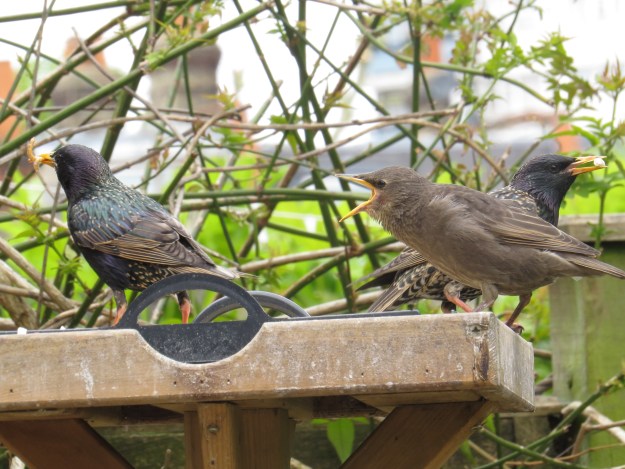
If you are lucky enough to see a baby starling at this time of the year, you might notice that it has some juvenile, dull-brown plumage, and some of the darker, more iridescent adult plumage.

Starling with full adult plumage

One type of bird that has a particularly tough time of it during the moult is the duck. Ducks, geese and swans lose all their feathers at the same time, which means that they can’t fly but have to stick to the safety of the water. To reduce the vulnerability of the more brightly-coloured drakes, they lose their brightest feathers first, which can lead to a variation on our main question: where have all the male ducks gone? The rather dowdier- looking drakes are said to be in their ‘eclipse plumage’ and this, my friends, is why identifying duck species at a wildfowl reserve is something of a challenge in the summer months. Female ducks, who may still have ducklings to care for, often lose their feathers later. One species, the shelduck, actually makes a ‘moult migration’, leaving their breeding grounds all over Europe to descend in vast numbers on the German Waddensea coast. Hundreds of thousands of shelduck arrive in July, and will leave to migrate to their wintering grounds once the process is complete. Although most European shelducks head to Germany, some spend the moulting period much closer to home, in Bridgewater Bay, Somerset.

Shelduck in January looking very pristine!

And so, although our gardens might be empty of birds, it’s a relief to know that they haven’t deserted us because they’re fed up with the quality of the food that we provide, or the way that we always seem to be at home these days. They are going through a perfectly natural process and, believe me, when the weather takes a turn for the worse they’ll be back, en masse, looking for mealworms. We just need to turn our attention to the other, smaller, less obvious critters in our gardens: keep an eye open now for queen bumblebees of many species, fattening themselves up prior to hibernation. And of course, the slow reddening of the berries, and the ripening of the blackberries. It looks as if it might be a bumper year!

Two siskins and a chaffinch in the garden in December 2017


Scene in May