Monthly Archives: January 2021

Birthday in Lockdown

Dear Readers, last year on my birthday I had a pizza lunch in a real restaurant with my work colleagues, dinner in our local French restaurant in the evening with my husband and a birthday trip to the cinema. I also had my 60th birthday very-special-holiday to Borneo, in the teeth of the pandemic.

This year, by contrast, I am very excited by my vegetable box delivery. I have treated myself to the ‘cooks special’ box, which includes weird and wonderful things that you wouldn’t normally see, such as these strange roots in the picture above. Does anybody know what they are?

Well, maybe this will be a clue….

Yep, it’s salsify. Beneath that uninspiring grubby interior lies the queen of root vegetables (apparently). Let me know if you’ve ever cooked it, I am on the hunt for recipes! Also in the box was this…

And here we have some chervil, which I shall need to use up at great speed because it looks very fragile. Maybe in an omelette? Again, all suggestions welcome.

And finally, these little chaps. Kumquats are tiny members of the citrus family, apparently favoured in the colder areas of East Asia because the trees are frost-hardy. Who knew? I have a Gary Rhodes recipe for chocolate pudding with kumquats which I shall find hard to resist.

Anyhoo, in case you thought all I got for my birthday was a bunch of fruit and veg (though that would have been very fine), it will be no surprise to regular readers that I also got some books.

My reading pile is getting higher and higher – I no sooner  read one than I add another two to the pile it seems. I am still struggling with ‘Wilding’ by Isabella Tree – it’s inspirational for sure, with lots of really valuable information, but maybe it’s not ideally suited for night time after a hard day sorting out management overheads and trying to nail currency conversions. Let’s see how I get on. I have certainly learned a lot from ‘Wilding’ but to me it reads more like a text book.

And my lovely husband got me a few more books in the British Wildlife series. How I love them! And how I’d like to head off to a salt marsh or a rocky shore. One day soon, I hope.

And finally, a lovely friend bought me the tea towel below. The giraffe is my totemic animal ( I was a tall skinny child and I identified with these lanky beasts from a very young age) so this is perfect. Much too nice to dry up with though I think.

And so, on a rainy day in North London in the middle of a pandemic, I feel extremely lucky. I have made my own birthday cake (oats, pecan nuts, chocolate, bananas) which is baking as I write this. And to top it all, I have new slippers. After ten years in the house in which I swear I didn’t end a single winter’s day without frozen appendages, here, I hope, is the answer.  There’s nothing like toasty toes to celebrate being another year older. Onwards!


Wednesday Weed – Snowdrop Revisited

Dear Readers, I hope you will forgive this cheekiness, but as I have been toiling away over a hot spreadsheet all day I figured that I could do with some snowdrops, and you probably could as well. I have a tiny clump emerging under the whitebeam tree in the garden, but it’s too dark and rainy to take a photo of the blooming (literally!) things so that will need to wait until the weather is a bit more clement.

I also wanted to alert you to the fact that the Devon Snowdrop festival, which usually attracts thousands of visitors, is now online due to the lockdown. I have been thoroughly enjoying it on Facebook and rumour has it that it’s also on the new-fangled Instagram.I often think that I should post there, but keeping up with the blog generally plus Facebook plus (very occasionally) Twitter is quite enough social-media-ing for one person, although there are some wonderful things to see. 

And finally, tomorrow is my birthday, and I plan to make myself a cake, though I shall hold fire on the 61 candles that it would require. I am thinking orange and almond, but chocolate is also calling. Maybe I could combine the two :-). What do you think, Readers? Let me know your favourite cake so that I can be inspired. Snowdrops in St Pancras and Islington Cemetery (Galanthus nivalis)

Snowdrops in St Pancras and Islington Cemetery (Galanthus nivalis)For me, the sight of the first snowdrops of spring is like a long drink of cold water after a hot, dusty walk. The dazzling white flowers and the fresh green-grey foliage seem fresh and toothsome, as delicious as the first asparagus.

IMG_1353This is especially true in a woodland setting, and in St Pancras and Islington Cemetery there are a number of unkempt, wild areas, where the graves have become overgrown with moss and lichen. Here, the Snowdrops have naturalised, creating a wash of white that glows in the dim spaces.

IMG_1359Some vernacular names for the Snowdrop include February Fairmaids, Candlemas Bells and, my own particular favourite, Snow Piercer. This last has a fine Saxon edge to it, as if the plant were a well-loved sword. And yet, there is much debate over whether it is a native plant or naturalised. The answer is probably that it is both. As Richard Mabey points out in Flora Britannica, it is native to Continental Europe, and grows wild in northern Brittany, so it may be that the colonies in the south-west of England are native, arriving while the UK was still part of the European mainland, while those elsewhere are the result of garden escapes, albeit from hundreds of years ago. The Snowdrop has long been associated with purity, and may have been deliberately planted in monastery gardens and churchyards.

St George's Churchyard, Near Damerham, Hampshire, UK ( © Copyright Miss Steel and licensed for reuse under this Creative Commons Licence.)

St George’s Churchyard, Near Damerham, Hampshire, UK ( © Copyright Miss Steel and licensed for reuse under this Creative Commons Licence.)

IMG_1354I have found Snowdrops extremely difficult to grow in my garden, and I have the feeling that they are not a hundred percent at home in our climate. They emerge too early for most pollinating insects, which makes sense if you consider that they probably come from an area with warmer winters and earlier springs. Because of this, they spread by division of the bulbs, rather than by seed. Many cultivated varieties are also sterile. Chelsea Physic Garden runs Snowdrop Days during February, to show off the sheer variety of cultivars: to read the Gentle Author’s account of a visit, and to see photos of some of them, have a look here.

IMG_1363The Latin name for the Snowdrop genus, Galanthus, means ‘milk-flower’, and the nivalis species name means ‘of the snow’. So, even if you had never seen a snowdrop you would have the definite impression that it was white. And such a white! But each flower also has exquisite green markings on the petals, and also inside the flower itself.

IMG_1355In Homer’s ‘The Odyssey’, a priestess, Circe, turns Odysseus’s crew into pigs. To protect against her enchantments, Odysseus is given the plant Moly by Hermes, and there is some agreement that Moly was, in fact, the Snowdrop. One theory is that the transformation of the crew was a metaphor for the euphoria and hallucinations induced by plants such as Deadly Nightshade and Datura. It just so happens that the Snowdrop contains a chemical called Galantamine, which can counteract the effects of these plants. I love the way that story and science mix here, as they so often do. In the painting below, Circe is offering Odysseus a nice refreshing drink, though the pig on her left-hand side is something of a warning. Just as well Odysseus has his Snowdrop to protect him.

Circe Offering the Cup to Odysseus, by John William Waterhouse. Note the tell-tale pig on the right hand side. Just as well Odysseus has his Snowdrops!

Circe Offering the Cup to Odysseus, by John William Waterhouse.

Snowdrops at Welford Park, Berkshire ("Welford Park Snowdrops 1" by Chris Wood (User:chris_j_wood). - Photograph by myself with original filename DCP_3674.JPG. Unmodified.. Licensed under CC BY-SA 3.0 via Wikimedia Commons - http://commons.wikimedia.org/wiki/File:Welford_Park_Snowdrops_1.jpg#mediaviewer/File:Welford_Park_Snowdrops_1.jpg)

Snowdrops at Welford Park, Berkshire (“Welford Park Snowdrops 1” by Chris Wood (User:chris_j_wood). – Photograph by myself with original filename DCP_3674.JPG. Unmodified.. Licensed under CC BY-SA 3.0 via Wikimedia Commons )

Because of their association with purity, the flowers were sometimes used in Victorian times to warn off over-passionate lovers – a few Snowdrops in an envelope might be enough to dampen a young man’s ardour. But Snowdrops have also been considered unlucky, and in some parts of the UK a single flower is still seen as a death-token, perhaps because, as Mabey explains, Victorians felt that the flower looks ‘for all the world like a corpse in its shroud’. But to me, the bloom looks more like a beautiful white and green moth, and, coming from Bugwoman, there is no higher praise.

"Snowdrop 'Viridi-Apice'" by Schnobby - Own work. Licensed under CC BY-SA 3.0 via Wikimedia Commons - http://commons.wikimedia.org/wiki/File:Snowdrop_%27Viridi-Apice%27.jpg#mediaviewer/File:Snowdrop_%27Viridi-Apice%27.jpg

“Snowdrop ‘Viridi-Apice'” by Schnobby – Own work. Licensed under CC BY-SA 3.0 via Wikimedia Commons – http://commons.wikimedia.org/wiki/File:Snowdrop_%27Viridi-Apice%27.jpg#mediaviewer/File:Snowdrop_%27Viridi-Apice%27.jpg


New Scientist – Domesticated Dogs, A New Giant Dinosaur and Guess What the Oldest Image of an Animal Ever Found Shows?

Photo One By Gunner Ries Amphibol - Self-photographed, CC BY-SA 3.0, https://commons.wikimedia.org/w/index.php?curid=5996125

Wolf on the look out (Photo One)

Original article by Michael Marshall here.

Dear Readers, domesticated dogs split genetically from wolves at some point between 27,000 and 40,000 years ago, but we don’t know where it happened, or why. Some scientists believe that the wolves helped humans to hunt, and the relationship developed from there. Others think that wolves scavenged around waste dumps, and so became used to humans.

However, Maria Lahtinen of the Finnish Food Authority has another explanation. She and her colleagues estimated how much food was available during the Arctic winters, and has calculated that humans probably ended up with more meat than they could eat – humans have a limited capacity to process protein, which would have led to food being available to feed to orphaned wolf cubs. To my mind, this is part of an explanation rather than the whole thing: after all, lots of animals eat meat, but only wolves ended up becoming domesticated. Maybe the cubs were recognised as being useful in the hunt, and so were treated as working animals rather than pets? It’s an interesting theory, however, and helps to fill in the mosaic of reasons for why dogs rather than wolverines or badgers or otters ended up becoming ‘man’s best friend’.

Photo Two by Dinosaur Zoo, CC BY-SA 3.0 <https://creativecommons.org/licenses/by-sa/3.0>, via Wikimedia Commons

Argentinosaurus with human for size comparison (Photo Two)

Stop press! Scientists in Argentina are excavating a fossil that they *think* might belong to the largest land animal that ever lived. Known as Argentinosaurs or titanosaurs, these huge animals lived about 98 million years ago. They are sauropods, more familiar to old ‘uns like me via animals like the brontasaurus and brachiosaurus – all of them have small heads, a long, long neck and tail, and four pillar-like legs. When I was growing up, it was assumed that they had to be at least semi-aquatic to bear the weight of their bodies, but these days scientists think that, while they probably lived in wet and coastal areas, they had plenty of physical adaptations to ensure that they could wander across the landscape like so many gigantic reptilian giraffes.

So, how big were they? The scientists, led by researchers from Argentina’s National Scientific and Technical Research Council, are saying that, from the remains that they’ve discovered, they think that their sauropod is ‘bigger than Patagotitan’, a creature that measured 37 metres (121 feet) long, and weighed 85 tonnes. However, everyone is a little nervous about definitively stating that this is ‘the big one’, as researchers have been found to have overestimated the size of ‘their’ critter before.

One very interesting thing is that there were sauropods of various sizes walking around 98 million years ago – some were a mere 6 metres long (which is still bigger than a car of course). It’s likely that each species had a particular ecological niche, preferring specific plants or types of habitat. Oh for a time machine, to go back and see these amazing creatures in action! Though I’ve watched enough science fiction films to know what happens if I accidentally drop a hair pin or a pair of nail scissors, so it’s probably not a great idea.

The original article by Joshua Rapp Learn is here

Cave paintings showing three pigs (one complete, two vestigial) plus two handprints (Photos by A. A. Octaviana)

And finally, cave paintings found in Indonesia show the oldest known image of an animal in the world – they are at least 45,000 years old, and could be older. The paintings, in Sulawesi, show a complete life size Sulawesi warty pig (Sus celebensis), an animal that was extremely important to the early hunter-gatherers of the region. The painting has been partly covered by a mineral deposit, and it’s this that gives the approximate date although, as the deposit overlaps the image of the pigs, the image itself could be much older.

The hand prints in the top left-hand corner are usually made by someone taking a mouthful of paint and blowing it over the hand, so the researchers hope that they can extract some residual saliva for DNA analysis.

The date of the paintings, which makes them as old as those found in Europe, raises interesting questions about the routes taken by humans when they left Africa – it used to be thought that eastern Asia was inhabited rather later. There is a scarcity of human remains in the area, so there are some thoughts that the paintings could actually have been made by Neanderthals, rather than humans. It will be very interesting to see how this story develops, but what it does point up, to me, is the extremely close observation of animals by early societies, and the significance that such creatures had in the lives of humans.

You can read the original story, by Ibrahim Sawal, here, and there is also a short film which gives an idea of the scale of the painting

Photo Credits

Photo One By Gunner Ries Amphibol – Self-photographed, CC BY-SA 3.0, https://commons.wikimedia.org/w/index.php?curid=5996125

Photo Two by Dinosaur Zoo, CC BY-SA 3.0 <https://creativecommons.org/licenses/by-sa/3.0>, via Wikimedia Commons

A Sunny Walk in St Pancras and Islington Cemetery

New growth on the weeping willow

Dear Readers, there was a definite touch of spring in the air this morning, so off we went for our usual trot around the cemetery. I always love the entrance with its cedars of Lebanon and stately weeping willow. Apparently the cemetery used to have a lovely lodge which was demolished in 1850 and replaced by a very functional brick building. The quest for modernity in the 1960s and 1970s seems to have involved many acts of vandalism, but at least the trees are still here. They make me feel more peaceful as soon as I see them.

One of the gravestones along the first path that we walk has fallen over, and turned into an impromptu birdbath. I often see crows taking advantage of the shallow water.

The spring weather seems to have kicked off a whole lot of corvid activity. There was a family of magpies in the ash trees, calling to one another and cheerfully picking through the twigs. I imagine there are lots of little insects who are having their hibernation brought to an abrupt end.

And then further on, I see a pair of crows, one of whom has what looks like a chocolate brownie in his beak. At least I hope that’s what it is. I suppose it could be something more unpleasant, but I don’t know of any animal that produces rectangular droppings, so I’m going with the brownie theory.

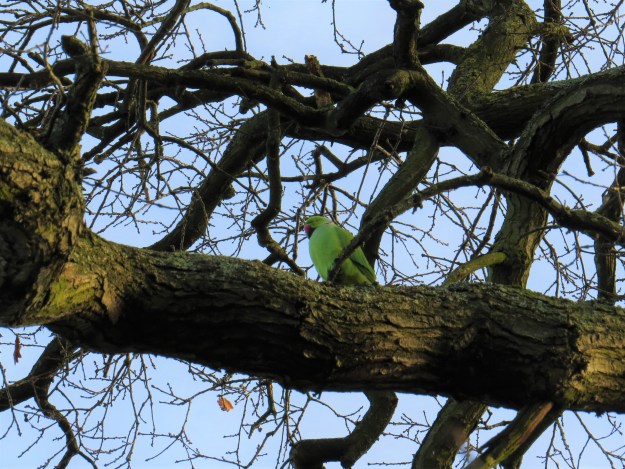
Down by the eastern entrance I notice a parakeet, perched up in a high branch. There seemed to be a lot of these birds around today, enjoying the sunshine.

Walking along Withington Road within the cemetery, I was struck by how the sun illuminated some of the angels.

And suddenly I had a sense of being watched.

And yes, it’s the statue of the Scotsman that I’ve mentioned before. He must only be visible from this point at the very turning point of the year, when all the leaves have fallen but the new growth hasn’t got going yet. There’s always something new to see here. And how splendid the rosehips are looking! There are still so many redwings here that I’m surprised there are any left at all.

Earlier, I’d seen two or three crows chasing the poor old kestrel. But as we were leaving there was a right old ruckus, with crows flying in from all points of the compass. Nowadays I always look up and try to get my camera ready.

And there, right in the middle of the whirl of wings was the buzzard. Poor thing, I am beginning to feel almost sorry for it. It’s the bird in the lower centre with the paler mottled underwings. The angle is deceptive, but it’s at least half as large again as the crows. I still haven’t worked out where it roosts, but I can’t imagine it’s popular in the cemetery.

The crows, on the other hand, seemed to be having the time of their lives. They’ll fly at anything – kestrel, sparrowhawk, buzzard or their particular favourite, the heron (which of course looks like a gigantic bird of prey in flight. As far as I know, none of these birds will take crow eggs or nestlings, so it seems almost visceral. Plus, crows generally hang out in family groups or pairs and aren’t supposed to be particularly social: however they’ll happily join in when a mob starts forming. I wonder what studies there have been? Let me know what you’ve noticed, readers: I’m intrigued.

A Bit of a Bubble

Dear Readers, I’m still trying to get out for a walk every day, although with the dark mornings, the Year End (which I fear will be a theme for the next few weeks) and the habit some companies have of scheduling meetings for the Crack of Doom, it’s been a bit trickier than it was in spring. Plus, hauling oneself out of bed on a freezing cold morning takes more willpower than being woken by the sound of the dawn chorus. Nonetheless, I found myself in Coldfall Wood on Friday, and I was very pleased that I did. Although it is still muddy, it is now alive with the sound of Great Spotted Woodpeckers drumming on the trees. I listened to one as it drummed, flew to another tree, drummed on a thinner branch which resulted in a higher pitched sound, and then whizzed back to its original tree. A few weeks ago I reported on a study in San Francisco that found out that white-crowned sparrow females  preferred a deeper- pitched call so maybe female woodpeckers feel the same? At any rate, it’s a joyful sound and, along with the yaffle of green woodpeckers and the male song thrushes testing out their spring songs it gives me some hope that the world is still turning. Plus, the rose-ringed parakeets are getting very over-excited, as well they might – they start selecting nesting sites long before anyone else gets round to it, and some of them are now actively courting.

If you haven’t heard any of these sounds before, here they are. Firstly, a great spotted woodpecker drumming in the Highlands of Scotland.

Secondly, a green woodpecker ‘yaffle-ing’

And here’s a song thrush.

And finally, the sound of rose-ringed parakeets in flight. It’s becoming as much a sound of English woodland as any of the three above, although the sight of those elegant bright-green birds munching on horse chestnuts is still strangely exotic.

Anyway, on we go. You might remember that last year the seasonal pond in the woods overtopped all of the bridges and boardwalks. This year, there has been some work done on the drainage, and the water is flowing freely. Hopefully we’ve found a happy medium, so that there is water enough for the plants and animals that rely on the dampness, while also not turning the whole site into a lake. Let’s see how we get on.

But what is this?

There is foam on some of the rivulets and streams. It doesn’t have the tell-tale soapy odour of pollution, but I’m intrigued nevertheless. So I have a look at the Environmental Agency website, which tells me that the foam (which is made up of millions of tiny bubbles) occurs when molecules such as fatty acids (known as surfactants) interact with the surface tension of the water, and allow air and water to mix more easily. Sometimes these surfactants are natural – they can occur when there is a high volume of organic material, such as dead leaves, in the water. Fatty acids are also released in small amounts by living organisms. When these organic compounds are dissolved in water, they’re known as Dissolved Organic Carbon (DOC). The majority of foam in rivers and streams is natural, and has the following characteristics:

  • It might start off white but quickly becomes cream-coloured or brown as it picks up matter and sediment
  • It has a natural, earthy, fishy or grassy smell
  • It occurs in many locations and accumulates in eddies and sheltered areas

  • The foam can persist for some time, but will gradually diminish in size
  • It’s often found where the water is turbulent or agitated (the majority of the foam in Coldfall was along the streams running into the main pond)
  • It’s often seen on windy days or following heavy rain that washes down leaves etc.

So, this seems very like natural foam to me, though I will keep an eye on it – the streams are often contaminated with run-off from the roads round about, and many of the nearby houses have been wrongly connected to the water system.

Just so that we know the difference, man-made foam

  • Appears white in colour, but often has a perfumed or soapy odour
  • Usually appears over a small area, near the site of discharge
  • Doesn’t usually occur over long distances
  • Foam disappears quickly, as modern detergents are biodegradable and will dissipate once the source of the surfactant is removed
  • Generally not related to natural events.

However, when foam-pollution events do occur they can be devastating – the River Ouse was contaminated by a soapy substance that killed thousands of fish in 2018. In 2019 a long stretch of the river Irwell in Salford turned into a ‘bubble-bath’ after someone disposed of something down a surface drain. Rivers have long been thought of as being a way to get rid of something liquid that we don’t want, with little thought for the other creatures and people who rely on it. And I haven’t forgotten the day back in 2011 when the stream in Coldfall turned bright green following someone deciding to get rid of something noxious. Some recent water testing in the Wood showed that the quality was actually surprisingly good, so let’s hope that we can keep it that way.

Sound Credits

Great Spotted Woodpecker by Simon Elliott from XC593993 Great Spotted Woodpecker (Dendrocopos major) :: xeno-canto (xeno-canto.org)

Green Woodpecker by Ramya from XC610865 European Green Woodpecker (Picus viridis) :: xeno-canto (xeno-canto.org)

Song Thrush by Rombout de Wijs from XC611036 Song Thrush (Turdus philomelos) :: xeno-canto (xeno-canto.org)

Rose-ringed Parakeet by Stanislas Wroza from XC606442 Rose-ringed Parakeet (Psittacula krameri) :: xeno-canto (xeno-canto.org)

Saturday Quiz – Musical Plants

Dear Readers, after the high culture of last week here’s something a bit more tuneful. All you need to do is match the plant to the lyrics from the (hopefully) popular song below. Normally I would knock up some photos, but as it’s year end at work (and some of you will know what that means!) I am just going to give you 10 plants and 10 lyrics, and all you have to do is match one to t’other. An extra mark for the full name of the song (or thereabouts)  and a discretionary mark if you can name the singer/band (though some of these are ancient, rather like me, and will therefore have been knocked up by multiple folk).

So, if you think that lyric 1 is about blackberry, your answer is 1/A

Now, if I spot that you have answered in the comments (and some of you are very very quick) I will send you a quick message and then unapprove your answer so that it doesn’t influence anyone else. However, if you think you might be influenced I would be inclined to write them down on a piece of paper first.

Answers on Friday next week, so get your ideas in by 5 p.m. UK time on Thursday 21st January if you want to be marked.

Lyrics

  1. ‘And you’ll look sweet, upon the seat, of a bicycle made for two’

2. ‘I beg your pardon…’

3.  ‘And then worst of all (worst of all)

You never call baby when you say you will (say you will)

   4. ‘Small and white, clean and bright,

You look happy to greet me’

   5. ‘Tiptoe, through the window,

By the window, that’s where I’ll be’

   6.  I lost myself on a cool damp night
I gave myself in that misty light
Was hypnotized by a strange delight.

7.You gonna need an ocean of calamine lotion
You’ll be scratchin’ like a hound
The minute you start to mess around

8. Ooh, I bet you’re wonderin’ how I knew
‘Bout your plans to make me blue

9. Absolutely going down the drain
It’s a terrible day
Up with a knock
Silly girl I don’t know what to say
She was running away

10. I was working part time in a five-and-dime
My boss was Mr. McGee
He told me several times that he didn’t like my kind
‘Cause I was a bit too leisurely

Seems that I was busy doing something close to nothing
But different than the day before
That’s when I saw her, ooh, I saw her
She walked in through the out door, out door

Plants

A. Blackberry

B. Lilac

C. Grape

D. Tulip

E. Poison Ivy

F. Daisy

G. Raspberry

H. Rose

I. Buttercup

J. Edelweiss

Onwards! Make me proud!


Saturday Quiz – The Poetry of Plants – The Answers

Some frosty fennel

Dear Readers, you really know your poems! On the basic quiz, Mike at Alittlebitoutoffocus got 7 out of 10, while FEARN, Anne and Fran and Bobby Freelove all got 10 out of 10 on matching the plants to the poems. Fran and Bobby then went the extra mile by also getting some of the poets, giving them a total of 16 out of 20. But runaway winner this week, with an amazing 20 out of 20 was Anne. Well done Anne! A fantastic result, but you should all be very proud of yourselves, and thank you for playing. Now, I wonder what will happen tomorrow?

1.C) Daffodils – ‘I Wandered Lonely As A Cloud’ by William Wordsworth. My Mum used to know this by heart, as she did many poems.

2. E) Cuckoo-pint/Lords and Ladies – ‘Cuckoo-pint’ by Blake Morrison. I love some of the imagery in this – the brown matchstick, the half-unrolled umbrella. Blake Morrison is better known as a writer of prose, but I think this is a most creditable work.

3. H) Ivy – ‘ To the Ivy’ by John Clare. I doubt there was ever a better poet of our  ‘weeds’, and I make no apology for including Clare twice.

4. J) Himalayan Balsam – ‘HImalayan Balsam’ by Anne Stevenson. What a great description this is! The whole poem is a feast.

5.D) Saguaro (Giant) Cactus – ‘To the Saguaro Cactus Tree in the Desert Rain’ by James Wright. Wright is a new poet to me, but I love that opening image of the owl peering from a hole in the tree.

6.A) Autumn Crocus – ‘Autumn Crocus’ by Ruth Fainlight. Such lovely close observation, and I love the way that the religious and natural imagery seem to infuse one another.

7. G) Yarrow – ‘The Yarrow’ by John Clare. Look how he notices the leaves of the yarrow, and the way that the colour of the flowers varies! The man was a genius.

8. B) Daisy – ‘To a Mountain Daisy – On Turning One Down With the Plough, in April 1786’ by Robert Burns. I love how Burns can move from the tiniest daisy to the existential fate of all human beings in a few verses. You might not want to read all of this if you’re already feeling glum.

9.I) Thistle – ‘Thistles’ by Ted Hughes. What a ‘male’ poem this is! I love Ted Hughes’s imagery in this, though, what with all those Vikings.

10.F) Gorse/Whin – ‘Whinlands’ by Seamus Heaney. Oh Seamus. What a poet. His poems always seem to involve an opening-out to me. At the end of them I just want to stare into space for a bit.

What Works – A Personal View

Dear Readers,  I’m finding the present UK lockdown much more difficult than the first two, and I’m sure I’m not alone. In the Northern Hemisphere it’s winter, and so the days are shorter, and the possibilities for going for a local walk are squeezed into a few hours. Plus I find myself ‘doomscrolling’ on the phone, going from news of the frightening events in the US to the seemingly unstoppable march of the virus, to tales of climate change, extinction and disaster. Some days I am so anxious that my skin crawls. Other days, I feel close to despair.  If I am feeling like this when I am in such a privileged position – no real money worries, no children or family to worry about, a job, a roof over my head and a garden – I can only imagine what it’s like if you have terrible neighbours, children to home school, a job that forces you to go out and expose yourself, no outside space where you can decompress. And those of us who have lost some one dear to them during the course of this pandemic, whether directly through Covid-19 or indirectly, I can only bow my head in sympathetic sorrow – as regular readers will know, I lost my poor old Dad in March last year. He didn’t die from Covid, but the circumstances around it caused a chain of events that led to his death.   So I offer this in all humbleness, and I hope that some of it will resonate and help.

  1. Stop, or at least limit, doomscrolling!

Tempting as it can be to just spend your life on the phone, worrying, I’ve learned that setting limits has helped my mental health enormously. I put my phone on to recharge when we have dinner, and don’t look at it again (usually) till the morning. I had to start doing this when Dad’s dementia meant that he could ring at any hour of the day or night – once he was in the Home, and I knew he was being looked after, I knew that I could phone him back in the morning. But these days, it’s because if I read something particularly troubling it spoils my sleep.

The worst thing about having the whole world come at you through your phone is that it can make you feel helpless. Which brings me to the next thing that’s helped.

2. If you can, do something about it!

As I’m lucky enough to still be working, I donate to organisations like my local foodbank. I sign petitions for things that are happening, especially locally where the numbers really count – we recently got a stay of execution on some ancient oaks in Queen’s Wood in Highgate for example. I am on the Whatsapp group for our street, and have been able to help out with people who are unwell or shielding – without the group, I wouldn’t have know what was needed. You can be an activist without even stepping out of  your front door. There’s nothing to stop us from joining a campaign, writing to our MPs or making a donation if we have any spare cash, and the benefits are endless, not least in making us feel useful and engaged.

3. You are not alone

Well, except in an existential sense of course. But this is one way in which the internet has helped – you can make  connections with people that you can’t currently see in real life, but who can share ideas or a joke or news. I think one positive thing that might come out of all this is that people who used to shun the internet have learned to use things like Zoom and Facetime, and although it’s no substitute for getting together for a chat over coffee and cake, it’s so much better than nothing. Also, I have recently rediscovered the joys of talking on the phone.

Do reach out. It’s very easy for the world to contract, and that’s something that should be pushed against at all costs. Phone a friend! It always makes me feel better.

4. Get outside, but choose your time and place carefully

I love going for walks in Coldfall and Cherry Tree Wood, and especially in the Cemetery. But these places can sometimes be extremely busy, and there’s not much fun in dodging people every five seconds. I tend to avoid the woods at weekends, even now, and was also avoiding the times when children were being taken to school and coming home, as those times were busy too.

However, I have become an even bigger fan of walking in cemeteries, as regular readers might have gathered. If you have a cemetery locally and haven’t visited it yet, do give it a go if it’s open – they are full of interest, both in terms of history and of wildlife and plants, and I find them surprisingly uplifting. Many of them have restrictions due to Covid so do check. I also prefer them at the weekend because there aren’t usually funerals going on, and so I don’t feel as if I’m intruding, though our cemeteries are big enough to avoid gatherings.

5. Get creative

I have spent the past months knitting like a maniac. For me, it’s always something that I’m making for someone else, just because otherwise I don’t have the impetus, but I also love it: there’s something about the rhythm of crafts such as knitting or embroidery or crochet that seems very soothing. Also, it adds steps onto my Fitbit so I usually hit my exercise target :-).

A jumper I made for my Boss’s little boy. I wouldn’t mind one meself.

6. Exercise your brain!

There has been a lot of advice around physical exercise, which I largely get from my walks, but how about our brains? I’ve gone the whole hog and embarked on a degree with the Open University (never one to do things by halves) but there are literally thousands of courses online, many of them free. People speak highly of Coursera but the Open University also do a range of free courses. Plus, if you have some money to spare there are courses in everything from embroidery to cookery to languages (this one is free, and I also recommend Rosetta Stone).

Plus, if you don’t want to study intensively, there are a raft of free talks and lectures out there. I have been reporting on the LNHS (London Natural History Society) talks (which are all free and are also recorded so you can catch up with them even if you can’t watch them live).  In fact I hope they carry on with them after the lockdown is over. New Scientist also has talks, so does The Guardian, and practically every cultural institution has been running at least a few, so there should be something for everyone.

The great advantage of a course or a lecture is that it helps me to look outside my very small world and feeds my curiosity.

7. Read, but carefully

I thought that 2020 would be the year when I really got stuck into reading, and so I did, but I soon learned that I had to be particular about what I read. Normally I read the whole Booker Prize shortlist, but I soon found that the mood and atmosphere of a book could colour my whole day. So, at a time of high anxiety, I would put aside writing that made things worse, or which filled me with dread. Unfortunately that was most of the Booker Prize out of the window for a bit, regardless of the excellent writing! I am a bit delicate on this front, and some people don’t seem to be affected in the same way, so go for it if tales of dystopian apocalypse cheer you up.

I thought I might get into comfort reading (which for me means Dickens or Trollope or Jane Austen) but I haven’t so far. I also normally re-read the Gormenghast Trilogy by Mervyn Peake every few years, but that’s also not cropped up. What I’ve really enjoyed are books by Madeleine Miller based on the tales from the Odyssey and the Iliad, Pat Barker’s book ‘The Silence of the Girls’ about Penelope and Briseis, the women in the Odyssey, and also Emily Watson’s translation of The Iliad. There’s something about Homer that resonates, whatever the age.

Mostly, I’ve read non-fiction, which can also contain some horrors, but which somehow seem more manageable. I read the whole of the Wainwright Prize for Nature Writing shortlist, and wrote about most of them on the blog – my personal favourite was Brigit Strawbridge’s ‘Dancing With Bees’ but I enjoyed all of them. I’m currently reading ‘Wilding’ by Isabella Tree, so expect a review soon!

8. Watch TV for comfort and inspiration

I love watching things like The Great British Bake-Off, The Great British Sewing-Bee and, starting this week, The Great British Pottery Throwdown. I love to see ordinary people showing their skills, and while I’m not the slightest bit interested in things like Big Brother or Love Island, I cannot get enough of reality shows where there’s actually a purpose. I love all the varieties of Masterchef except for (usually) the celebrity one – what’s the fun in watching someone who can’t cook make a hash of a shepherd’s pie?

After Mum died in 2018 I spent hours watching all the series of RuPaul’s Drag Race that were on Netflix (yep, all eleven of them). I found myself not only amazed at the extraordinary transformations, but also moved and inspired by the stories of the drag queens themselves. It was a kind of balm to my soul when I couldn’t move off of the sofa. I had no idea how exhausting grief was. This past few years have been an education.

I also love documentaries, particularly the wildlife ones, though they can be a bit too ‘when animals attack’ for if I’m feeling particularly vulnerable. I somehow don’t need David Attenborough, lovely as he is, to tell me how bad things are at the moment. After all, I work for a Climate Change organisation and am studying environmental science, so I think I have enough to contend with :-).

9. Make Unexpected Connections

And finally, dear readers, I can’t overstate how helpful writing the blog has been for me. When I decided, almost instinctively, to blog every day during lockdown, I could never have anticipated what the repercussions would be. Every day I have to get out of my little bubble of doom to think about what has interested or inspired me. Every day I get to interact with people all over the world, to share your thoughts and observations and to get a feeling for how you are doing. I’ve discovered some wonderful blogs, and some wonderful people. I have learned so much, and am constantly learning. Other blogs might have more followers and might make more of a splash, but I feel that we have built a real community here, and it makes me very happy. So thank you for reading, and do let me know what’s worked and hasn’t worked for you – I might create a page with links to resources on it so we can all share websites that could be useful.

Together, we’ll get through this.


Wednesday Weed – Pomegranate

Dear Readers, I never know what’s going to turn up in the organic fruit and vegetable box that I get once a fortnight, so finding a pair of pomegranates this week was a real treat! They are a strange fruit in lots of ways: the only edible bit is around the seeds, so they’re quite a lot of work. I remember my Mum saying that when she was a little girl, a pomegranate was such a treat that she’d sit curled up in the armchair for hours, winkling out the seeds one at a time with a pin. She was born in 1935 so I imagine this would have been just after the war, and surely such a fruit would have been an extraordinary luxury.

I remember Dad saying that he was given a banana by Princess Elizabeth as she was then when she visited the East End. It looks as if she spent a lot of the post-WWII period doling out bananas, and in this story, someone actually gives some back. Dad maintained that they ate them with the skins on because they didn’t know any different, though he was always one for embroidering a story if he thought it would make you laugh. It makes me even more determined to eat the ones that are gradually darkening in my fruit bowl. And, in case you missed it, Nigella Lawson even found a use for the banana skins in her recent TV series, to the bafflement of many. I’m sure my Mum would have thought it was a good idea.

But anyway, back to the pomegranate. To my surprise, it’s a member of the Loosestrife family, Lythraceae, which gave us such stars as purple loosestrife. The name ‘pomegranate’ came from medieval Latin, and means ‘seeded apple’. The Latin species name, Punica granatum, led to the idea that the fruit originally came from the city of Granada in Spain, and also led to the name ‘grenadine’ for the pink syrup that was a trendy mixer back in the days when I was a gal (hence ‘pink gin’).

The shrub can grow up to 33 feet tall, but also can be turned into a Bonsai. I’d never seen pomegranate flowers, so here they are!

Photo One by By Sanu N - Own work, CC BY-SA 4.0, https://commons.wikimedia.org/w/index.php?curid=70975838

Pomegranate flower (Photo One)

Photo Six by By Uwe Barghaan - Own work, CC BY 3.0, https://commons.wikimedia.org/w/index.php?curid=4107571

Even more excitingly, for me anyway, the word ‘grenade’ comes from the appearance of the fruit, and you can see why. Light the bit on the top and you’re away.

Actually, though, pomegranate comes originally from an area from modern-day Iran through to north-western India, though it has been cultivated throughout the Mediterranean region for centuries, and has been farmed in Arizona and California. Thomas Jefferson had a pomegranate tree in his garden at Monticello in 1771, and the earlier settlers in the south managed to get some fruit from the tree. I suspect that it has always been a luxury: the fruit was found in the  Bronze Age Uluburun shipwreck, off the coast of Turkey, alongside perfume, ivory and gold jewellery, and where it is found in tombs these are usually of high-status individuals.

Pomegranates growing on a tree in Casa D’Oro, Venice

Pomegranates are having something of a resurgence at the moment, along with a rise in interest in ‘Middle Eastern’ food. In particular, I find myself falling over recipes that feature pomegranate molasses, and I can see why – it has an interesting sweet/sour taste that is more interesting than a lot of sugary ingredients. I have even had a drizzle over my porridge and yoghurt in the morning, which is the height of decadence! But those jewel-like seeds look so pretty scattered over savoury dishes that I can see why they’re a hit, and they also add an interesting crunch.

In Iran, pomegranates and walnuts are used, along with other ingredients, to make a fesenjãn, a kind of chicken stew flavoured with spices such as turmeric, rose, cinnamon and cardamom. Delicious!

Photo Two by By stringparts - originally posted to Flickr as Fesenjan, CC BY 2.0, https://commons.wikimedia.org/w/index.php?curid=9971172

Chicken and aubergine fesenjan (Photo Two)

The pomegranate has also been embraced by Mexicans, and it features in Chiles en nogada, a dish in which the green of chilli, the white of the cream sauce and the red of the pomegranate seeds represents the Mexican flag. It is often eaten during the Mexican Independence celebrations of August and September. In the photo below it looks as if parsley has been used to provide the green colour, although the dish itself is supposed to feature green stuffed chillis. Go figure.

Photo Three by By Jessica Toledo - Own work, CC BY-SA 4.0, https://commons.wikimedia.org/w/index.php?curid=37857302

Chile en nogada (Photo Three)

As you might expect for a fruit that’s been part of human culture for so long, there is a whole raft of folklore and mythology around the plant. In Greek legend, the pomegranate was thought to have sprung from the blood of Adonis, and Persephone’s consumption of the seeds while she was in Hades dictated how many months she had to spend underground. Even in modern Greece the pomegranate features in folklore: it is good luck to to be given a pomegranate as a gift when you move into a new house, and the dish kollyva which is brought as an offering to the dead contains wheat boiled with sugar and decorated with pomegranate seeds.

In Judaism, the pomegranate is one of the Seven Species, fruits and vegetables mentioned in the Hebrew Bible as part of the special products of the Land of Israel. It’s traditional to consume pomegranates at Rosh Hashanah because they are symbols of fertility, and this seems to be general: in countries from Azerbaijan to Armenia, China to India, the pomegranate means fruitfulness. In Armenia, which has a long association with the fruit, a bride traditionally smashes a pomegranate against the wall, with the scattered seeds ensuring that the marriage will be blessed with children.

Photo Four by By Tatevhovikyan - Own work, CC BY-SA 4.0, https://commons.wikimedia.org/w/index.php?curid=94336234

Pomegranate statue in Yerevan, Armenia (Photo Four)

Many Jewish scholars (and some Christian ones) believe that the fruit in the Garden of Eden was a pomegranate, not an apple. In Christian iconography, the split fruit represents Christ’s suffering and death, and this is prefigured in Botticelli’s ‘Madonna of the Pomegranate (1487).

Photo Five by By Sandro Botticelli - Web Gallery of Art:   Image  Info about artwork, Public Domain, https://commons.wikimedia.org/w/index.php?curid=912727

Detail from Botticelli’s ‘Madonna of the Pomegranate’ (circa 1487) (Photo Five)

And now, a poem.In fact, two poems.  Eavan Boland died in April last year. She is one of Ireland’s most important poets, and yet I hadn’t come across her before. There is so much to learn in our short lives. Below, I’ve included two of her poems. Pomegranate, because of today’s theme – it might help to know that Boland moved with her family to London in 1950, and had her first experience of the anti-Irish sentiment that was rife. The second poem, Quarantine, is one of those poems that makes everything stop for a moment. See what you think.

The Pomegranate
Eavan Boland – 1944-2020

The only legend I have ever loved is
the story of a daughter lost in hell.
And found and rescued there.
Love and blackmail are the gist of it.
Ceres and Persephone the names.
And the best thing about the legend is
I can enter it anywhere. And have.
As a child in exile in
a city of fogs and strange consonants,
I read it first and at first I was
an exiled child in the crackling dusk of
the underworld, the stars blighted. Later
I walked out in a summer twilight
searching for my daughter at bed-time.
When she came running I was ready
to make any bargain to keep her.
I carried her back past whitebeams
and wasps and honey-scented buddleias.
But I was Ceres then and I knew
winter was in store for every leaf
on every tree on that road.
Was inescapable for each one we passed. And for me.
It is winter
and the stars are hidden.
I climb the stairs and stand where I can see
my child asleep beside her teen magazines,
her can of Coke, her plate of uncut fruit.
The pomegranate! How did I forget it?
She could have come home and been safe
and ended the story and all
our heart-broken searching but she reached
out a hand and plucked a pomegranate.
She put out her hand and pulled down
the French sound for apple and
the noise of stone and the proof
that even in the place of death,
at the heart of legend, in the midst
of rocks full of unshed tears
ready to be diamonds by the time
the story was told, a child can be
hungry. I could warn her. There is still a chance.
The rain is cold. The road is flint-coloured.
The suburb has cars and cable television.
The veiled stars are above ground.
It is another world. But what else
can a mother give her daughter but such
beautiful rifts in time?
If I defer the grief I will diminish the gift.
The legend will be hers as well as mine.
She will enter it. As I have.
She will wake up. She will hold
the papery flushed skin in her hand.
And to her lips. I will say nothing.

Quarantine
Eavan Boland – 1944-2020

In the worst hour of the worst season
of the worst year of a whole people
a man set out from the workhouse with his wife.
He was walking—they were both walking—north.

She was sick with famine fever and could not keep up.
He lifted her and put her on his back.
He walked like that west and west and north.
Until at nightfall under freezing stars they arrived.

In the morning they were both found dead.
Of cold. Of hunger. Of the toxins of a whole history.
But her feet were held against his breastbone.
The last heat of his flesh was his last gift to her.

Let no love poem ever come to this threshold.
There is no place here for the inexact
praise of the easy graces and sensuality of the body.
There is only time for this merciless inventory:

Their death together in the winter of 1847.
Also what they suffered. How they lived.
And what there is between a man and woman.
And in which darkness it can best be proved.

Photo Credits

Photo One By Sanu N – Own work, CC BY-SA 4.0, https://commons.wikimedia.org/w/index.php?curid=70975838

Photo Two by By stringparts – originally posted to Flickr as Fesenjan, CC BY 2.0, https://commons.wikimedia.org/w/index.php?curid=9971172

Photo Three  By Jessica Toledo – Own work, CC BY-SA 4.0, https://commons.wikimedia.org/w/index.php?curid=37857302

Photo Four By Tatevhovikyan – Own work, CC BY-SA 4.0, https://commons.wikimedia.org/w/index.php?curid=94336234

Photo Five  By Sandro Botticelli – Web Gallery of Art:   Image  Info about artwork, Public Domain, https://commons.wikimedia.org/w/index.php?curid=912727

Photo Six  By Uwe Barghaan – Own work, CC BY 3.0, https://commons.wikimedia.org/w/index.php?curid=4107571

New Scientist – Harvesting Plants for Rare Metals

Photo One by Anthony van der Ent from https://www.newscientist.com/article/mg24933160-900-plants-that-suck-metals-from-the-soil-can-be-farmed-to-make-our-tech/

Phyllanthus rufuschaneyi oozing nickel-rich sap (Photo One by Anthony van der Ent) 

This post is based on this article from New Scientist by Michael Allen. 

Dear Readers, for many years it’s been known that plants are useful for bioremediation: some species of brassica guzzle up metals such as nickel from the soil, cleaning it in the process, and lichens are also known to help clean up pollutants. It’s thought that plants do this because the metals are toxic, and might therefore help to protect them against insect predators. Such plants are known as hyperaccumulators because they store so much of the element.

However, when Anthony van der Ent, a plant-hunter based at the University of Queensland in Australia, found a shrub called Phyllanthus rufuschaneyi at a park ranger’s station in Malaysian Borneo, he noticed that it oozed a bright blue-green sap. Upon analysis, it turned out that the sap contained 25% nickel by weight.

Nickel is an essential ingredient in products such as computers and smart phones, but will become even more important with the advent of the rechargeable batteries in electric cars. The metal is also needed for wind turbines. It’s estimated that for electric cars alone, the amount of nickel needed will double, to 256,000 tonnes, by 2025. But the normal method of getting the metal is by strip-mining, one of the most environmentally devastating extraction methods: it creates defoliation, soil erosion and pollutant run-off which contaminates sea water and rivers. One of the leading world nickel producers is the tiny island of New Caledonia. 

Photo Two by Gunnar Ries, CC BY-SA 3.0 <http://creativecommons.org/licenses/by-sa/3.0/>, via Wikimedia Commons

Open cast nickel mine in New Caledonia (Photo Two)

So, would it be possible to grow hyperaccumulating plants so that the nickel could be extracted from them, rather than despoiling the environment? One problem is that the plants don’t grow just anywhere: the metals in the soil are found in areas which had a lot of tectonic activity which meant that instead of just sinking, the elements were raised to the surface. Such soil is known as ‘ultramafic’.

Having found his plant, Anthony van der Ent set about creating the world’s ‘first tropical metal farm’ in Sabah in Borneo. He and his colleagues are growing Phyllanthus ruruschaneyi: every year the shrub is coppiced, the stems and leaves are pulped, and the nickel is extracted. In 2019 they reported a yield of 250 kilograms per hectare, currently worth almost $4000.

A long-time collaborator of van der Ent’s, Guillaume Echevarria of the University of Lorraine in France, also wanted to see what was possible, but using a tropical plant didn’t seem the right way to go. Instead, he used a different hyperaccumulator (not specified in the article but probably an Alyssum species). He has chosen some plots on ultramafic soil in Albania, and the plant is sowed and harvested by local farmers. The plant is then transported to France and burned to produce nickel-rich ash, from which the metal is extracted. The energy yielded by the burning is used as a heat source for nearby buildings, so Echevarria considers that the whole project comes in as carbon-neutral.

Although the results are not as promising as in Borneo, the plant still yields about 200 kilograms per hectare which, at around $3000 at today’s prices still makes this a viable business. For comparison, a hectare’s worth of wheat in the UK can be sold for about $2100.

While Van der Ent thinks that the whole project could be scaled up in areas where there are ultramafic soils, such as Indonesia, Echevarria is more cautious, and I have to say that I would be worried about large scale ‘phytomining’ too. Many areas of the world which are otherwise suitable for growing hyperaccumulators are also biodiversity hotspots and protected areas, and having seen the palm oil plantations in Sabah, the last thing the world needs is more hectares of monocultures. However, there are some areas, particularly in Greece, Albania and Bulgaria, where farms are being abandoned because the soil is so poor for other agricultural applications, and at least growing plants could help to stabilise and revegetate such areas, whilst providing the farmers with some extra income. Echevarria thinks that phytomining could provide a few percent of the global nickel requirements, which is not to be sniffed at.

It’s not just nickel either. Plants that hyperaccumulate arsenic, cobalt, manganese, zinc and rare earths have been discovered. Marie-Odile Simonnot, also at the University of Lorraine, has been assessing Dicranopteris dichotoma, a fern that grows naturally on spoil heaps near rare earth mines in China’s Jiangxi province.

Photo Three from https://www.amazon.co.uk/Dicranopteris-dichotoma-Fern-100-Seeds/dp/B07BJ9GPVG

Dicranopteris dichotoma (Photo Three)

It seems to be possible to harvest about 300 kilograms of mixed rare earth metals per hectare, including lanthanum, cerium, prasedoymium and neodymium from this plant, and Simonnot is working with Chinese scientists to run trials at old mining sites. This seems like a win-win to me, as the plant seems to grow in landscapes that are already environmentally devastated, and which could only be improved by a bit of native plant cover.

Nowadays, though, Van der Ent is no longer trudging through the jungles of Borneo. Instead, he is hunting through the herbariums of the world’s museums with a handheld X-Ray flourescence spectroscope. This gives an instant read-out of the elements that a specimen contains, and hundreds of new hyperaccumulators have been found in this way. Who knows what other secrets the plant kingdom contains? Let’s hope that this time we are able to work with nature to make the most of them, rather than against her.

Photo Credits

Photo One by Anthony van der Ent from https://www.newscientist.com/article/mg24933160-900-plants-that-suck-metals-from-the-soil-can-be-farmed-to-make-our-tech/

Photo Two by Gunnar Ries, CC BY-SA 3.0 <http://creativecommons.org/licenses/by-sa/3.0/>, via Wikimedia Commons

Photo Three from https://www.amazon.co.uk/Dicranopteris-dichotoma-Fern-100-Seeds/dp/B07BJ9GPVG