Monthly Archives: January 2021

A Mellow Walk in St Pancras and Islington Cemetery

Dear Readers, for once the elements were with us for this week’s walk in the cemetery. Things are so bad with the pandemic in London now that we wore our facemasks along the High Road until we were actually in and had room to social distance properly. Not all the pavements in East Finchley are wide enough to avoid getting closer than two metres to other people, and with the hospitals fit to busting, and the new variant apparently anything up to 70% more transmissible than previous ones, it seemed sensible to take every precaution we could think of. The last thing we want to do is to catch the virus ourselves or to inadvertently pass it on to anyone else, and I have to say that the vast majority of people are being extremely careful at the moment. I’m sure there are still a few folk who think that they are immortal, or don’t care enough to protect other people, but they really are few and far between around here.

But to get back to the walk – as we approached the entrance, I noticed that there were bits of car all over the place, and as we rounded the corner it became clear that a vehicle had gone bang into the wall of the cemetery. It’s been very icy around here, but this is a straight road so goodness only knows what happened. I just hope that nobody was seriously hurt.

Once we’re into the cemetery, I make a beeline for the chapel. My friend A told me that she’d spotted an interesting fungus growing from one of a group of plane trees, and her directions were excellent – it only took me about two minutes to find it. Having had a conversation with the experts on the British and Irish Fungi Facebook group, we think it might be the Spectacular Rustgill (Gymnophilus junonius),  and what an apt name that is! Apparently it tastes bitter and turns green when you cook it, but I’d have thought that the former fact precluded anyone doing the latter. Anyhoo, this is a very fine fungus, and I’m glad to have made its acquaintance.

Spectaccular Rustgill

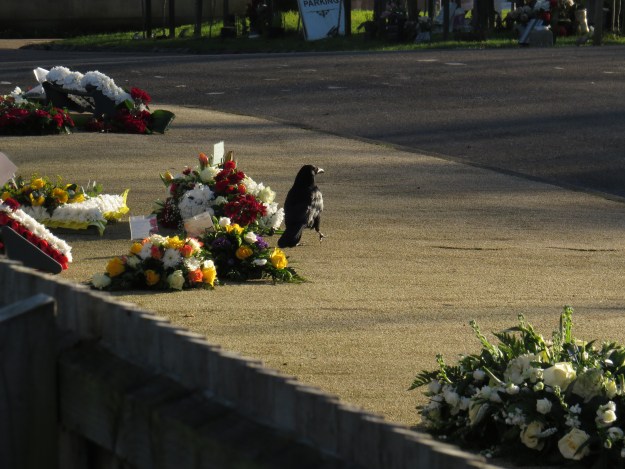
The crows, squirrels, parakeets and jays were all in abundance today, gathering food and chasing one another. The crows in particular were very evident. The chap below seemed to be about to peck over one of the mourner’s wreaths that has been left out after a service. When he saw me, he folded his wings and hustled away as if to indicate that there was nothing to see here.

There are already primroses in flower in the woodland burial site, which always cheers me up.

And how I love the sunbeams coming through the trees.

The sun is so low that there are places in the graveyard that the sun doesn’t touch at all. I loved this icy stone with its hieroglyphics of fern and moss and seed.

And there is another crow, pecking over the leaves of a conifer to see what s/he can find. Maybe there are some tiny insects trying to hibernate amidst the needles.

And I do love a good reflection in a pothole. Isn’t that what they’re there for?

Last week, someone asked me about people in the cemetery who were buried following the 1918 flu epidemic, and it got me to thinking. I feel as if I haven’t noticed many non-military graves from this period: I found the one below today, but my husband assures me that the worst of the flu would have passed through by November 1919, so probably this person died of wounds or from the effects of gassing. It’s a very interesting question though, and one that I shall think on further.

I love the way that the melting frost lights up every blade of grass, as if each one was holding up a candle at a rock concert. Remember them?

And then, on the way home, I notice this wall.

Look at the moss! The cracks and crevices between the bricks are positively furry with the sporangia, the reproductive bodies. The moss must have found this spot to its liking, and multiplied like billy-ho (this is a relatively new wall). I loved the green and red of the moss against the terracotta stonework. It just goes to show how nature will colonise even the most unpromising of habitats.

London Natural History Talks – Trees and Fungi by David Humphries

Dear Readers, this week’s talk was by David Humphries, Tree Management Officer for the City of London. He has been based in Hampstead Heath for 35 years, and recently won a special award for caring for London’s trees. I was really looking forward to this talk, and I wasn’t the only, as for the first time since the LNHS talks started, this one was sold out! Fortunately, you can still watch the whole thing here, and I’d recommend that you do so, as the photos were fantastic, and I can only capture the merest flavour of the range of the talk.

Humphries is something of a fungiphile: he gave us a quick look at his computer, where he has 22,000 photos of fungi, neatly arranged into 584 folders, one for each species. Most of them were taken on Hampstead Heath, which has over 25,000 trees, and where upwards of 600 fungal species have been recorded. Humphries thinks this is probably because, unlike in 1830 when John Constable painted a view of the Heath that shows it completely bereft of trees, there are now a substantial number of habitats and tree species.

First, we had a quick run through the variety of fungi that can be found in association with trees. There are the perennial bracket fungi such as hoof fungus (Fomes fomentarius) which persist for years. They form layers, as you can see from the photo below, but these are not necessarily annual – each layer is created when the fungus produces spores, and in one example that Humphries showed us later in the talk, it’s clear that they can be produced on multiple occasions in a single year if the conditions are right.

Incidentally, Otzi the iceman who was retrieved from a glacier in Austria and turned out to be about 5000 years old had some pieces of hoof fungus in his bag – it is used to produce amadou, which can be used as tinder. But as usual I digress.

Photo One by By George Chernilevsky - Own work, Public Domain, https://commons.wikimedia.org/w/index.php?curid=10577678

Hoof fungus (Fomes fomentarius) (Photo One)

Then there are the annual bracket fungi, such as shaggy bracket (Inonotus hispidus) which produce fruiting bodies and spores and then die every year. They may remain in the same location for many years, and on the photos that Humphries shared you could see the scars of the previous generations on the bark.

Photo Two by Stu's Images, CC BY-SA 3.0 <https://creativecommons.org/licenses/by-sa/3.0>, via Wikimedia Commons

Shaggy bracket (Inonotus hispidus) (Photo Two)

However, with so many types of fungi, many looking superficially the same, how to ID them to species level? For some, you have to use microscopy of the spores, but Humphries had some general tips:

  • Take a slice through the fungus to look at the spore layer and the flesh
  • Have a look at the spore colour – anything from white to saffron to darkest inky black
  • Look in detail at the spore layer to see how the tubes from which the spores are released are coloured and shaped – Humphries recommended two useful resources:
  • If you are looking at a more typical ‘mushroom’, look at the gills and check to see whether they are attached to the stem or not (the word for where gills do form part of the stem is ‘decurrent’, a new word for me!)

Then, we moved on to the three ways in which fungi can be associated with trees.

  • Parasitic – it was Humphries view that parasitic fungi start to become problematic when a tree is weakened, either. A typical example would be honey fungus (Armillaria mellea)
Photo Three by Stu's Images, CC BY-SA 3.0 <https://creativecommons.org/licenses/by-sa/3.0>, via Wikimedia Commons

Honey Fungus (Armillaria mellea) (Photo Three)

  • Saprophytic – fungi that feed on fallen leaves, dead branches etc. They recycle nutrients that would otherwise not be released back into the soil. The earthstar that I found in St Pancras and Islington Cemetery would be an example.

  • And finally, there are the Mycorrhizal fungi. It’s only recently that we’ve learned what a vital part these fungi play in the health of plants – they form a mutualistic relationship with the roots of trees in this case, vastly extending the range of the roots in return for some of the benefits of photosynthesis. Some very familiar fungi, such as the edible boletus mushrooms and the traditional ‘toadstool’, Amanita muscari, are examples of mycorrhizal fungi. The fruiting bodies can often be seen exactly following the lines of the roots of the trees that are hosting them.
Photo Four by Amanita_muscaria_3_vliegenzwammen_op_rij.jpg: Onderwijsgekderivative work: Ak ccm, CC BY-SA 3.0 NL <https://creativecommons.org/licenses/by-sa/3.0/nl/deed.en>, via Wikimedia Commons

Amanita muscaria (Photo Four)

Humphries has, as you might expect, found some very interesting fungi in Hampstead, and one of the most attractive is the Many-Zoned Rosette (Podoscypha multizonata), of which the UK has about 80% of the European population. This is a rare species, which is being assessed by the IUCN for the Global Fungal Red List, and one reason for its rarity is that it is normally found on veteran oaks in oak pasture, a vanishingly rare habitat in the UK (though as I’m currently reading in Isabella Tree’s ‘Wilding’, it was probably once much more common. However, Humphries has noticed that the fungus has increased its range of hosts to include beech, hornbeam, lime, red and turkey oak and even horse chestnut, so maybe this bodes well for its future.

Photo Five by Lukas from London, England, CC BY-SA 2.0 <https://creativecommons.org/licenses/by-sa/2.0>, via Wikimedia Commons

Many-zoned Rosette (Podoscypha multizonata) (Photo Five)

As you might expect from someone who is involved in maintaining the health of trees, Humphries has a lot of interesting things to say about the different ways that fungi can infiltrate a tree. There are broadly three colonisation strategies.

The first is fungal-induced dysfunction, as favoured by our old friend honey fungus. Basically, rhizomorphs, which are a ‘rope’ of hyphae (the filaments of the fungi) travel through the soil and colonize a tree which already weakened. Once they’ve found such a tree, they fan out under the bark and infiltrate the vascular system, preventing the tree from transporting water and nutrients. In honey fungus the rhizomorphs are often called ‘bootlaces’ and you can see why.

Photo Six by Ericsteinert, CC BY-SA 3.0 <http://creativecommons.org/licenses/by-sa/3.0/>, via Wikimedia Commons

Honey fungus rhizomorphs (Photo Six)

Secondly, some fungi infiltrate the sapwood when it’s suddenly exposed, whether by storm damage, lightning, injudicious pruning, or, in the case of the poor tree on my road, sudden collision with a skip. Examples include the beefsteak fungus, which at least has the benefit of being edible.

Photo Seven by Dan Molter, CC BY-SA 3.0 <https://creativecommons.org/licenses/by-sa/3.0>, via Wikimedia Commons

Beefsteak fungus (Fistulina hepatica) (Photo Seven)

And finally, there are the fungi that are living in the tree already, but which can only proliferate when the tree is weakened (endophytic fungi). These remind me a bit of the bacteria that live happily on our skin for ages, until our immune systems take a knock and then they lurch into action (Staphylococcus springs to mind). An insect attack, storm damage, root rock in high winds can all be starting points for such fungi (one example would be the birch polyphore (Fomitopsis betulinus). Humphries noted how, when a tree is cut down, these fungi can appear remarkably quickly once the sapwood is exposed to the air.

Photo Eight by Bernie Paquette, CC BY 4.0 <https://creativecommons.org/licenses/by/4.0>, via Wikimedia Commons

Birch polyphore (Fomitopsis betulina) (Photo Eight)

Trees can live quite happily with fungal infestations, sometimes for decades. However, many fungi will eventually cause problems. Some cause white rot, which is where the wood turns white and spongy because the fungus has ‘eaten’ the lignin which provides stability – this is what honey fungus does. Some cause brown rot, which is where the cellulose is ‘eaten’ instead, and the tree becomes brittle – an example of this would be chicken of the woods (Laetiporus sulphureus). Some trees will eventually be hosts to both. And it isn’t just trees in forests, either.

Photo Nine by Gargoyle888., CC BY 3.0 <https://creativecommons.org/licenses/by/3.0>, via Wikimedia Commons

Chicken of the woods (Laetiporus sulphureus) (Photo Nine)

Humphries mentioned two fungal diseases that are affecting that icon of the capital, the London Plane (Platanus x hispanica). One is Massaria Disease, caused by the fungus Splanchnonema platani. Humphries is of the opinion that this used to largely appear during droughts, but as most street trees have roots that are compacted, and as climate change affects rainfall in unpredictable ways, it has been seen in the UK. It normally causes branch fall in trees over 40 years old.

The second is elbowpatch crust (Fomitiporia punctata). According to the Forest Research UK site, this seems to affect a particular clone of the London Plane which has a propensity to develop weak forks. When infected by the fungus, it can drop whole branches, which is something of a health hazard considering how many there are.

Humphries spent some time explaining how part of his work is assessing trees, and deciding whether or not to save them, and how. There are various techniques that can be used to assess the amount of damage – a microdrill can be used to take a core through the tree without harming it, to see how far any rot has progressed. The whole tree can also be fitted with what sonic tomography receivers, which used sound waves to detect the integrity of the trunk – the photo of the tree in Humphries’s photo makes it look rather as if it’s getting an ECG. And there is much that often can be done, in terms of reducing the wind load that the plant has to bear in storms to prevent it being knocked over, and to support the tree. However, when the worst comes to the worst, the standing wood is endlessly useful for everything from beetles to woodpeckers, and fungi themselves are food for many invertebrates and other creatures (I’ve even watched a fox take a speculative bite out of a puffball.

However, the lockdowns and the increased footfall in Hampstead have caused additional challenges for fungi, and for the people who care about them. The big enemy seems to be compaction of the soil – no one seems to know how much this will damage the underground hyphae of the mycorrhizal fungi, without which many of the trees on the Heath will no longer thrive. Soil health is an issue for all of us, wherever we are, and it’s something to which we pay far too little attention in my view. I worry about the trampling in my local wood, but am also uncertain what we can do about it.

I really recommend this talk. It was stuffed full of information, and some of the photos that Humphries presented were wonderful. I learned so much, and I think I’ll probably watch it again to pick up some of the things that I missed or didn’t understand the first time round. So if you have an hour to spare and are wondering what to do during lockdown, here’s something to keep you entertained (along with all the other LNHS talks). The amazing world of fungi awaits!

Photo Credits

Photo One By George Chernilevsky – Own work, Public Domain, https://commons.wikimedia.org/w/index.php?curid=10577678

Photo Two by Stu’s Images, CC BY-SA 3.0 <https://creativecommons.org/licenses/by-sa/3.0>, via Wikimedia Commons

Photo Three by Stu’s Images, CC BY-SA 3.0 <https://creativecommons.org/licenses/by-sa/3.0>, via Wikimedia Commons

Photo Four by Amanita_muscaria_3_vliegenzwammen_op_rij.jpg: Onderwijsgekderivative work: Ak ccm, CC BY-SA 3.0 NL <https://creativecommons.org/licenses/by-sa/3.0/nl/deed.en>, via Wikimedia Commons

Photo Five by Lukas from London, England, CC BY-SA 2.0 <https://creativecommons.org/licenses/by-sa/2.0>, via Wikimedia Commons

Photo Six by Ericsteinert, CC BY-SA 3.0 <http://creativecommons.org/licenses/by-sa/3.0/>, via Wikimedia Commons

Photo Seven by Dan Molter, CC BY-SA 3.0 <https://creativecommons.org/licenses/by-sa/3.0>, via Wikimedia Commons

Photo Eight by Bernie Paquette, CC BY 4.0 <https://creativecommons.org/licenses/by/4.0>, via Wikimedia Commons

Photo Nine by Gargoyle888., CC BY 3.0 <https://creativecommons.org/licenses/by/3.0>, via Wikimedia Commons


Saturday Quiz – The Poetry of Plants

Some frosty fennel

Special thanks to my friend A this week for the loan of her book ‘Flora Poetica’, edited by Sarah Maguire. Let me know when you want it back 🙂

Dear Readers, I feel that we are lacking poetry in our lives, so now is the moment to see if you can identify what plant each of these poems is going on about. Bonus points for the author! And if you have a favourite plant poem, let me know. No extra points, but it’s nice to share….

As usual, answers in the comments by 5 p.m. UK time on Thursday 14th January please if you want to be marked. The answers will appear on Friday 15th.

Match the plants to the poems: so, if you think poem 1 is about autumn crocuses, your answer is 1) A). As usual, I will hide the answers that appear in the comments when I see them, but if you don’t want to be influenced by speedy people, write your answers down first.

Onwards!

The plants are:

A) Autumn crocus

B) Daisy

C) Daffodil

D) Saguaro (Gian) Cactus

E) Cuckoo-pint/Lords and Ladies

F) Gorse/Whin

G) Yarrow

H) Ivy

I) Thistle

J) Himalayan Balsam

  1. Continuous as the stars that shine
    And twinkle on the milky way,
    They stretched in never ending line
    Along the margin of the bay:
    Ten thousand saw I at a glance,
    Tossing their heads in sprightly dance‘.

2. A brown matchstick held up in the wind, 
The bract-leaf cupped around it like a palm

March had not extinguished it: there it lurked,
sly as something done behind the sheds,

slithering from its half-unrolled umbrella
as we snipped pussy-willow in the lanes. 

3.But bloom of ruins, thou art dear to me,
When, far from danger’s way, thy gloomy pride
Wreathes picturesque around some ancient tree
That bows his branches by some fountain-side:
Then sweet it is from summer suns to be,
With thy green darkness overshadowing me. 

4. Orchid-lipped, loose-jointed, purplish, indolent flowers
with a ripe smell of peaches, like a girl’s breath through lipstick, 
delicate and coarse in the weedlap of late summer rivers,
dishevelled, weak-stemmed, common as brambles…. 

5. I had no idea the elf owl
Crept into you in the secret
Of night.

I have torn myself out of many bitter places
In America that seemed 
Tall and green-rooted in mid-noon.
I wish I were the spare shadow of the roadrunner, I wish I were
The honest lover of the diamondback 
And the tear the tarantula weeps.

I had no idea you were so tall 
And blond in moonlight. 

6. Anomalous bright blossom 
in late afternoon shadow

Mercury-pale stems 
surging out of the dark
earth: Halloween candles.

Mauve flowers with amber
yellow pollen-swollen anthers.

Each clump is bordered 
by a halo of rotting 
petals like votive objects
around a damaged Ikon 
or a martyr’s statue.

7. Dweller in pastoral spots, life gladly learns
That nature never mars her aim to please;
Thy dark leaves, like to clumps of little ferns,
Imbue my walk with feelings such as these;
O’ertopt with swarms of flowers that charms the sight,
Some blushing into pink and others white,
On meadow banks, roadsides, and on the leas
Of rough, neglected pastures, I delight
More even than in gardens thus to stray
Amid such scenes and mark thy hardy blooms
Peering into autumn’s mellowing day;
The mower’s scythe swept summer blooms away
Where thou, defying dreariness, wilt come
Bidding the loneliest russet paths be gay.

8. Wee, modest, crimson-tipped flow’r
Thou’s met me in an evil hour;
For I maun crush amang the stoure
They slender stem:
To spare thee now is past my pow’r
Thou bonie gem. 

9. Against the rubber tongues of cows and the hoeing hands of men
xxxxxxx spike the summer air
Or crackle open under a blue-black pressure.

Each one a revengeful burst 
Of resurrection, a grasped fistful 
Of splintered weapons and Icelandic frost thrust up

From the underground stain of a decayed Viking.
They are like pale hair and the gutturals of dialects. 
Every one manages a plume of blood.

Then they grow grey, like men.
Mown down, it is a feud. Their sons appear,
Stiff with weapons, fighting back over the same ground. 

10. All year round the xxxxx
Can show a blossom or two
But it’s in full bloom now.
As if the small yolk stain

From all the birds’ eggs in
All the nests of the spring
Were spiked and hung
Everywhere on bushes to ripen.

Hills oxidise gold.
Above the smoulder of green shoot
And dross of dead thorns underfoot
The blossoms scald.

Put a match under 
xxxxx, they go up of a sudden.
They make no flame in the sun 
But a fierce heat tremor

Yet incineration like that 
Only takes the thorn. 
The tough sticks don’t burn,
Remain like bone, charred horn.

Gilt, jaggy, springy, frilled
This stunted, dry richness
Persists on hills, near stone ditches,
Over flintbed and battlefield. 

Saturday Quiz – 2020 Vision – The Answers

Cycrolamen missing from last week’s post!

Dear Readers, an excellent turn out as usual, with some new folk having a go, welcome! Our winner this week was Sylvie with 12 out of 12, with Fran and Bobby Freelove getting 10 out of 12 and Claire getting 8 out of 12 – very creditable all round, so thank you for taking part. 

January

  1. Japanese Cedar (Cryptomeria japonica var Elegans)

February

2. Alder (Alnus glutinosa)

March

3. Heavenly Bamboo (Nandina)

April

4. Alexanders (Smyrnium olusatrum)

May

5. Hoary Cress (Lepidium draba)

June

6. Black Horehound (Ballota nigra)

July

7. Mugwort (Artemisia vulgaris)

August

8. Horseradish (Armoracia rusticana)

September

9. Smoke Bush (Cotinus coggygria)

10. Rowan/Mountain Ash (Sorbus aucuparia)

November

11. Carrot (Daucus carota)

December

12. Lychee (Litchi chinensis)


Natural Navigation – How Do We Find Our Way Around?

The Mistletoe Tree in East Finchley Cemetery

Dear Readers, this week I have been wondering about navigation. Why is it that some of us seem to be naturally good at finding our way around, even in unfamiliar territory, while others seem capable of getting lost in within a hundred metres of their house? I was prompted to think about this last week when we went for a walk in East Finchley Cemetery. We found an area that we hadn’t explored before, because it had been fenced off for maintenance, and very interesting it was too – look at the vistas through that Italianate Crematorium that had previously been inaccessible unless you were actually there for a service.

Anyhoo, on coming outside I somehow got turned around, and we wandered around vaguely (in the sleet I might add) until I spotted a tree with mistletoe growing in it. As far as I know this is the only mistletoe tree in the cemetery, and in fact the only one I’ve spotted in my ‘territory’. Once I saw it, everything fell into place, and I knew the way home.

It’s been shown that, in Western cultures at least, there are two methods of wayfinding: one that relies on landmarks, which is why you’ll get instructions such as ‘turn right at the supermarket, and then left at the flower shop’. The other relies on a ‘mental map’, which I think of as more of a top-down view, as if one were an eagle soaring above the land and noticing where to turn left and right. For a long time, it was thought that women naturally used the former, and men the latter, but more recent studies have shown that  most people use both methods to find their way around, though they often have a strong preference for one or the other. I am strongly biased towards the landmark method, probably because I often notice natural signs, such as the mistletoe tree, or particular things that strike me as unusual or interesting. A typical route around St Pancras and Islington Cemetery would sound something like ‘walk past the cedars of lebanon, go along the grassy path past the little pond where the crows bathe, left of the chapel, down the road past the dog roses, turn right at the pet cemetery and walk through the woodland graveyard, don’t miss the swamp cypress’.

Of course, if you don’t know what a cedar of lebanon looks like, you’d be better off with the kind of instructions that my husband might give, which would be much more of the ‘go straight ahead, turn left, turn right’ variety. He might also throw in something about walking north or south but then he is Canadian.

Which brings me to another thing. In a recent study, people from the Nordic countries were in the top ten in the world when playing a navigation game. There was a theory that this could because of Viking seafaring ancestry, when presumably people who could actually find their way to land would have been positively selected for, but a more likely explanation to my mind is that, from a very early age, Scandinavian children are out and about, cross-country skiing and orienteering and walking. I suspect that this might develop that ability to notice where you are in relation to where you started that is so important in a landscape that might, in winter at least, be almost devoid of landmarks. I am reminded, also, of the way that the Inuit question their children constantly to make sure that they are paying attention to their location.

But to return to this question of men and women navigating in different ways. Is this just a Western thing? And what is going on?

Anthropologist Elizabeth Cashdan, from the University of Utah, is working with her colleagues and other scientists to look at societies in other parts of the world, and to determine whether there are sex differences regarding the ability to navigate. In two tribes, the Tsimane of Bolivia and the Twe of Namibia, there were no differences in the ability of boys and girls to point accurately to distant locations, and imagining being in one location and pointing at another. However, at puberty, girls in both tribes become much more anxious about physical dangers, and about getting lost.

This is borne out in the research of Sarah Creem-Regehr at the University of Utah. She found that Western women in an unfamiliar environment tended to roam less, to take less shortcuts and to return more often to familiar places than men. It seems that, almost universally, women are more cautious than men, and for good reason. I would love to see studies done on the navigational abilities and tendency to risk-taking of older women, however – I suspect that it would show that, post-menopause, women can be much more inclined to be bold and to take considered risks, at least while they have the health and the opportunity to explore.

To return to the Twe and the Tsimane, though, there is a twist – Cashdan found that although girls became more afraid of exploring their environment in both groups, it was only in the Twe that this led to a marked difference in navigational ability between the groups. The Twe in Bolivia live in dense jungle, and don’t tend to roam far anyway – the jungle is a dangerous place, and both sexes hunt, forage and fish in a relatively small area. The Tsimane in Namibia live on grassland, and the men travel long distances to visit family, while the women stay at home. The men therefore have greater navigational challenges, and continue to develop and hone their skills throughout their lives. The women are stuck at home waiting for some chap to turn up.

Interestingly, other markers for being good at navigation include having a good sense of smell – the olfactory part of the brain seems to vary in size with the hippocampus, which is where our locational sense ‘lives’. This is probably evolutionary – think of the salmon ‘smelling’ their way home, or the way that wolves home in on their prey.

So, it seems that navigational ability is something that is dependent not just on culture or sex, but on the opportunities that we have to test ourselves and to experience the world around us. I suspect that we all develop our own styles according to the things that we notice, be it plants and gravestones or houses or shops. One thing that does seem clear though is that we have to get out and notice things. Some scientists suggest that this is key to improving our navigational ability. Another technique is to look behind us often – for one thing you might spot a fox sitting on the path watching us depart, but it also helps our brain start to visualise our route for the way back.

One thing we definitely shouldn’t be doing is relying on our phones. One scientist, Dan Montello of UCSB,  who has been studying navigational ability has this to say:

‘“I’m fairly confident that regular use of map software impairs a person’s ability to wayfind on their own,” says Montello. “It certainly impairs cognitive map formation.” He believes that satnav and phone map apps are undermining our natural navigation abilities, going as far as to describe this as “technological infantilism”.

Plus there’s always the danger of walking under a car, or into a lamp post.

So, what do you think, readers? I know a lot of you do a lot of walking. How do you navigate, and has it changed? What advice do you have for the navigationally-deprived? What do you do when you get lost? Do you view GPS as handy, or the work of the devil (or somewhere inbetween, like most things?)

Read more: https://www.newscientist.com/article/mg24032082-900-the-disorientated-ape-why-clever-people-can-be-terrible-navigators/#ixzz6ilFv5vke


Wednesday Weed – Mango

Dear Readers, my Mum often used to get ‘stuck’ on a particular foodstuff, which she would eat daily for weeks. One year it was an apple with a packet of cheese and onion crisps. Another year it was those ‘fruit corner’ yoghurts. Then there was the time of the Solero ice lollies (tropical fruit flavour only if you please). But at some point she was introduced to the delights of a ripe mango, and that was it. She bought them by the boxful, and the sound of slurping and licking of fingers was often a bit much for the more delicate among us. How she loved them!

And then one day the inevitable happened (just after I’d sourced a box of Alphonso mangos, naturally). As usual, Mum cut one as close as she could to the skin on either side of the stone, cut the flesh into cubes, and after the first nibble she looked up, astonished.

‘You know,’ she said, ‘I think I’ve gone off of these’.

And that was that. Never a mango crossed her lips again.

So when I was presented with a red mango in my fruit and veg box today, it brought back so many memories. But sad to say, I have never had a really good ripe mango in the UK since the days of getting them for Mum. Are they storing them differently, I wonder? They seem stringier and more insipid than I remember them, and like so many other things they go from as hard as a shot putt to rotten without any intervening period. When I’ve been travelling, though (remember those days?) I have been party to some exquisite mangoes, ripened gently on the tree in someone’s garden and picked at the perfect moment.

Mango is an Asian fruit, and is the National Fruit of India, and National Tree of Bangladesh.  There are 27 edible species. The most familiar to us, and the most commonly cultivated, is Mango indica. All mangoes are in the cashew family (Anacardiaceae).

Photo One By Ram Kulkarni - Photograph taken by a digital camera, CC BY-SA 4.0, https://commons.wikimedia.org/w/index.php?curid=14897964

Fruits and flowers of Alphonso mango (Photo One)

Tropical mangoes (such as those from the Philippines) are typically yellow, while sub-tropical mangoes, from the cooler parts of India, are usually red and green, like my fruit. The world’s highest selling cultivar, Tommy Atkins, is liked because of (guess what) its transportability, long shelf life and ease of handling. Personally I much prefer Alphonsos, but there have been problems with importation, due to fear of bringing in, among other things, ‘non-European fruit flies’. The EU ban was lifted in 2015, but I well remember the 2014 ‘year without Alphonsos’. The season is short, but the fruit is remarkably lacking in the stringy fibres of other cultivars. India has a large number of different varieties, but exports very little – the Indian people very sensibly eat their mangoes themselves. The goddess Ambika is traditionally shown sitting under a mango tree, after all.

Photo Two By G patkar at English Wikipedia - Transferred from en.wikipedia to Commons., Public Domain, https://commons.wikimedia.org/w/index.php?curid=10899806

Alphonso mangos (Photo Two)

Photo Three By Y.Shishido - http://pipimaru.dyndns.org/india_2004/index.html, CC BY-SA 3.0, https://commons.wikimedia.org/w/index.php?curid=365739

The goddess Ambika sitting under a mango tree in the Ellora Caves, Maharashtra, India (Photo Three)

I love mangoes in desserts, and one of my favourites is mango shrikhand, a thick, creamy south Indian delicacy made with thickened yoghurt, cardamom, saffron, pistachios and mango. Oh my goodness! I used to go to a restaurant called Diwana on Drummond Street in Euston for their vegetarian food but in particular for the shrikhand. There’s a recipe here How could you resist?

Photo Four from https://www.manjulaskitchen.com/mango-shrikhand/

Photo Four

Incidentally, when mangoes were first discovered by the West, they were largely eaten as pickles, because they would rot before they could get there. So, the first taste of a mango was likely to have been a sour, pungent, hot affair, rather than the sweetness that we associate with them – there’s what looks like a great recipe here. Amchoor, or mango powder, is another popular ingredient in South Asian food, and adds a similar sourness.

Now, as you might expect, mangoes are not only eaten by humans, and lots of animals are involved in the dispersal of those giant seeds. In Florida (where the Tommy Atkins comes from) deer, squirrels and raccoons all eat the fruit. In tropical zones parrots, hornbills and lorikeets enjoy them, and monkeys and apes will eat them by the bucketload. Fruit bats also have a particular liking for a ripe mango. As the seed can happily survive a trip through an animal’s alimentary tract (if the seed is small enough and the animal is large), the seedlings often pop up a long distance from the ‘mother plant’, which is presumably why the fruit is so tasty. Elephants also eat mangoes, and in this they probably take on the role of the extinct gomphothere, which was also involved in the distribution of avocado seeds.

Photo Five By Unic - Own work, CC BY-SA 3.0, https://commons.wikimedia.org/w/index.php?curid=24434273

Gomphothere statues in Osorno, Chile (Photo Five)

What pollinates a mango, though? The flowers are plentiful but very simple in design, so it might come as no surprise that the main pollinators appear to be flies, along with solitary bees, some beetles and even ants. In fact, in India a method of attracting flies that was trialled involved hanging bags full of rotten fish or mutton from the tree branches. Although mango flowers are actually hermaphroditic, fruit production was much higher when the plant was cross-pollinated by insects.

Photo Six from http://blogs.ifas.ufl.edu/trec/2018/06/21/378/

Different mango pollinator species (Photo Six)

As you might expect from a plant that has grown in the company of humans for such a long time, mango has been used for an extraordinary range of medical purposes. Here is an excerpt from a paper on the National Library of Medicine website.

Studies indicate mango possesses antidiabetic, anti-oxidant, anti-viral, cardiotonic, hypotensive, anti-inflammatory properties. Various effects like antibacterial, anti fungal, anthelmintic, anti parasitic, anti tumor, anti HIV, antibone resorption, antispasmodic, antipyretic, antidiarrhoeal, antiallergic, immunomodulation, hypolipidemic, anti microbial, hepatoprotective, gastroprotective have also been studied. These studies are very encouraging and indicate this herb should be studied more extensively to confirm these results and reveal other potential therapeutic effects. Clinical trials using mango for a variety of conditions should also be conducted.

And here’s me thinking that mangoes are just tasty! The texture of the fruit of a good mango always screams ‘moisturising’ to me, and if only I could stop myself from eating them I might try plastering them all over my face to see if they help with my dry skin. This is probably not a good idea – some people have a very bad allergic reaction to mango flesh so maybe best to stick to the Oil of Ulay (though my Mum had a reaction to that too!)

And here, finally, a poem, by the inimitable Mary Oliver, who is up there with my top five favourite poets. I love the way that she shifts from the experience of eating the fruit to something else entirely.

The Mango by Mary Oliver

One evening
I met the mango.
At first there were four or five of them
in a bowl.
They looked like stones you find
in the rivers of Pennsylvania
when the waters are low.
That size, and almost round.
Mossy green.
But this was a rich house, and clever too.
After salmon and salads,
mangoes for everyone appeared on blue plates,
each one cut in half and scored
and shoved forward from its rind, like an orange flower,
cubist and juicy.
When I began to eat
things happened.
All through the sweetness I heard voices,
men and women talking about something—
another country, and trouble.
It wasn’t my language, but I understood enough.
Jungles, and death. The ships
leaving the harbors, their holds
filled with mangoes.
Children, brushing the flies away
from their hot faces
as they worked in the fields.
Men, and guns.
The voices all ran together
so that I tasted them in the taste of the mango,
a sharp gravel in the flesh.
Later, in the kitchen, I saw the stones
like torn-out tongues
embedded in the honeyed centers.
They were talking among themselves—
family news,
a few lines of a song.

Photo Credits

Photo One By Ram Kulkarni – Photograph taken by a digital camera, CC BY-SA 4.0, https://commons.wikimedia.org/w/index.php?curid=14897964

Photo Two By G patkar at English Wikipedia – Transferred from en.wikipedia to Commons., Public Domain, https://commons.wikimedia.org/w/index.php?curid=10899806

Photo Three By Y.Shishido – http://pipimaru.dyndns.org/india_2004/index.html, CC BY-SA 3.0, https://commons.wikimedia.org/w/index.php?curid=365739

Photo Four from https://www.manjulaskitchen.com/mango-shrikhand/

Photo Five By Unic – Own work, CC BY-SA 3.0, https://commons.wikimedia.org/w/index.php?curid=24434273

Photo Six from http://blogs.ifas.ufl.edu/trec/2018/06/21/378/

January in the Garden

Dear Readers, the first day back to work after a fortnight off is always a little bit anxiety-provoking, at least for me. What will have turned up in my Inbox while I’ve been off, eating rose and violet creams and watching episodes of 1970s favourite ‘Lord Peter Wimsey’ (don’t ask). But my Inbox turns out to blissfully free of crises (at least so far), and so I spend a few minutes actually in the garden. Not many though, as it’s starting to sleet, the wind is enough to blow your wig off and I don’t want to deter the poor hungry birds. Have a look at the bittersweet berries though! So glad I didn’t cut them back.

And at least now I know where the squirrels are hanging out. I interrupted one eating my grape hyacinth bulbs yesterday and s/he wasn’t the slightest bit perturbed when I banged on the window. They have that ‘who, me?’ look down to a T.

Next door’s shrubs are in full flower – the hebe has been going since May. Just look how windy it is! Very alarming. No wonder all the bees are staying tucked up in bed.

Not so the starlings though. They practically live in my garden these days, as my budget for suet pellets is blown every month. I have two whole sacks on order, but of course they’re delayed what with Covid, and the poor old Royal Mail struggling to keep up. However, I do have a final tub of live mealworms. This starling almost seems to know it.

And while I’m on the subject, spring isn’t really that far away – look at the buds bursting out everywhere! These are on my lilac, but nearly all the shrubs are starting to stir.

So, out I go into the cold and wet to pop out some mealworms onto the bird table. The scene is like something from Alfred Hitchcock.

But once I’ve put the food out, and they’ve got their courage up, it’s chaos for about three minutes.

And then it’s all gone. I just hope the suet turns up soon. Those starlings will be outside with placards if I don’t find something to feed them.

New Scientist Highlights of 2020 – Part Two

Photo by Gerry Matthews (Alamy) from https://www.newscientist.com/article/2255352-coronavirus-lockdown-changed-how-birds-sing-in-san-francisco/

White-crowned sparrow (Zonotrichia leucophrys) (Photo One)

Dear Readers, before we finally say goodbye to 2020, here are a few final stories from New Scientist that caught my eye.

The first is pandemic-related, as nearly everything seems to be at the moment. White-crowned sparrows (Zonotrichia leucphrys) were found to be singing differently during the Covid lockdown in San Francisco, and scientist Elizabeth Derryberry, from the University of Tennessee, wondered how, and why.

The birds were found to be singing more quietly and at a deeper pitch – it’s known that birds react to the low-frequency background drone of traffic and air conditioners by singing not only louder, but at a higher frequency so that they can be heard over the racket. The noise level in San Francisco had dropped by a full 7 decibels, and so the birds seem to have reverted to their older, sexier songs – birds actually seem to prefer deeper sounds (think Barry White as opposed to Tiny Tim). If you go to the full article here, you can hear both birdsongs. The scientist says that ‘they sing like they used to thirty years ago’. I suppose this is both sad, but also hopeful – birds and other urban animals seem to be so much more adaptable than we thought.

Photo Two by By Ra'ike (see also: de:Benutzer:Ra'ike) - Own work, CC BY-SA 3.0, https://commons.wikimedia.org/w/index.php?curid=4540111

Skeleton of cave bear showing enormous sinuses! (Photo Two)

But not all animals are able to adapt. The prehistoric cave bears (Ursus spelaeus) that used to weigh over 1000 kilograms, and existed alongside our present-day brown bears (Ursus arctos), probably became extinct because they had over-large sinuses. Who knew? These huge animals, who disappeared about 24,000 years ago, lived on a largely plant-based diet. When the ice-ages made vegetation difficult to come by, the cave bears couldn’t switch to a meat-based diet, because their sinuses meant that they could only chew food with their back teeth, while carnivores typically cut up their food with their incisors and canines at the front. The brown bears had smaller sinuses, and hence could switch from a herbivorous to a carnivorous diet.

But why have such big sinuses in the first place? They are thought to play an important role in gas-exchange during hibernation, allowing the bears to hibernate for longer. However, as the poor cave bears wouldn’t have been able to fatten up due to the lack of plant food, they probably starved while they were sleeping. It was one of those evolutionary trade-offs that failed.

You can read the whole article here.

Photo Three from https://www.newscientist.com/article/2229070-hagfish-tie-their-bodies-into-complicated-knots-to-escape-tight-spots/

Pacific hagfish (Photo Three)

Hagfish are extraordinary animals. Early ancestors of the eel, they have four times as much blood compared to their volume as any other fish, four hearts and only half a jaw. When trapped by a predator or accidentally stuck in a tight spot, they throw complex knots and shapes in an attempt to escape. Because this is a very slippery fast-moving process, it’s taken modern technology and a slow-motion camera to decipher what’s going on. Now, scientist Theodore Uyeno has discovered that the animals prefer more complex knots – the hypothesis is that the simpler ones may be more uncomfortable because the loops are so tight.

So, 45 percent of the time the hagfish do a trefoil knot:

Photo Four from By Jim.belkAnimation: MichaelFrey (talk) - Own work, Public Domain, https://commons.wikimedia.org/w/index.php?curid=75360346

Trefoil knot (Photo Four)

33% of the time they do a figure-of-eight knot…

Photo Five by By Lucasbosch - Own work, CC BY-SA 3.0, https://commons.wikimedia.org/w/index.php?curid=17249329

Figure-of-eight knot (Photo Five)

and 4% of the time they manage a three-twist knot, the only animal able to do so (Moray eels can knock up a knot, but nothing this complicated). Kompologists rejoice!

Photo Six by Original: Jim.belk Animation: MichaelFrey, CC0, via Wikimedia Commons

Three-twist knot (Photo Six)

And finally, how about this little creature with its ‘hats’?

Photo Seven by Alan Henderson at Cover Images. Photo from https://www.newscientist.com/article/mg24632881-200-weird-caterpillar-uses-its-old-heads-to-make-an-elaborate-hat/

Uraba lugens caterpillar – the moth is also known as the ‘gumleaf skeletoniser’ (Photo Seven)

Each ‘hat’ is the moulted skin of the caterpillar’s head – they moult up to thirteen times before they metamorphose into moths, and from the fourth moult on, each ‘hat’ stays stuck. You can see how the size of the head gets bigger from the top down, as the larva munches on eucalyptus leaves: an alternative name is the ‘gumleaf skeletoniser’ because the foliage is eaten right back to the veins.

The ‘hats’ seem to fulfil a useful purpose: biologists have watched the caterpillar using them to swat away predators, and they may also serve to distract a curious bird who will hopefully peck at the wrong ‘head’. You can read the whole article here.

And so, dear readers, onwards and into 2021. Who knows what those scientists will discover next?

Photo Credits

Photo One by Gerry Matthews (Alamy) from https://www.newscientist.com/article/2255352-coronavirus-lockdown-changed-how-birds-sing-in-san-francisco/

Photo Two By Ra’ike (see also: de:Benutzer:Ra’ike) – Own work, CC BY-SA 3.0, https://commons.wikimedia.org/w/index.php?curid=4540111

Photo Three from https://www.newscientist.com/article/2229070-hagfish-tie-their-bodies-into-complicated-knots-to-escape-tight-spots/

Photo Four By Jim.belkAnimation: MichaelFrey (talk) – Own work, Public Domain, https://commons.wikimedia.org/w/index.php?curid=75360346

Photo Five  By Lucasbosch – Own work, CC BY-SA 3.0, https://commons.wikimedia.org/w/index.php?curid=17249329

Photo Six by Original: Jim.belk Animation: MichaelFrey, CC0, via Wikimedia Commons

Photo Seven by Alan Henderson at Cover Images. Photo from https://www.newscientist.com/article/mg24632881-200-weird-caterpillar-uses-its-old-heads-to-make-an-elaborate-hat/

The First Cemetery Walk of 2021

Dear Readers, our first walk in St Pancras and Islington Cemetery this year saw us getting some glorious weather for a change – this week it has felt as if the sun hasn’t really risen above the horizon, so some brightness was most welcome. The birds seemed to feel it too – this ring-necked parakeet was uncharacteristically obliging as s/he posed in this horse chestnut tree and munched the buds. I see that Defra are talking about culling parakeets, but only in areas where they are new. They are well-established around here, so hopefully they’ll be safe. Personally, I think that with everything else that’s going on, shooting a few parakeets should be low down on the agenda but there’s  no stopping some folk.

Elsewhere, the ash trees were a-twitter with goldfinches, who kept up a constant babble of contact calls that could be heard even over the traffic noise.

There were redwings everywhere, and they were being shy, as usual.

I must have counted twenty blackbirds, probably newly arrived from cooler parts of the continent – although it was long thought that blackbirds didn’t migrate, it’s now known that they often rear their young in one place, and over-winter somewhere else, with one bird spending every summer in a Devon garden and every winter in the south of France. In the winter the birds are much less aggressive and territorial, especially where there’s plenty of food, but they also seem shyer. Not one stood around long enough for a photo.

Fortunately, the moss is a lot more obliging, and on some of the older graves there is a whole miniature ecosystem.

I can just imagine all the tiny creatures slithering and creeping through the ‘jungle’ in search of safety, or prey. And look how the sun catches the moss sporophytes (the ‘flowers’ of the moss).

We have been walking different paths over the last few weeks, and every trip I find another new interesting grave. How about this one, for example?

Gillian Elinor was a bit of a late starter, having given up education to look after her children. However, she was nothing if not determined – she did her A-levels part time, followed by a degree in English and Art History at Birkbeck, followed by a Masters in the USA. Her first teaching job was at the Polytechnic of North East London (now UEL) where she started, at the age of 40, with a one day a week appointment. She stayed for 20 years, for the last 5 of them holding the post of Head of the Arts Department at the University of East London, and devoted many years of her life to the subject of women in the arts. She brought the African and Asian visual arts archive to the university, and was a founder member of Feminist Arts News and was heavily involved in the  Women Artists Slide Library. In 1987 she was joint editor of Women and Craft, published by Virago. She was also involved in the Women’s Art Group in Education, which sought to disclose how few women there were in academic posts.

In her later years, Elinor moved away from the visual arts and became more interested in poetry. Her headstone is an elegant and rather beautiful tribute to her dedication to the recognition of the talents of women, so many of whom are still unsung.

My husband is particularly interested in the war graves in the cemetery: there is a ‘proper’ war graves area, but many are scattered about, often hidden amongst the trees, although all of them have bright, well-scrubbed new headstones, dating from the hundredth anniversary of WW1. This week we found this one; the graves of those who were in the Navy when they died often have more details than those from other services, as in the one below.

A little bit of research shows that Able Seamen Dennis Watts died of ‘illness’ after the war, on 9th March 1946. H.M.S Orlando appears to have been a shore-based HQ on the Clyde in Greenock, sometimes also known as a ‘secret facility’. The trail goes cold at this point however (unless I want to shell out another £180 a year for Ancestry.com). What a sad loss of a human being, though, at only 22 years old.

And this one actually brought me to tears.

George W. Dell was killed at the land-based centre H.M.S Christopher, which was again in Scotland, and was a base for training personnel to use the anti-submarine and patrol boats which were on constant watch around the coast. There are no details, but the lad was only 19. We can only imagine the sorrow with which his parents, back in Barnsbury, Islington, received the news.

That heartfelt message ‘Just one of many – but he was ours’ echoes down the years. I’m sure that the people who are losing their loved ones in the pandemic are just as intent that those that they’ve lost shouldn’t just become another statistic, but should be remembered as the unique individuals that they were. When I read that Joe Biden is planning a remembrance event for 19th January in the US, the day before his inauguration, it makes me think how much we will need something similar when this is finally under control.

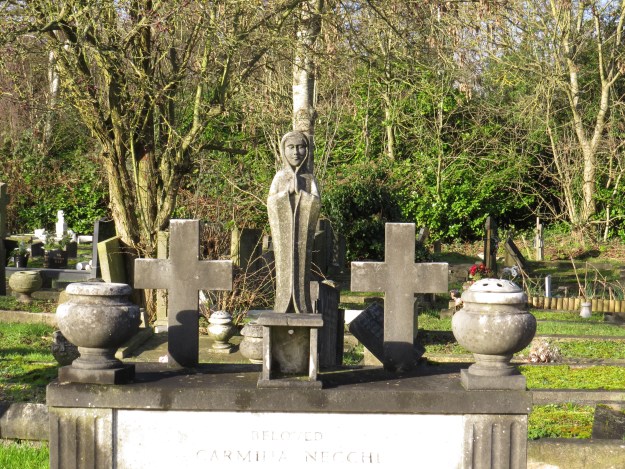
But finally, I had never noticed this very elegant little figure before. I am not sure if she is the Virgin Mary, or another saint, but I love how precise and neat she is, with that air of austerity that I usually associate with Japanese sculpture. I think she will be someone that I’ll look out for on future visits.

And finally finally, here are a few more goldfinches, because you can never have too many 🙂


Saturday Quiz – 2020 Vision

Cyclamen missing from last week’s post!

Dear Readers, what a year it’s been! And to round it off nicely, and ease us into 2021,  here is a ‘simple’ plant ID quiz. Each photo comes from a Wednesday Weed of the corresponding month. All you need to do is to ID the plant. Good luck! The answers will appear next Friday morning UK time (8th January 2021), so if you want to be ‘marked’, please get your responses into the comments by Thursday 7th January at 5 p.m. I will ‘unapprove’ any answers when I see them, so that they don’t distract other quizzers, but to be certain of not being influenced I would still write your answers down first.

Onwards!

January

  1. What species are these small red trees?

February

2. Can you name this tree?

March

3. What plant is this?

April

4. What’s this plant?

May


5. What plant is this?

June

6. What’s this plant?

July

7. What’s this plant?

August

8. What’s this plant?

September

9. What’s this extraordinary plant?

October

10. What species are these splendid street trees?

November

11. What root vegetable was used to play this tarantella?

December

12. What is this tropical fruit?