Monthly Archives: February 2021

Book Review – A Natural History of the Hedgerow by John Wright

Dear Readers, I fell in love with hedgerows when I was visiting Mum and Dad in Dorset – when I was able to get out for an hour I would spend much of it wondering at the sheer variety of bird life that rustled and fluttered in the depths of the hawthorn, or that flew away at speed as soon as I got within camera range. So I approached this book with a great deal of interest. The fact that the author lives in Dorset was an added bonus. Plus, he sounds very much like me, which is always a bonus (from my perspective anyway):

‘.….a walk from one end of 100 metre hedgerow to the other can take me half an hour and any companions soon get bored and walk on ahead. ‘But aren’t you interested?’ I might ask rather pompously. ‘Look at this elder tree that’s had its bark rubbed away by a deer’, or ‘Here’s an oak apple, let’s see if the wasp has flown,’ or ‘This plant will have you dead in half an hour if you eat it’, and so on.

What Wright has is a stupendous, compendious knowledge of all things hedgerow, ditch, dry wall and dyke -related. He starts with the story of hedgerows, from the arrivals of the first Mesolithic peoples (and here he joins in the discussion about whether the UK was one unbroken forest or ‘oak pasture’, something that ‘Wilding’ by Isabella Tree discusses at length. Then we get into Neolithic land clearance. What have the Romans ever done for us? Well, we owe such things as

‘ ……oats, cabbage, cherries, wine grapes, apples (a much better species than the native crab apple, which is barely edible), plums (better than sloes, except in gin), several familiar herbs and, perhaps less welcome, the cucumber’.

What has Wright got against the cucumber, we may ask? But then we’re on to the Anglo-Saxons, inclosures and enclosures, parliamentary enclosures and hedgerow loss. In short, the first part of the book is an interesting resumé of not just hedges, but the agricultural history of the UK, and fascinating it is too.

Then we move on to the natural history of the hedgerow, and this is obviously the part that attracted most of my attention. Wright points out that there is no such thing as a typical hedgerow flora, fauna or mycota – the only plant that grows only in hedgerows is the Plymouth Pear (Pyrus cordata). It is vanishingly rare, but if you find one in flower you’ll know all about it – according to the Woodland Trust website, the blossom is said to smell like decaying scampi or wet carpet, and to attract mainly flies.

Photo Two by Ross Joliffe/Alamy Stock Photo from https://www.woodlandtrust.org.uk/trees-woods-and-wildlife/british-trees/a-z-of-british-trees/plymouth-pear/ Photo by

The flower of the Plymouth Pear (Photo Two)

What the hedgerow most resembles, Wright says, is woodland edge habitat, although it is more exposed and hence often drier. However, the type of plants and animals that inhabit it will vary according a wide range of variables, including soil type, amount of moisture and sunlight, and location. Furthermore, the habitat in the middle of a hedge will be very different at the top and at the bottom.

Nonetheless, what follows is a most entertaining gallop through the major trees, shrubs and plants that can be found in a hedgerow. It’s clear that Wright is interested in fungi, and in plant galls, and he manages to address the imbalance in between flora and fungi that is so often present in guides of this kind. I learned a lot about mushrooms, and hawthorn, and dog rose. There are frequent ‘aha’ moments, when I recognise the links between the different inhabitants of a hedgerow, and it certainly gave me lots of ideas about what to look for next time I’m walking down a country lane. Plus he is able to bring even the commonest of hedgerow plants into fresh focus.

We have something of a love-hate relationship with the bramble – the berries are by far the most abundant and among the tastiest of all wild fruits, and nearly every child will have happy memories of picking them. On the other hand they are intractable weeds bearing thorns that can rip through clothing and skin. The leaves of bramble look as though they had intended to fall off during the autumn but had changed their minds and soldiered on until spring. It is certainly an untidy and disreputable looking plant and even in late summer, when the berries are full, it seems to have been half eaten by pestilential insects.’

Anyone hoping for details on hedgerow mammals and birds, however, may be a little disappointed, but then I wonder if this would be fair. We are rather deprived of mammals in the UK, and those that we do have are rarely hedgerow specialists, though Wright does discuss the stoat and the weasel. He is even clearer on his lack of interest in birds, though I suspect he is being tongue-in-cheek when he says that

I have little interest in birds, considering them to be nasty, feathery things that fly away before you can even identify them.

But really, what’s wrong with being passionate about plants and fungi? Very few of us can be passionate about all the inhabitants of the natural world, and even those of us who are will admit, if pushed, to having favourites.

The last part of the book is about the different styles and methods of boundary making – there is much on the hurdle, the dry-stone wall and the varying styles of hedge-laying. This was less interesting to me than the earlier parts, but those of you with a more practical bent (and the opportunity to knock up a boundary on your estate) will I’m sure find much of interest here.

Wright finishes with a summing-up of the different regimes and methods that are currently used for maintaining and trimming hedges. All have their advantages and disadvantages, but what seems to work best is for us to take an interest in our own local hedgerows and to hold the council accountable. He mentions Sarah Carter, a Cornishwoman who was so horrified by the loss of species in her local hedgerows due to the flailing technique and timing of council ‘maintenance’ that she kept a list of the species that disappeared and, as Wright says, used the ‘time-honoured practice of making a thorough nuisance of herself to those responsible for the trimming of Cornish hedges‘. As Wright says:

We should, perhaps, all follow Sarah’s example in treasuring what we have in our wonderful hedges and hedgerows and make an almighty fuss about what we perceive to be lost through bad hedge management along the roadside or indeed anywhere else. Then, maybe, we can have our hedges back’.

You can buy A Natural History of the Hedgerow by John Wright from many places, but let me suggest the Natural History Society Bookshop, an absolute treasure trove of titles.


A Cold, Sweet, Silver Life

Photo One from https://lookup.london/bloomberg-london/

The Fish Tank at Bloomberg HQ (Photo One)

Dear Readers, I haven’t been to the office for almost a year now, and there are things that I miss, and things that I don’t. I don’t miss getting up at 6 a.m. on a cold, dark, January morning so that I can beat the crowds on the Northern Line. I don’t miss the crush on the same trains on the way home. I don’t miss the feeling of being overwhelmed by the sheer size of the building and the number of people in it, or the sense of being surrounded by people who are mostly in too much of a rush.

I do miss my colleagues, and I miss chatting to the security staff and the cleaners. I miss the free coffee. But strange to say, what I miss most is the fish tank. While many people were too busy to stop and look at this wonder of nature, spending ten minutes catching up with the fish was often a space of serenity at a time that was filled with anxiety.

As you might remember, the charity that I work for is housed in the Bloomberg Building, the most sustainable office building in the world. Most of the charities that I’ve been involved with have been housed in decrepit, damp offices, often with mould on the walls, ageing furniture and an inadequate internet connection. Strange to say I feel more at home in those downbeat buildings – everything about this one makes me feel rather small and unimpressive. But hanging out with the fishes filled me with wonder, as I gradually got to know them.

In one corner of the tank there was a bright red crustacean with a delicate white filigree pattern on its claws. It shared a burrow with a little silver goby, who had orange and blue spots like a pantomime clown. They were most unsuitable house mates – the shrimp took up most of the deepest part of the tunnel and would sometimes tweak the goby’s tail, while the goby was forever fussing about, taking mouthfuls of gravel and spitting them out. Sometimes it appeared that the shrimp wasn’t allowing the goby back into its home, but on another occasion I came in early to see the goby firmly ensconced and the shrimp outside, sulking.

On one sad day, I couldn’t find either of them when I came in in the morning. The tanks are so well-maintained that I’m sure a fish could have died and been removed before anyone even had time to notice. But later that day I found the goby on the other side of the tank, happily constructing a new home. I wondered if it had just got fed up with its room mate, but by the next day the shrimp had moved in again. Whether there was any mutual benefit involved I have no idea, but in spite of the odd contretemps they seemed to generally knock along rather well.

Photo Twohttps://www.abyssaquatics.co.uk/product/orange-spot-goby-diamond/

An orange-spot goby (Photo Two)

But what made me think about this was an excerpt from a poem that I read in Jean Sprackland’s book ‘Strands’. The poem is an 1836 work by Leigh Hunt, called ‘The Fish, The Man and The Spirit’, which sounds very much like a dreary philosophical work. But then, I read this excerpt, and although we can never know what it’s like to be a fish, I thought it captured something of the essence of these creatures, so different from us and yet surely not so different as we’d like to think.

‘Man’s life is warm, glad, sad, ‘twixt loves and graves,

Boundless in hope, honour’d with pangs austere;

Heaven-gazing, and his angel-wings he craves:

The fish is swift, small-needing, vague yet clear,

A cold, sweet, silver life wrapp’d in round waves,

Quicken’d with touches of transporting fear’.

It seems strange to me that scientists are only just conceding the fish feel pain, make friends, have intelligence, even mourn their dead, but then, I suppose that thinking of animals as unfeeling automata has generally served us well as a species. What a different world it would be if we gave some credence to the notion that we have a lot in common.

Photo Credits

Photo One from https://lookup.london/bloomberg-london/

Photo Two from https://www.abyssaquatics.co.uk/product/orange-spot-goby-diamond/

New Scientist – Bat Stories

Photo One by Uwe Schmidt, CC BY-SA 4.0 <https://creativecommons.org/licenses/by-sa/4.0>, via Wikimedia Commons

Common vampire bat (Desmodus rotundus) (Photo One)

Dear Readers, there are more species of bats on Earth than any other mammal group except for rodents, and yet we know very little about them. So for today’s update from New Scientist, I wanted to pick up on a few stories that shed light on their complex lives.

Vampire bats are not everyone’s choice as favourite small furry animal, but this article shows how little we know about their social structures. Imran Razik of Ohio State University was studying a colony of vampire bats which comprised 23 adult females and their young. Although vampire bats roost together, they normally raise their young individually, although bats form close ‘friendships’ with one another. The researchers noticed the burgeoning relationship between Lilith, a nursing female, and BD, a single bat with no offspring of her own.

When vampire bats form a friendship, they spend a lot of time grooming one another, and sharing food. It was noticed that BD spent a lot of time feeding Lilith, and that this increased as Lilith became ill, even though she was not sharing food reciprocally with BD. As Lilith became sicker, BD also spent more time looking after the baby, grooming it, carrying it and even feeding it.

When Lilith eventually died, BD adopted the baby fully. It is extremely rare for this to happen even amongst mammals that are more closely related to us, such as chimpanzees, so this is a very exciting observation. Why, though, do bats choose one individual over another to be their friend? As it’s hard enough to work this out even in humans, I think this could be a fascinating study.

Photo Two by Emanuel Yellin - עמנואל ילין, CC BY 3.0 <https://creativecommons.org/licenses/by/3.0>, via Wikimedia Commons

European free-tailed bat (Tadarida teniotis) (Photo Two)

Now, let’s have a look at the European free-tailed bat, a rather melancholy-looking creature if the photo is anything to go by. It’s long been known that birds can often reach extreme heights by finding thermals and riding them, but these are much less common at night. However, by attaching light-weight GPS monitors to lactating female bats, it was found that they could reach heights of up to 1600 metres. How do they do it? It appears that, although they fly in almost total darkness, they have an excellent knowledge of the landscape of their territory, and use the uplift from where south or west-facing slopes meet the prevailing winds of north-west Portugal, where the colony is located. They soar upwards, gently sail down and then find another slope of similar topography so that they can repeat the process. The team who studied the bats, led by Teague O’Mara from Southeastern Louisiana University, note that this gives a flight-plan that looks rather like a rollercoaster ride. One question would be ‘why go so high’? I would speculate that the bats’ insect prey may also fly high, probably to avoid predators, but this style of flight would be energetically very efficient for the bats. You can read the whole article here.

Photo Three by Barry Mansell/Naturepl.com from https://www.newscientist.com/article/2112044-speedy-bat-flies-at-160kmh-smashing-bird-speed-record/

Brazilian free-tailed bat (Tadarida brasiliensis) (Photo Three)

And now for another free-tailed bat. The Brazilian free-tailed bat was cited as the fastest vertebrate in the world at level flight during tests on the population from the Frio cave in south-western Texas. The bats clocked speeds of 100km an hour, with one bat having a maximum speed of 160km, faster than the spine-tailed swift at 112 km per hour. However, then the controversy started, over the way that the bats were measured, uncertainties about the wind speed, and whether the ‘level’ flight was actually level. Nonetheless, there is no doubt that these are extremely speedy bats – they travel more than 50km to their feeding grounds every night, and fly at heights of more than a kilometre. Perhaps they’re in an arms race with speedy prey?

You can read the whole article here.

Now you might think that with all these speedy, high-flying bats around, moths would stand no chance. In fact, some moths are able to hear the echolocation clicks given by bats and literally fold their wings and drop out of the air to avoid capture. What happens, though, if you have no ears?

Photo Four  By Ivo Antušek - https://www.biolib.cz/en/imagegalleryuser/id60700/?uid=295, Public Domain, https://commons.wikimedia.org/w/index.php?curid=13321460

Chinese Tussar Moth (Antheraea pernyi) (Photo Four)

Marc Holderied was studying earless moths, such as the Chinese Tussar Moth, at Bristol University. He found that when sound waves were projected at the wings of the moth, they bounced back much more  quietly. Structures on the wings absorbed the sound at the specific frequencies that are emitted by the bats, in effect acting as a ‘stealth coating’. Holderied also studied another species of earless moth, Drury’s Owl Moth (Dactyloceros lucina) and found that it had the same structures on the wings. Moths who could hear didn’t have them. 

Photo Five from https://www.learnaboutbutterflies.com/Africa%20-%20Dactyloceras%20lucina.htm

Drury’s Owl Moth (Photo Five)

Scientists are speculating whether similar structures could be designed to help with things like sound-proofing and noise-cancelling headphones. In our increasingly noisy world, that could surely be good thing.

You can read the whole article here.

Photo Credits

Photo One by Uwe Schmidt, CC BY-SA 4.0 <https://creativecommons.org/licenses/by-sa/4.0>, via Wikimedia Commons

Photo Two by Emanuel Yellin – עמנואל ילין, CC BY 3.0 <https://creativecommons.org/licenses/by/3.0>, via Wikimedia Commons

Photo Three by Barry Mansell/Naturepl.com from https://www.newscientist.com/article/2112044-speedy-bat-flies-at-160kmh-smashing-bird-speed-record/

Photo Four By Ivo Antušek – https://www.biolib.cz/en/imagegalleryuser/id60700/?uid=295, Public Domain, https://commons.wikimedia.org/w/index.php?curid=13321460

Photo Five from https://www.learnaboutbutterflies.com/Africa%20-%20Dactyloceras%20lucina.htm

A Sunday Walk in Coldfall Wood

Dear Readers, as if by a miracle the temperature has gone up a tad, the mud has (probably temporarily) abated in Coldfall Wood and on Muswell Hill Playing Fields, and so it was a good day to get some air. The woods have been more heavily used this year because of lockdown, and I don’t think I’ve ever seen the understorey quite so bare. The leaf cover makes it difficult for smaller plants to survive in the uncoppiced areas, but because of the need to socially distance, many new paths have been carved through the trees. Still, some plants are still popping up, like this Italian Cuckoo Pint (Arum italicum), poking out from below the holly.

We head out to the fields for the first time in ages – it was such a mud bath for a few months that we decided to give it a miss. But today it’s full of people walking their dogs and playing with their children. It’s been such a hard time for everyone, in so many different ways.

On the way round, I spot the crossbar from at least three football goals. I wonder if people swing on them and they collapse?

The pyracantha berries on the big hedge look to be well-nibbled, and I wonder if it’s the redwings.

There is a small group of black-headed gulls – the ‘black’ mark behind the ear of this one is gradually getting bigger. Soon it will have a fine chocolate-brown hood, and summer will be here, and this gull will probably be much further north. Over two million black-headed gulls overwinter in the south of the UK, so they aren’t rare, but they are elegant, and noisy!

I have a look at ‘my’ wildflower border. Not much to tell at this time of year, except for some impressive burrs and the new leaves of the lambs-ear.

Oh, and the fennel seedheads.

I almost walk past the Japanese knotweed, though I do like the mixture of browns and tans that the dead stalks make at this time of year.

But then I spot this.

I thought that it was some kind of man-made object, but when I waded through the stems to get a closer look, I was fairly convinced that it is in fact a bird’s nest. It’s attached to the stalks by a filigree of plant stems. What bird made it I’m unsure, let me know if you have any thoughts. I did wonder about long-tailed tits, but then they tend to be mossy rather than grassy. At any rate, it proves that Japanese knotweed is at least good for something – I doubt that anything could have reached the nestlings while the plant was in full leaf. And what fun to find a nest! Considering how many birds nest every year, they do a fine job of keeping the locations pretty secret.


A Chilly Walk in St Pancras and Islington Cemetery

Dear Readers, I often get a glimpse of a fox in the cemetery, but today we had quite a long encounter with this vixen. She looks in fabulous condition, and was cheerfully trotting around the area at the entrance to the cemetery, sniffing at twigs and occasionally squatting to scent-mark. However, when I got home and looked at the photos properly, it’s clear that she’s had a close encounter with something very recently.

My guess would be that she’s narrowly avoided being run over by a car, poor thing. However, the fact that she’s still alert and moving normally makes me think that it’s probably just a flesh wound. I do hope so. She looks a bit thick around the midriff to me, so it may be that she’s pregnant (or just well-fed, which is another good sign). The main road that surrounds the cemetery is a death trap as the young foxes try to disperse, but fingers crossed that this one will be ok. If I’ve learned one thing, it’s that foxes are extraordinarily resilient creatures, and seem to bounce back from things that would fell a human.

I know that people are still feeding the foxes in the cemetery, so she’s in a good place at any rate, and the cemetery security guys have a soft spot for all the wildlife, so they’ll keep an eye on her.

As we walk on, I have a quick look at the swamp cypress to see if it’s getting any spring growth yet. Not much yet, but these things happen very gradually, and I’m sure this cold snap will have put everything back a bit. Next week the temperature is supposed to be up to 59 degrees Fahrenheit at the weekend, which will feel positively spring-like. I’d bet my bottom dollar that it will bring the frogs in my garden out.

Nothing very exciting happening on the swamp cypress

I spotted a rather exciting new grave today, simply by taking a quick detour to the left instead of the right. The memorial is for Francisco ‘Frank’ Manzi, born in 1913 and died in 1962. He was the chairman of the Amusement Trades Association, and appears to have been married to Elizabeth Paolozzi, but only for three months in 1934. Therein hangs a tale, I’m sure. And I couldn’t find any indication of who sculpted the memorial, which is really rather remarkable.

As we took the perimeter path around the edge of the cemetery, closest to the North Circular Road, I noticed that some of the twigs were absolutely covered in lichen. Then I remembered an LNHS talk by Jeff Duckett about the flora of Hampstead Heath, in which he noted that there are lichen which actually thrive on the nitrous oxide from car exhausts. I wonder if this species is one of them? It certainly loves this area, and I haven’t noticed it in anything like as much profusion anywhere else in the cemetery. I have a feeling that this might be golden shield lichen, and if so it’s known to love nitrogen – it’s often found in areas where there are lots of bird droppings which are rich in ammonia. Who knew that being a nature detective could be so much fun?

Someone has put up a little bird house next to Randall’s Path in the cemetery, and I was delighted to see a pair of robins checking it out. In fact, in even more exciting news (for me anyway) I saw a pair of blue tits checking out the bird houses that I’d put up for sparrows last year. They might not meet with the approval of the prospective tenants, but it’s the first interest that anyone’s shown in almost two years, so at least my hopes are raised a little.

I loved this statue too, swathed in ivy and holding artificial flowers.

And also this modern cross, with the red stems of dogwood glowing behind.

The snow has almost gone in some places, but is clinging on in others. The places where it remains are the least trodden, and so the most interesting.

And finally, four graves that caught my eye today. The first is of Thomas Hollyman Nicholls, a despatch rider for the Royal Engineers, who served in the First World War and who finally passed away in 1930 as a result of his war service. I have found some information about his war record, and it seems that he was discharged with heart and lung trouble, caused by being gassed at Ypres. Poor man.

The second is this one, with its beautifully carved anchor and chain. Walter Hugh Price was in charge of a motor boat during the raids on Zeebruge and Ostend, a campaign that ended up costing 200 British lives. However, it wasn’t enemy fire that killed him: according to an article on the history of Friern Barnet (where Price lived), he caught a cold during the raid which turned into something worse, and he actually died on a hospital ship in Dover harbour.

Thirdly, there’s another anchor, this one broken by frost and time. Robert Samuel Nodes was Chief Officer on board HMS Vesuvio when she was torpedoed in 1914. On his pension card, his death in 1916 is described as being due to ‘shock caused by explosion on ship’. In the War Graves records, his death is said to have been caused by ‘acute laryngitis’. On his grave, it says, more explicitly, ‘shell shock’, though I wonder if, at this point, it refers to what we now think of as shell shock (i.e a mental breakdown), or if it means the physical effects of being caught in a confined space when there’s an explosion. Whichever it is, Robert Samuel Nodes died at 27 years old.

And finally, I found the austerity of this grave, with its broken column, rather affecting. John Stuart Alexander was born in Alnwick in Northumberland, and was married to Maria, who was from Scotland. He seems to have been a secretary in a private company, and the 1881 census finds them living in Barnsbury, Islington, at 52 Mildmay Grove. They shared the house with their son, Stuart, who worked as a commercial clerk, and their servant, Mary. John was only 53 years old at this point, and I imagine that dying was the last thing on his mind. However, he did at least leave his widow and son well provisioned: probate records show that he left an estate of £2417 0s 7d, which would have been a sizeable amount in those days. And could there be a better epitaph?

‘He was one of the best of husbands, and the kindest of fathers’.

Saturday Quiz – Edible Flowers

Title Photo byAnemoneProjectors, CC BY-SA 2.0 <https://creativecommons.org/licenses/by-sa/2.0>, via Wikimedia Commons

Borage (Title Photo)

No, not those flowers that you find scattered all over your salad in posh restaurants (remember them)? This week, I want you to identify some edibles by their flowers. Not quite as simple as you’d think, lovely people! Though the gardeners out there will have a head start. Simply match the picture of the flower to an item from the list of fruit and vegetables below.

As usual, you have till 5 p.m. on Thursday 18th February to get your answers in the comments, and as usual I will unapprove any answers as soon as I see them, so that they will disappear. However, I am not always as quick as I could be, and I’d advise you to write your answers down first if you think you might be influenced by speedy people.

Onwards! Simply match the edible from the list below to the photo. So, if you think photo 1 shows a banana flower, your answer is 1) A)

Edibles

A. Banana

B. Parsnip

C. Strawberry

D. Tomato

E. Cabbage

F. Fennel

G. Brazil nut

H. Redcurrant

I. Potato

j. Jerusalem Artichoke

K. Cashew Nut

L. Cherry

M. Hazel Nut

N. Pumpkin

O. Quince

Photo One by AnemoneProjectors, CC BY-SA 2.0 <https://creativecommons.org/licenses/by-sa/2.0>, via Wikimedia Commons

1)

Photo Two by Rillke, CC BY-SA 3.0 <https://creativecommons.org/licenses/by-sa/3.0>, via Wikimedia Commons

2)

Photo Three by M. C. Cavalcante, F. F. Oliveira, M. M. Maués, and B. M. Freitas, CC BY 3.0 <https://creativecommons.org/licenses/by/3.0>, via Wikimedia Commons

3)

Photo Four by © Copyright Evelyn Simak and licensed for reuse under this Creative Commons Licence.

4)

Photo Five by Samtoucan, CC BY-SA 3.0 <https://creativecommons.org/licenses/by-sa/3.0>, via Wikimedia Commons

5)

Photo Six byMokkie, CC BY-SA 3.0 <https://creativecommons.org/licenses/by-sa/3.0>, via Wikimedia Commons

6)

Photo Seven by By Skogkatten at English Wikipedia, CC BY-SA 4.0, https://commons.wikimedia.org/w/index.php?curid=56154151

7)

Photo Eight by Public Domain, https://commons.wikimedia.org/w/index.php?curid=64059

8)

Photo Nine from https://www.gardenia.net/plant/prunus-avium-bing

9)

Photo Ten from Alan Fryer / Coeden cwins - Quince tree

10)

Photo Eleven by Vishalsh521, CC BY 3.0 <https://creativecommons.org/licenses/by/3.0>, via Wikimedia Commons

11)

Photo Twelve by CC BY-SA 3.0, https://commons.wikimedia.org/w/index.php?curid=45027

12)

Photo Thirteen by Earth100, CC BY-SA 3.0 <https://creativecommons.org/licenses/by-sa/3.0>, via Wikimedia Commons

13)

Photo Fourteen Harvinder Chandigarh, CC BY-SA 4.0 <https://creativecommons.org/licenses/by-sa/4.0>, via Wikimedia Commons

14)

Photo Fifteen by By Kateelkshetra - Own work, CC BY-SA 3.0, https://commons.wikimedia.org/w/index.php?curid=30569277

15)


Saturday Quiz – Bopping Birds – The Answers

Dear Readers, another great week! Mike at Alittlebitoutoffocus, Susan, Claire, Anne and Fran and Bobby Freelove all got 30 out of 30, Liz got 27 and FEARN got 23, mainly for muddling up chickens and gibbons :-). But a most creditable performance from everybody, and thank you for playing. Let’s see what my fiendish imagination can come up with on Saturday….


Answers

1)E) – Rockin’ Robin, most famously by Michael Jackson and The Jackson Five but originally sung by Bobby Day in 1958. I’m not sure if I don’t prefer the Bobby Day version, have a listen and see what you think. I really enjoyed the jiving going on as well, it reminded me of Mum and Dad rock and rolling when I was a child. Rockin’ Robin has also been covered by an extraordinary range of artists, including McFly and The Hollies. Here’s Michael Jackson doing his stuff for comparison.

https://www.youtube.com/watch?v=z-OteAgvINc

2) I) Skyline Pigeon by Elton John. A bit of a tearjerker, this one. It’s that line about the ‘aching metal ring’ that gets me every time. See what you think.

https://www.youtube.com/watch?v=P30CR7v7c5w

3) J) ‘Blackbird’ by The Beatles. Paul McCartney originally said that it was composed during a meditation retreat in India, but subsequently said that it was inspired by the Civil Rights movement during rising racial tensions in the US in 1968. Whichever it was, the guitar accompaniment was inspired by Bach’s Bourrée in E Minor, which McCartney and George Harrison tried to learn as a ‘show-off’ piece. There are many, many covers including this one by Eddie Vedder which has much to commend it, but there is something about the simplicity of the original that I think is pretty much unbeatable.

https://www.youtube.com/watch?v=c5GCNDw4X_0

4) F) ‘When Doves Cry’ by Prince. Don’t be telling me about any cover versions, peeps! (Though it’s been done by Ginuwine and The Be Good Tanyas to name but two). Prince is the Man as far as I’m concerned. Case closed.

https://www.youtube.com/watch?v=IUc0R8bbWQE

5) A) ‘Fly Like An Eagle’ by The Steve Miller Band in 1977. Have a listen – it sounds like the quintessence of dreamy laidback 70’s songs, at least until you get to the bit about children with no shoes (for whom the answer seems to be ‘fly like an eagle. Very helpful).

https://www.youtube.com/watch?v=WuXwSyahgW4

Twenty years later, Seal did a cover, and it’s also been recorded by The Neville Brothers . I rather like both versions.

6) B) Sparrows Will Sing by Marianne Faithfull. I’ve always been fond of Marianne Faithfull, though it would be a bit of a push to call her a great singer. She can certainly put a song across though.

https://www.youtube.com/watch?v=yHVFarjq-D0

7) D) ‘Do The Funky Chicken’ by Rufus Thomas from 1972. Just the thing to shake up those lockdown blues.

https://www.youtube.com/watch?v=8lCI63H1neY

8) G) ‘Snowbird’ by Anne Murray from 1970. Don’t you love the way that you can hear every single word? It has been recorded by about twenty other people, let me know if you have a favourite!

https://www.youtube.com/watch?v=4mjfQG4lD_M

9) H) ‘Skylark’ originally recorded by Hoagy Carmichael in 1941. Goodness, what a romantic song! Just about right for Valentine’s Day. Also recorded by Ella Fitzgerald, and this is also swoonworthy. Sigh.

10) C) ‘Mockingbird (Hush Little Baby)’. This is a traditional song, recorded about 3 billion times, so whoever you said is fine by me! Amongst those who’ve recorded it are Carly Simon and James Taylor, (with a great deal of enthusiasm, at least judging by this live performance) and Aretha Franklin, who makes everything that she sings sound new.


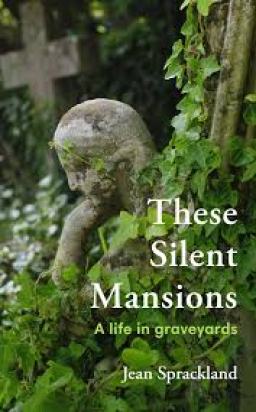
Book Review – These Silent Mansions by Jean Sprackland

Dear Readers, you might remember that last week I was very enthusiastic about Peter Ross’s book ‘ A Tomb With.a View‘. Well, this week I would like to introduce you to a very different but equally compelling book – Jean Sprackland’s ‘These Silent Mansions – A Life in Graveyards’.  It’s a book that’s difficult to categorise –  part memoir, part social history, part biography, but always somehow managing to be a coherent whole. Sprackland is a poet, and I enjoyed the thoughtfulness of her writing, the way that she notices things that others don’t. And as she returns to the towns where she has lived, and the graveyards that were part of her life, she tells one fascinating story after another.

She starts in St. Mary’s Churchyard in Stoke Newington, to follow the story of a young woman whose clothes caught fire back in 1781, and travels on via a secret graveyard for Catholics in Lancashire. In Ilfracombe she investigates the wreck of a slave ship which still divides the local population. Her time as a schoolteacher in Blackbird Leys in Oxford is linked to the story of families so desperate that they sold the bodies of their dead children to science so that they could feed the ones who remained. There is the death of a circus owner, ruminations on holly blues, and why stone angels are so often decapitated, and on nostoc, that strange gluey stuff that sometimes appears overnight on stones and garden furniture.

But it’s the story at the end of the book that’s the real kicker. A child is drowned, and his friend tries to rescue him. Sprackland goes to interview the survivor, who is in his nineties. What happens when she talks to him is one of those moments when your jaw just hangs open.

But to find out what it was, you’ll need to read the book. It’s a splendid companion piece to ‘A Tomb with a View’, rather more introspective and thoughtful, but none the worse for that. It’s made me want to rush out and get her other books, both her poetry and her book about the coast called Strands. That’s the trouble with being a reader, things do rather lead from one to another. But what a splendid path it is.

These Silent Mansions – A Life in Graveyards’ by Jean Sprackland.

Wednesday Weed – Paperbark Maple

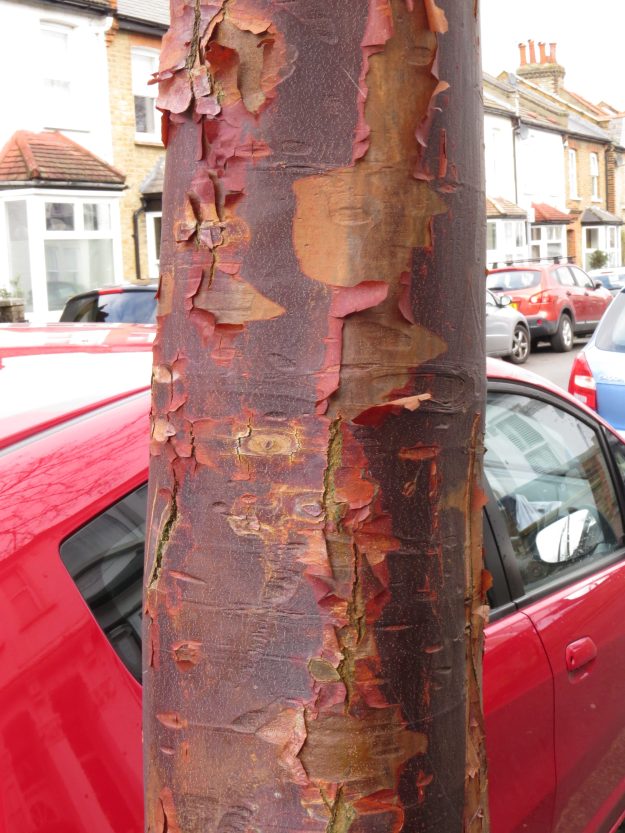
Paperbark Maple (Acer griseum)

Dear Readers, I was so taken with this Paperbark Maple,  spotted in East Finchley earlier this week, that I had to find out a bit more about it. As you can see, it has bark that peels away in tissue-thin layers of of coral and blush pink. The effect was even more impressive when I looked up at the branches. This peeling bark first appears when the tree is 6 or 7 years old, and continues for the rest of the plant’s life.

While the bark reminds me slightly of when I got sunburn as a child, it’s also a quite extraordinary effect. In his book ‘London’s Street Trees’, Paul Wood describes Paperbark Maple as ‘occasionally planted’, but it seems like a good choice to me – the trunk is the one thing that everybody sees, and so you don’t even have to look up to be impressed. It’s also a tree that’s happy on clay soil (which is basically what London sits on).

Paperbark maple is a long way from home, though – a native of China, it’s usually found at altitudes of 1,500 to 2,000 metres. It was introduced to Europe in 1901, and to North America shortly afterwards: apparently only two trees reached the US, and all paperbark maples in the country are descended from this pair of trees. It is a difficult plant to cultivate – a lot of the fruits that develop are seedless ( a phenomenon known as parthenocarpy, another new word!), and  a joint American/Chinese expedition met up in China in 2015 to try to collect seeds to improve the genetic diversity of the plants in cultivation. This is not purely to enhance North American trees, either – the plant is considered endangered by the IUCN, with the populations in China increasingly fragmented and threatened. It’s quite something to find an endangered plant growing in a suburban street.

The bark isn’t the end of the story with Paperbark Maple, however: in autumn, the leaves flush orange/red. The leaflets are arranged in threes, as are the flowers (which turn into the typical maple ‘keys’). In spring, the leaves are dark green above, but decidedly furry underneath.

I wonder if it’s the difficulty in propagation that results in this amazing tree not being planted more often?

Photo One from https://treeheritage.co.uk/planting-trees-for-autumn-colour/acer-griseum-autumn-colour/

Paperbark Maple autumn colour (Photo One)

Why, though, would a tree lose its bark in this way? Many trees do this, the most familiar to us Londoners being the London Plane tree (Platanus x hispanica). In this species, the loss of bark is thought to be a way of getting rid of accumulated toxins from pollution, although in the very hot summer a few years ago I noticed that the plane trees were losing much more bark than usual, possibly from stress. However, it seems unlikely that a tree that evolved in China’s mountains would be doing the same thing.

Another possible explanation is that the exfoliation helps the tree to rid itself of unwanted parasites and fungi. Yet another is that trees at high altitudes actually have their bark damaged by the UV light from intense sunshine, and also that they might suffer frost damage, so getting rid of damaged bark makes sense. It can also deter climbers and epiphytes. So, who knows? One explanation that I have rejected for ‘my’ tree, as I’ve come to think of it, is that the bark cracks and peels as the tree grows, a bit like an insect growing out of its exoskeleton. In that case, why doesn’t it happen to all trees? And why doesn’t it stop when the tree reaches its full height? Let me know what you think, readers. I know that you’ll all have some native trees where the bark peels, but why? I know we won’t get to the bottom of it here, but it’s always good to ponder.

Photo Two By Bruce Marlin - Own work http://www.cirrusimage.com/tree_paperbark_maple.htm, CC BY-SA 2.5, https://commons.wikimedia.org/w/index.php?curid=2988653

A Paperbark Maple in summer (Photo Two)

And finally, a somewhat tangential poem. It actually made me tear up, this poem: partly because I remember the sheer excitement of a library, and partly because of the destruction of the library system in the UK which means that so many children will never experience that excitement.

Maple Valley Branch Library, 1967
For a fifteen-year-old there was plenty
to do: browse the magazines,
slip into the Adult section to see
what vast tristesse was born of rush-hour traffic,
decolletes, and the plague of too much money.
There was so much to discover-how to
lay out a road, the language of flowers,
and the place of women in the tribe of Moost.
There were equations elegant as a French twist,
fractal geometry’s unwinding maple leaf;
I could follow, step-by-step, the slow disclosure
of a pineapple Jell-O mold-or take
the path of Harold’s purple crayon through
the bedroom window and onto a lavender
spill of stars. Oh, I could walk any aisle
and smell wisdom, put a hand out to touch
the rough curve of bound leather,
the harsh parchment of dreams.
As for the improbable librarian
with her salt and paprika upsweep,
her British accent and sweater clip
(mom of a kid I knew from school)-
I’d go up to her desk and ask for help
on bareback rodeo or binary codes,
phonics, Gestalt theory,
lead poisoning in the Late Roman Empire;
the play of light in Dutch Renaissance painting;
I would claim to be researching
pre-Columbian pottery or Chinese foot-binding,
but all I wanted to know was:
Tell me what you’ve read that keeps
that half smile afloat
above the collar of your impeccable blouse.
So I read Gone with the Wind because
it was big, and haiku because they were small.
I studied history for its rhapsody of dates,
lingered over Cubist art for the way
it showed all sides of a guitar at once.
All the time in the world was there, and sometimes
all the world on a single page.
As much as I could hold
on my plastic cards imprint I took,
greedily: six books, six volumes of bliss,
the stuff we humans are made of:
words and sighs and silence,
ink and whips, Brahma and cosine,
corsets and poetry and blood sugar levels-
I carried it home, five blocks of aluminum siding
and past the old garage where, on its boarded-up doors,
someone had scrawled:
I CAN EAT AN ELEPHANT
IF I TAKE SMALL BITES.
Yes, I said to no one in particular: That’s
what I’m gonna do!

– Rita Dove

Photo Credits

Photo One from https://treeheritage.co.uk/planting-trees-for-autumn-colour/acer-griseum-autumn-colour/

Photo Two By Bruce Marlin – Own work http://www.cirrusimage.com/tree_paperbark_maple.htm, CC BY-SA 2.5, https://commons.wikimedia.org/w/index.php?curid=2988653


Storm Darcy Arrives in East Finchley

Dear Readers, well I’m not having to shovel my way out of the front door, but we do have snow this morning, and so it’s on with the walking boots and woolly hat, and out into the garden to make sure there’s food and water for the birds. A blackbird was pecking over the bird table before it was even light, so the critters are definitely hungry. Sure enough, the robin was down pecking at the mealworms before I’d even left the garden. And then the starlings arrived.


And the chaffinches.

I’ve noticed before how more tolerant birds are of one another in the winter, but even I was surprised when this little gathering on the bird table didn’t end up with ‘pistols at dawn’.

It doesn’t take much to spook them though.

And it turns out that one of the starlings has ‘cracked’ the nut butter feeder. I’ve seen coal tits feeding on the other one (which is hidden away next to the bittersweet) so at least somebody likes them.

But the height of the excitement was spotting a female blackcap working over the bittersweet. At least I’m thinking that it’s a female – juveniles look similar. Some folk have found that these birds are aggressive at the bird table, but this one couldn’t be more reclusive. I love that she’s eating the berries – at one point she hung upside down on a twig to get one. I hung a roosting pouch in the hedge so I wonder if she’s using it?

And it’s still snowing, though just wispy little flakes. The temperature isn’t expected to get above 30 degrees Fahrenheit for the rest of the week, so I’m glad that I stocked up on birdfood. And who knows, maybe we’ll get lucky and see a fox like we did last time.