Monthly Archives: February 2021

London Natural History Society Talks – ‘Bird Flight and Cooperative Dynamics’ by Steve Portugal

Dear Readers, can I start by saying that this was a fascinating and well-presented talk, with lots of fascinating videos and graphics, and if you have an hour to spare I would hot-foot it over to the LNHS Youtube channel to watch the whole thing. Steve Portugal is such a clear and entertaining speaker that it’s best to get this info direct, but here is my synopsis.

The talk is really about why birds gather in groups, how they behave when they do, and what advantages they gain from their behaviour. There are two main ways of ‘flocking’, and these are dictated largely by size. A bird that is smaller than a black-headed gull is likely to form a ‘cluster’ – we see this in pigeons and starlings and all those other little  birds. Any bird larger than this is likely to fly in a V-formation, so that includes cranes, geese, pelicans, flamingoes and, as we’ll see, ibises.

To start with, Portugal looked at birds that fly in a V-formation. Partly this might be because large birds are much less manoeuvrable – a crane has the same turning circle as a jumbo jet, apparently. Other reasons might be:

  • the dilution effect – if lots of birds fly together, an individual is less likely to be predated  (this applies to cluster flocks too)
  • Navigation – older, more experienced birds fly at the front to teach the younger birds behind the route.
  • Vision – it’s easier to see the lead bird if you fly in a V formation
  • Energetic – birds are able to save energy by flying in this way.

It’s this last point that Portugal is most interested in. When a plane or a bird flies, it pushes the air in front of it out of the way. At the wing-tip something called a wing-tip vortex is created, and this provides an updraft, which makes staying in the air easier. However, most of the air gets pushed down and creates a downdraft, which will push anything following down. It’s this effect that dictates the gap between planes when taking off at an airport, and its the wingtip vortex effect that is thought to be one of the reasons why birds fly in a V formation.

Lest you think that this is all about birds, Portugal explained that aircraft manufacturers are desperate to copy this effect, to save fuel. He showed a short film made by an airline in which a plane takes off from Melbourne and is joined by others from other Australian airports to fly across the Pacific. When the planes join, they get into a V formation, and fly together until they make landfall above the US, at which point the planes peel off to go to their different destinations. However, another film showed a group of small planes trying to do just this, and getting into all kinds of trouble – planes have to get so close together to find the updraft from the wingtip that they risk stalling or tumbling over. It’s thought that only a computer will be able to calculate the manoeuvres required with enough accuracy to avoid disaster.

Photo One By Myself (Adrian Pingstone). - My own photo, taken with a Nikon D5300 DSLR and Nikon 18-200 mm lens, Public Domain, https://commons.wikimedia.org/w/index.php?curid=71095389

The Red Arrows display team in a V Formation. Not as easy as it looks! (Photo One)

However, back to the birds. Portugal’s subject study was made possible by the advent of biologgers that are small and light enough to attach to a bird, and also by a study into the Waldrapp Ibis (also known as the Northern Bald Ibis). Historically they were present all through Mediterranean Europe, Northern Africa and the Middle East but, after the recent extinction of the Syrian population, the only wild birds left are in Morocco. This population doesn’t migrate, but it was hoped that they could be trained to return to their old haunts and establish new groups in Europe. To do this, the birds were given a human foster parent, who lived with them for nine months. Then, they were trained to fly after a microlite, and were eventually taught a migration route to Northern Italy.

Photo Two  By Richard Bartz, Munich aka Makro Freak - Own work, CC BY-SA 2.5, https://commons.wikimedia.org/w/index.php?curid=3329144

Waldrapp Ibis (Geronticus eremita) (Photo Two)

What Portugal found was that these birds, who had human ‘parents’, automatically formed a V Formation when they flew, at 45 degrees to one another, approximately 1.2 metres apart. This was exactly as predicted by aerodynamic theory, which is based on fixed-wing planes. What the birds did was synchronise their wingbeats naturally to avoid generating turbulence between them. Each bird except the one right at the front rode on the updraft of the bird in front.

The group was dynamic, with no clear leader, though birds did seem to have a preference for their position, be it to the right or left, front or back.

However, the birds noticed how long another bird took at the front of the flock, and would then allow it to take a rest at the back, as if they had an innate sense of fairness.

What happened in the flock also depended on the ‘popularity’ of the individual bird. Portugal defined this as ‘the number of connections and interactions’ that a bird had with other birds. If an ‘unpopular’ bird stopped off for a rest, the others would look round, notice who it was, and then just keep going. If a ‘popular’ bird stopped, however, all the other birds would go down for a rest too. What we think of as ‘leadership’ might just be about a network of relationships instead.

Photo Three from https://e360.yale.edu/features/after-a-400-year-absence-waldrapp-rare-ibis-returns-to-european-skies

Waldrapp Ibis in flight (Photo Three)

Portugal finished his talk with something a bit closer to home: pigeons. Pigeons are about the maximum size for birds that fly in a cluster, and, unlike V Formation flying, being at the front of the group is good from an aerodynamic point of view, being at the back is bad.

Sadly, in pigeon society the popular/unpopular thing plays out in a different way. Shy pigeons are nearly always at the back. Bold, investigative pigeons are nearly always at the front. And unlike with geese and cranes, that’s the way it stays – if you’re a backmarker, that’s where you’ll stay.

Portugal had his pigeons fly over a number of routes. To start with, the group would be somewhat inefficient, but after a dozen flights they’d have the most direct route mapped, and that would be the one that they’d always follow. However, here’s the rub. After the flock had flown a route over a hundred times, he would take pigeons out for a solo flight. The ones who were always at the front came home pretty directly (though interestingly the flock as a whole always flew faster than a solo bird). But when he released a bird that had been at the back of the flock, they almost always either gave up and went to sit in a tree, or got lost, sometimes for days.

Were they just not paying attention? Or were they so intent on keeping up that they didn’t have the energy to see where they were going? Could they maybe not see the lead bird properly? All very good questions for which we have no answers. But how fascinating! I learned so much from this talk, and in particular I loved the clear structure, which makes it so much easier to take in and to remember – I’ve barely had to look at my notes while I’ve been writing this. Do pop over and have a look. I guarantee that you won’t be disappointed.

Photo Credits

Photo One By Myself (Adrian Pingstone). – My own photo, taken with a Nikon D5300 DSLR and Nikon 18-200 mm lens, Public Domain, https://commons.wikimedia.org/w/index.php?curid=71095389

Photo Two By Richard Bartz, Munich aka Makro Freak – Own work, CC BY-SA 2.5, https://commons.wikimedia.org/w/index.php?curid=3329144

Photo Three from https://e360.yale.edu/features/after-a-400-year-absence-waldrapp-rare-ibis-returns-to-european-skies

A February Visit to East Finchley Cemetery

The Tate Tomb (you can read more here)

Dear Readers, this week we decided to ring the changes with a walk to East Finchley Cemetery. This is owned in part by Westminster City Council (with the crematorium owned by Barnet Council), and it is a much more manicured site than St Pancras and Islington. Nonetheless, the range of huge Victorian statement trees attracts a range of animals, and there are lots of wilder corners which I find very appealing.

The crows seemed particularly restless and vigilant today, in part because a gang of magpies were cackling their way through the treetops. I’ve seen a family group of the black and white marauders harass a pair of crows until they left they nest, whereupon the magpies started to steal the nesting material (it’s too early yet for them to be stealing anything more precious.

A pair of magpies were indeed setting up home close to the entrance, though whether they’d gathered their own twigs or had stolen somebody else’s was impossible to tell. They are such communicative birds, constantly checking in on one another. They always seem to be up to some kind of mischief.

Award-winning magpie photo (not)


And in another tree there were a posse of parakeets. They have probably already decided where their nest sites will be, being birds who like to plan well ahead.

I found this small memorial garden, rather charming with its low hedges and central statue.

But what really stopped me in my tracks was this flowering quince, backlit by the low winter sun.

Just around the corner there is a natural burial area, full of snowdrops. It’s called the Willow Garden but the new young trees look to me like downy (rather than silver) birch (feel free to tell me I’m wrong). The headstones are simple, natural stones. It’s rather lovely.

And just around the corner from here is another memorial garden for people who have been cremated. The headstones are all of the same shape and size, but they have room for a small engraving which gives you a notion of the person and what they were like in life. I found them very appealing. Here is a selection. It really set me to thinking about what I would have on my headstone. An insect for sure, but which one? Maybe an emperor dragonfly.

In Madagascar, the tombs are the size of a family car, and are often painted with scenes from the person’s life – herding cattle, eating with their family, buying a car. There was a craze for Kung Fu in Madagascar in the 80’s, and so many tombs show the deceased performing some airborne manoeuvres of surprising complexity. So much more interesting than our graves!

My husband rather likes those Roman graves where the carving goes on forever and gives a full eulogy for the person in great detail, extolling their sterling virtues and achievements. I would love to know more about the people buried in both of my favourite cemeteries. We are too modest in the UK! More stories, please.

In another nod to spring, the crocuses are out in some of the lawns. They are such delicate, pale-lavender things. A friend of mine noted that whatever the colour of the bulbs that she planted, after a few years they’re all lilac in colour. I wonder if they revert to type? What’s your experience, readers?

I’d noted the magnificent Tate Tomb (in the first photo) in previous posts about this cemetery, but hadn’t paid much attention to this copper lady before. She is on the tomb of Harry Dwight Dillon Ripley, grandson of a New York railway magnate, and therein hangs a tale, beautifully told on The London Dead website here. Suffice to say that the grieving widow paid the sculptor, Sir William Reid Dick, £500 for the statue, an enormous amount in 1914 (in fact, enough for Reid Dick to get married on).

And on the way out, a couple of other things of note. There is this impressive array of ivy berries for one thing. I love the way that they’re dangling like conkers on a string.

And finally, someone has planted a new monkey puzzle tree. It looks very small and almost cuddly at the moment, but no doubt it will soon be over-topping its neighbours. It’s nice to see a new one after the one that I based my Wednesday Weed article on was cut down. Although they have virtually zilch wildlife value in the UK, I confess to being rather fond of Araucaria, with its peculiar leaves and sculptural quality.

And so, as we head home, we decide to walk down a different road from our usual one, and I see this tree.

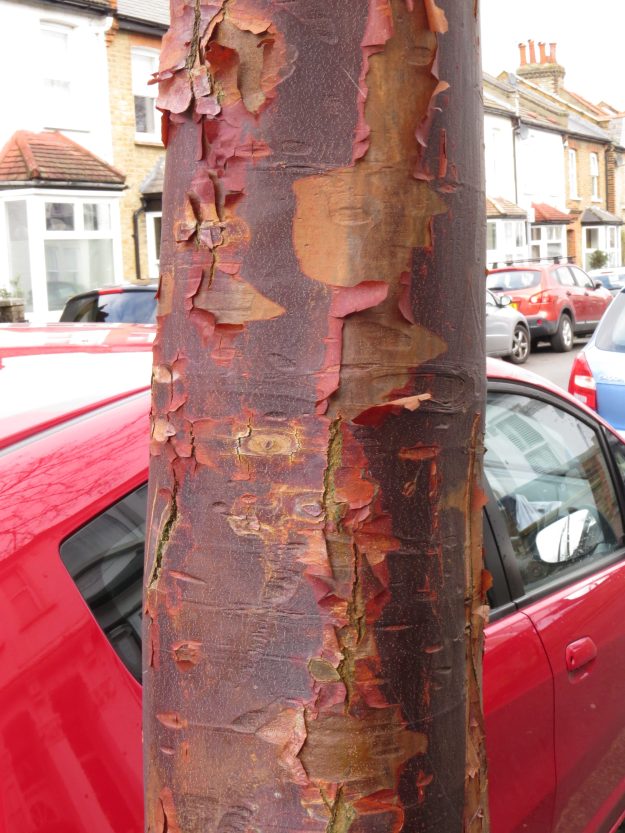
Getting closer to it, I notice the extraordinary bark.

A paperbark maple (Acer griseum)! I love the tissue-thin peeling, in all those shades of rose and coral. I think I feel a Wednesday Weed coming on….

Saturday Quiz – Bopping Birds

Dear Readers, we had so much fun with the ‘songs about plants’ quiz a few weeks ago that I thought we’d have a bash at songs about birds this time! As usual, I’ve put some lyrics below. Match the song to the bird (one point). Identify the song (another point). And tell me an artist that sang it (a third point)! If this doesn’t cheer us up and fill our heads with ‘ear worms’ I don’t know what will.

Answers in the comments by 5 p.m. UK time on Thursday 11th February please, and I’ll publish the answers on Friday 12th February. Gosh, is that Valentine’s Day coming up apace? So it is. It will be Christmas before we know it.

As usual, I will ‘disappear’ the answers in the comments when I see them, but if you want to avoid any chance of being influenced, write your answers down before you put them on the blog.

So, let’s go! Match the bird to the song. So, if you think the lyrics in 1) are about an eagle, your answer is 1) A). Then just add the name of the song and an artist, and you’re in business…

Bird

A) Eagle

B) Sparrow

C) Mockingbird

D) Chicken

E) Robin

F) Dove

G) Snowbird

H) Skylark

I) Pigeon

J) Blackbird

Lyrics

  1. Every little swallow, every chick-a-dee
    Every little bird in the tall oak tree
    The wise old owl, the big black crowFlappin’ their wings singing go bird go
  2. Turn me loose from your hands
    Let me fly to distant lands
    Over green fields, trees and mountains
    Flowers and forest fountainsHome along the lanes of the skyway
  3. xxxxxx singing in the dead of night
    Take these broken wings and learn to fly
    All your lifeYou were only waiting for this moment to arise
  4. Dream, if you can, a courtyard
    An ocean of violets in bloom
    Animals strike curious poses
    They feel the heatThe heat between me and you
  5. Time keeps on slippin’, slippin’, slippin’
    Into the future
    Time keeps on slippin’, slippin’, slippin’Into the future
  6. A child breaks the ice and peers into the hidden depths
    I’m trying to decipher the horror of un-holiness
    I have no doubt you’ll figure it out somedayCalo, calo, cale
  7. You raise the left arm up and your right arm too
    Let me tell you just what to do, start both of ’em to flappingStart your feet to kicking…
  8. Spread your tiny wings and fly away
    And take the snow back with you
    Where it came from on that day
    The one I love forever is untrue
    And if I could you know that I wouldFly away with you
  9. Have you anything to say to me
    Won’t you tell me where my love can be
    Is there a meadow in the mistWhere someone’s waiting to be kissed
  10. Hear me now and understand
    He’s gonna find me some peace of mind
    And if that peace of mind won’t stay
    I’m gonna find myself a better way
    And if that better way ain’t so
    I’ll ride with the tide and go with the flow
    And that’s why I keep on shoutin’ in your ear
    Say yeah, yeah whoa, whoa, whoa, whoa, whoa, uh, oh

Saturday Quiz – Elemental! – The Answers

Title photo by Charles James Sharp, CC BY-SA 4.0 <https://creativecommons.org/licenses/by-sa/4.0>, via Wikimedia Commons

Silver-washed fritillary (Argynis paphia) (Title Photo)

Dear Readers, this one was obviously too easy 🙂 or possibly you are all getting more brilliant, because Mike from Alittlebitoutoffocus, Anne, and Fran and Bobby Freelove all got 30 out of 30. The one where there was a little bit of difference was the silver langur, but as it’s also known as the silver leaf monkey I am happy to allow it.  The sulphur beetle also has a couple of common names, so again I’ve allowed a little bit of variation. Well done everyone! Let’s see what Saturday brings :-).

Photo One by Eric Kilby from Somerville, MA, USA, CC BY-SA 2.0 <https://creativecommons.org/licenses/by-sa/2.0>, via Wikimedia Commons

1) Gold – Golden Lion Tamarin

Photo Two by Zeynel Cebeci, CC BY-SA 3.0 <https://creativecommons.org/licenses/by-sa/3.0>, via Wikimedia Commons

2) Copper – Small Copper butterfly

Photo Three by By Greg Hume - Own work, CC BY-SA 4.0, https://commons.wikimedia.org/w/index.php?curid=61605332

3) Silver – Silver Dollar fish

Photo four by User:Nino Barbieri, CC BY-SA 3.0 <https://creativecommons.org/licenses/by-sa/3.0>, via Wikimedia Commons

4) Iron – Cast Iron plant (Aspidistra)

Photo Five by By Greg Hume - Own work, CC BY-SA 4.0, https://commons.wikimedia.org/w/index.php?curid=34913396

5) Iron – Ironweed

Photo Six by liz west, CC BY 2.0 <https://creativecommons.org/licenses/by/2.0>, via Wikimedia Commons

6) Gold – Goldenrod

Photo Seven by gailhampshire from Cradley, Malvern, U.K, CC BY 2.0 <https://creativecommons.org/licenses/by/2.0>, via Wikimedia Commons

7) Gold – Goldcrest

Photo Eight by Tan Meng Yoe at English Wikipedia, CC BY 4.0 <https://creativecommons.org/licenses/by/4.0>, via Wikimedia Commons

8) Neon – Neon tetras

Photo Nine by © Hans Hillewaert

9) Sulphur – Sulphur Beetle

Photo Ten by Julian Berry, CC BY-SA 2.0 <https://creativecommons.org/licenses/by-sa/2.0>, via Wikimedia Commons

10) Sulphur – Sulphur-crested cockatoo

Photo Eleven by Robert Jenssen, CC BY 3.0 <https://creativecommons.org/licenses/by/3.0>, via Wikimedia Commons

11) Silver Langur

Photo Twelve by By RhinoMind - Own work, CC BY-SA 4.0, https://commons.wikimedia.org/w/index.php?curid=58445949

12) Copper – Copper Beech

Photo 13 by Jim Champion / Silver birch on the edge of Brinken Wood, New Forest

13) Silver – Silver Birch

Photo Fourteen by Karen Stout, CC BY-SA 2.0 <https://creativecommons.org/licenses/by-sa/2.0>, via Wikimedia Commons

14) Gold – Asian Golden Cat

Photo Fifteen By Rocky - Flickr, CC BY 2.0, https://commons.wikimedia.org/w/index.php?curid=2947840

15) Gold – Golden Eagle.

Photo Credits

Title photo by Charles James Sharp, CC BY-SA 4.0 <https://creativecommons.org/licenses/by-sa/4.0>, via Wikimedia Commons

Photo One by Eric Kilby from Somerville, MA, USA, CC BY-SA 2.0 <https://creativecommons.org/licenses/by-sa/2.0>, via Wikimedia Commons

Photo Two by Zeynel Cebeci, CC BY-SA 3.0 <https://creativecommons.org/licenses/by-sa/3.0>, via Wikimedia Commons

Photo Three by By Greg Hume – Own work, CC BY-SA 4.0, https://commons.wikimedia.org/w/index.php?curid=61605332

Photo Four by User:Nino Barbieri, CC BY-SA 3.0 <https://creativecommons.org/licenses/by-sa/3.0>, via Wikimedia Commons

Photo Five by By Greg Hume – Own work, CC BY-SA 4.0, https://commons.wikimedia.org/w/index.php?curid=34913396

Photo Six by liz west, CC BY 2.0 <https://creativecommons.org/licenses/by/2.0>, via Wikimedia Commons

Photo Seven by gailhampshire from Cradley, Malvern, U.K, CC BY 2.0 <https://creativecommons.org/licenses/by/2.0>, via Wikimedia Commons

Photo Eight by Tan Meng Yoe at English Wikipedia, CC BY 4.0 <https://creativecommons.org/licenses/by/4.0>, via Wikimedia Commons

Photo Nine by © Hans Hillewaert

Photo Ten by Julian Berry, CC BY-SA 2.0 <https://creativecommons.org/licenses/by-sa/2.0>, via Wikimedia Commons

Photo Eleven by Robert Jenssen, CC BY 3.0 <https://creativecommons.org/licenses/by/3.0>, via Wikimedia Commons

Photo Twelve By RhinoMind – Own work, CC BY-SA 4.0, https://commons.wikimedia.org/w/index.php?curid=58445949

Photo Thirteen by Jim Champion / Silver birch on the edge of Brinken Wood, New Forest

Photo Fourteen by Karen Stout, CC BY-SA 2.0 <https://creativecommons.org/licenses/by-sa/2.0>, via Wikimedia Commons

Photo Fifteen By Rocky – Flickr, CC BY 2.0, https://commons.wikimedia.org/w/index.php?curid=2947840

Book Review – ‘A Tomb With a View’ by Peter Ross

Dear Readers, as you know I have had a long relationship with graveyards. I find them an endless source of interest, in terms both of social history and of the wildlife that makes its home there. In ‘A Tomb With a View’, Peter Ross zips about between the cemeteries of the British Isles with an unerring sense of a story, and limitless curiosity about people. Whether it’s meeting a British-Nigerian drag queen in Brompton Cemetery, talking to a medium who wants to liberate the spirit of Greyfriars Bobby in Edinburgh, or being present at the funeral of Lyra McKee in Belfast, he is an evocative and compassionate guide. Take this excerpt, from McKee’s funeral:

One card read, ‘Words fail me’. That felt about right. We carve words on stone to remember our dead – the names and dates and some blandly appropriate text. The formality and finality of headstone convention takes all the mess of grief and loss and reduces it to something that can be said with hammer and chisel. Beloved wife of. Sadly missed by. But that wee card with its admission of the limits of language felt real. Perhaps these are the truths we should engrave in straight lines and elegant fonts. Words fail me. I don’t know how I’m ever going to get through this. I will never be the same again. 

Lyra McKee lies in a corner of Carnmoney Cemetery, north of Belfast. She is wearing a flower in her hair. ‘

When he visits Highgate Cemetery, he talks to the gardener, the stone mason and the person who makes Karl Marx cookies for the gift shop. He tells how the Cedar of Lebanon that stood in the cemetery’s centrepiece, probably a hundred years old when the cemetery was opened in 1839, has finally died after being infected with Chicken of the Woods fungus, and how a tiny new tree has been planted in its place:

A young tree had been planted in the centre of the grass, where the old tree had been. Only three metres tall, it was dwarfed by its surroundings. Yet this new Cedar of Lebanon had a certain forlorn dignity: like a child at a parent’s funeral, it provoked pity, but also admiration for the strength one could already see building within. It might, with luck and care, grow to thirty-five metres and live for a thousand years.’

There is a very interesting and moving chapter on the outcast dead, which moves from Crossbones Graveyard (one of my favourite places) to the cillíns (little churches) of Ireland, where children who died before baptism and people who’d committed suicide were buried, because the church decreed that they could not be buried in consecrated ground. Often these areas were close to conventional graveyards, but sometimes they were in a corner of a field, or even under the flagstones of a house. There are the  stories of the women who are working in Ireland to help reunite families with their beloved dead: Toni Maguire, who has suffered miscarriages herself, speaks of her work:

Sometimes I think, “Was this particular research laid at my door? Did I have to have that experience of miscarriage in order to take this on and relate to it?” I feel these women and babies have nobody to speak for them. But I will bloody speak for them’.

Ross visits the War Graves Commission Cemetery at Loch Shiel in Scotland, and also goes to Belgium where the work of recovering bodies from the First World War is still continuing. He finds the only grave of a woman buried as a witch in Scotland. He visits Haji Taslim Funerals in Whitechapel, and visits the Gardens of Peace in Hainault, where thirty four of those who died in the Grenfell fire are interred. Every chapter has a new story, a new way of looking at death, and life, and the ways that we deal with both. The book manages to be both diverse and coherent, which is difficult to pull off.

I really can’t recommend this book enough. And I’m not alone – you can read about other aspects of the book in this review here. But it’s probably best to read it yourself. You can buy it from one of my favourite bookshops in London if you’re trying to avoid Amazon.

Ross is the author of two previous non-fiction collections ‘Daunderlust – Dispatches from Unreported Scotland‘ and ‘The Passion of Harry Bingo – Further Dispatches from Unreported Scotland‘ which both also look interesting. He’s also written many pieces for The Scotsman and The Guardian. I’m very glad that I’ve made his acquaintance.

Next week, I’ll review my other favourite, and very different, book on graveyards – ‘These Silent Mansions – A Life in Graveyards’ by Jean Sprackland. These two books complement one another very well. But more of that next week.

Wednesday Weed – Blood Orange

Dear Readers. there is something almost shocking about cutting into an orange and discovering flesh the colour of liver rather than the expected citrus hue. In fact, the marketing of the fruit has included changing the name to ‘Sicilian red orange’ and ‘ruby orange’, among other synonyms. It’s interesting that some websites refer to the orange having a ‘raspberry flavour’ – I wonder how much this is the influence of the colour, rather than the taste itself? I realise now that I should have done a blindfold taste test to see if there was actually any difference.

Blood oranges are red because they contain anthocyanins, the same pigments that we see in blueberries and black rice. They are protective against low temperatures, and blood oranges tend to be grown in areas where it’s cold at night. The flesh of blood oranges actually gets redder as the pigments accumulate during cold storage.

Blood oranges are thought to be the result of a natural mutation, and there are three main varieties. The Sicilian ‘Moro’ variety is thought to have originated originated in Syracuse at the beginning of the nineteenth century, and is said to be the reddest of all the red oranges, with flesh that is nearly black and pink rind. The variety has been given Protected Geographical Status, which means if you’re calling an orange a Sicilian Red Orange it had better come from Sicily or else. My oranges are the Sicilian variety, and very nice they were too, though my delight in them was tainted by the realisation that most Sicilian Red Oranges are harvested largely by immigrants from West Africa, who live in tin shacks on low wages and who are subject to constant harassment and ill treatment by their bosses and the local population. I shall be writing to the people who provide my fruit and vegetable box to ask about the provenance of the fruit.

Then there’s the Tarocco, also Italian but without such deep red flesh. The name is said to have come from an exclamation of wonder by the farmer who first discovered it. It’s said to the sweetest of the varieties, but I rather like the hint of sourness in the flesh of citrus. There is evidence that most fruit and vegetables have been bred to be sweeter during the past thirty years – who can remember the mouth-puckering sourness of old-school grapefruit? These days we barely need the brown sugar.

But I digress, as usual.

And finally we have the Spanish Sanguinello, which has flesh which is orange with red streaks. It can be harvested from February, but  can stay on the tree right through to May.

As you might expect, you can use blood oranges for all the things that you’d use a normal orange for, with the added bonus of that pretty pink tinge. You can make marmalade with them, although if you’re like me, you’ll add some Seville oranges to big-up the orange flavour. You can make orange and almond cake with them, or pop them into a salad. You can do what I just did and whoosh them up in a smoothie. I think they’re good with oily fish such as mackerel, although again they can tend a bit too much to sweetness. And I once had a blood orange icecream in Venice that was possibly in the top ten most delicious things I’d ever eaten. This website has some fabulous recipes if you find yourself juggling with some blood oranges in a hesitant way. I love the way that the author has added a lemon to the ice cream recipe to add sourness.

Photo One from https://theviewfromgreatisland.com/blood-orange-ice-cream/

Blood orange icecream (Photo One)

And finally, a poem. This is only tangential to a blood orange, though one is mentioned. It’s one of those poems that has an obligatory moment of silence at the end. See what you think.

The Park Drunk by Robin Robertson

He opens his eyes to a hard frost,
the morning’s soft amnesia of snow.

The thorned stems of gorse
are starred crystal; each bud
like a candied fruit, its yellow
picked out and lit
by the low pulse
of blood-orange
riding in the eastern trees.

What the snow has furred
to silence, uniformity,
frost amplifies, makes singular:
giving every form a sound,
an edge, as if
frost wants to know what
snow tries to forget.

And so he drinks for winter,
for the coming year,
to open all the beautiful tiny doors
in their craquelure of frost;
and he drinks
like the snow falling, trying
to close the biggest door of all.

·Photo Credits

Photo One from https://theviewfromgreatisland.com/blood-orange-ice-cream/


In Tearing Haste….

February 2020

Dear Readers, the Year End is reaching a positive crescendo at the moment, so I have somehow not managed to get my blogposts lined up. Never mind! As it was 1st February today, I thought I’d share a couple of images from February’s past. The one above shows the nature reserve at East India Dock Basin, and how it can only be a year since I had a wander round I have no idea. I did actually see some birds (including some teal, who are fairly rare in these parts), but what strikes me are those magnificent skies.

The O2 Centre as seen from East India Dock


Teal

In February 2019 I made a visit to a new roof garden in the heart of the City at Fenchurch Street. Once this blooming lockdown is over, I must pop back to see how it’s developing.

The view from the Roof Garden

Persicaria

February 2018 saw me a long way from home in Costa Rica. I loved the teeth on this crocodile!

This oropendola was a bit prettier but a lot noisier.

And how about the hummingbirds?

February 2017 seems to have been all about winter aconites….

And blackbirds….

And my cat Willow, who made herself at home on the blanket that I’d just finished knitting…

February 2016 saw the seasonal pond in Coldfall Wood about to inundate the boardwalk. Since some drainage works it’s been much drier this year.

And this was an art installation at Tate Modern which had collected soil from all over London. I was pretty unimpressed. 

Back at Tate Modern on Friday 19th February

In February 2015, I was most taken by this heron at London Zoo. The penguins were not so impressed.

Heron and Humboldt Penguin

And finally, here is my first ever blogpost from February 2014. It feels like half a lifetime ago. What a lot of water has passed under the bridge since 2014! And how glad I am to have the chance to remember it all.

https://bugwomanlondon.com/2014/02/15/the-perils-of-a-mild-winter/

The Final January Walk in St Pancras and Islington Cemetery

Dear Readers, what a cold and windy day it was today, made rather worse by my not getting to sleep until 3 a.m. Usually I haven’t been sleeping badly during the lockdown, but on some nights my brain starts racing and won’t stop, and this was one of those nights. Plus in the rush to get out of the door I forgot my trusty hat, so the icy wind seemed to get into the deepest interstices of my ears. Harrumph! It’s fair to say that I wasn’t in the best of moods.

However, there’s always something to see in the cemetery, even though on some days you have to dig deeper than others.

I noticed this angel, with fist raised and trumpet. I would love to see the cemetery through the eyes of someone who didn’t share our iconography. What on earth would they think of all these winged figures, I wonder?

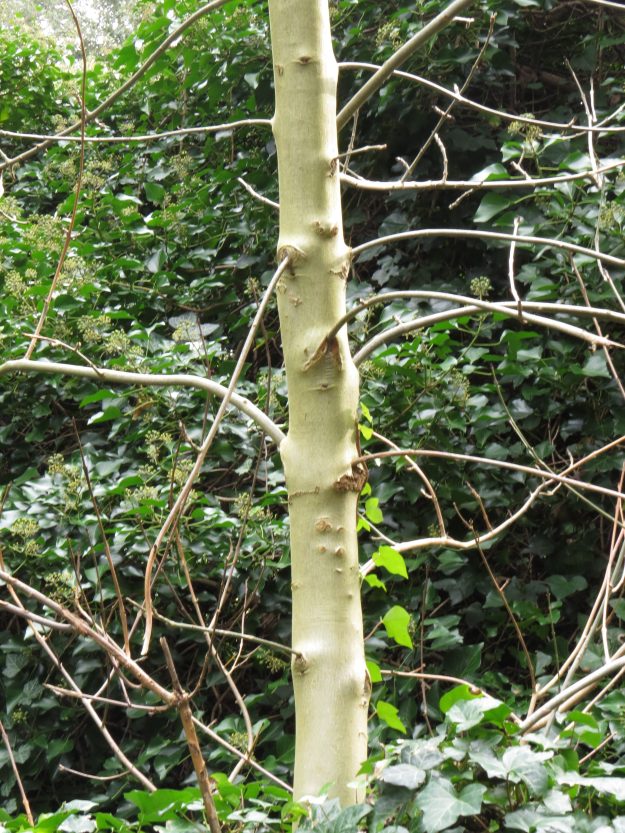
And I found myself completely fascinated by, of all things, the bark on the ash trees. As I’ve mentioned before, there are ash springing up all over the cemetery, and they are by far the most numerous tree, although it’s the stately Victorian plantings that get most of the attention.

On the younger saplings, the bark is smooth and pretty much without blemish.

However, according to The Science Photo Library, the smooth bark of the ash tree is also less acidic than that of many other common forest trees, which encourages the growth of lichens. The pH of the bark also offsets some of the effects of sulphur dioxide and nitrogen oxides, making them more amenable to the lichens and to fungi.  In fact, 536 different species of lichen have been found on ash trees, and ash dieback will put them in danger too.

My guess is that the lichen is black apothecia (Arthonia) though I am no expert. Some trees also have a marked rusty tone (as this one does), which could be another lichen called pale orange apothecia (Leconora). I shall have to come back with a hand lens and have a proper look. ‘Apothecia’ relates to the cup-shaped fruiting bodies of the lichen.

Marked orange staining on this ash tree.

Ash trees often develop huge scars on their trunks as they get older. My Collins Tree Guide refers to these as ‘erupting black cankers’ that ‘disfigure many trees’. That might be so, but the trees largely seem unperturbed by these scabs. 

And having referred to the stately Victorian planting, I rather liked this fine tree, which could not be more conical if it tried. It could be a Western Red Cedar or it could be a Leylandii (which I just discovered is a hybrid between a Western Red Cedar and a Monterey Pine). It just goes to show that even the much maligned Leylandii (if that’s what it is) is fine in the right place. It’s just not a good idea to create a suburban hedge out of it without being prepared to do a lot of trimming.

And here is a fine Scots Pine, which must have looked even more magnificent without the current backdrop of other trees. Now I look at the photo though, do I see the outline of what was once a holly hedge to the left of the tree? In my cemetery guide, it says that it seems that the custodians of the cemetery were overwhelmed by the sheer size of the place (at 185 acres it’s the second largest cemetery in London), and seem to have decided largely to keep the more recent areas neat and tidy, letting the rest of it grow wild. Long may it continue!

And here is some more forest statuary – the lady seems to be clasping a palm branch, but I’m not quite sure what the object is to the left. An urn, possibly?

And finally,  as we leave, my husband decides to go into the War Graves Cemetery for a quick look. I, however, am distracted (as always), this time by this stump.

Just look at the fine array of bracket fungi that are breaking down what remains of the tree!


I am thinking that the fungus is a variety of forms of the ubiquitous turkeytail (Trametes versicolor) but I’m no expert. I was just very taken by the way that the stump was providing sustenance even as it disappeared. Some red deadnettle was just coming into flower in the shelter of its roots.

I’m guessing that the tree was cut down because of some kind of fungal disease – even the main branches have been cross-hatched with an axe, and even they are providing a home for moss.

And so, feeling slightly less tired and with my head full of questions about lichens and fungi, I head for home. And by the time you read this it will be February! The cemetery is full of singing robins and squabbling blackbirds. Spring is on the way, readers.