Monthly Archives: October 2021

Hope For the Future

Dear Readers, as I walked around the Sunshine Garden Centre in Bounds Green yesterday, my thoughts turned to the act of faith that is involved in gardening, and particularly in planting things. Every autumn, I plant some bulbs in the hope that they will come up in the spring, and that I will be there to see them. The planning that’s involved, the vision in my head (that never quite matches what actually happens) and the idea of the future all seem to me to give us a delusion of control that is comforting and uplifting, even if it isn’t actually true. The bulb may get eaten by squirrels, we might get run down by the proverbial bus, our house might be compulsorily purchased for HS2 and yet we still carry on, throwing our dreams into the future. We keep our fingers crossed, put the effort in, and sometimes we are rewarded, sometimes now. I think that gardening is a lesson in perseverance and humility, and it always exercises my creative muscle like almost nothing else.

I have two focuses (focii?) for my purchasing today. One is for the shady area around the pond, where I’m going to plant some candelabra primulas, having seen a spectacular display of them at Compton Acres gardens in Poole when I was a child, although I can’t see any mention of them on their website. I’m going to plant some grape hyacinths in the area as well, as they’ll hopefully provide some cover for the frogs, and if they’re invasive I don’t mind. I am a sucker for new varieties, hence the ‘Night Eyes’ and the ‘Grape Ice’ in the photo above, but I suspect that the good old-fashioned blue Armeniacum muscari will do best. Somewhere in this area I planted some lily of the valley as well, but goodness only knows where. I’ll have to wait until they pop up (or don’t).

I also could resist some more of the Sicilian honey garlic (Nectascordum siculum). I note that the good folk at the bulb company have rebranded the plant as ‘honey lily’. Maybe the ‘garlic’ bit is putting people off. It was my favourite plant of last year, once I’d worked out what the hell it was, having forgotten that I’d planted it.

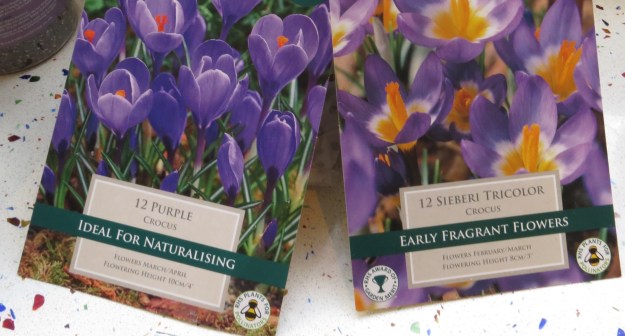
And in the south-facing front garden, I’m going all guns blazing for crocuses. They’ll have to be in pots, as there’s only a narrow strip of soil which is completely taken up with buddleia and lavender, but at least the early bees will get something. I may well get a few more packets once I’ve got these in and have worked out how many spare pots I have, as they are so cheerful and punch well above their weight in terms of attractiveness to pollinators. I’m trying to extend the planting season from February through April, so let’s see how we get on. I am sometimes raided by squirrels at the front of the house as well as the back, but I think they prefer tulips so maybe they’ll toddle on and annoy someone who is planting them.
Anyhow, lovelies, I wanted to finish this post with a few words about my lovely friend J. I normally visit the garden centre with her, and she often shops for plants for her Mum –  we usually spend a few minutes while J rings her Mum to confer on the correct colours for the cyclamen, or which variety of pansies to buy. But J’s Mum spent her 84th birthday in hospice on Saturday and  if you have a few minutes to just wish her well in your heart, or say a quick prayer if that is what you do, I am sure that it will help. We are all held in a net of connections, both in ‘real life’ and virtually these days, and those moments of kindness and support are what help to keep the darkness out.

And good luck with your gardening! Let me know if you have plans for the spring, even if it’s just a pot on the windowsill. Every little helps.

Sunday Quiz – Leaf Shapes

Dearest Readers, the Royal Horticultural Society Gardening School teaches that there are 11 different basic leaf shapes (there are lots of others that they don’t seem to have included here, but bear with me :-)). All we need to do this week (‘all’ she says) is match the leaves below to their shape. I will give a bonus point if you can also tell me which plant the leaves come from. I will also give you a definition of what the shapes mean just to help you on your way. We are all going to learn something here, I’m sure (including me!)

In view of the similarities between some of these leaf shapes, I am also going to exercise some latitude if you are close – one person’s ovate might be another person’s oval, for example. I am using Francis Rose’s Wild Flower Key and the RHS site, but they are not always in agreement. Sigh. Let’s see how we get on, and I am open for debate, though Bugwoman’s final word is final (if you know what I mean).

Answers by next Friday (15th October) at 5 p.m. UK time please, and I will disappear your answers when I see them (though WordPress has been extremely remiss in notifying me just lately), so if you are easily influenced by the brilliance of others I suggest you write your answers down first.

So, if you think that the leaf in Photo 1 is a flabellate leaf, your answer is 1) A)

Onwards!

Leaf Shapes

A) Flabellate (resembling a fan)

B) Ovate (egg-like with the broader part at the base)

C) Elliptic (shaped like an ellipse) (leaf is twice as long as broad, with the broadest bit in the middle)

D) Lanceolate ( shaped like a spear head)

E) Perfoliate (a leaf with a base that appears to be pierced by the stem)

F) Spathulate (spoon-shaped)

G) Linear ( long and narrow)

H) Falcate (sickle-shaped, like the beak of a falcon)

I) Oblanceolate (shaped like an upside-down spear head)

J) Obovate (shaped like an upside-down egg, with the broader part at the top)

L) Oval (similar to elliptical but ‘fatter’ – the width is more than half the length, widest in the middle).

1)

Photo Two by Mehmet Karatay, CC BY-SA 3.0 , via Wikimedia Commons

2)

3)

4)

Photo Five by No machine-readable author provided. Lorenzarius assumed (based on copyright claims)., CC BY-SA 3.0 <http://creativecommons.org/licenses/by-sa/3.0/>, via Wikimedia Commons

5)

Photo Six by Dcrjsr, CC BY 3.0 <https://creativecommons.org/licenses/by/3.0>, via Wikimedia Commons

6)

Photo Seven by By Casliber - Own work, CC BY-SA 3.0, https://commons.wikimedia.org/w/index.php?curid=15212665

7)

Photo Eight by Public Domain, https://commons.wikimedia.org/w/index.php?curid=1079274

8)

Photo Nine by Emőke Dénes, CC BY-SA 4.0 <https://creativecommons.org/licenses/by-sa/4.0>, via Wikimedia Commons

9)

Photo Ten by Σ64, CC BY 4.0 <https://creativecommons.org/licenses/by/4.0>, via Wikimedia Commons

10)

Photo Eleven by Matt Lavin from https://www.flickr.com/photos/plant_diversity/6124894886

11)


Sunday Quiz – Poems of Harvest – The Answers

Title photo by Marc-Lautenbacher, CC BY-SA 4.0 <https://creativecommons.org/licenses/by-sa/4.0>, via Wikimedia Commons

Canadian Harvest Festival (Title Photo)

Dear Readers, I think this was mega-difficult, but even so Claire got 30 out of 30 (one point for identifying the fruit or vegetable, one point for the title, one point for the author) and Fran and Bobby Freelove got 27 out of 30. Well done to everyone, and I think for Sunday’s Quiz we might have something a bit more identification-related :-)…..

  1. Figs, from the poem ‘Figs’ by D.H.Lawrence

  2. Plums, from the poem ‘This is to Say’ by William Carlos Williams

  3. Blackberries, from the poem ‘Blackberry-Picking’ by Seamus Heaney

4. Apples, from the poem ‘After Apple-Picking’ by Robert Frost

5. Potato, from the poem ‘Potato’ by Jane Kenyon

6. Carrot, from the poem ‘Carrot’ by James Bardolino

7. Corn, from the poem ‘Sweetcorn’ by Isabella Mead

8. Pear, from the poem ‘Pear’ by Paisley Rekdal

9. Cherry, from the poem ‘Cherry Ripe’ by Thomas Campion

10. Barley, from the poem ‘Barley’ by Ted Hughes


A Walk in Waterlow Park

View of St Joseph’s Church, Highgate from Waterlow Park

Dear Readers, as you stagger up the hill from Archway to the heady heights of Highgate, you might be tempted to stop in Waterlow Park. For one thing, they have a very nice cafe, and I can recommend the cheesecake brownie. For another, the grounds are rather lovely at any time of year, and there is a kitchen garden to admire and several borders that are full of pollinator-friendly plants. 

The park was originally the grounds of Lauderdale House, which dates back to the 1580s and was the home of the Dukes of Lauderdale. Following relentless ‘improvements’ and a fire in the 1960s nothing of the Tudor building remains, but there are still rumours that Nell Gwyn, Charles II’s mistress, used to live there, and the poet Andrew Marvell also had a house in the grounds. The estate was bought by Sir Sidney Waterlow, Lord Mayor of London, who leased the site to St Bartholemew’s Hospital as a convalescent home in 1872. I can’t help thinking that convalescent homes were a great idea which should be brought back into service, but I digress. Then in 1889 Waterlow donated the estate to the London County Council as a ‘garden for the gardenless’. Looking at the range of people using it when we visited, I can’t help thinking what a generous gesture this was. The park suffered a period of neglect in the 1980s and 1990s but was restored with a grant from the Lottery Fund in 2001, and is now in the loving hands of the London Borough of Camden.

There are three ponds, all fed by natural springs. In spite of the signs asking people not to feed the ducks, the number of pigeons, moorhens and ducks who looked hopefully at us as we walked past makes me think that many folk are just doing what comes naturally.

Young moorhen

Adult coot. Look at the feet!

Foot close-up!

Young heron

Pretty hybrid duck

We found this astonishing oak tree, which may have been struck by lightning and then vandalised by some idiot setting a fire inside the hollow. I’m pleased to report that it still has leaves and seems to be doing fine in spite of the nonsense.

We take a wander down to the kitchen garden and amidst the sweetcorn and the cabbages there are these sunflowers, still abuzz with bees in spite of the cold.

The church of St Josephs towers over the park – it was originally established in 1858 by Father Ignatius Spencer, who had converted to the Roman Catholic faith and was a member of the Passionist order, who have a special mission to evangelise on the meaning of the Passion of Christ. The church itself opened in 1889, and a very fine building it is too, with its copper dome estimated to weigh 2000 tonnes. The cost was so great that the church wasn’t consecrated until 1932 when the debt for building it was cleared.

In addition to the church itself there is a community of Passionist fathers who live on the site. Their way of life is described below:

“The Passionists make a special promise to promote the Memory of the Passion of Jesus by word and deed. They do this especially in preaching and in various ministries among the poor and the marginalised of every kind in whom they see the Crucified today.

Another characteristic of the Passionists is their life in community. Passionist fraternity means that everything is held in common. Time is given to community prayer and to the contemplative dimension of life. Passionists are active contemplatives who, in a creative way, unite contemplation and an active pastoral life.” (from the St Josephs Highgate website).

But of course, in addition to the cake I visit places for the plants. And here is a quick view of some of the borders. Notice the sedums, the cosmos, the verbena boniarensis and the rudbeckias. There’s something here for pollinators of all kinds just as they head into their winter hibernation.

Waterlow Park has lots going for it – there are a variety of playgrounds for children and young people, the ponds, the cafe and a variety of art and musical events at Lauderdale House throughout the year (I’ve certainly gone to a very nice crafts/antiques market). But it also has places which are peaceful, where you can sit and read a book and gaze at the trees and feel a sense of serenity gradually seeping into your bones. I shall definitely visit again.

A Wet Walk in St Pancras and Islington Cemetery

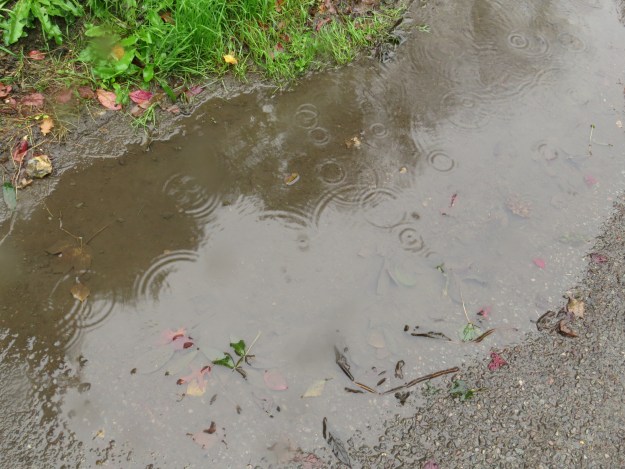
Dear Readers, as we come to the end of our holiday, even the weather seems to be colluding with my low mood. The pathetic fallacy (the idea that nature reflects our thoughts and feelings) was alive and well in East Finchley on Saturday, as I grumbled through the drizzle and raindrops dripped off my nose.

Grumble, moan, grumble, moan. What pleasant company I must have been for a whole half hour, as I paused to take photos in the rain and to dab the raindrops from my camera lens. My long-suffering husband took it all with a barely supressed grin. He knows that something will soon happen to distract my attention and to make me aware that nature is just going about her business and could care less about me having to go back to work.

Look at this tiny mushroom, for instance, heralding the start of fungi season. All summer long the fungi have been growing underground, and any day soon their fruiting bodies will burst forth as if by magic. It is a sign of autumn, and that’s my favourite season, so already I can feel my mood lift.

When we first moved to our house in Seven Kings when I was fourteen, we woke one morning to see a perfect fairy ring of fungi in the garden. The mushrooms were purest white, and of differing sizes. We stood agape at their surprising perfection. There was a very old apple tree in the garden (which sadly fell down the following year), so maybe this was related to the phenomenon. I rather like the alternative interpretation, that the rings are caused by the tiny feet of dancing elves or fairies, although the consequences for a mortal enticed into the centre of the ring can be disastrous: it was said that the person became invisible to anyone outside, and that the fairies might try to keep the mortal imprisoned forever.

Photo One by By Daniel Ullrich, Threedots - Own work, CC BY-SA 3.0, https://commons.wikimedia.org/w/index.php?curid=374929

A fairy ring of Clouded Funnel (Clitocybe nebularis) mushrooms (Photo One)

Help is at hand, though! Touching the enchanted person with iron or a branch from a rowan tree might help to lift the spell, and throwing wild marjoram or thyme can also befuddle the fairies. If you are tempted to pop into a fairy ring, you should first run around it nine times under a full moon, and in the direction of the sun. Doing a tenth lap is apparently a recipe for disaster.

It’s strange how the sight of a single mushroom can bring back some many memories.

On we go, with the rain heavier but my heart lighter. We decide to stick to the leafier parts of the cemetery, and I am suddenly much taken by the bark on this tree.

Judging by the leaves, I would say that this is a goat willow (Salix caprea), but I have never seen one with such a lattice-like pattern on the trunk. This must be quite an old tree – goat willows can live to 300 years and grow to 10 metres tall. This one can’t be far off that height. Also known as the pussy willow, this tree is an invaluable source of early pollen for bees, and I remember seeing one at Crossbones Graveyard in South London that was absolutely covered with honeybees on a warm spring day.

Willow bark from all species contains salicin, from which aspirin is derived: in medieval times the bark was chewed to alleviate toothache, which just goes to show that our ancestors were well attuned to the different characteristics of wild plants, even without knowing the chemical justification. The bark was also boiled in water and used to treat sore throats and to reduce the joint pain from arthritis, surely one of humanity’s most ancient banes. I remember seeing the skeleton of a stone-age person who had lived into middle-age, and her joints were eaten up with arthritis. I hope she was able to use some of nature’s painkillers to ease her suffering.

And then we emerge onto one of the avenues in the cemetery, the rain lifts just a little, and I stop to look back.

The horse chestnuts are shedding their leaves and their conkers, but there is a brief golden glow as a stray sunbeam grazes the tops of the trees. And then the rain really starts, so we hustle back home for a feta and spinach slice from Tony’s Continental (our local greengrocer) and a nice cup of tea. Yet again, the nature cure seems to have worked.


Wednesday Weed – Common Hemp-nettle

Common Hemp-nettle (Galeopsis tetrahit)

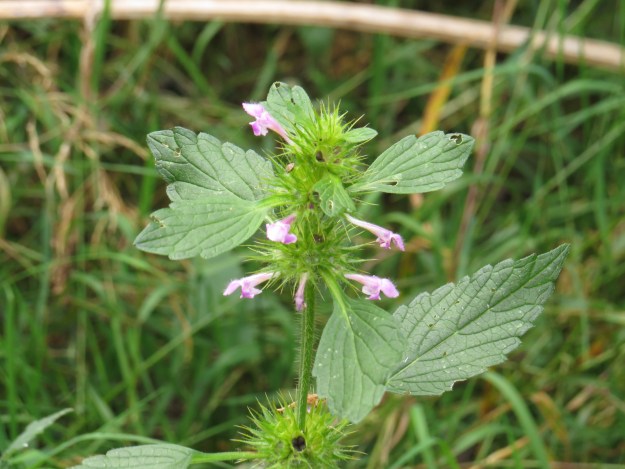
Dear Readers, I have a great fondness for dead-nettles, and have written about many of them: there’s white dead-nettle, red dead-nettle and hedge woundwort, black horehound and yellow archangel, bugle, self-heal and ground-ivy. They are called dead-nettles because their leaves have a superficial resemblance to those of stinging nettles,  but they don’t cause any skin irritation, and are much loved by pollinators. So, I always have my eyes open for a new species, and was much pleased to find this common hemp-nettle (Galeopsis tetrahit) with its pale pink flowers positively exploding out. This plant is less common than those on my list above, and is usually found in disturbed ground around arable fields, exactly where I spotted these plants in Dorset. I love the whorls of calyxes where the flowers have emerged and left a kind of vegetative sea-urchin shape.

This is a native plant, described as ‘common’, so I wonder how often I’ve passed it by. Like all members of the dead-nettle family it’s much favoured by bumblebees, giving it it’s alternative name of ‘bee nettle’. Like many members of the Lamiaceae it can be difficult to identify (in a previous post I’ve already named it as ‘henbit deadnettle’, which it clearly isn’t), but Plantlife mentions that the stem in this species is swollen just where the leafstalks begin, which isn’t clear in the photos but I do remember from the actual plant. It also hybridises with the bifid hemp-nettle (Galeopsis bifida) which doesn’t help, and it may well be a natural hybrid between the downy hemp-nettle (Galeopsis pubescens) and the large-flowered hemp-nettle (Galeopsis speciosia). There’s a much better photo of the flower below, but bear in mind it can also be pink, as mine were.

Photo One by CC BY-SA 3.0, https://commons.wikimedia.org/w/index.php?curid=125208

Common hemp-nettle (Galeopsis tetrahit) (Photo One)

According to the Flora of the USSR (a 25 volume work by V.L. Kamorov and referenced by the Plants for a Future website), Common hemp-nettle is poisonous, but I find this a little surprising, as most of the rest of the family are known as herbs. Don’t take any chances though, peeps. The Glossary of Indian Medical Plants (also referenced by Plants for a Future) mentions that the plant is used for the treatment of tissue-wasting and pulmonary complaints.

An oil from the seeds has been used as a polish for leather, and apparently fibre from the stems can be used to make cord (hence the ‘hemp-nettle’ designation).

I can’t find any human edible uses for the plant, which rather backs up the idea that it might be poisonous, but marsh and coal tits are said to be partial to the seeds.

Apparently the genus name ‘Galeopsis‘ means ‘weasel-like’, probably a reference to the shape of the flower which could resemble a weasel’s snout if you squint. The ‘tetrahit‘ species name probably refers to the pattern of four leaves around the stem, though I can’t find an exact equivalent.

And finally, a poem. As you might expect, a search for ‘common hemp-nettle poem’ comes up with nothing. But wait! Here’s a poem by Louise Glück, which mentions the way that many dead-nettles are plants of damp, dark places (including our plant, which was growing in a very shady lane). The mention of the silver leaves makes me think of the garden variety of yellow archangel. See what you think.

Lamium by Louise Glück

This is how you live when you have a cold heart.
As I do: in shadows, trailing over cool rock,
under the great maple trees.

The sun hardly touches me.
Sometimes I see it in early spring, rising very far away.
Then leaves grow over it, completely hiding it. I feel it
glinting through the leaves, erratic,
like someone hitting the side of a glass with a metal spoon.

Living things don’t all require
light in the same degree. Some of us
make our own light: a silver leaf
like a path no one can use, a shallow
lake of silver in the darkness under the great maples.

But you know this already.
You and the others who think
you live for truth, and, by extension, love
all that is cold.

Photo Credits

Photo One by CC BY-SA 3.0, https://commons.wikimedia.org/w/index.php?curid=125208


Wandering into Omved Gardens

Dear Readers, on Friday last week we decided to go to Highgate, and purely on a whim we walked downhill towards where the old Highgate Garden Centre used to be. I feared that it would be a building site full of partially-built new flats, but instead we found this.

Omved Gardens is owned by Karen and Lekhu Leason, who used to own the Garden Centre, but who wanted to create a garden and event space, with a particular focus on sustainability and food. The site wasn’t officially open when we stumbled upon it, but we were given permission to wander around and take some photos. It looks like a lovely space, with lots of plants for pollinators and some statuary by Sarah Walton, including this fish, and some very fine bird baths.

The focus on food will be developed in partnership with the UN World Food Program and The Chef’s Manifesto, which aims to look at the production, distribution and preparation of food in line with sustainable goals. The next event is an Autumn Harvest supper club, to be held on 13th October, and very nice it sounds too. They are also holding poetry events and a photography exhibition.

Guelder Rose (Viburnum opulus)

The kitchen garden, which is used for the supper clubs and other food-related events, holds a whole host of interesting plants, such as amaranth…

spaghetti squash….

sweetcorn…

and all manner of other interesting herbs, spices and foodplants.

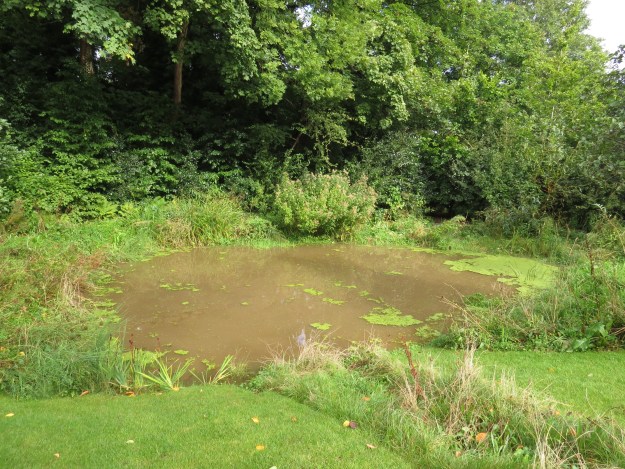
At the bottom of the site there are two ponds.

There was quite a lot of building and tree work going on around the site, but I’m not sure how much of it is related to extending the garden, or whether it is to do with building development. What I do know is that this is a most interesting and valuable resource, tucked away behind a row of shops. I was very sad when the garden centre went, but this is actually much more useful for the whole community, human and non-human. I have signed up for the newsletter, so let’s see what happens next!

Nasturtiums in the kitchen garden

An Autumn Walk in East Finchley Cemetery

Dear Readers, after arriving back in London we felt the need for a nice peaceful walk, and nowhere suits that brief better than a cemetery, particularly the one in East Finchley, which always seems  much quieter than St. Pancras and Islington. As mentioned before, it’s a much more well-manicured site, but there is always something interesting to see, especially as there are some fine specimen trees.

I’ve always had a great fondness for spindle, with its exotic-looking pink berries. If I didn’t know it was native I’d think it was an ornamental from the tropics.

We wander down to the memorial garden, where the Japanese acers form such a wonderful contrast to the lawns.

I have a great fondness for this weeping willow tree too.

There is a small woodland  burial plot, where the cyclamen are coming into flower and the geranium ‘Rozanne’ is still going. What great value this plant is!

In the War Graves section of the cemetery, someone has planted several varieties of aster, a great autumn plant even on a grey and miserable day. Something about those daisy flowers always cheers me up!

I liked seeing this statue from behind the hedge.

And here’s the view back towards the Italianate crematorium.

There’s a reminder of my husband’s home in Toronto in this blue spruce, with its furry cones.

And you might remember this bed of rudbeckia and salvia that I photographed on my last visit. It’s going over now, but there’s still something splendid about the sheer mass of flowers.

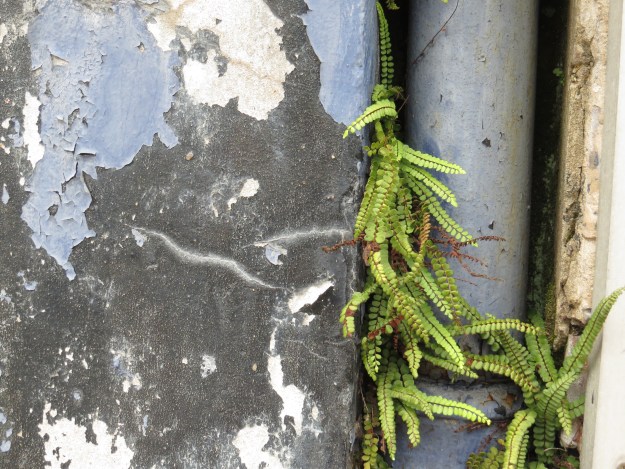
And then it’s time to head home, though there were one or two surprises left. One was the ferns making their way up this drainpipe – I always find it interesting how a microhabitat like this supports species that aren’t seen anywhere else close by. How many spores and seeds are lost because they don’t find a place that’s damp enough or sunny enough for them to thrive, I wonder? This is Maidenhair Spleenwort, last seen when I was down in Somerset.

And finally, there’s something rather odd about the flowers on this Greater Celandine.

It appears to be double-flowered, even though it’s growing as a ‘weed’ in front of some housing in East Finchley. There is a garden variety of this plant called ‘Flore Plenum’, so I’m assuming that this plant has ‘hopped over the fence’, but I was surprised to see it growing in such profusion. I’m assuming that it will revert to type over time, but I will keep an eye on it to see what happens. In theory, double-flowered blooms are much less appealing to pollinators because of the increased difficulty in accessing the nectar and/or pollen, so let’s see.

Sunday Quiz – Poems of Harvest

Title photo by Marc-Lautenbacher, CC BY-SA 4.0 <https://creativecommons.org/licenses/by-sa/4.0>, via Wikimedia Commons

Canadian Harvest Festival (Title Photo)

Dear Readers, the beginning of October is such a time of plenty (even allowing for the endless distribution/fuel/worker shortages that are happening here in the UK) that poets have been celebrating harvest time for centuries. So, here are some excerpts from poems about fruits, vegetables and grains. Your mission (should you choose to accept it) is to 1)identify which food the poet is describing, 2) tell us who the poet is and 3) give us all the name of the poem. I’ve selected ten poems below, so there’s a maximum mark of 30 points.

As usual, answers in the comments by 5 p.m. on Friday 8th October please (UK time), the answers will be published next Saturday. I will disappear any answers that I see, but write your responses on a piece of paper first if you are easily influenced like me. Onwards!

The proper way to eat a xxxxxxxx, in society,
Is to split it in four, holding it by the stump,
And open it, so that it is a glittering, rosy, moist, honied, heavy-petalled four-petalled flower.

  2.

Forgive me
they were delicious
so sweet
and so cold

  3.

At first, just one, a glossy purple clot
Among others, red, green, hard as a knot.
You ate that first one and its flesh was sweet
Like thickened wine: summer’s blood was in it
Leaving stains upon the tongue and lust for
Picking.

4.

My long two-pointed ladder’s sticking through a tree
Toward heaven still,
And there’s a barrel that I didn’t fill
Beside it, and there may be two or three
xxxxxxxxxx I didn’t pick upon some bough.

5.

It seemed to grow
until I might have made shepherd’s pie
for a whole hamlet, people who pass the day
dropping trees, pumping gas, pinning
hand-me-down clothes on the line.

6.

My lacy green
friendship with air
gives me the confidence

to make demands
of dirt. Consider me

a prospector probing
with my own gold.

7.

Rwanda, 2014

They appear at my doorway every morning:

golden parcels, encased in leaves;

8.

No one ever died for a bite
of one, or came back from the dead
for a single taste: the cool flesh
cellular or stony, white

as the belly of the winter hare
or a doe’s scut, flicking,
before she mates.

9.

There is a garden in her face
Where roses and white lilies blow;
A heavenly paradise is that place,
Wherein all pleasant fruits do flow:

10.

Each grain is like seeds of gold bullion.
When you turn a heap with a shovel it pours
With the heavy magic of wealth.
Every grain is a sleeping princess –
Her kingdom is still to come.
She sleeps with sealed lips.
Each grain is like a mouth sealed
Or an eye sealed.


Sunday Quiz – Seedy! The Answers

By Sheila Sund from Salem, United States (Dandelion center) [CC BY 2.0 (http://creativecommons.org/licenses/by/2.0)], via Wikimedia Commons

Dandelion (Title Photo By Sheila Sund from Salem, United States  )

Dear Readers, some great results this week – Fran and Bobby Freelove and Claire are in joint first place with 15/15, with Anne having 13/15 (and I suspect that this was due to mixing up a C and an L rather than any actual misidentification :-)). Well done all of you, and let’s see what I have in store for tomorrow….

UPDATE: Due to a combination of technical issues and author ineptitude, FEARN, Sharon and Rachael’s answers weren’t marked – FEARN and Rachael both got 15/15, and Sharon got 11/15, though I’m not sure if her answers got truncated somewhere along the line! Well done everybody, this wasn’t easy…..

1) H) Nigella/Love-in-a-mist (Nigella damascena)

2). F) Field Poppy (Papaver rhoeas)

3) K) Creeping Buttercup (Ranunculus repens)

4) J) Lucerne/Alfalfa (Medicago sativa) )

5)C) Meadowsweet (Filipendula ulmaria)

6)L) Stinging Nettle (Urtica dioica)

7)D) Honesty (Lunaria annua)

8) E) Rosebay Willowherb (Chamaenerion angustifolium)

9) G) Shepherd’s Purse (Capsella bursa-pastoris)

10) M) Curled Dock (Rumex crispus)

11) A) Wild Carrot (Daucus carrota)

12) O) Himalayan Balsam (Impatiens glandulifera)

13) I) Ribwort Plantain (Plantago lanceolata)

14) N) Greater Burdock (Arctium lappa)

15) B) Salsify (Tragopogon pratensis)