Monthly Archives: February 2022

Sunday Quiz – Don’t Know Why, There’s No Sun Up In The Sky….

Downed cherry-crab tree in St Pancras and Islington Cemetery

Dear Readers, well here in East Finchley we mostly got through Storm Eunice without too much trouble, though I notice a lot of requests for recommendations for tree surgeons and people who repair fences. However, one poor young woman was killed in Highgate/Muswell Hill when a tree blew down onto her car – such a tragedy, my heart goes out to her family. I took a walk around the cemetery, of which more in tomorrow’s post, but suffice to say that although there were a lot of branches down, there were only a few whole trees blown, down, such as the one in the photo above.

What the whole thing has made me think about, however, is how many songs there are out there that talk about storms, and rain, and generally inclement weather. So, for your task this week, can you name the lyrics that these songs came from, and name (at least one) singer? As usual you have until 5 p.m. UK time on Friday 25th February to pop your answers in the comments (I will disappear them as soon as I see them). And then the answers, plus some music, will be posted on Saturday 26th February. So have fun!

Onwards!

  1. When he went away
    The blues walked in and met me
    Oh, yeah if he stays away
    Old rocking chair’s gonna get me
    All I do is pray
    The Lord will let me
    Walk in the sun once more

2. Hey window pane
Tell me, do you remember?
How sweet it used to be
When we were together
Everything was so grand
Now that we parted
There’s just one sound
That I just can’t stand.

3. There’s a killer on the road
His brain is squirmin’ like a toad.

4. But there’s one thing I know
The blues they send to meet me
Won’t defeat me, it won’t be long
Till happiness steps up to greet me

5. Oh, where have you been, my blue-eyed son?
Oh, where have you been, my darling young one?
I’ve stumbled on the side of twelve misty mountains
I’ve walked and I’ve crawled on six crooked highways
I’ve stepped in the middle of seven sad forests
I’ve been out in front of a dozen dead oceans
I’ve been ten thousand miles in the mouth of a graveyard.

6. So, baby, talk to me
Like lovers do
Walk with me
Like lovers do
Talk to me
Like lovers do.

7. God bless Mother Nature (she’s a single woman, too!)
She took off to heaven (and she did what she had to do)
She fought every angel, and rearranged the sky
So that each and every woman could find the perfect guy

8. Yes, and how many years must a mountain exist
Before it is washed to the sea?
And how many years can some people exist
Before they’re allowed to be free?
Yes, and how many times can a man turn his head
And pretend that he just doesn’t see?

9. Well, there’s a small boat made of china
It’s going nowhere on the mantlepiece
Well, do I lie like a loungeroom lizard
Or do I sing like a bird released?

10. And I know, I know, I know, I know
I know, I know, I know, I know, I know
I know, I know.


Sunday Quiz – Who’s That Lady? The Answers

Photo One by Richard Bartz by using a Canon EF 70-300mm f/4-5.6 IS USM Lens - Own work, CC BY-SA 2.5, https://commons.wikimedia.org/w/index.php?curid=6449086)

Male and Female Mallards (Photo One)

Dear Readers, for some reason (probably author incompetence 🙁 ) the acknowledgement of everyone’s brilliance last week wasn’t published, so here it is now, and congratulations to all of you! And apologies!

Dear Readers, what a splendid selection of answers! Claire got a very creditable 8/10 (just a teeny tiny mix-up on the small raptors), and Mike from Alittlebitoutoffocus, Rosalind and Mark and Fran and Bobby Freelove all got a perfect 10 out of 10. Well done to all of you, and thanks to everyone for playing. I feel something weather-related coming on for Sunday 🙂 seeings as the wind from Storm Eunice which is racketing around outside as I write this is enough to blow anyone’s tiara off 🙂

Photo A by Sudhirggarg, CC BY-SA 4.0 <https://creativecommons.org/licenses/by-sa/4.0>, via Wikimedia Commons

A) 8. Sparrowhawk (Accipter nisus)

Photo B by sighmanb, CC BY 2.0 <https://creativecommons.org/licenses/by/2.0>, via Wikimedia Commons

B) 3.Siskin (Carduelis spinus)

Photo C Image by <a href="https://pixabay.com/users/theotherkev-9436196/?utm_source=link-attribution&utm_medium=referral&utm_campaign=image&utm_content=5848189">TheOtherKev</a> from <a href="https://pixabay.com/?utm_source=link-attribution&utm_medium=referral&utm_campaign=image&utm_content=5848189">Pixabay</a>

C) 5. Blackcap (Sylvia atricapilla)

Photo D by gailhampshire from Cradley, Malvern, U.K, CC BY 2.0 <https://creativecommons.org/licenses/by/2.0>, via Wikimedia Commons

D) 4. Greenfinch (Chloris chloris)

Photo E by Marton Berntsen, CC BY-SA 4.0 <https://creativecommons.org/licenses/by-sa/4.0>, via Wikimedia Commons

E) 7. Pied Flycatcher (Ficedula hypoleuca)

Photo F by Alexis Lours, CC BY 4.0 <https://creativecommons.org/licenses/by/4.0>, via Wikimedia Commons

F) 9. Common Kestrel (Falco tinnunculus)

Photo G by David Friel, CC BY 2.0 <https://creativecommons.org/licenses/by/2.0>, via Wikimedia Commons

G) 2.House sparrow (Passer domesticus)

Photo H by Zeynel Cebeci, CC BY-SA 4.0 <https://creativecommons.org/licenses/by-sa/4.0>, via Wikimedia Commons

H) 1.Chaffinch (Fringilla coelebs)

Photo I by Jerzy Strzelecki, CC BY 3.0 <https://creativecommons.org/licenses/by/3.0>, via Wikimedia Commons

I) 6. Redstart (Phoenicurus phoenicurus)

Photo J by Cephas, CC BY-SA 3.0 <https://creativecommons.org/licenses/by-sa/3.0>, via Wikimedia Commons

J) 10. Merlin (Falco columbarius)

Photo Credits

Photo One by Richard Bartz by using a Canon EF 70-300mm f/4-5.6 IS USM Lens – Own work, CC BY-SA 2.5, https://commons.wikimedia.org/w/index.php?curid=6449086)

Photo A by Sudhirggarg, CC BY-SA 4.0 <https://creativecommons.org/licenses/by-sa/4.0>, via Wikimedia Commons

Photo B by sighmanb, CC BY 2.0 <https://creativecommons.org/licenses/by/2.0>, via Wikimedia Commons

Photo C Image by The Other Kev for Pixabay. 

Photo D by gailhampshire from Cradley, Malvern, U.K, CC BY 2.0 <https://creativecommons.org/licenses/by/2.0>, via Wikimedia Commons

Photo E by Marton Berntsen, CC BY-SA 4.0 <https://creativecommons.org/licenses/by-sa/4.0>, via Wikimedia Commons

Photo F by Alexis Lours, CC BY 4.0 <https://creativecommons.org/licenses/by/4.0>, via Wikimedia Commons

Photo G by David Friel, CC BY 2.0 <https://creativecommons.org/licenses/by/2.0>, via Wikimedia Commons

Photo H by Zeynel Cebeci, CC BY-SA 4.0 <https://creativecommons.org/licenses/by-sa/4.0>, via Wikimedia Commons

Photo I by Jerzy Strzelecki, CC BY 3.0 <https://creativecommons.org/licenses/by/3.0>, via Wikimedia Commons

Photo J by Cephas, CC BY-SA 3.0 <https://creativecommons.org/licenses/by-sa/3.0>, via Wikimedia Commons

A Breezy Day at Walthamstow Wetlands

Dear Readers, for the past few days Storm Dudley has been busting through the UK, with 80 mph winds and snow and floods and all the usual shenanigans. And tomorrow (Friday) we are warned to beware of Storm Eunice – the Meteorological Office have issued a most unusual red warning for the Severn Estuary and Wales/the south west of England, meaning danger of loss of life. Even here in cosy old London we have an amber warning, and are being told that the winds could cause flying debris, tumbling trees etc etc. In short we are battening the hatches for the worse storm in thirty years.

But today, between two storms, it’s a precious sunny day, breezy but not alarming, and so a perfect time for a visit to Walthamstow Wetlands, especially as the place will be closed tomorrow because of the storm. A lot of the underbrush has been cut back, opening up views back to the Engine House (as in the photo above). Yet again I got the merest glimpse of what could have been a kingfisher powering away, but what I love most about the Wetlands is the chance to actually see some sky.

The heronry was very busy – apparently there were eighteen birds there, but there were very clear views of these three, two adults and a youngster in the background. Every so often they would lurch into the air and flap around for a bit, causing every crow in the vicinity to fly up and mob them. They seem supremely unbothered by all the nonsense. Hopefully the trees on this small island will soon be full of heronlets (a word I just made up), who look for all the world like baby dinosaurs (which technically they are of course).

In other news there were some pochards. What handsome birds these are, with their livery of copper, grey and black! They have a very close relative called a saddleback duck in North America.

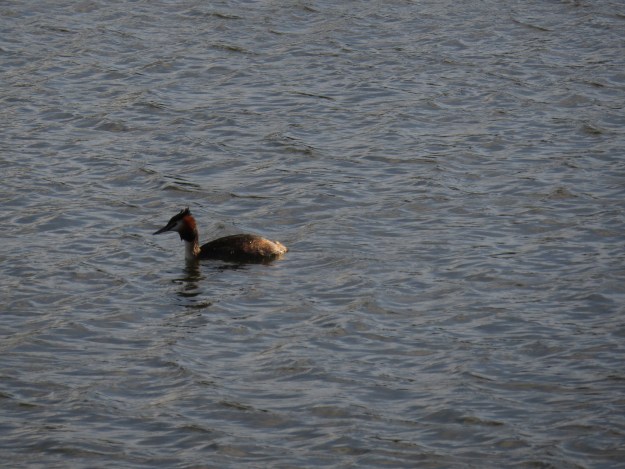
The great crested grebes were about, but not courting as far as I could see.

And while I was taking the ‘artistic’ (ahem) photo of the dead tree and the electricity pylon below, a lady stopped us to tell us that there was a peregrine falcon perched near the top of the ironwork. There then proceeded a long discussion on where exactly it was. Everyone could see it except me, until it flew off of course. So I did see it, but didn’t capture it for you. Sorry peeps!

The gorse is in flower, as it usually is…

and I was much taken with the alder trees. Small birds adore those little cones, and they have catkins at the same time. If I had room in my garden for another tree (which I definitely don’t) it would be an alder.

And look at this magnificent  chap! I love those leathery feet, and the frosted colouring on his head and neck.

And most of all, I love those sea-green eyes.

He stood there unperturbed while I faffed around with F-stops and such, the perfect subject. And he was still standing there when we headed home, anxious to get back to somewhere solid with no flying debris before Storm Eunice kicks off. Wish us luck, people! Hopefully this won’t be a repeat of the Great Storm of 1987, when we lost an estimated 15 million trees.

Wednesday Weed (on Thursday) – Chickpeas

Photo One by Serife Gerenschier (bluecherry.at), CC BY 3.0 <https://creativecommons.org/licenses/by/3.0>, via Wikimedia Commons

Chickpeas (Cicer arietinum) (Photo One)

Dear Readers, is there any food more versatile than the chickpea? This little legume has, along with the lentil, been the mainstay of civilisations all around the Mediterranean and beyond since at least Neolithic times, and if you want to get into a delicious culinary argument, just ask someone who makes the best falafel, or where to buy the best hummus. For Greece, Turkey, Egypt, and all the countries of the Middle East right through to the Indian subcontinent,  the chickpea is one of the most important staple foods, turned into purees, fritters, pancakes and dumplings, flavoured with everything from garlic and lemon to tamarind and turmeric. In Italy the chickpea turns up as farinata, a delicious egg-free pancake, and in Mexico and the islands of the Caribbean it can be found as a spicy street food. If you go to the grocery shop you can have enough protein for several hearty main meals for less than a pound and chickpeas also freeze well once cooked.

I must confess to a special love for the chickpea, because my husband has probably eaten several tubs of hummus every week for the past twenty years. I have even caught him eating it surreptitiously by the spoonful straight from the fridge. Luckily, I would agree with Nicolas Culpeper the herbalist, who says that chickpeas are less ‘windy’ than dried peas, and more nourishing.

It occurred to me, though, that I had no idea what a chickpea plant looked like – as with so many foods, the actual production takes place somewhere else. It cheers me greatly that the English company, Hodmedods, is looking at restoring the reputation of some of the UK’s native beans, such as field beans, which are well-suited to our climate, but they have also recently started to grow their own chickpeas. Hooray! So maybe we’ll soon see these little chaps growing in our fields (although there are also some wild ones who have presumably popped up from spilled bird seed or human food).

Has anyone out there tried growing some of these beans? I somehow forget that what we’re eating are seeds, and that if plonked in a pot they might turn into something interesting.

Photo Two by H. Zell, CC BY-SA 3.0 <https://creativecommons.org/licenses/by-sa/3.0>, via Wikimedia Commons

Chickpea plant (Photo Two)

As you can see, the chickpea plant looks very much a typical ‘bean’, with those pinnate leaves. The flowers are even more of a giveaway. Incidentally, the plant’s scientific name, Cicer arietinum, is thought to have given rise to the Classical name Cicero.

Photo Three by Forest & Kim Starr, CC BY 3.0 US <https://creativecommons.org/licenses/by/3.0/us/deed.en>, via Wikimedia Commons

Chickpea flowers (Photo Three)

Chickpeas are a nutrient-dense food, with a 100 gram serving providing over 20% of an adult’s daily requirement for protein, fibre, iron and phosphorous. However, they have also been used medicinally: Pliny the Elder suggests that the way to treat warts is to touch each one with a chickpea during the new moon and to then throw the chickpea over the shoulder. One way to cure gout was to soak the feet in the water that the chickpeas had been cooked in. These days we know that this water can be used to make an egg-free meringue, which makes sense if you think about how full of protein this substance is. For the sceptics among you, there’s a recipe for vegan meringues here, and very pretty they look too.

Photo Four from https://www.bbcgoodfood.com/recipes/vegan-meringues

Vegan meringues (Photo Four)

Although chickpeas are very widely grown in cultivation, they come originally from a tiny area of Anatolia in what is now Turkey. They are thought to be descended from the wild chickpea, Cicer reticulatum, and there were several varieties even before the plant was domesticated. These days you can buy black chickpeas, green chickpeas and the more usual golden chickpeas. I’m fairly sure that if blindfolded I wouldn’t be able to tell the difference.

Photo Five by By Sanjay Acharya - Own work, CC BY-SA 3.0, https://commons.wikimedia.org/w/index.php?curid=3131388

Different varieties of chickpeas (Photo Five)

And finally, a poem. There is a poem by Rumi in which he envisions a conversation between a poor chickpea being boiled and the cook who has put it there, but it seems to have a view akin to ‘that which doesn’t kill us makes us stronger’, a sentiment that I loathe with every fibre of my being, along with ‘everything happens for a reason’. No, sometimes terrible things happen, and people are shaped in ways that hinder the rest of their lives by those things. But I do rather like this poem by Lauren Whitehead, which feels appropriate to the season, and mentions a tin of garbanzos, which is the US term for chickpeas, so I think I can get away with it. Let me know what you think, readers.

Not Everything Is Sex
BY LAUREN WHITEHEAD

Okay
Tell that to the palm

of this Black man’s hand
ever so slightly cupped

and carrying in its bend
the finger tips of another

Black man, both of them
arms stretching upward

toward the sky, measuring
their reach against one another

on a basketball court
in Brooklyn, in spring

Okay
Spring

And when I say spring
I mean bee-buzzing-near-a-pink-bud-

almost-bursting spring
tantric spring

everyone-outside-in-three-
quarter-sleeves-despite-the-virus-

buzzing-near-our-tongues
spring So you can’t tell me

it’s not sex Cause it’s not not sex
The risk of all this tenderness

all this giving of ourselves
all this inside on the outside

open, vulnerable I know sex
when I see it and I see it

everywhere: lips on the nipple
of a soft serve, an arm fist deep in

a grocery store shelf, digging
for the last can of garbanzo beans

It’s not not a ménage à trois
these three men snuggled

in the front seat of a moving
van, singing bachata

dancing from the hips up
in the window, open

throats open, their whole necks
to the wind, reckless

reckless, I tell you, full on
abandon So say what you will

about transmission
about fluid, skin to skin

about the necessary things
that make the deed the deed

I don’t care cause it’s spring
and I’ve never seen anything so intimate

as this touch still taken
in the face of an apocalypse

Photo Credits

Photo One by Serife Gerenschier (bluecherry.at), CC BY 3.0 <https://creativecommons.org/licenses/by/3.0>, via Wikimedia Commons

Photo Two by H. Zell, CC BY-SA 3.0 <https://creativecommons.org/licenses/by-sa/3.0>, via Wikimedia Commons

Photo Three by Forest & Kim Starr, CC BY 3.0 US <https://creativecommons.org/licenses/by/3.0/us/deed.en>, via Wikimedia Commons

Photo Four from https://www.bbcgoodfood.com/recipes/vegan-meringues

Photo Five by By Sanjay Acharya – Own work, CC BY-SA 3.0, https://commons.wikimedia.org/w/index.php?curid=3131388

One of Those Days….

Dear Readers, today has been one of those days when you spend your whole time careering from one minor crisis to another, like a pinball ricocheting around between flashing lights and twitching switches. Hah! No wonder none of us have any focus any more, when we’re at everyone’s beck and call from the moment we turn on our laptops. So I had plans to do you a post on that most magnificent of legumes, the chickpea, in honour of my husband’s favourite food, but that will have to wait. Instead, here is a telegraph pole from the cemetery, which has clearly been treated with some kind of preservative, which is now peeling off in a most intriguing way. What can you see in the photo above? I see a most benign one-eyed elephant.

There are several animals in this one, maybe some fox cubs peering around from behind a tree trunk?

And I do believe I can see a rather miserable fish in this one. But do let me know what you see, if anything. There’s something about exercising the imagination that always cheers me up.

A Most Unusual Visitor

Dear Readers, some of you reading this from North America might be wondering what all the fuss is about, but for those of us in the UK there’s real excitement at the appearance of an American Robin (Turdus migratorius) in Eastbourne on the Sussex coast.  The bird is apparently healthy and is demolishing the cotoneaster berries in a suburban backyard, holding its own amongst the blackbirds and the last of the redwings. And while it’s easy to be sniffy about ‘twitchers’, for many people this will be a rare chance to see a North American bird without jumping on a plane. The local residents have apparently been very understanding about all these chaps turning up with their telescopes and long lenses, and have set up a Gofundme to encourage the people who’ve travelled to donate to Eastbourne Foodbank.

Photo One by By Arustleund - Own work, CC BY-SA 3.0, https://commons.wikimedia.org/w/index.php?curid=32745016

Photo One

Although this is an unusual case, it’s not unknown for American Robins to turn up in Europe, and in particular in the UK – there have been 28 recorded cases, with the latest being a bird that arrived in Devon in 2018. American Robins migrate; from the end of August they head south from Canada and the northern USA, and in February they start heading back north. It’s thought that this bird was somehow nudged rather further east than expected due to weather conditions, and has ended up in a Sussex garden. It seems happy enough (often windblown birds are damaged and sick by the time they make landfall), but of course this bird won’t be able to breed unless there’s a miracle and a female turns up too.

And so, good luck, American Robin! In 2003 three American Robins turned up and even tried to stay for the winter, though one of them was killed by a sparrowhawk. It will be interesting to see what happens to this bird.

Photo Credits

Photo One by By Arustleund – Own work, CC BY-SA 3.0, https://commons.wikimedia.org/w/index.php?curid=32745016


A Spring Walk in St Pancras and Islington Cemetery

Dear Readers, one thing about feeling under the weather for a while is how glorious it feels when you finally feel better. And so it was that this morning’s walk in St Pancras and Islington Cemetery felt thoroughly new-minted, as if spring had gotten going in the fortnight since my previous walk. What I think is a Cherry-crab (Malus x robusta)  is just about coming into blossom, and very beautiful it is too, with the flush of pink at the centre and the almost purple buds.

I noticed a biggish thrush heading off into the treetops, and there was something about the way that it swooped that made me think it wasn’t one of the song thrushes that is often seen in this part of the cemetery. I gave many thanks for my x50 optical zoom on the camera, because this is a fieldfare, the first one that I’ve seen this year. These are big, bold birds, who will take on all comers in the garden. I love the frosted grey on the head, and the wings are a very dark red/brown. This one will be heading back to Scandinavia in a week or so, as the winter visitors head home and the spring ones arrive.


I had to stop by my favourite group of graves, which is absolutely alive with snowdrops at this time of year. Someone, once, probably planted just a few bulbs, and look at them now.

But in shady part of the cemetery there’s a much more unusual bulb coming into flower – Spring Snowflake or Loddon Lily (Leucojum aestivum). At first glance it looks much like a snowdrop, but the flowers are shaped like little hats.

But what is always glorious at this time of year is the crocuses along Kew Road. In truth, crocuses do best in full sunlight, so they always have a very delicate, etiolated look to them here, as if reaching languidly towards the sky. They are here, and then they’re gone, but they make a very fine sight.

On Withington Road there’s another area where the snowdrops have been left to do their own thing, and I love how they are gradually advancing across the forest floor.

A few of the daffodils are getting ready to pop too, though we’ll have to wait a while for the bluebells, which seem to be only just getting going. And I don’t know if the lesser celandine haven’t had a good year, or if they haven’t really got started yet, but they were noticeable by their absence.

So, it was so good to be back outside again – I always feel like I’m going slightly bonkers if I don’t get outside the house at least once a day. And as today (Sunday) is windy, cold and pouring with rain, I’m glad that I got some sunshine too.

Sunday Quiz – Who’s That Lady?

Photo One by Richard Bartz by using a Canon EF 70-300mm f/4-5.6 IS USM Lens - Own work, CC BY-SA 2.5, https://commons.wikimedia.org/w/index.php?curid=6449086)

Male and Female Mallards (Photo One)

Dear Readers, with Valentine’s Day coming up tomorrow, my thoughts turned (as they do) to sexual dimorphism in birds. Why is it that in some species (like the Mallards in the photo above) the male and female look completely different, while in others (like most geese) the sexes look identical? One theory is that this relates, in part at least, to the male’s ‘fitness’, and in particular his parasite load – if the male is beautifully coloured, chances are that he’s also healthy. And females clearly tend to choose the healthiest males. In species where the males play no part in rearing the offspring, they can afford to be highly ornamented, but the differences might be toned down where, as in many song birds, the males are essential to the survival of the chicks. Also, in some birds the sexes look identical but have complex breeding displays (such as those of many grebes) which will also show how fit the ‘dancers’ are. In short it’s a very complex area, and I’m sure for all species there is an intricate balance to be calculated between survival of the individual, and the passing on of genes. Let me know if you have any theories! I am just starting to feel well enough to exercise my brain again.

Now, to the quiz. Here are some female birds that look very different from their male counterparts, but what species are they? Just choose the name of the bird from the list below and match to the photo. So, if you think the bird in Photo A is a chaffinch, your answer is 1)A. I have chosen just two groups, songbirds and raptors, but I think this is mega-tricky (and after me promising to be kind this week too). Let’s see how we all get on.

All answers in the comments by 5 p.m. UK time on Friday 18th February please, and the results will be posted on Saturday 19th February. I will disappear your answers as soon as WordPress is kind enough to let me know about them (or probably sooner as they have been remarkably tardy just lately).

Onwards!

Bird Species

  1. Chaffinch (Fringilla coelebs)
  2. House sparrow (Passer domesticus)
  3. Siskin (Carduelis spinus)
  4. Greenfinch (Chloris chloris)
  5. Blackcap (Sylvia atricapilla)
  6. Redstart (Phoenicurus phoenicurus)
  7. Pied Flycatcher (Ficedula hypoleuca)
  8. Sparrowhawk (Accipter nisus)
  9. Common Kestrel (Falco tinnunculus)
  10. Merlin (Falco columbarius)
Photo A by Sudhirggarg, CC BY-SA 4.0 <https://creativecommons.org/licenses/by-sa/4.0>, via Wikimedia Commons

A)

Photo B by sighmanb, CC BY 2.0 <https://creativecommons.org/licenses/by/2.0>, via Wikimedia Commons

B)

Photo C Image by <a href="https://pixabay.com/users/theotherkev-9436196/?utm_source=link-attribution&utm_medium=referral&utm_campaign=image&utm_content=5848189">TheOtherKev</a> from <a href="https://pixabay.com/?utm_source=link-attribution&utm_medium=referral&utm_campaign=image&utm_content=5848189">Pixabay</a>

C)

Photo D by gailhampshire from Cradley, Malvern, U.K, CC BY 2.0 <https://creativecommons.org/licenses/by/2.0>, via Wikimedia Commons

D)

Photo E by Marton Berntsen, CC BY-SA 4.0 <https://creativecommons.org/licenses/by-sa/4.0>, via Wikimedia Commons

E)

Photo F by Alexis Lours, CC BY 4.0 <https://creativecommons.org/licenses/by/4.0>, via Wikimedia Commons

F)

Photo G by David Friel, CC BY 2.0 <https://creativecommons.org/licenses/by/2.0>, via Wikimedia Commons

G)

Photo H by Zeynel Cebeci, CC BY-SA 4.0 <https://creativecommons.org/licenses/by-sa/4.0>, via Wikimedia Commons

H)

Photo I by Jerzy Strzelecki, CC BY 3.0 <https://creativecommons.org/licenses/by/3.0>, via Wikimedia Commons

I)

Photo J by Cephas, CC BY-SA 3.0 <https://creativecommons.org/licenses/by-sa/3.0>, via Wikimedia Commons

J)

Sunday Quiz – A Bouquet of Flies – The Answers!

Female striped horsefly (Tabanus lineola) by Thomas Shahan (From https://www.flickr.com/photos/opoterser/4915106328)

Dear Readers,  I think this was a mega-tricky quiz, so thank you to Sarah and to Fran and Bobby Freelove who all had a go! Sarah got a most respectable 5/10, but Fran and Bobby managed 8/10. so well done, and I promise to be kinder tomorrow 🙂

Photo A by Frank Vassen from Brussels, Belgium, CC BY 2.0 <https://creativecommons.org/licenses/by/2.0>, via Wikimedia Commons

A) 7) Hornet Hoverfly (Volucella zonaria)

Photo B by Alvesgaspar, CC BY-SA 3.0 <https://creativecommons.org/licenses/by-sa/3.0>, via Wikimedia Commons

B) 8) House Fly (Musca domestica)

Photo C by By AfroBrazilian - Own work, CC BY-SA 3.0, https://commons.wikimedia.org/w/index.php?curid=26873272

C) 3) Golden Horsefly (Atylotus fulvus)

Photo D by gailhampshire from Cradley, Malvern, U.K, CC BY 2.0 <https://creativecommons.org/licenses/by/2.0>, via Wikimedia Commons

D) 10) Great Pied Hoverfly (Volucella pellucens)

Photo E by James Lindsey at Ecology of Commanster, CC BY-SA 2.5 <https://creativecommons.org/licenses/by-sa/2.5>, via Wikimedia Commons

E) 1) Giant Cranefly (Tipula maximus)

Photo F by Pjt56, CC BY-SA 4.0 <https://creativecommons.org/licenses/by-sa/4.0>, via Wikimedia Commons

F) 4) Banded General (Stratiomys potamida)

Photo G by jp hamon, CC BY-SA 3.0 <https://creativecommons.org/licenses/by-sa/3.0>, via Wikimedia Commons

G) 5) Dark-edged Beefly (Bombylius major)

Photo H by Rocktrotter, CC BY-SA 3.0 <https://creativecommons.org/licenses/by-sa/3.0>, via Wikimedia Commons

H) 2) St Mark’s Fly (Bibio marci)

Photo I by NobbiP, CC BY-SA 3.0 <https://creativecommons.org/licenses/by-sa/3.0>, via Wikimedia Commons

I) 9) Greenbottle  (Lucilia sericata)

Photo J by Charles J. Sharp, CC BY-SA 3.0 <https://creativecommons.org/licenses/by-sa/3.0>, via Wikimedia Commons

J) 6)  Marmalade Hoverfly (Episyrphus balteatus)

Photo Credits

Photo A by Frank Vassen from Brussels, Belgium, CC BY 2.0 <https://creativecommons.org/licenses/by/2.0>, via Wikimedia Commons

Photo B by Alvesgaspar, CC BY-SA 3.0 <https://creativecommons.org/licenses/by-sa/3.0>, via Wikimedia Commons

Photo C By AfroBrazilian – Own work, CC BY-SA 3.0, https://commons.wikimedia.org/w/index.php?curid=26873272

Photo D by gailhampshire from Cradley, Malvern, U.K, CC BY 2.0 <https://creativecommons.org/licenses/by/2.0>, via Wikimedia Commons

Photo E by James Lindsey at Ecology of Commanster, CC BY-SA 2.5 <https://creativecommons.org/licenses/by-sa/2.5>, via Wikimedia Commons

Photo F by Pjt56, CC BY-SA 4.0 <https://creativecommons.org/licenses/by-sa/4.0>, via Wikimedia Commons

Photo G by jp hamon, CC BY-SA 3.0 <https://creativecommons.org/licenses/by-sa/3.0>, via Wikimedia Commons

Photo H by Rocktrotter, CC BY-SA 3.0 <https://creativecommons.org/licenses/by-sa/3.0>, via Wikimedia Commons

Photo I by NobbiP, CC BY-SA 3.0 <https://creativecommons.org/licenses/by-sa/3.0>, via Wikimedia Commons

Photo J by Charles J. Sharp, CC BY-SA 3.0 <https://creativecommons.org/licenses/by-sa/3.0>, via Wikimedia Commons

Some Buds and a Poem

Dear Readers, I am clearly of a poetic turn of mind this week, and so, although it’s a couple of months too early, I wanted to share with you this poem by Philip Larkin, a misogynistic curmudgeon of a man who nonetheless had a gift for poetry that seems to capture something important about the human condition. It’s as if he’s creating something beautiful almost against his will.

I read this poem at my Mum’s interment, in May, under a cherry tree. The fourth line gets me every time.

The Trees (1974)
Philip Larkin

The trees are coming into leaf
Like something almost being said;
The recent buds relax and spread,
Their greenness is a kind of grief.

Is it that they are born again
And we grow old? No, they die too.
Their yearly trick of looking new
Is written down in rings of grain.

Yet still the unresting castles thresh
In full-grown thickness every May.
Last year is dead, they seem to say,
Begin afresh, afresh, afresh.