Monthly Archives: August 2022

The Capital Ring – Finsbury Park to Stoke Newington – Part One

Travellers’ Joy in Finsbury Park

Dear Readers, as you might remember a fortnight ago I started my peregrination around the Capital Ring, London’s 78 mile footpath that meanders around the Capital through Transport for London’s Zones 2 and 3. As it was in the low  temperature-wise last Saturday we skipped it like the no-hopers that we clearly are, but this week we retraced our steps to Finsbury Park and headed east. First up was the Traveller’s Joy/Old Man’s Beard along the path. This is the UK’s only native clematis, and I loved the way that it showed all the stages of its growth, from bud to full-blown seedhead.

Then it was off through Finsbury Park itself. This is a surprisingly large park, and as I reported last time it was established in 1862, to replace the pleasure gardens that were in the area before. A fairground was setting up in the distance as we walked past, and the park is host to music festivals and all kinds of community events during the year. This time there was no sign of the random drummer, but there was a hip-hop dancing class led by a very enthusiastic chap in his fifties. It appeared that I was a smidge too early for the Latino Life festival which is being held this weekend, and it only costs a pound too.

Magnificent old planes in Finsbury Park

There is a small flower garden, known as Mackenzie Gardens, which is named for Alexander Mackenzie. He landscaped the original park back in the late nineteenth century, and was also involved in the design of the Victoria Embankment and Southwark Park. The flowerbeds are being restored to their original colours.

Like many urban parks, Finsbury Park felt pretty safe with an edge of what my Canadian friends describe as ‘sketchiness’. Unfamiliar ground is always slightly more alarming than places that you know – I’m sure people who are unfamiliar with my beloved Coldfall Wood might find it a bit eerie and dark. Still people seem to be relaxed, there are lots of play areas for children of all ages, and on a sunny day it feels as if everyone is just out to enjoy themselves and chill out.

Mature trees in Finsbury Park


On the way out of the park, I saw this poor tree with the most extraordinary damage to its trunk – it’s obviously an old wound, and from the way that it zigzags down the trunk I wondered if it was a lightning strike.

And yet, the amazing thing is that the tree is in full leaf and looks to be doing very well in spite of its injury. I love the resilience of these amazing plants.

Leaves on the wounded tree.

Then we leave Finsbury Park and cross Green Lanes (named because this rather daunting A Road was once a tangle of meandering tracks that led to local village greens, hence the plural). At this point, the Capital Ring joins the New River Path. The New River isn’t a river, and it isn’t new – it is an artificial water course, finished in 1613 and designed to bring fresh water from Ware in Hertfordshire to the burgeoning city of London. It was designed by a Welsh engineer, Sir Hugh Myddleton, and over its 40 mile course it drops just 2 inches every mile, so that the water flows along due to gravity. These days the water doesn’t go any further than the reservoirs at Stoke Newington, apparently (though I do wonder where the water that flows through the Islington leg of the New River comes from in that case). But honestly, on a lovely summer’s day I wonder if there is a more peaceful spot in the whole of London.

As we wander along, the air is filled with the cries of almost fully-grown cootlets (a word that I just made up). How pathetic they sound, and how glad their parents will be to see the back of them! I’m sure that the one below is well able to fend for his or herself at this point. I love the water droplets on his/her back, showing just how water-resistant their plumage is.

This mother duck seems to have just a single duckling, and both parties were travelling at great speed.

This flotilla of mute swans glided past, partially concealed by the reeds, and they were so quiet that I didn’t notice them until they’d nearly gone.

As we journey on, the other side of the New River becomes rather more industrial. What is OCC, for example?

Well, my friends, it is the Oriental Carpet Centre. I can find out nothing about it except that in one Google review, someone mentions that it has really violent security guards. Maybe check the opening hours before visiting.

After crossing the Seven Sisters Road, we walk alongside the New River and beside the Woodberry Estate, once the largest council housing complex in Britain but now a mixture of public and private housing. I’ve written before about how a new bright and shiny estate is being built here, and how the residents of the old estate have largely been written out of the picture, as usually happens. The Guardian did a series of interviews with people involved in the project and it makes for a very interesting read. When I look at the faces and hear the accents, it takes me back to growing up in the East End of London sixty years ago. These are my people, and it feels as if we’re becoming an endangered species. But then, London has always changed, always morphed into something new. Who knows what will come next? Certainly the young moorhens and mallards on the other side of the New River have no idea, and neither do I.

We cross Lordship Road and walk alongside the East Reservoir, now part of the Woodberry Wetlands Nature Reserve. Look at these rather fancy apartment blocks!

Some of the old machinery and buildings that were used to control the flow of water into and out of the reservoir still remain.

And how about this rather fine view south? The blooming Shard seems to photobomb every photo looking south.

And of course this wouldn’t be a Bugwoman blog without one of our insect friends, so here is a particularly fine hoverfly – I think Volucella inanis rather than the hornet-mimic hoverflies that I’ve been commenting on for weeks. This is a female (as you can tell by the yellow ‘gap’ between the eyes). What a spectacular critter she is, and this species is pushing north at a rate of knots, so you’ll probably spot her soon. As with the closely-related hornet-mimic hoverfly, the larvae of this species live in wasp nests, but unlike those of the hornet-mimic, who largely live on detritus and are a generally good thing for the wasps, these cheeky larvae actually eat the wasp grubs, and are specially flattened so that they can wriggle into the cells which protect them.

Volucella inanis

Anyway, by now we’re getting hungry (it must be a full two hours since we’ve eaten anything, poor things that we are) and so we detour into the café of the Wetlands Centre, where I have what is possibly the best smoked salmon and cream cheese bagel with pickled cucumber that I’ve ever had in my life. Swallows are skimming the water, I think I spot a yellow wagtail, and an emperor dragonfly is patrolling the weeds. What a splendid walk the Capital Ring is! I had forgotten how much green space there is in London, and how lucky us Londoners are. And so, I will leave you for today with a few photos of the lovely new flats that have sprung up next to the reservoir, unaffordable though they are by most of the people who used to live in the Council Houses with this magnificent view.

After the Rain at Barnwood

Dear Readers, it’s always interesting to see what has and hasn’t thrived during the drought of the past few months. At the Barnwood Community Orchard, some of the trees and fruiting shrubs are still doing very nicely, even the recently planted ones (largely due, I suspect, to the care and attention given to them by the volunteers at the site. On the other hand some plants, such as the hazel to the left of the photo, are covered in crisp brown leaves and look very sorry for themselves. I wouldn’t give up hope just yet, though – native shrubs such as this can be very resilient, and it’s more  than possible that it will resurrect itself after the recent rains.

Many of the other plants are looking very healthy. This guelder rose (Viburnum opulus) is full of berries. What good value this plant is, with its white flowers in spring, its red fruit in late summer and its fine golden colour in the autumn. It’s also one of the national symbols of Ukraine, and so it couldn’t be more appropriate.

I love the way that small fruit trees look when they have a few pears or apples on them – they often look almost overwhelmed by what they’ve produced. This little apple is called ‘Ellison’s Orange’, and is apparently a cross between Cox’s Orange Pippin and a variety called Cellini. It’s said to develop an aniseed flavour in storage (unlikely to be a problem this year as I imagine these apples will get munched up very quickly), and to be more disease-resistant, and juicier, than Cox’s. However, it is said to be prone to apple canker (a fungal disease of apple trees that attacks the bark) and therefore requires good drainage. The variety was first seen in 1905, and is believed to have been developed by C.C. Ellison, a Lincolnshire priest who clearly had a fondness for apples.

Ellison’s Orange

Now, as usual I was keeping my eyes open for invertebrates, and I found a very fine spider on some dried-up teasel. It seemed to be feeding on a shieldbug nymph, and at first I thought it was something exotic – look at that lovely lacy pattern on the abdomen.

But no, this our old friend the Noble Spider (Steatoda nobilis) – I normally have a couple of these living in my sash windows in the kitchen. The good folk at the UK Spider Identification Group on Facebook, along with many other people, have been trying to rehabilitate this rather fine spider by changing its common name from ‘Noble False Widow Spider’, which was rather playing into the sensationalist headlines of the tabloid press. Schools have been shut down because of this spider, people have accidentally burnt down their houses by trying to get rid of them with flame throwers and they have been blamed for people losing their limbs.

It’s true that they can bite, but only if provoked or trapped next to skin, and in most cases the result is no worse than a wasp sting. There have been cases of infections after ‘spider bites’, but this would be the case with any puncture wound, and in none of the cases has the initial cause been proven. In short, if you leave these guys alone (the male is more prone to bite, but only because he wanders further in search of a mate, and is therefore more likely to come into contact with people), and just admire them from a safe distance everybody will be ok. And just think of all the midges and mosquitoes and houseflies that they consume! Spiders are some of my favourite house guests, and I don’t even need to change the bed.


And finally, here is a Barnwood-related puzzle. A moth trap has been run in Barnwood for several months, but when Leo, custodian of all things Barnwood-related, opened the trap to inspect it a few days ago, he found that all  the Jersey Tiger moths had been beheaded and partially eaten. What could be causing this crime? We did wonder if the culprit was the mosquito who was found alongside the ‘body’, but only briefly.

Jersey Tiger with completely innocent mosquito

The murderer is likely to be a wasp – they are voracious hunters, and I believe that they can learn about food sources, and how to exploit them. They may even communicate with one another to reveal where food is. Leo is currently considering how to manage this new problem – he notes down the moths that he finds and releases them safely, but has never had dead moths before. It will be interesting to see what happens next.


After the Rain

Scabious

Dear Readers, we have finally had some rain over the past few days, and everything in the garden seems to have uttered a sigh of relief. We opened the front door midway through the first downpour to find several frogs hopping around – I have a suspicion that they’ve been waiting for some dampness to disperse. Certainly the pond is a lot quieter now than it was.

I still think that the hawthorn is outdoing itself, though, I have never seen it so heavy with berries. No wonder the area under the trees is bone dry, they must be using all the moisture for themselves, and who can blame them? I have terrible trouble finding something that will thrive under them after the spring bulbs are finished though. I suspect that some more soil improvement is key, but let me know if you’ve planted anything in a very dry shady area that works for you from mid-summer onwards. Gardening is such a lot of trial and error!

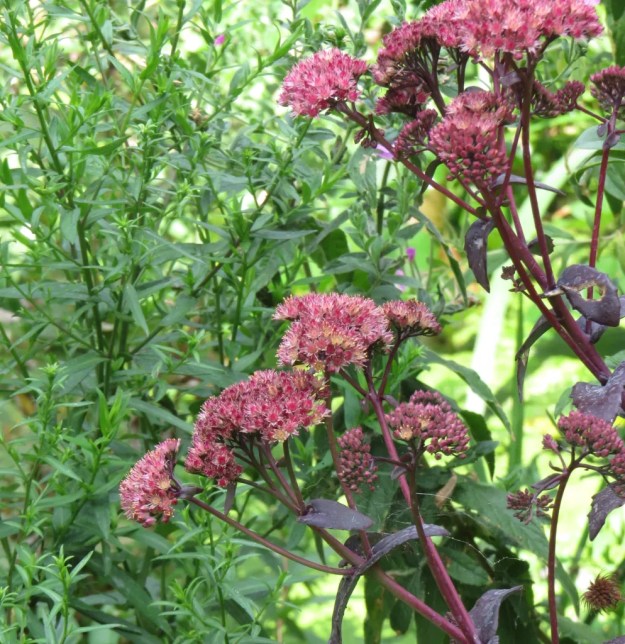
So, what else is in flower? Well the hemp agrimony – one plant is now just covered in rather untidy brown seeds, but the other two plants, which are in shadier spots, are still going well. The great willowherb is in full flower, and very pretty it is too.

My sedum (sorry, hylotelephium, old habits die hard) is coming into flower – what a bonus it is in late summer when everything else is going over! Bees and hoverflies seem to love it.

And how about this rather handsome fly? This is Xylota segnis, a hoverfly, although it spent more time leaping from leaf to leaf than flying. Apparently it doesn’t visit flowers and spends most of its time sitting around or scuttling across leaves collecting honeydew. Look at those massive compound eyes! Clearly this is a creature that it would be difficult to swat, should you be unkind enough to want to do so.

The fly would be very happy on my buddleia which is still dripping honeydew and has attracted a small army of flies and wasps. Every time I think about cutting it back it throws out some more flowers and all the butterflies, so I don’t have the heart.

Xylota segnis

So, how are you all doing, Readers? Has the drought played havoc with your courgettes? Have your runner beans keeled over? Let me know your news, good and bad.


A Tiny Pollinator

Common Furrow Bee (Lasioglossum calceatum)

Dear Readers, one great thing about the hemp agrimony around my pond is that it not only attracts masses of hoverflies, bees and butterflies, but that it’s also at a convenient height for me to get a good look. And so it was that this tiny bee, only 7 mm long, suddenly came to my attention. I had thought that it was a hoverfly, but close up it’s clearly not – it has those almond-shaped eyes that bees have, rather than the big round compound eyes of flies. Plus, it was gathering pollen at an astonishing rate, although as this is a male it must have been for his own consumption.

Bees in the Lasioglossum family might be more familiar to some of my overseas readers as ‘sweat bees’ – I certainly came across some tiny bees in Cameroon that were harmless but a bit of a nuisance. You couldn’t take a mouthful of food without getting a mouthful of bees which was very unpleasant for everyone concerned. However, this Common Furrow Bee (Lasioglossum calceatum) is a pure nectar and pollen feeder, and didn’t give me a second glance.

What is particularly striking about the males is that their abdomens look metallic, and in some they have these red and gold stripes. I’m fairly sure that I also saw some males who were black with gold stripes.  What handsome creatures they are! The females may nest together in aggregations, like solitary bees, usually in light soils, but they have also been observed in some areas as being ‘primitively eusocial’ – this means that there is some evidence of the development of workers and queens with distinct roles. The consensus is that in the north of the UK, where the flight season is a lot shorter, the bees tend to be solitary, probably because they don’t have time to rear workers and build up a nest.What ‘normally’ happens is that a single female will dig a long vertical tunnel with a tiny lateral chamber at the end, into which she will lay 4 to 7 eggs. She will then rush around feeding these larvae until they are old enough to take over the foraging, whereupon she will lay some more eggs that will develop into fertile females and males. Any resulting queens will overwinter as adults, ready to start breeding and pollinating again as early as the following March.

The Lasioglossum family contains over 1700 species worldwide (with about 30 species in the UK), and it’s fascinating to me that these creatures are showing such a wide variety of behaviours.

The males show a strong preference for flowers in the daisy family, so it’s not surprising to find one on this plant. Apparently the males sometimes ‘roost’ on flowerheads overnight – I shall have to have a look when the evenings draw in. The Common Furrow bee is one of the last of the solitary bees to cease flying in the autumn, with the last appearing as late as October.

We tend to think of bees as being large showy buzzy animals, but these little bees go about their business with a minimum of fuss, and if one ventured into your house I doubt if you would even notice. And yet, they are extremely active pollinators – the one in the photo didn’t stop flitting from one flower to another for the whole twenty minutes that I was watching. It really is the little critters that run the world.


Wednesday Weed – Abelia

Photo One by Photo by David J. Stang, CC BY-SA 4.0 <https://creativecommons.org/licenses/by-sa/4.0>, via Wikimedia Commons

Abelia x kaleidoscope (Photo One)

Dear Readers, as I wander the dry and dusty streets of East Finchley there is one plant that I can usually hear from several metres away, as it is usually covered in bees, and that’s the abelia. There is one outside my friend A’s house which is actually more of a small tree at this point (and none the worse for it) and there is another, smaller shrub on Summerlee Avenue. Both of them have a delicious scent, to my nose midway between jasmine and honeysuckle, and the latter perfume is not surprising, as abelia are members of the honeysuckle family. The genus includes about 30 species and hybrids. Some are evergreen, and some are deciduous, but the plant occurs in two distinct ranges, with some coming from Mexico and Central America, and others coming from Asia (Japan west to the Himalayas). In both areas, the tropical species keep their leaves all year round, while those in temperate areas lose theirs.

Photo Two by By A. Barra - Own work, CC BY-SA 4.0, https://commons.wikimedia.org/w/index.php?curid=3995941

Chinese abelia (Abelia chinensis) (Photo Two)

My Gardening for Wildlife book (by Adrian Thomas) waxes lyrical about both the forms of abelia pictured above, but rates the Chinese abelia slightly higher because of its ‘pulling power’ for butterflies. Both are said to need a sheltered and sunny spot, and clearly they do well on London’s clay soil.

Abelia is named after Clarke Abel, a naturalist and surgeon who accompanied Lord Amherst on his diplomatic mission to China in 1816-17. While Lord Amherst was being diplomatic, Abel was collecting the seeds of the plant that would bear his name. Alas, on the trip home Abel’s ship was attacked by pirates and subsequently wrecked, so he lost all of his prized plants. Fortunately, he had left some abelia with a friend in Canton, and these were eventually returned to him in the UK.

Clarke Abel (1780 – 1826)

Abel was also the first European to report the presence of orang-utans on Sumatra, and the animal also now bears his name.

Photo Three by By Tbachner - first upload in de wikipedia on 20:19, 10. Feb 2006 by Tbachner, Public Domain, https://commons.wikimedia.org/w/index.php?curid=727180

Sumatran orang-utan (Pongo abelii) (Photo Three)

And Abel was also the first European to report on the existence of the Tibetan antelope, or Chiru. This vanishingly-rare animal was driven almost to extinction because of its soft, warm underfur, which is woven into highly-prized shawls known as Shahtoosh in areas of Kashmir.

Photo Four by By 6-A04-W96-K38-S41-V38 - Own work, CC BY-SA 4.0, https://commons.wikimedia.org/w/index.php?curid=39336592

Tibetan Antelope (Photo Four)

Medicinally, abelia has been used in India to treat blood in the urine – the seeds are boiled in buffalo milk and the resulting concoction is drunk daily for three days. The roots are thought to have anti-bacterial properties.

Although I can see no real evidence of abelia being edible, the flowers are certainly sold, vacuum-packed, for 8 euros, and can be used for salads, cocktails, desserts etc etc. The flowers are said to taste slightly of honey which is not surprising, considering how nectar-rich they are.

Photo Five by Photo by David J. Stang, CC BY-SA 4.0 <https://creativecommons.org/licenses/by-sa/4.0>, via Wikimedia Commons

Abelia x grandiflora ‘Confetti’ (Photo Five)

I keep reading that Abelia is symbolic of equality in Mexico, but this is one of those Wikipedia statements that just goes round and round with no source material ever cited, so it would be interesting to find out how accurate it is. However, one thing that has become abundantly clear is that Abelia is a very popular girl’s name, and this has wreaked havoc with my attempts to find a poem that actually mentions the plant, rather than being written by an Abelia. But then, I found this, by Robin Davidson, a poet who teaches Creative Writing in Houston.  See what you think.

LISTEN
…………..for Tony

Where do we go from here, where will the light across the cornice
of our love lead us, you and I, after the carnal breath?
Amaryllis and orchid tree, abelia and hawthorne, bougainvillea trailing
thorns and blossoms. We have made a desert of stones flower
at a seventy-year-old house’s edge. How long will a dying voice
shake this soil? Our bodies in laughter, dance? When will these shoulders
be clouds instead, a shroud, a swaddling, to meet some lake of things
we’ve known by heart. At this window, I watch the western cerulean sky
become blood-rose, study this pause which is not yet night,
the constellations still invisible. A bright memory is on the horizon,
postponed but nearer. We are here, nestled now in the furniture of
a house that speaks, doubles our love. Listen.

Photo Credits

Photo One by David J. Stang, CC BY-SA 4.0 <https://creativecommons.org/licenses/by-sa/4.0>, via Wikimedia Commons

Photo Two By A. Barra – Own work, CC BY-SA 4.0, https://commons.wikimedia.org/w/index.php?curid=3995941

Photo Three by By Tbachner – first upload in de wikipedia on 20:19, 10. Feb 2006 by Tbachner, Public Domain, https://commons.wikimedia.org/w/index.php?curid=727180

Photo Four by By 6-A04-W96-K38-S41-V38 – Own work, CC BY-SA 4.0, https://commons.wikimedia.org/w/index.php?curid=39336592

Photo Five by David J. Stang, CC BY-SA 4.0 <https://creativecommons.org/licenses/by-sa/4.0>, via Wikimedia Commons

The Lesser of Two Weevils?

Listronotus elongatus, the pennywort weevil (Photo Credit CABI from New Scientist (see article link below)

Dear Readers, I cannot tell you how delighted I am to have finally had the chance to use ‘the lesser of two weevils’ as my post title. I have been waiting since 2014 when I started the blog to make a really terrible pun, and here it is. But what we have here is another example of bioremediation, where an alien organism (usually a plant) is combatted with another alien organism (in this case, a weevil) in the hope that the results won’t be worse than the initial problem.

The problem here is a water plant called floating pennywort (Hydrocotyle ranunculoides), which is native to North and South America. Unfortunately it became popular as a pond plant and promptly escaped, choking watercourses up and down the land and being a general pest. As invasive species are estimated to cost the UK along up to 1.7 billion GBP per year, it’s clearly worth thinking about creative ways of dealing with the problem, but all of us will remember the law of unintended consequences, such as the release of harlequin ladybirds, originally brought in to tackle aphids but ending up being predators of other ladybird species. Is it possible to stop this kind of thing happening again?

Floating pennywort doing it’s ‘thing’ on the River Soar in Leicester

It’s clear that our weevil has been carefully selected.  In South America, the adult insect eats the leaves, but the larvae eat the stalks from the inside out. The weevils were first deployed in the UK last winter, and everyone seems want some, from Hertfordshire to Yorkshire. Plus, the Dutch have a similar problem with the plant and are also keen to get their hands on some weevils.

Any creatures that are being considered as biological controls are assessed in the UK by CABI (the Centre for Agriculture and Bioscience International. Before the weevils are released, they were assessed on the ten or so plants that grow next to floating pennywort, to make sure that they wouldn’t eat them. They were then tested on another 70 possible target plants that are found in the UK. Amongst the tests was the ‘no-choice’ test, where the poor long-suffering weevils are only presented with a single species of plant, and will basically starve if they don’t eat it. This sounds rather like my cat being presented with a different variety of cat food – I am fairly sure that she would starve rather than eat something inferior. Fortunately, I don’t put her to the test.

Floating pennywort on a pond in Anglesey (Public Domain)

Once the weevils were considered to be very floating-pennywort-specific in their tastes, a licence was granted by the UK government, which allows for releases over the nest three years.

The next question is, will the weevils establish themselves, or will it be a case of ‘ see no weevil”? You might remember (or possibly not) that some sap-sucking bugs were released in 2010 to help to clear up Japanese Knotweed, and we can all see how effective that was (ahem).

The Japanese Knotweed bug (Aphalara itadori) (Photo from CABI)

Maybe we’ve just been singularly unlucky here in the UK – worldwide, according to New Scientist, of the 468 organisms released in 90 countries, 71 per cent established themselves, and 55 per cent caused medium or heavy damage to the target species that they were meant to be controlling. Less than ten per cent of biological control organisms target species that they weren’t meant to, and it seems that, with tests like those outlined above, we’re getting better at making sure that only the plants that are meant to get eaten get eaten.

The folk at CABI will be cheerfully breeding and rearing weevils in their hundreds of thousands now that the licence has been given. Let’s wish them (people and insects) the best of luck!

You can read the full New Scientist article here

A Very Fine Bug

Dear Readers, one of the advantages of being a lover of invertebrates is that, during this hot weather, all manner of creatures have flown into the house. The house flies and green bottles are something of a nuisance, but then there are animals like this tiny bug with its very impressive red and black patterning. I rather think that it looks like an impressive African mask.

This is a Cinnamon bug, or Black and Red Squash Bug (Corizus hyoscyami), also known as a ‘scentless plant bug’ to distinguish it from the more commonly-seen stink or shield bugs. It was a very relaxed creature, allowing me to gently prod it into a glass once I’d taken its portrait, and ambling onto a plant once I’d taken it into the garden. None of that manic buzzing that many insects indulge in when trapped! Historically this insect was found in coastal areas but (and here I feel a bit like a stuck record) it is moving north as our climate changes. It also favours dry environments, which might also help to explain the increase in its range.

The Cinnamon bug belongs to the Rhopalid family, all of which are plant-feeders, though none are thought to be pests. It overwinters as an adult, and new bugs emerge from August to October. What I haven’t found is any convincing reason for the creature to be named after cinnamon. One theory is that it emits a spicy smell if handled, but I’m having trouble squaring that with it belonging to the scentless bug family. Cinnamon comes from the inner bark of various trees, so I’m thinking that this little chap doesn’t have the jaws necessary to feast on it. Who knows? If you have any ideas, let me know. I’m just really impressed with his red and black livery, and easy-going nature. Who knows what other insects will fly in? I shall keep you posted.

A Hot Walk around East Finchley

Cherry Tree Wood. Nice and shady!

Dear Readers, this was meant to be posted on Sunday, but WordPress is playing up, so here it is today, and very confusing I’m finding it all too. 

Dear Readers, the weather is due to be in the mid-to-high 30s Celsius today (about 93 degrees Fahrenheit if you still think of things in ‘old money’ like I do), and so it seemed to make sense to toddle over to Cherry Tree Wood and see how things were doing. On the face of it, the woods themselves look much as usual – the mature trees have deep roots, and there has long been a drainage problem in the wood and the adjacent grassland, so maybe they’re tapping into that.

The area beside the tennis courts, which was impassably wet only a few months ago, is now dry enough to walk around – I note some purple loosestrife which has gone over and is starting to develop scarlet leaves, which are most attractive. There’s lots of yellow flag iris (which has finished flowering but is still in fine leaf), and other plants which like it damp – there’s some bistort (pale persicaria (Persicaria lapathifolia I think), and what looks like a crack willow, another plant often found close to bogs.

Pale persicaria (Persicaria lapathifolia)


Crack Willow (Salix x fragilis)

Last time I was in the wood I noticed a young woman feeding the squirrels by hand – she looked like some kind of rodent goddess surrounded by her worshippers. Alas, this can sometimes make the squirrels fearless of humans, and even rather demanding, leading to human/animal conflict that could easily have been avoided. This very handsome squirrel was clearly weighing us up to see if we were generous souls with pockets full of peanuts, but alas we were a grave disappointment. Still, I confess a great fondness for squirrels. If I could go back to 1876 and prevent them from being released into Regent’s Park I probably would, but now they’re here they and our native foxes are the closest that most city dwellers get to a ‘wild’ mammal.

Looking back across the grass to the mature trees on the other side of the wood, it’s easy to see where the damp patches are – whilst some of the grass is burnt to a crisp, there are still a few hollows of emerald green.

On the edge of the wood, it’s easier to see where the younger trees have been affected by the drought. These conditions also make it much easier for insect predators and fungal, bacterial and viral infections to take home – much as someone who is immune-suppressed can be more likely to fall ill, so it is with plants. Many gardeners (and I’m amongst them) maintain that making sure that plants are in the right spot, adequately watered and in suitable soil will make them much more able to shrug off most of the things that nature would normally throw at them. Of course, this doesn’t help when diseases such as Dutch Elm disease or Ash Dieback strike, as the plants have no natural protection against infections that they’ve never come across before.

And then we brave the heat and head home. I’m not sure if this is just me, but trees and shrubs seem to be fruiting early than usual – has anybody else noticed? I have never seen so many haws on my hawthorn at home, and just look at this rowan on Huntingdon Road.

I always check out one of my favourite street trees – this poor soul was badly damaged when it was struck by a swinging skip which was being manoeuvred into position by a driver in a hurry. It seems to be doing remarkably well.

Skip damage!

And finally, although my lavender is well past its best, the lavender on the north side of the road is still in full flower, and attracting a whole range of bees. I took a quick video for your delectation. Enjoy!


Another Unusual Visitor

Photo by James Hanlon – taken fromhttps://www.nokiamobilephonenews.co.uk/uk/the-first-ever-uk-sighting-of-the-rare-cape-gull-bird-draws-thousands-of-birdwatchers-to-cambridge/

Dear Readers, what do you think all these people are doing on a sweltering hot afternoon, with their long lenses and sun hats and general air of expectation? Well, they’re here to see a gull. Not just any gull, though: this is subspecies of the Cape Gull (also known as the Kelp Gull), and it normally lives in such far-flung places as The Gambia and South Africa. This is the first recorded sighting ever in the United Kingdom, and so it’s no wonder that people were so excited. After all, a trip to Grafham Water in Cambridgeshire is a lot cheaper than a flight to Cape Town.

The appearance of this splendid bird had been predicted for several years: it was thought that an individual might get carried away with a flock of yellow-legged gulls and carried north, especially after one was spotted at a zoo in Paris nicking the fish that was thrown to the penguins. But being a gull, it has probably been hiding in plain sight for a while: these seabirds are a niche speciality amongst birdwatchers. For the longest time the best place to see an unusual gull was at a landfill site, and as you can imagine if it’s a heap of smouldering rubbish or a lovely woodland scene, many naturalists would plump for the former. I can imagine that whoever identified it would be over the moon at spotting not just a rarity, but a unique bird, because the first of anything is always special.

Photo by Peter Hines – you can watch his video here. 

Normally I feel very sad for these windblown wanderers, but there’s something about this bird that makes me think that s/he will be fine. If you have a look at the video, you’ll see the bird getting stuck into a rotting fish and generally looking at home. Maybe s/he’ll head back south later in the year.

Cape gull in flight (Photo byBy DickDaniels (http://theworldbirds.org/)

You can see why a casual observer (i.e. me) would walk past this bird without giving it a second thought – Cape Gulls are midway between greater and lesser black-backed gulls in size. However, Cape Gulls have a white ‘trailing edge’ to their wings, dark eyes, and a really imposing bulbous-shaped bill. You wouldn’t want to get on the wrong side of one of these chaps, and they seem extremely intelligent and opportunistic, as most gulls are: in Cape Town they’ve been seen picking up shellfish and then dropping them onto stones in order to break them open. Less appealingly, they seem to land on the backs of southern right whales and peck holes in them, and they are even reputed to peck the eyes out of fur seal pups. I realise that I’m not painting an altogether cheery picture, but you have to admire the adaptability. After all, humans only have to see a resource to want to plunder it, so it’s hard to be judge-y about a seabird.

Cape gull with chicks (Photo by Philip Capper)

As at this morning (Friday) the Cape Gull appears to have gone. But where, I wonder? There are rumours of hybrids between yellow-legged gulls and Cape gulls, so maybe s/he is hanging out with a little flock of gulls of another species, and thinking about settling down. Whatever the outcome of this particular bird, I suspect that we’ll see many more southern species in the UK as changing weather patterns move everything around. Whether this will be good, harmful or neutral remains to be seen.

My Favourite Things

Dear Readers, it has been a very long day, what with technology problems and deadlines and other such nonsense, and so, as I have absolutely no brain cells left, here are some of my favourite photographs from the past few years. As you might expect, quite a few of them feature foxes – the one at the top was taken in my garden, but the little one below was in St Pancras and Islington Cemetery, and very pretty she was too.

Then there are those cheeky parakeets…

And the birds of Coldfall Wood, such as this treecreeper….

Or this stock dove

or this song thrush…

or even these fledgling long-tailed tits

But of course, my heart belongs to invertebrates in the end, and so I leave you with a bumblebee….

and a jumping spider….

and a rather splendid rose chafer beetle. And now I’m off to get a cold drink and put my feet up for half an hour. I hope you’re all taking care of yourselves, and drinking lots of fluids (not just beer :-))