Monthly Archives: August 2022

In The Time of Burning

Dear Readers, we were litter-picking in Coldfall Wood yesterday evening, and discovered not one, not two but three sites where people had clearly been lighting fires or having barbecues during our recent bout of hot weather. In one case, a local dog walker was so incensed that s/he called the Fire Brigade, who doused the barbecue and sent the people involved on their way with a flea in their ear. Luckily, everyone who lives close to the wood, or uses it regularly, is on high alert – we’ve all seen the blazes on grassland in nearby Enfield, and the wood and playing fields are surrounded on three sides by houses, which would certainly make me nervous if I lived  in one. But in spite of the signs on every entrance to the woods and fields, explaining that fires and barbecues are banned, it’s clear that some people think that such prohibitions  don’t apply to them.

We are so lucky to have this little remnant of ancient woodland on our doorstep, and it’s great that people enjoy it in so many ways. However,  I think we have also grown very out of touch with how destructive fire can be, how quickly it can take hold, and how even a fire that looks dead can be roused back into life by the hint of a breeze. The woods and the playing fields are tinder dry. One thing we were looking for that is a bit less obvious is glass – a bottle can concentrate the sunlight and set the grass on fire without any more human intervention than the inability to put the bottle into the litter bin. Suffice it to say that we found many, many bottles just thrown casually away. And then there is the cigarette butt, flicked away into the brambles and subtly, quietly catching fire to the undergrowth. We do not realise the harm that we do, or could do, and I sometimes wonder if we are so used to not having power that we fail to realise the extent to which we are powerful, for good or ill.

How terrible it would be to see the wood burn, with its song thrushes and treecreepers, robins and sparrows, wood mice and woodpeckers killed or made homeless. Coldfall brings such joy to so many people.

And so, while the summer is a time of easy relaxation for many people, for those of us who care about the wood,  who walk their dogs or who live nearby, who gather blackberries or watch the birds or who simply enjoy the beauty of the place, this is a time of heightened anxiety and not a little dread. Fortunately, people are aware and watchful now. Let’s hope that it’s enough.

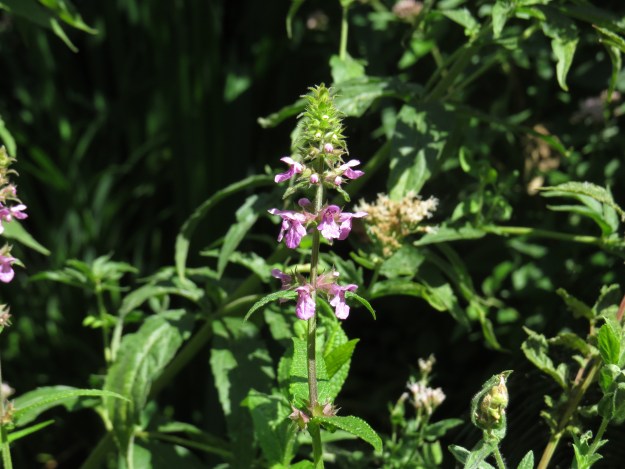
Wednesday Weed – Marsh Woundwort

Marsh woundwort (Stachy palustris)

Dear Readers, it is always such a delight when a new plant pops up alongside the pond. I have been watching this one for some weeks, so when it came  into flower I was, for a moment, a little confused. Clearly it’s a deadnettle, but I thought it might be hedge woundwort (Stachys sylvatica). The pale pink flowers are a giveaway though, plus the leaves on the upper stem are stalkless. In addition, the leaves of hedge woundwort give off a rather unpleasant smell when crushed, whereas those of marsh woundwort are much less scented. Finally, as the name suggests, marsh woundwort likes damp places, and so here it is, nestled amongst the meadowsweet and the hemp agrimony.

Marsh woundwort is native to the UK and to most of Europe and Asia, and has been introduced to North America. Like all of the woundworts, it has a long history of use medicinally – in her ‘Modern Herbal‘, Mrs Grieve tells the following story:

This plant had formerly a great reputation as a vulnerary, being strongly recommended by Gerard in his Herbal. He tells us that once being in Kent, visiting a patient, he accidentally heard of a countryman who had cut himself severely with a scythe, and had bound a quantity of this herb, bruised with grease and ‘laid upon in manner of a poultice’ over the wound, which healed in a week, though it would ‘have required forty daies with balsam itself.’ Gerard continues:’I saw the wound and offered to heal the same for charietie, which he refused, saying I could not heal it so well as himself – a clownish answer, I confesse, without any thanks for my good-will: whereupon I have named it “Clown’s Woundwort.” ‘

Afterwards, however, Gerard himself used the plant to cure many ‘grievous wounds’, including some that were considered life-threatening. Mrs Grieve says that the plant, when harvested in July, just as it comes into flower, can be used to relieve gout, cramps, pains in the joints and vertigo. The fresh juice can be made into a syrup and used to alleviate haemorrhage and dysentery. In a more recent record, Monica Wilde, a forager and herbalist, records how marsh woundwort tea, and a poultice soaked in the liquid, helped to alleviate the symptoms from a very nasty insect bite. Very interesting stuff.

Marsh woundwort is also said to be edible – the roots, according to Mrs Grieve ‘are tuberous and can attain a considerable size’. When boiled, they are said to form ‘a wholesome and nutritious food, rather agreeable in flavour’. The roots were also dried, powdered, and added to bread and soup in the winter months when there was not much in the way of greens to eat. The shoots can also be eaten and are said to taste pleasant in spite of their disagreeable smell.

In Shetland, marsh woundwort, along with several other plants, was known as grice mooriks, with ‘grice’ meaning ‘pig’ and ‘moorik’ meaning ‘edible root’. So clearly it wasn’t just humans who found the roots palatable.

Like all deadnettle species, the flowers of marsh woundwort are popular with bumblebees. The caterpillars of the rather spectacular speckled yellow moth (Pseudopanthera macularia) can also be found feeding on woundworts of all kinds, and what a fine moth it is!

Photo One by Ben Sale from UK, CC BY 2.0 <https://creativecommons.org/licenses/by/2.0>, via Wikimedia Commons

Speckled Yellow moth (Pseudopanthera macularia) (Photo One)

And finally, a poem. This is so atmospheric – set during the English Civil War, you can almost hear the hammering as the church is stripped of its angels and decoration, smell the smoke. See what you think.

Commission by Damian Walford Davies

Suffolk, 1650 
I was in the graveyard, islanded
by creeks, parsing deep botched
cuts that pass for epitaphs.
Horses drummed their piss
on clumps of woundwort –
so loud, the troopers laying
statues on the fire turned to look.
Stare long enough, the tower’s
flintwork will bewilder you. Gilt
paint burns especially. He called me
from the porch, framed by gargoyles
and the Lamb, bitter ramsons
mixed with sweetish smoke.
My sergeant rose among the reeds,
a tan bird mewing in his gloves.
The church was cool; their eyes
were hammering at three angels
on the roof. I wrapped the balls
inside a paper patch and shot,
walked out decked in golden dust.


Photo Credits

Photo One by Ben Sale from UK, CC BY 2.0 <https://creativecommons.org/licenses/by/2.0>, via Wikimedia Commons

The Capital Ring – East Finchley to Finsbury Park – Part Two

Dear Readers, the second part of the walk takes us along the Parkland Walk. This is the longest linear park in London, and it started life as the Edgware, Highgate and London line in 1867, taking passengers from Edgware to Finsbury Park.  Alas, it was never very successful, and in the 1930s there were plans to electrify it and make it part of the Northern Line, but then WW2 came along and the plans were abandoned. In 1954 the line was closed to passenger traffic, and in the 1970s it was closed altogether. There were plans to plonk a motorway here, but the land was acquired by the London Borough of Haringey, and in 1984 the Parkland Walk was born, later becoming a nature reserve.

It really is a fine, shady walk, at least along the section that we walked along – there was outrage last year when over 80 trees were felled on the Muswell Hill end of the walk as part of works to preserve some of the old railway bridges. But here, all is relatively serene, though the path is shared with runners, joggers, dogwalkers, cyclists and people with prams. Fortunately the path is wide enough for people to get out of one another’s way, and pedestrians are given priority so the chance of being mown down by a speeding cyclist is relatively low.

There are the usual speckled wood butterflies, many of them looking a little worn after a summer of guarding their territories.

Speckled wood butterfly

And I liked the way that this tree was growing over the remains of a wall.

Many of the old foot and road bridges over the Parkland Walk have been decorated by graffiti artists. Some of the designs are really striking. There is, I imagine, a lot of competition between the different artists – often a design has been tagged, or even painted over, and then reinstated. There was a chap under one of the arches working on a painting, his cans of different colours stowed in a backpack on the ground, music blaring. The smell of the paint was enough to get anyone high, and I worry a bit about the long-term impact of the fumes in such a relatively enclosed space.

We soon came upon the old platforms for Crouch End station. What a different place this suburb might have been if it had remained! As it is, places like Crouch End and Muswell Hill have retained a village-y feel largely because they are relatively difficult to get to (though after the pandemic, with so many people working from home, I imagine this is no longer the concern that it used to be).

The old platforms of Crouch End station

The old station footbridge leading between the platforms

As we walked between the old platforms, now full of hogweed and comfrey, the most massive chubby rat leapt across the path in front of us. He looked very well fed, and gazed up at us from amongst the weeds before disappearing. Rats seem to be having a very good year in many of our green spaces, I suspect because there is a lot of waste food around from picnics and barbecues that people can’t be bothered to take home, and which are easy pickings if left in the bins.

The path opens up to give splendid views over London. You can see the Shard (to the right) and the Walkie Talkie (to the left) below. I imagine the Gherkin is lurkin’ in there somewhere as well (don’t say I have no poetry in my soul).

And look, here’s the Post Office Tower, plus a plethora of cranes, just to prove that the building boom is not over yet.

There is some traveller’s joy/old man’s beard growing in the hedgerow here, a relative rarity in these parts.

And then, suddenly, the path ends, leading up into Finsbury Park, one of the largest parks in North London, and given to the people of the area in 1862 after the closure of the Finsbury Pleasure Gardens in 1862. It features tennis courts, a skate park, a lake and a cafe, along with some fine trees and this birch grove.

We plonked down in the shade and drank some water. Somewhere, someone was beating on a drum, badly. This is pretty much characteristic of London parks during the summer months – someone takes out a very large drum and starts beating out a rhythm that is, well, not very rhythmic. I sometimes wonder if it’s the same chap doing a tour of green spaces – maybe there’s a Tiktok bad-drumming challenge that I haven’t come across. It will be interesting to see if it follows us around as we embark on future legs of the Capital Ring. But for now, we’re off to find our bus stop, and to head home. We’ve had quite enough excitement for one day.

Bridge over the Parkland Walk

The Capital Ring – East Finchley to Finsbury Park – Part One


Queen’s Wood

Dear Readers, the Capital Ring is a circular walking route 78 miles long that meanders around London, mostly in Transport for London zones 3 to 4. I have actually done it before (and have the certificate to prove it 🙂 ), but after nearly two years of stop-start lockdowns and general confusion, it felt like a good time to do it again. Plus I have been growing increasingly sedentary, so it seemed like a good time to gently get active again.

The Capital Ring actually runs right through Cherry Tree Wood, which is a mere quarter of a mile from our front door so on Saturday, after a long-postponed visit to the dental hygienist (clearly I know how to enjoy myself at the weekend) we set off. Everywhere on the walk is looking extremely parched, but in the early morning it was pleasantly cool. The new café was doing a roaring trade, and rightly so – the food is delicious. I stopped briefly to see if I could get a copy of a new history of the park by our very own Roger Chapman, but it had been so popular that it was briefly out of stock. Clearly there is a renewed interest in our local green spaces, which is very encouraging.

Cherry Tree Wood in the Sunshine

View back to the new cafe

The fenced off area was being used to grow a meadow. Interestingly, it seemed to have the finest crop of greater plantain (Plantago major) that I think I’ve ever seen – meadows often throw up surprises in their first few years, depending on what has been hiding in the seed bank and what the conditions are. The young fruit trees look to be doing very well, though, and the wild service tree has lots of berries this year.

A fine crop of greater plantain

Berries on the wild service tree

I also really liked these mosaics on the side of the Ladies Toilet – very pretty, and very unexpected. I’m wondering if some more are planned, to fill the gaps.

Then it’s out of the gate, along Fordington Road, and off to Highgate Wood. We look back to see the tiny ‘village green’ with its mature trees.

And we pause briefly to consider these bollard-y things, which look as if they’ve been freshly-painted, probably to make them more obvious to drivers. I always thought that they marked the boundary of a parish or somesuch, but the company that makes them, Furnitubes, describes them as a Bell Bollard. Their role seems to be to “deflect the wheels of heavy vehicles protecting pedestrians, people and buildings in busy public realm environments.” These were on the corner of a mini roundabout, so maybe some vehicles take the corner too quickly.

Maybe we should have them on the corner of Leicester Road in East Finchley rather than the concrete bollard which is almost always in a horizontal position.

Horizontal bollard on Leicester Road

Then it’s up a steep hill and into Highgate Wood. This is part of the same great wood as Cherry Tree Wood and my beloved Coldfall Wood, the whole lot originally being owned by the Bishop of London and used as his hunting ground. Highgate Wood used to be known as Gravel Pit Wood, and is the same mix of oak and hornbeam as the other woods.

Highgate Woods.

I note a lot of use of dead hedges to try to protect the understorey areas, and there are some places with actual fences. It’s very hard to try to persuade people not to let their children and dogs trample through places where the young plants are struggling to survive, and most folk don’t seem to even notice them unless they’re higher than usual. Still, they do provide habitat for all manner of small animals and for fungi.

A dead hedge

It is so deliciously cool under the trees at this time of year, but the spider webs give an indication that the year is moving on. How can it be August already?

Then it’s out of Highgate Wood, across the busy road to Muswell Hill, and into Queen’s Wood. There is a delightful cafe here in what looks almost like a hobbit house, with much of the produce grown in the kitchen garden at the back. It used to be known as Churchyard Bottom Wood until it was acquired by Hornsey Borough Council in the 19th century, and named for Queen Victoria. I love the old-fashioned signposts.

This is a much shadier and hillier wood than Highgate Wood, with the amenities all clustered close to the entrance, and the rest of the wood feeling wild and rather mysterious. It’s usually much quieter than Highgate Wood, and none the worse for it. During lockdown both woods were used to within an inch of their lives, with some areas a sea of mud. Now, they have a chance to recover, though the current drought is leaving things dangerously dry. The photo below, for example, shows what is usually a pool full of frogs and dragonflies.

I do wonder what the water companies think they’re doing. Our local company, Affinity Water, actually sent us an email telling us that they have no plans to impose a hosepipe ban, even after the driest few months in living memory. They are, however, dependent on rainfall this autumn and winter to help them to maintain supplies. Surely it would be prudent to conserve water now in case this doesn’t happen? The reasons for not imposing a ban are apparently

But other companies, even in drier areas, have held firm. Those involved in drought discussions say companies would rather wait until the last minute, when rivers are running dry, rather than irritate customers by putting bans in place early” (The Guardian, 3rd August 2022)

In the meantime, river levels are dropping, with the subsequent danger to wildlife. Honestly, ‘irritate customers?’ There’s a lot to how a message is put across, and I’m sure most reasonable people would understand the need to be sensible after the weather this year. In the meantime, fish are gasping in the rivers and the invertebrate life is being wiped out.

Anyhow, at this point we leave Queen’s Wood and walk up Priory Road, passing the most beautiful dark maroon-coloured rose in the front garden of a house which is undergoing a thorough refurbishment. I’m so glad that it was left.

And on the other side of the road there’s a very fine Victorian terrace. These look like very upscale houses for the time, with decorative green tiles outside and all sorts of little plaster details. On the other hand, this is a very hilly spot, and we passed the poor postman who has to tackle some of the steepest external staircases I’ve ever seen.

“It keeps me fit”, he said as he rocketed past us as we huffed and puffed up the hill. Clearly we need to do more of this walking stuff.

Victorian houses on Priory Road – note the ground level green tiles, the double bay windows and the decorative plaster on the top floor.

Then we pass through a very steep path between number 63 and number 65 Priory Gardens and head up to the Archway Road. We pause at the traffic lights to gaze at Jackson’s Lane Community Centre. This used to be a Methodist church, but these days showcases all kinds of innovative performance art of all kinds, with a particular emphasis on shows for young people.

Jackson’s Lane Community Centre

And now, we’re about to walk the second part of the route, along the Parkland Walk. But to hear about that, lovelies, you’ll have to wait until tomorrow…..

What Do You Think?

Dear Readers, this is not actually the  megalith from Stanley Kubrick’s ‘2001 – A Space Odyssey’, though I can definitely see the resemblance. No, this is one of two huge containers that I’ve bought for my south-facing front garden, in an attempt to plant something that will extend my flowering season (well, not my personal flowering season but you get what I mean). They are made out of recycled tyres, which is rather cool, and they are heavy, so once they’re in position that is (hopefully) where they’ll stay. However, I have a dilemma, and so I am appealing to your collective brilliance.

The containers are designed to be used indoors or out, so they have an optional internal water reservoir.

After all, if you had put them in your office lobby you wouldn’t want them to drain all over your marble flooring, as this little diagram so clearly illlustrates.

My question is, do you think that the benefits of having a water reservoir in the summer would outweigh the danger of rot during the winter? Once the decision is made to put the plug in, or take it out, I fear that the only way to change it would be to completely empty the container and start again.

I am planning to plant autumn flowering plants such as sedum, aster, perennial wallflower and a bit of catmint in the first instance, followed by some grape hyacinth and possibly crocus for spring (if the squirrels can restrain themselves from digging up every single one of course).

I am in a bit of a quandary. Let me know what you think, lovelies. I won’t hold anyone responsible (except myself, clearly) if it all goes pear-shaped.

Christmas Comes Early to Camden Passage

Christmas Lights in Camden Passage

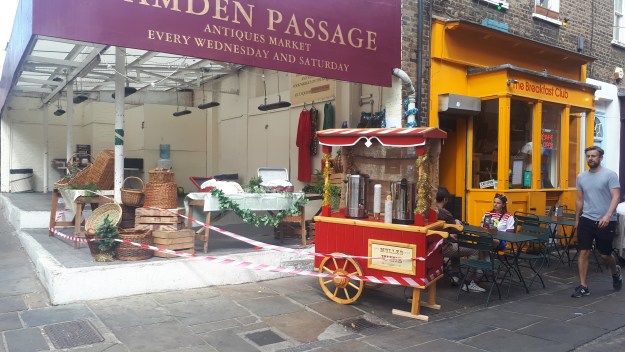
Dear Readers, I was walking through Camden Passage in Islington today en route to my pilates class and was somewhat surprised to see that, for a short stretch of the road, the petunia-filled hanging baskets had been replaced with Christmas lights, which looked very incongruous in the summer sunshine. And this wasn’t the only unexpected sight…

The area outside The Breakfast Club is set up for mulled wine, definitely not required today when it’s nearly 28 degrees Celsius….

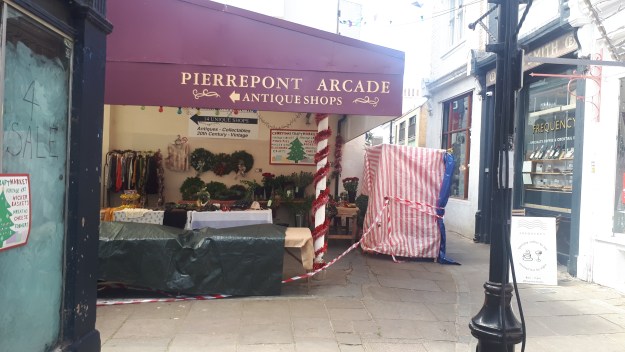
And there are all manner of Christmas wreaths hanging on the wall of the Pierrepoint Arcade, along with some decidedly homemade Christmas Fayre signs (definitely not the done thing in Islington).

It felt a bit as if I’d stepped into a parallel universe. But then, of course, all was revealed….

Ha! Well, they had me worried there for a minute. What I don’t know is what was being filled, and how far the illusion was going to go. Is Camden Passage about to be filled with fake snow at any minute? Are sweltering actors going to be meandering about in their winter coats and woolly hats? Alas, I was heading home, so I will never know, but any Islingtonians might want to keep an eye on the goings on, and if I find out anything subsequently I will let you know.

Camden Passage is, confusingly, not in Camden at all, but in Islington. I lived in Islington from about 2000 to 2010, and in that time it has changed from a historic antiques market, with dozens of small specialist shops selling everything from militaria to glass to medals to jewellery, to a place full of cafes, with a few artisan food shops, a barbers and some upscale clothes shops. Honestly I think it’s a shame – while there are some great shops (Loop the wool shop and Pistachio and Pickle the cheesemongers spring immediately to mind), Camden Passage was unique. Unfortunately the rise in rates and a devastating flood, when a water main burst and many of the shops lost their stock due to the flood water, finished off many of the little places, and then the pandemic was the final straw. Still, the place is bustling, and it’s traffic free, which makes it a much more pleasant place to idle away a few hours than many spots in the Capital.

Ooh, I nearly forgot Paul A.  Young the chocolatier when I was mentioning places to visit. I notice that at the moment they are offering a mango, coriander, chilli, coconut and lime truffle and a bergamot bellini truffle, amongst other flavours, and that they do vegan and gluten-free as well. Worth skipping a few Snickers for, for sure.

This was not the most extraordinary change I’ve ever seen to a building to facilitate filming though. Where would you think this is?

Photo by Gary Hassan via Twitter

No, it’s not the Bolshoi Theatre in Moscow, it’s Caird Hall in Dundee, from 1983. The snow was all artificial, and, in this very bolshie town it caused quite a lot of excitement, not least amongst my colleagues and I who worked at the local night shelter and were all too eager for the revolution. The Caird Hall was being used for the TV production ‘An Englishman Abroad’, which told the story of Guy Burgess, who spied for the Russians while he was an officer at M16, and his meeting with actress Coral Browne, who was appearing as Gertrude in a production of ‘Hamlet’ in Moscow. The unlikely true tale was turned into TV by Alan Bennett, and was directed by John Schlesinger. I seem to remember it being rather fine. Burgess was played by Alan Bates, and Coral Browne played herself, which must have been a very strange experience.

Photo One from https://www.imdb.com/title/tt0085492/

Alan Bates as Guy Burgess and Coral Browne as herself (Photo One)

And so this is a reminder that television and film really are a box of tricks, changing summer into winter, Dundee into Moscow and Alan Bates into Guy Burgess. But how magical it is! If the story is good enough, we are drawn in and spend a few hours in a place that exists only in the imagination. Let’s remember that such trickery, while innocent enough in these cases, can also be used to persuade us that things are different from how they actually are.

Photo Credit

Photo One from https://www.imdb.com/title/tt0085492/


A Dry Walk at Walthamstow Wetlands

Goodness Readers, you would think that autumn had started at the Wetlands judging by the berries. Everything seems to have come out at once. There are blackberries which are looking surprisingly juicy considering the drought, though this particular bush was right next to a stream so maybe it’s doing better than most.

And look at these lovely sloes. We made sloe gin once, which involved pricking holes in about 300 sloes and then submerging them in gin (Gordons of course, as that was my Dad’s employer for 30 years). It was definitely better than the bottled stuff, but not so much better that it was worth all that effort. Let me know if your experience of homemade beverages has been better!

This reminds me that my Uncle Roy used to make homemade wine. His parsnip wine was notorious – it didn’t taste too bad, though it was a bit on the cloudy side, and the headaches after a few glasses were legendary. Making your own wine and beer seems to have rather fallen out of favour lately, it will be interesting to see if it comes back as the financial constraints of the winter start to bite.

At home my hawthorn tree is absolutely covered in berries already, and the tree here is the same. These are dry, sour little things, and yet the birds seem to love them. And are they not a little early too?

Some of the paths at the Wetlands are closed at the moment – up to 3,000 tufted ducks moult at this time of year, and so can’t fly. Closing the paths means that they aren’t disturbed, and can get on with growing their new feathers without having to waste energy avoiding people. There are still a few surprises though, like this female Tufted duck with two tiny ducklings (one of them out of sight in the photo).

And so this was a brief visit, but what strikes me is how dry and crisp the shrubs look, and how everything seems to be holding its breath, waiting for rain. The weather forecast shows none for the next few weeks, and I am wondering why there is still no hosepipe ban in London. What are we waiting for, I wonder?

So, Who Was Greyfriars Bobby?

The Statue of Greyfriars Bobby (Public Domain)

Dear Readers, Greyfriars Bobby(1855 – 1872) was a little dog who, according to legend, belonged to an Edinburgh nightwatchman called John Gray. When Gray died, he was buried in Greyfriars Kirk (Church) yard, and Bobby is said to have spent the rest of his life sitting on his master’s grave. When the dog died, he was buried not far from his master (actually within the Kirkyard), and the English Philanthropist Lady Burdett-Coutts had this rather fine drinking fountain erected opposite the entrance to the churchyard.

Now, two questions remain. One relates to the truth of the story. Tired old cynics might raise an eyebrow at this tale, which fits in so beautifully with the Victorian sentimentality about animals that was so prevalent at the time  – take a look at this classic by Edwin Landseer. However, the loyalty, bravery and sensitivity of dogs is unquestioned (certainly by me).

The Old Shepherd’s Chief Mourner (Edwin Landseer, 1837) (Public Domain)

On the other hand, dogs are also extremely intelligent animals, and one theory is that stray dogs used to live in the graveyards. Visitors believed that the dogs were staying because they missed their owners, and would feed the dogs. I imagine that an appealing little dog, looking up with that head tilt that requires a treat on any occasion, would quickly become something of a draw too, and apparently a whole industry grew up around Greyfriars Bobby, with people selling food to give to the dogs and telling his story to a crowd of weeping visitors for a few pence.

There is even a tale (whisper it) that the original Greyfriars Bobby died in 1867 and was replaced by a younger dog (much as my poor old Mum tried to fool us with a new goldfish when ours died when I was six).

And so, I imagine we will never know whether Greyfriars Bobby was a loyal little dog, a mischievous scrounger or an endearing mixture of the two. But the second debate that rages on is, ‘what breed of terrier was Greyfriars Bobby?’. Here is a photo that is believed to be of the dog himself.

The National Galleries of Scotland (Public Domain)

What a sweetie! Now, Bobby’s Wikipedia page describes him as a Skye terrier. Here is a modern day Skye terrier (these days a vanishingly rare breed – maybe it’s all that hair that puts people off). A Skye terrier is also said to have hidden under the skirts of Mary, Queen of Scots when she was executed, and to have refused to leave her body after the deed was done, so the breed certainly has ‘legendary loyalty’ points in its favour.

Photo One by By Pleple2000 - Own work, CC BY-SA 3.0, https://commons.wikimedia.org/w/index.php?curid=1851190

Skye Terrier (Photo One)

What strikes me is the ears which look very similar between the two photos. But wait! Only this week an alternative case has been put for another extremely rare terrier breed, the Dandie Dinmont terrier, by Mike MacBeth who is the president of the Dandie Dinmont Terrier Association of Canada. He points out that Skye terriers were found mainly on Skye, whereas there were 60 Dandie Dinmont breeders in Edinburgh alone. The dog was named after a character from Sir Walter Scott’s book ‘Guy Mannering’. Scott was pretty much responsible for the creation of the romantic image of Scotland,

Photo Two by By en:User:Sannse - http://en.wikipedia.org/wiki/Image:Dandie_Dinmont_Terrier_600.jpg, CC BY-SA 3.0, https://commons.wikimedia.org/w/index.php?curid=1324957

Dandie Dinmont Terrier (Photo Two)

Now, forgive me but this dog doesn’t look much like the photo. On the other hand, is the photo actually Greyfriars Bobby? I admire Mr MacBeth’s attempts to boost his breed, but I remain to be convinced.

The mud is further thickened by the various filmic representations of Greyfriars Bobby. I mean, what the hecky-decky is the dog in this photo of the Disney film from 1965? It looks like a very hairy Border Terrier to me.

Poster of the 1961 film ‘Greyfriars Bobby’ by the Walt Disney Company

Even worse, in the 2006 version of the film they seem to have cast a West Highland White terrier – these dogs are extremely cute, but I think it’s clear that Greyfriars Bobby was not one of them.

Poster for ‘The Adventures of Greyfriars Bobby’ from 2006

Now, as you might expect, I have a theory of my own. I suspect strongly that in Victorian times, breeding purebred dogs was pretty much a hobby for the rich – for everyone else, dogs were bred for their characteristics without much regard for how they looked. If John Gray was indeed a nightwatchman, he would have wanted an alert, feisty little terrier to accompany him, and he would have got one from a local person who was breeding from a dog that seemed to fit the bill. I am going to stick my neck out and say that Greyfriars Bobby was probably a mixture of various breeds and of dogs with no breed, and he would have been no less loyal, intelligent or handsome because of it. Our obsession with how animals look has led us to some very dark places, so I have always championed mongrels, those mixed-up, unique animals without a pedigree registered at the Kennel Club. I would love to think that Greyfriars Bobby wasn’t a Skye terrier, or a Dandie Dinmont, or a hairy Border terrier, but a terrier type all of his own, like the Polish mongrel terrier in the photo below. Whatever the truth about him is, he was clearly a very special little dog.

Photo Three by Shalom, CC BY-SA 3.0 <https://creativecommons.org/licenses/by-sa/3.0>, via Wikimedia Commons

Photo Three

Photo Credits

Photo One by By Pleple2000 – Own work, CC BY-SA 3.0, https://commons.wikimedia.org/w/index.php?curid=1851190

Photo Two by By en:User:Sannse  http://en.wikipedia.org/wiki/Image:Dandie_Dinmont_Terrier_600.jpg, CC BY-SA 3.0, https://commons.wikimedia.org/w/index.php?curid=1324957

Photo Three by Shalom, CC BY-SA 3.0 <https://creativecommons.org/licenses/by-sa/3.0>, via Wikimedia Commons


Wednesday Weed – Delosperma (Ice Plant)

Delosperma sp.

Dear Readers, the local garden centre is absolutely full of these cheery little plants at the moment, and the ones in my window boxes are positively busting out all over. These are succulents, and so are (helpfully) drought-resistant, a theme that feels more and more important as hosepipe bans loom, and heatwaves and dry spells are likely to become more common.

The common name for Delosperma is ‘ice plant’, but this is also used for a whole variety of what I used to call sedums. Older readers might also remember the name ‘Mesembryanthemum’. There are about 170 plants in the genus, and all of them live in Southern Africa. They are beautifully adapted to dry conditions: their leaves are fleshy and store water for arid times, and the seed capsule opens in response to rain to free the seeds at the most auspicious time. These plants have been flowering consistently since I planted them over a month ago, with no sign of stopping yet! They seem to be attractive to hoverflies, though the marjoram that they’re planted with is a much bigger draw for bees.

Another adaptation to arid living is the bladder cell: this is what gives the plant the name ‘ice plant’, as sometimes the cells shimmer with liquid. They are modified hair cells, and during times of high stress will manage the salt intake of the plant – as less water is available, the salts in the plant can reach toxic levels. There is some thought of using members of the Delosperma genus for bioremediation of salt-logged soils.

Leaves of the Delosperma, showing the bladder cells.

So, Delosperma is clearly a great plant for a sun-drenched south-facing window box, and it comes in a whole array of colours too, from red, orange and yellow through cool blues and icy whites. I imagine it must look strikingly beautiful when it blooms in its natural surroundings. In California it seems to be a favourite in some ocean-front properties, maybe due to its ability to cope with the salty breezes.

Photo One by By Peter D. Tillman - Own work, CC BY-SA 2.0, https://commons.wikimedia.org/w/index.php?curid=89361118

Delosperma cooperi planting on ‘Millionaire’s Row’, Cambria, California (Photo One)

Remarkably, though, the plant is also very hardy – one gardener that I follow has found that his Delosperma specimens will survive a Newfoundland winter, and I may well leave mine out just to see if they can make it through the colder months.

Although the plant doesn’t look as if it might be particularly edible, it was apparently taken onboard ship and the leaves eaten to prevent scurvy – again, maybe its drought and salt tolerance would have made it appealing. I imagine that the leaves taste a little like samphire. Medicinally, the leaves have been used to make a soothing cream, and have also been used to treat bloating, dysentery, liver and kidney disease and pneumonia. Interestingly, the leaves are also said to contain hallucinogenic chemicals, and a deep dive into the internet realm of people rearing plants for their psychedelic properties reveals lots of folk growing pretty pink succulents and having no success with getting high whatsoever. Personally, I think that the flowers are quite ‘trippy’ enough without eating the poor thing.

However, the Batu people of South Africa use the leaves of Delosperma to make khadi, an alcoholic wine which induces hallucinations. The roots are used to grow yeasts which are then used for beer.

And now, how about a poem, lovely people? I am reminded of the photo of the California coast (above) as I read this. It takes a couple of readings, I think, to absorb all the nuance. W.S di Piero was born in Philadelphia in 1945, and his poems are said to be full of ‘gritty realism’: he also takes inspiration from painters such as Caravaggio and (my favourite!) Carpaccio. I think there’s something epic about this work, as it reaches back in time and then focuses in on the flowers around a child’s feet. See what you think.

Ice Plant in Bloom

BY W. S. DI PIERO

From where I stood at the field’s immaculate edge,
walking past the open patch of land that’s money bounded,
in California’s flat sunlight, by suburban shadows of houses
occupied by professors, lawyers, radically affluent do-gooders,
simple casual types, plus a few plumbers, children of lettuce-pickers
and microchip princes, grandchildren of goatherds and orchard keepers
who pruned and picked apricot trees that covered what wasn’t yet
block after block. Vaporized by money, by the lords and ladies of money,
in one month, on one block, three bungalows bulldozed, and the tanky smells
of goatherds and, before them, dirt farmers who never got enough water,
held momentary in the air like an album snapshot’s aura,
souls of roller-rink sweethearts and sausage-makers fleeing
heaps of crusty lath, lead pipe, tiny window casements,
then new foundations poured for cozy twelve-room houses.
So what was she doing in that field among weeds and ice plant?
The yellow and pink blooms spiking around her feet like glory?
Cranking her elbow as surveyors do, to a bored watcher in the distance,
she fanned the air, clouds running low and fast behind her.

A voice seeped through the moodless sunlight
as she seemed to talk to the flowers and high weeds.
She noticed me, pointed in my direction. Accusation, election,
I could not tell, nor if it was at me myself
or the green undeveloped space she occupied,
welded into her grid by traffic noise. Okay!
A word for me? A go-ahead? Okay! Smeared by the wind
and maybe not her own voice after all. I held my place.
She would be one of the clenched ministers adrift
in bus terminals and K-Marts, carrying guns
in other parts of America, except she dressed like a casual lady of money,
running shoes, snowbird sunglasses, wristwatch like a black birthday cake.
The voice, thin and pipey, came from the boy or girl,
blond like her, who edged into view as I tracked the shot. The child,
staring down while he cried his song, slowly tread the labyrinth
of ice plant’s juicy starburst flesh of leaves.
Okay! He follows the nested space between flowers that bristle at his feet,
his or hers, while the desiccated California sky so far from heaven and hell
beams down on us beings of flower, water, and flesh before we turn to money.
The sky kept sliding through the tips of weeds. The sky left us behind.

Photo Credits

Photo One By Peter D. Tillman – Own work, CC BY-SA 2.0, https://commons.wikimedia.org/w/index.php?curid=89361118

A New Hoverfly and A Reluctant Frog

The ‘Batman’ Hoverfly (Myathropa florea)

Dear Readers, after my adventures with the hornet-mimic hoverfly last week, I was keeping an eye open for other new-to-me species today, and spotted this hoverfly sitting on my sedum (some of which is already in flower rather earlier than usual). This species is sometimes known as the ‘Batman hoverfly’ because if you squint, the pattern on the thorax looks rather like the ‘Batman’ symbol that lights up the sky above Gotham City when something particularly nefarious is going on.

I can tell that this fly is a female because there is a tiny gap between the eyes  – in the males of many genuses (genii???) of hoverflies the eyes meet at the top of the head with no gap whatsoever.

Female Batman hoverfly

Photo One by By Anevrisme - Own work, CC BY 2.5, https://commons.wikimedia.org/w/index.php?curid=2550278

A male Batman hoverfly – note how the eyes meet at the top of the head (Photo One)

Batman hoverflies will breed in anything that holds water, and since I have a pond, a bird bath and several dishes for ground-feeding animals they have plenty of choice. The ‘rat-tailed’ larvae (the ‘tail’ is actually a breathing tube) will lurk amongst decaying leaves and twigs, and their number one preferred habitat is a ‘rot hole’ – a cavity in a tree that holds water and detritus. As the detritus rots down, the habitat in the rot hole holds less and less oxygen, and so the larvae need their long ‘tails’ in order to breathe.

Interestingly, it’s been found that the larvae actually have control over their buoyancy – being naturally quite fat, they sometimes naturally float to the surface of the water, whereupon they expel air and dive back down, rather like miniature long-tailed whales. They can also control the length of the breeding tube depending on the depth of the water that they’re in, as described in this ‘Country Diary’ piece in The Guardian by Phil Gates.

A larval Batman hoverfly (Photo by Phil Gates)

The adult hoverflies have a long flight season, from April to November, and can often be seen happily basking in the sun on some convenient flowers. The hoverfly in my photos sat around quite happily for half an hour while I clicked away. How I wish that all insects were so cooperative!


I am becoming more and more interested in hoverflies, and one suggestion to encourage more species that nest in rot holes, such as the Batman hoverfly, is to create an artificial hoverfly ‘nest’. You can do this by taping a two-litre plastic drinking bottle low down on the sheltered side of a tree. You then cut a hole in it, and partially fill it with sawdust, twigs and water, making sure that you keep it topped up during dry spells. What an interesting idea! It’s easy to forget that hoverflies are excellent pollinators and that they also need a helping hand. Maybe I’ll have a go at this. I’ll let you know how I get on.

And in other news, the frogs are very reluctant to leave the pond this year, and who can blame them? Everywhere outside the garden is absolutely parched. If I was a frog, I would definitely hang around until the rain returns, though with a hose pipe ban in the offing and no rain forecast for the next fortnight, the amphibians could have a long wait.