Author Archives: Bug Woman

The Blustery Day

Dear Readers, it has been a very blustery day here in East Finchley, as you can see from the squirrel above – he took some time out from eating to chase a female squirrel round and round the garden, but then went back to eating all the (very expensive) sunflower hearts.

The magpies were anxious about their nest too, as it swayed backwards and forwards at the top of the whitebeam. It must be quite deep now (it’s difficult to assess the real size from down here on the ground). Suffice to say it’s big enough for both the magpies to disappear into it. Apparently early April is the key month for egg laying, so by then we’ll know if these two are playing or serious. According to the RSPB website, Magpies start to breed at about two years old, and normally have a territory of about 12 acres, so these two are definitely ‘ruling the roost’ on our street.

Above the sound of the wind there’s the clear, thin song of the robin. He (or she) is looking very dapper at the moment.

And when the sun comes out, it lights up the colours on the goldfinches and the chaffinches. The weather might not know what it’s doing, but it’s good to see so much activity. There’s a real sense that the pace of life is speeding up.


A Brisk Walk Around the East Finchley

Dear Readers, after our walk around Coldfall Wood yesterday we took a stroll back, and spotted this amazing car – you certainly wouldn’t miss this one in an underground car park, it’s unique! I love the decoration, and I wonder if the Mongul Rally is actually the Mongol Rally, which finishes in Mongolia. It looks as if the owners might also raise money for the Macular Society, which is close to my heart as Mum had macular degeneration in the last years of her life. At any rate, there is no mistaking this vehicle, and it really cheered me up.

I paused next to All Saints Church on Durham Road to look at this house – if you look closely, you can see that it would have had black and white mock Tudor woodwork on the upper elevation, and it still has its original terracotta tiles right at the top. The glass in the small panels on the first and ground floors is coloured, something that you can see on several houses on this part of the road. I love how individual the houses are here, with the style varying from one small block to another, which reflects the tastes of theĀ  different builders who were developing the area.

Elsewhere on Durham Road, this beautiful magnolia is just about to burst into flower…

And then it’s time for a look at the pavement plug-in points on Bedford Road. There are certainly a lot of them…

But they seem to come in two different types, or maybe the one above hasn’t been finished yet? Looking at them, I suspect the latter. They are mostly at either end of the road rather than in the middle. It will be interesting to see how they work out.

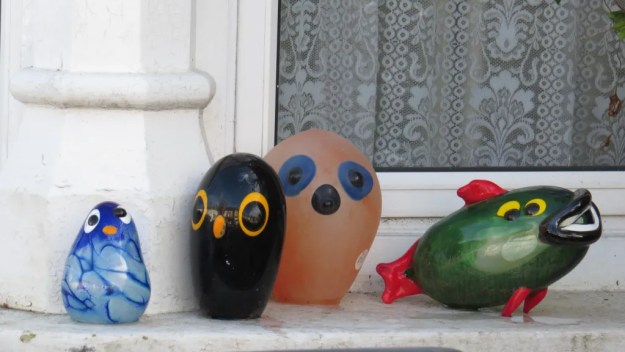
And another thing that always cheers me up are the lovely glass creatures outside this house, and the many containers and baskets full of flowers. A nice front garden is such a gift to everyone who walks past (says she, thinking of her very-much-inbetween-season containers in her front garden).

I love this moss ‘forest’ growing on one of the old brick walls…

And how come I’ve never noticed this plaque before? How things change in a century and a bit…

And finally, as I get back to my house I notice that the catkins on the Kilmarnock Willow are finally fully open – I love all the individual spots of pollen. If you look closely, you can see a tiny fly – not the pollinator that I had in mind when I bought the tree, but an underrated pollinator nonetheless, and I suspect it’s still too cold for many of the bees. Still, this catkin is a thing of beauty, and I’m so pleased that it’s providing sustenance to someone.

Exciting Times in Coldfall Wood

Dear Readers, after nearly three years and many, many delays, it looks as if Muswell Hill Playing Field, which is next to Coldfall Wood, is finally going to get its wildflower meadow. Two big patches have been staked out – one has been completely rotavated and the other, which already had a variety of grassland plants growing last year, has been rotavated in strips. Next week, children from Coldfall and Eden Primary Schools will come with their scarecrows and will help with the seeding. We are all very excited at the prospect of improving the biodiversity here, and I will keep you posted over the next few months as things develop.

At the moment, the main wildlife is a flock of crows, who are also very excited at all the juicy earthworms and beetle larvae that the rotavator has turned up. The main problem once seeded will be the pigeons, I suspect, who are very fond of grain. Let’s hope that the scarecrows will also be ‘scare-pigeons’. Certainly some of the scarecrows that I saw last week looked completely terrifying, so even if they don’t upset the birds they’ll certainly give the rest of us nightmares. I shall provide photos of the scary creations next week.

Crow making the most of the banquet

There will be a fine array of native plants, including wild angelica, red campion, white campion, ox-eye daisy, cowslip, meadow buttercup, hedge parsley, common knapweed, greater mullein, lady’s bedstraw, musk mallow, garlic mustard, selfheal, teasel and vetch, so there should be something here for any passing pollinator. The soil here is heavy clay but it didn’t look too claggy, so I am optimistic that we’ll get a good show. Haringey Council have also agreed to maintain the meadow, so hopefully it won’t revert quickly to perennial weeds like thistle as some meadows have. Watch this space.

In the meantime, there’s lots going on in the woods themselves. There are the very first flower on the blackthorn beside the Playing Fields – soon, these bushes will be a mass of white flowers.

There’s the last of the cherry plum…

Some not-altogether-natural crocuses and daffodils…

And this is a very fine fungus. I’m thinking beefsteak fungus, but I shall have to ask my resident expert.

There was a pair of very active nuthatches looking for insects in this dead branch, yet another reason for keeping deadwood wherever possible.

There has been a lot of very vigorous cutting back and treatment of the Japanese Knotweed. I will be fascinated to see how quickly it recovers (it’s usually quite a battle to get rid of a thicket as impressive as this one was in its heyday).

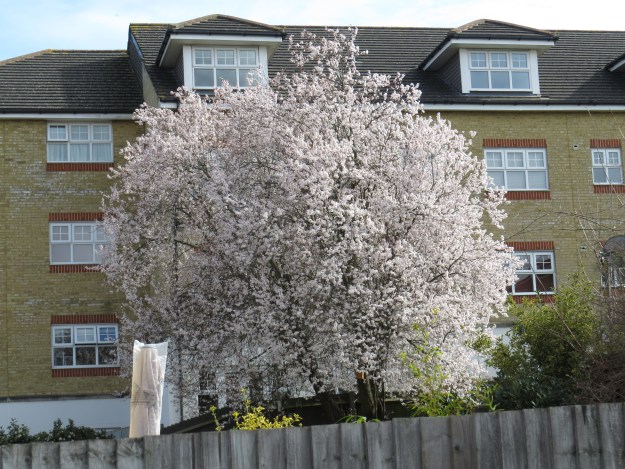
I caught a glimpse of a cherry tree in amongst the houses on Osier Crescent (just the other side of the field) and it was so magnificent that I had to go and have a closer look. I’m sure it gives a lot of pleasure to whoever looks at it.

And this cat looked pretty impressed too…

There’s water in the ‘wet woodland’ part of the woods…

The crows are hanging out in the trees overlooking the stream and the fields – there must have been thirty of them cawing and carrying on, and they all took off when an unfortunate buzzard flew past (probably one of the pair that live in the cemetery).

There are still catkins on the hazel…

The hornbeams are doing their frozen dance, the result of coppicing when they were very young which was never repeated, and has left them with multiple trunks…

and look, here’s a parakeet, just checking us out and making sure that we’re behaving ourselves.

We are so lucky to have ancient woodland so close by. It is such a wonderful space to explore, and already punches above its weight in terms of the variety and number of plants and animals who live here. It will be interesting to see what the meadow attracts over the next few months.


Yet More Shenanigans

Dear Readers, no this isn’t some abstract work of art focussed around twigs, but there is a story attached to it, so let me start at the beginning. Yesterday I was peering out of the window when I noticed a pair of squirrels chasing one another round and round the whitebeam. I am pretty sure that at one point they stopped to have one of those ‘when a daddy squirrel loves a mummy squirrel very much’ moments. Then it was off for another chase.

Grey squirrels only breed twice a year, in late February/March, and then again in June/July. The gestation period is about six weeks. An average litter is about three, but a female can have up to nine youngsters, which she rears alone for about a month, before they leave the drey. And herein lays the problem. The female usually rears her young in the whitebeam- you might remember these short filmsĀ  of two youngsters that I took during the first lockdown in 2020.

This year, however, there’s a pair of magpies nesting right where the drey used to be (in fact, I think the birds might have used the drey as a starting point before adding twigs of their own). One of the squirrels actually entered what is now the nest from below, and was soundly chased off by a very cross magpie, who was sitting in the nest (though whether she is actually incubating eggs I cannot tell).

Squirrel heading for the drey/nest


Very irritated magpie

So who knows how this will all play out? Will the squirrel move to the hawthorn and risk raising her young in such close proximity to a known nest robber? Will the aggression of the magpie actually keep other predators away? Who knows, but it’s fascinating to see such interactions without even having to go out into the sleet and snow that we’ve been having this week. I shall keep you posted….