Category Archives: Bugwoman on Location

Bugwoman on Location – The Best Laid Plans

Clematis seedheads in Milborne St Andrew

Dear Readers, you may remember that last week I reported that Mum had been stricken down with a chest infection, but seemed to be on the mend, and was at least not in hospital. Well, on Sunday I phoned Mum and Dad, and realised that Dad had succumbed to the same bug. Add to this the fact that one of their lovely carers is currently struggling with her own health emergency, and that the washing machine has broken irreparably, and the only feasible course of action was to leap on a train and head down to Milborne St Andrew on a rescue mission.

Flint nodule from wall in Milborne St Andrew

And so, I have been on tea-making/cooking/washing machine wrangling/cleaning/medicating duty for the week, and have been trying to persuade Mum and Dad that they need some additional help while their carer is sorting out her own crisis. I have met with some resistance (understatement) because they love their current carers, and would rather not have to deal with anyone else. Plus, Dad in particular is sanguine about the future, which is lovable but occasionally infuriating. For example, on the coldest day of the week I returned from the walk that I am about to describe, only to find that the enormous wheelie bins had been put on the kerb for the dustbin men. Yes, in spite of barely being able to breathe, Dad had wrangled them outside, in -5 degrees of wind chill.

I love that Mum and Dad are so determined to be independent. I think that their sheer cussedness and determination is what’s kept them going so far. I just worry myself sick about them. But they are of sound mind, and I don’t want to be one of those children who railroads their parents into doing things that they don’t feel comfortable with. So, on Thursday, while they were having a nap, I wrapped myself up and went out for a walk.

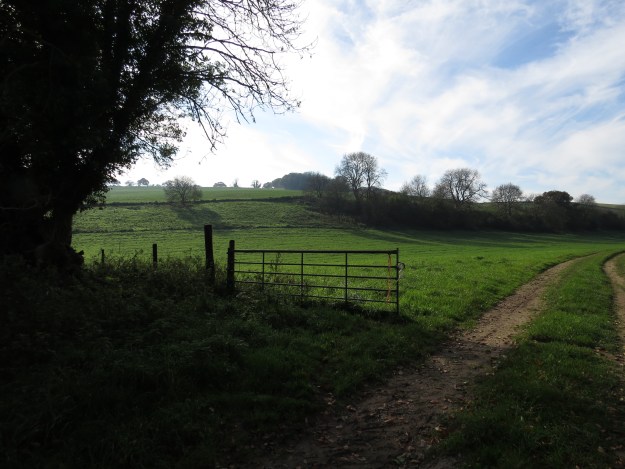
The sun was so low on the horizon that for half the walk I could barely see where I was going.

Bugwoman’s shadow….

I stomped along Chapel Road, and stopped as a flock of blackbirds erupted from one of the gardens. What could have brought these normally solitary birds together? I inhaled a deep lungful of sweet apple scent, and realised that the kind house owner had left the windfalls for the birds.

And it wasn’t just blackbirds who were ready to feed – I also spotted my first redwing of the year.

Onwards I trudged, feeling my anxiety ease with every step. I even made the mistake of thinking it was warmer than I’d thought. Hah! I was to discover the error of my ways when I walked back, into the wind.

A mole had been very busy in the ex-cabbage field, and the soil was the colour of cocoa. These little animals are very common, and yet I’ve never caught a glimpse of one. How busy they are, turning the soil and munching on the worms and leatherjackets.

Earlier in the year, I’d passed a dry stream bed, and speculated that maybe it was a winterbourne – a river that only runs in the winter. It seems that I might have been right. Many villages in Dorset are called Winterbourne something, such as the nearby Winterbourne Whitechurch.

Over a stile, and then a decision on which of three paths to take. In the mood of Robert Frost, I decided to take the one less travelled, diagonally up hill and into a little copse of trees. The low sun burnished the dry thistles into something softly miraculous.

At the top of the hill was the path through trees, which looked strangely menacing compared with the open field. But somehow I wasn’t ready to turn back yet, and so up I went.

And when I came out on the other side, there was a view of another cabbage field, and a single wind turbine.

Back I go, and immediately realise that it’s colder than I thought.

I pause at a sign before the wood. I have not heard shots here, and so I don’t think that I’m in danger of being peppered with pellets. Plus, I am wearing a bright red (and very unsuitable) coat, so I should at least be obvious. I know that shooting things is part of country life, but I confess that I loathe it, especially when it’s done for sport and the dead creatures are not even eaten. Still, you could argue that at least a pheasant has had a decent life before it meets its end, unlike a factory-farmed chicken or pig.

I’m out into the field again, and heading home. I spot the sheep from my last walk on a field across the way.

The tractor ruts are full of water, necessitating some clever manoeuvering to keep my feet dry. At least I’m wearing suitable walking shoes.

I fall in love with this dancing bush. It looks to me like a couple in the middle of a tango, and rather reminds me of the Fred and Ginger House in Prague….

The Fred and Ginger House, Prague.

It’s becoming colder, and I notice that some of the water in the ruts here is frozen. A pied wagtail is picking over the puddles, and the hedgerow is full of goldcrests and long-tailed tits. As usual, I don’t get a photo of them, but the wagtail is very obliging, flying along just a few feet ahead of me as I pick my way through the muddy morass.

Pied Wagtail

There is a huge bonfire in the wood to the left of the path as I turn for home, and I soon realise why. You might remember that last time I reported on this walk, I mentioned a very fine dilapidated barn in some woodland. Well, most of the woodland is now gone, and the logs are stacked up. I walked through a veil of woodsmoke, which lingered in my hair (and probably my lungs) for the rest of the day.

As I got to the brow of the hill, I noticed how some of the trees have previously been heavily coppiced, but have now grown into trees.

Notice all the tree trunks growing up from one horizontal trunk

It occurs to me that this was maybe once a hedgerow, or at least a piece of ancient woodland coppiced for firewood, which has been allowed, over many years, to grow freely. On the other side of the path, a hedgerow is still maintained, and I was struck by the similarity in the pattern of growth, but on a miniature scale. It would take me a lifetime to be able to truly read this landscape, but I am determined to learn while I can.

Part of the hedgerow

And as I passed another modern barn, I noticed the moon rising.

How serene it looked above the trees.

Underneath an abandoned farm building, a piece of old machinery was burnished with late afternoon light.

I had seen a few starlings roosting earlier, but now the big oak tree was full of twittering, whistling birds bedding down for the night.

And in the field opposite, the very last rays of the sun seemed to blessing a pair of horses.

And so I walk briskly home as the light fades and the wind picks up, chilling my face and making me yearn for a centrally-heated living room and a cup of tea. The parents are both asleep in their reclining chairs. Dad’s chest is wheezing gently, while Mum’s is distinctly more crackly. I put the kettle on, knowing that regardless of how deeply asleep he is, Dad will launch into alertness for our daily watching of ‘Pointless’. I am filled with such a rush of love for the pair of them that I’m brought to the edge of tears. I have to learn to relax into the uncertainty of the situation, and not try to control every decision (hard as that is for someone who thrives on making things happen). Sometimes, it’s best to just listen and trust that, in the words of Julian of Norwich:

‘All shall be well,

and all shall be well,

and all manner of things shall be well’.
Bugwoman on Location – Cake-Making and Bird Spotting in Milborne St Andrew.

IMG_2182

Dear Readers, it has been something of an exciting week for Mum and Dad. On Sunday, they were walking up the steps to their front door (which have two very sturdy handrails) when it appears that one of them slipped, and the other one tried to save them (the story varies somewhat according to who you talk to). The end result was that they both ended up laying in the front garden, unable to get up. Fortunately Dad had his mobile in his pocket, and was able to ring a) an ambulance and b) one of their neighbours/carers who lives just down the road. Dad had hit his head, and Mum had a bad pain in her hip, but Dad managed to get himself up with some help. Mum, however, was stranded in the garden, because no one wanted her to get up if she’d potentially fractured something. The lovely neighbour wrapped Mum up in blankets and made her as comfortable as possible.

Two and a half hours and several calls to the ambulance service later, an ambulance arrived from Swanage (some distance away), and took Mum and Dad to the hospital for observation. A few hours, an X-Ray and a CT scan later, they were released and got home for a well-earned cup of tea, and a rest.

So it was no surprise that when it came to making this year’s Christmas cake, Mum wanted to supervise rather than stand up and actually make it.

‘And then you’ll know the recipe’, she said, ‘And it can pass on down to you’.

And so I creamed the sugar and butter, taking Mum’s advice and using a fork (‘Much quicker’). I added the eggs and the flour a bit at a time, taking the mixture in for Mum’s approval (‘Add a bit of milk, that looks too dense’). And then in with the fruit (‘Cut the cherries in half!’). And then, into the oven at 140 degrees (‘It’s supposed to take four hours, but it never does, so let’s check on it in two’).

Just enough time for Mum and Dad to have a nap in their reclining chairs, and for me to go out for a walk. The fog had finally lifted, and the sun streamed in through the window of the bungalow.

I felt a bit sad. All these years Mum had been making the Christmas cake, and she prides herself on being the one to bring it to the Christmas feast. It felt like a bit of a defeat, but at least we’d have a cake. I put on my walking shoes. A trot through the countryside always cheers me up.

I noticed a fine spider’s web on the doorway of their house as I went out.

IMG_2141

I headed down towards the church on the other side of the main road through Milborne St Andrew. I had done this walk back in September, before Mum and Dad’s party, and I wanted to see what difference six weeks had made.

The spiders’ webs were thick in the hedges, and so white that I had to check them  to make sure that they weren’t something leftover from Halloween.

IMG_2152

One of the houses is for sale, and very fine it is too. I loved the hanging basket holders, shaped like a wren and a robin. If anyone is looking for a house in Milborne I would definitely have a peep at this one.

IMG_2154

The horses were in the field, as usual.

IMG_2161

But there were some new inhabitants in the field opposite.

IMG_2163

They looked like so many clouds scattered about the hill.

IMG_2164


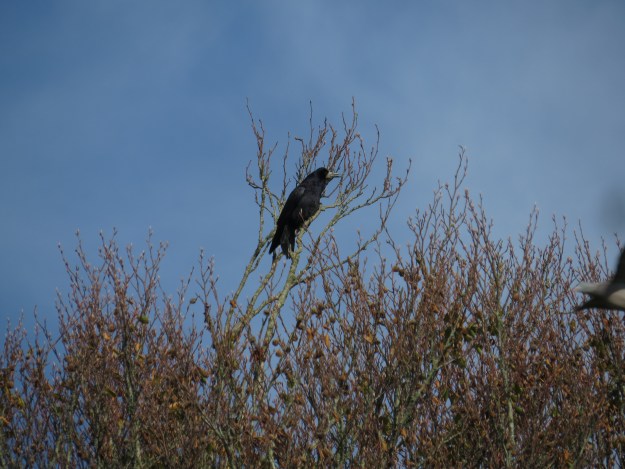
A rook called out from the top of a tree.

IMG_2166

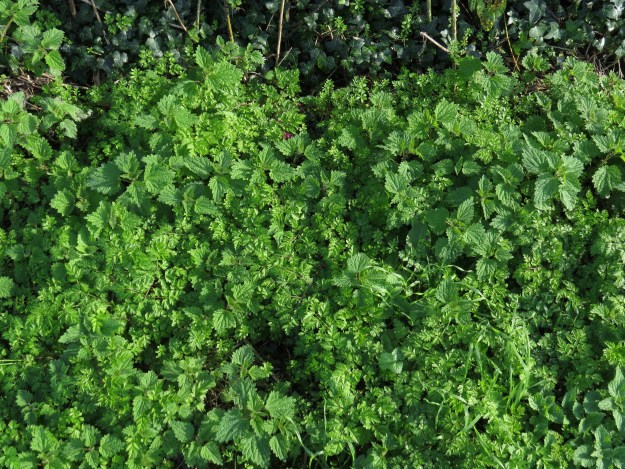
Last time I did this walk, there was Himalayan Balsam and Comfrey in full flower. But today, the prevalent colour was green, from new nettles and goosegrass and feverfew.

IMG_2168

All the plants by the little river had been cut back, but the hedgerow was alive with wrens and flocks of tits.

IMG_2170


The cabbages on the field on the other side of the track were gone, but something new had already been planted.

IMG_2174

The last of the cabbages, missed in harvesting

IMG_2178

New crop. Of what, I have no idea. Maybe it will be clearer next time I visit.

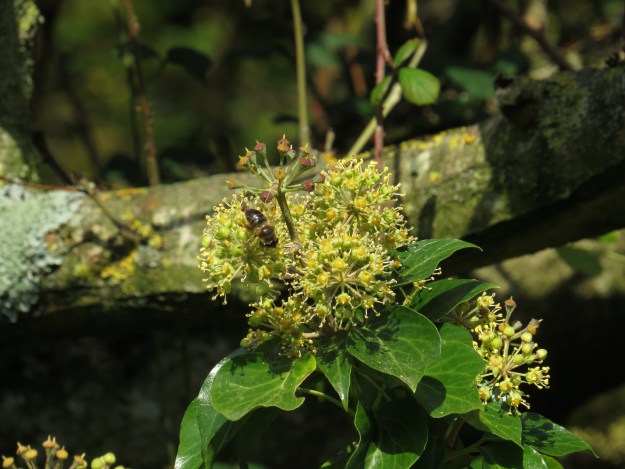
At last, at the top of the field, I find a few things in flower. There is the odd dandelion and hogweed still blooming, but then there is the ivy. It’s the main nectar source at this time of year and I must have seen a dozen red admirals stopping for a quick sip and then hurrying on as I did this walk, not one of them hanging around long enough for a photo.

IMG_2180

A lonely dandelion

IMG_2193

The Sputnik-shaped flowers of ivy, with a lone honeybee

At the end of the track I stop, and look at my watch. Still an hour and a quarter before the cake needs to be looked at. I have three choices: right, diagonally right, and left. I decide to go up the hill to the right, and just see where it goes.

IMG_2182

The first thing I notice is how hot it is on this south-facing hedgerow – I’m sorry I’ve worn a scarf. And then I notice the sound of insects, a persistent drone every time I get close to the abundant ivy. I look around for bumblebees (and do see an enormous queen disappearing back into her hibernation burrow in the grass) but the noise is actually coming from some hoverflies.

IMG_2190

This is a drone fly (Eristalis pertinax), and its resemblance to a male bumblebee is supposed to give it some measure of protection from predators. It certainly sounds like a bee, although its big eyes and shiny body are much more fly-like. It loves farmland: the larva is known as a ‘long-tailed maggot’, and it thrives in nutrient-rich, polluted water, which can often be found where there is nitrate run-off. The larva breathes via a breathing tube, which is how it got its name. The adult lives on nectar and is one of the few hoverflies that can be found all year round. A tough creature, indeed.

IMG_2187

A drone fly on yarrow. In this photo you can just about make out the rust-coloured patches on the fly’s ‘hips’ which identify it as Eristalis pertinax

And then I look up.

IMG_2198

I have been waiting for years to actually get some photos of a buzzard (Buteo buteo). They are not rare in Dorset, but I still find them magnificent as they ride the thermals, searching for a rabbit to pounce on or a carcass to investigate. They are adaptable animals, able to hunt for themselves or scavenge, and they’ve even been seen marching over a ploughed field and pulling up worms.

IMG_2195

This one is an adult (you can tell from the mostly cream-coloured underwings). Last time I did this walk I got a distant view of three buzzards, an adult and two juveniles. Today, it was just this one bird, effortlessly soaring over the fields, changing direction with the merest twist of a tail. I wondered if it was enjoying its freedom now that the fledglings were off-hand. There certainly seemed to be a kind of joy in its flight.

IMG_2196

I realise that the track isn’t actually going to give me a short-cut home, and so I turn to retrace my steps. At the bottom, I decide to take a chance on another track, which seems to head back towards Milborne.

IMG_2205

And who is this handsome chap/pess, perched on the telephone wires?

IMG_2208

I wonder if it’s some kind of thrush, but it’s not until I get home that I am able to blow the photo up and identify this as my first ever meadow pipit (Anthus pratensis). How do I know? Well, the general look of the bird, but the clincher for me was the description of the bird as having a ‘long back claw’. Furthermore, the bird is described as ‘near-threatened’. I have a new spring in my step.

IMG_2208 (2)

I pass a derelict barn hidden  in the woods. How I would love to explore it! I bet it’s home to bats, or owls.

IMG_2214

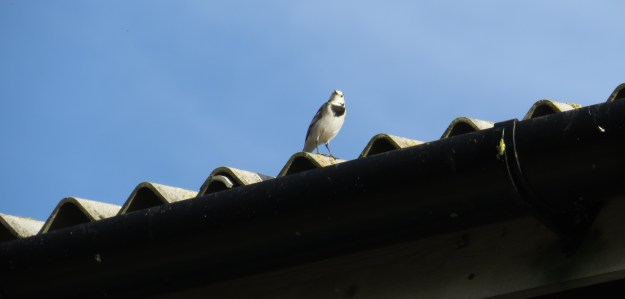
The farm buildings and machinery are a playground for pied wagtails and sparrows.

IMG_2218

IMG_2220

And a horse looks like he or she wants a chat. Or an apple.

IMG_2226

I know I’m nearly home when I see the stag on Stag House, a private dwelling that was once the house of a Mr Cole. The stag was a gift from Earl Drax, for ‘support during an election campaign’. The Drax estate is still a major land owner in these parts.

IMG_2228

As I reach Mum and Dad’s house, the smell of baking cake and mixed spice reminds me that I’ve had no lunch. I put my key in the door, and something catches my eye. The sunshine is low, shining through the spider’s web that I spotted on the way out. It is making rainbows.

IMG_2134

It reminds me that there is always more than one way to look at a situation. Looked at one way, this is a simple spider’s web. With a tilt of the head, it becomes magical, a scintillating interplay of colour and light.

IMG_2137

I am sad that Mum is no longer well enough to make the Christmas cake on her own, but how good it is to work together to create something. I am reminded that I don’t know everything, and that I could, if I chose, be a little less inclined to try to do everything for Mum and Dad, as if they were helpless. Instead, I could allow myself to receive the many things that they still have to offer – wisdom, experience, love.

The cake looks as if it will be delicious. We’ve pricked the top so that Mum and Dad can feed it with brandy over the next month, until I return in December, and then we’ll put on the marzipan and the icing. Together.

IMG_2231


Bugwoman on Location – Dundee: ‘I Was a Stranger, and Ye Took Me In’

The sign above the door of the old Dundee Cyrenians night shelter

Dear Readers, back in the 1980’s, when I was as energetic and as naive as a spring lamb, I spent three years working in Dundee at a nightshelter for single homeless people. This week I travelled back for the first time in thirty years, to visit the site of the shelter at 5 West Bell Street.

The place is deserted, though it is apparently scheduled for conversion into luxury flats. Pigeons nest on the windowsills, and weeds spring from the steps. But the words  ‘I was a stranger and ye took me in’ show me that I am in the right place. The old double door was useful when we were letting in the people who wanted a bed for the night – this was a ‘dry’ shelter and everyone had to be searched to make sure that the only alcohol they were bringing in was already in their stomachs. There were two, maybe three of us on shift, and some nights all of the 50 beds were full, plus up to 20 folk popped in for a bowl of soup and a roll. At ten o’clock, all those without a bed had to leave, even if there was snow on the ground. Occasionally, someone would walk down the road to the police station and break a window so that they could have a bed in a police cell for a night.

I cross the road. There is a new university building here, right where ‘The Bothy’ was – the workers from the shelter used to fall into the bar at the end of an early shift (10.30 p.m. finish). The irony that we were drinking after an evening spent looking after folk who included many alcoholics wasn’t lost on us. The ‘beer garden’ where the lads gathered to share a few cans of Strongbow cider or drink their way through a bottle of QC British Sherry is long gone. But in my mind’s eye I can still see the lads lining up as they did at 5 o’clock every night, waiting for the doors to open.

There’s Andy at the head of the queue, with his coat tied together with a piece of string around his ample middle, his feet bursting through his shoes, his legs like tree-trunks. He doesn’t take a drink, but his disreputable appearance has him barred from every shop and mall within a 5 mile radius. One of our workers took him out to buy new slippers, and only managed it by telling the shop manager that she was his grand daughter. How proud Andy was of his new footwear, though with the miles he walks, they didn’t last for long. He always has a terrible pun for us, and will bash on the counter where we sell the cigarettes at 5p each with his stick if we’re tardy.

Behind him is young Chris, shivering in his leather biker jacket and  ‘A For Anarchy’ ripped teeshirt. He came straight out of care and into the shelter. He is a cheeky, handsome lad in spite of his acne, and he often runs errands for the older lads. Today, though, he is talking to Jack. Jack is wearing a smart jacket and polished shoes. He has many tales of violence done (by him) and wrongs righted (by him) and his ice-green eyes exude a manic menace. He is only in his twenties, but has been in jail twice. Some of the older ‘hardmen’ make a bee-line for Jack, as if to see if his air of single-pointed danger is real. Once, I was in the office sorting out cigarettes when I had a crunch from the kitchen. Jack had broken someone’s nose with a single punch, and was putting on his jacket to leave.

‘He was nipping ma heid*’, said Jack, reaching down to wipe a spot of blood from his shoes with a white hankerchief.

Next in the queue outside the shelter is Shug. Shug is an ex-soldier in his late 60’s, a tall, distinguished man. He probably always had a drink problem, but after he left the army and lost the structure that it gave him, he fell to pieces. He has Korsakoff Psychosis, lesions on the brain that cause failure of memory. He can be as playful as a grandfather, or he can take an instant, violent dislike to someone that he mistakes for a former enemy. His mood swings are the stuff of legend, and have him barred from the shelter on a regular basis. But every night he washes out his single shirt and hangs it up to dry, and every morning he shaves. He leaves the shelter with a steady stride, and sometimes returns on his hands and knees.

Behind Shug is Mark. Mark was also a soldier, but much more recently. He was in Northern Ireland. We talked one night, and he told me how, after being in a virtual war zone, everything else seemed dull.

‘Nothing compares to going on patrol, Vi, nothing. It was the only time I ever felt really alive’.

Mark does not have a drinking problem yet, but he has lost his wife and child because he couldn’t adjust to civilian life. He is picking up odd-jobs, but has no idea what he will do next. He shouldn’t be in the shelter, but there is nowhere else for him to go. His loneliness is palpable.

Sheila is next in line. There are only three beds for women in the shelter and Sheila is a long-term resident. She is in her seventies now, and acts as mother to many of the other men. I sometimes wonder why she’s here – she has no obvious addictions or mental health problems. I have come to the conclusion that she finds community here, and friends, and doesn’t want to be lonely in some dismal council flat, or warehoused in a home. As soon as the doors open she will be downstairs stirring the soup and helping us to make sure that everyone eats. She’ll be the first with the mop afterwards, as well.

And then there’s Peter, a tiny elfin man. He drinks once a week, and always buys chips to share with the workers.

‘Hae a chip! Hae a chip!’ he’ll chirrup, throwing the chips everywhere, before retiring to bed. Peter was rehoused in Whitfield, a housing estate 8 miles outside Dundee, where the snow drifts can reach twelve feet in the winter, where packs of discontented youths terrorise the old and vulnerable, and where it costs too much to travel into town. I’m not surprised that he’s back.

And there’s Charlie, who only visits in the winter – he is the only true ‘gentleman of the road’ that we have, with his long wild grey hair and his weather-beaten face. In the summer months he roams the lanes of Scotland with his long strides, but the snow and cold are too much for him now he’s in his seventies.

And bringing up the rear are Bobby and Wullie. Bobby walks with the tiny steps of someone with arthritis in their feet, and Wullie is in a wheelchair. Both are incontinent. Both have dementia. It is sometimes my job to give Bobby a bath, and it always goes the same way. He’s embarrassed, but tells me

‘Och, I’ll just pretend you’re my mother’.

He has his bath, and then he holds my hand and sings me a Scottish lullaby.

Then he becomes convinced that I’ve stolen his money, and he curses me out soundly and spits at me while I’m trying to get him dressed.

And then he falls asleep.

At least he doesn’t have two sticks like Wullie, who can be lethal when armed.

Working at Dundee Cyrenians taught me most of what I know of community and of honour,  It taught me to look beyond appearance. I was enriched beyond measure by my years in Dundee, and the stories here are only the briefest summation of the complexity of the lives that I describe. In many ways they are not my stories to tell, but who is left to tell them, and remember?

Where are they now,the lads and lasses of 5 West Bell Street? The average age of death of a homeless person in the UK is 47. I doubt that any of the people that I’ve written about, even the youngest, are still alive in 2017.  But on the streets of Dundee and London, Manchester and Cardiff, there are many people without the tiniest spot of this good earth to call their own. People huddle in doorways and clamber over fallen masonry to make a nest in derelict buildings. They lay on the grates behind the swimming baths, and put out their cardboard and sleeping bags in the doorways of shops. Changes to the benefits system, lack of housing, lack of mental health services all play their part. The people that I cared about are gone, but the problem is even worse.

The queue in front of the shelter fades out, one by one, until all that’s left is the cooing of pigeons.

*’Nippin’ ma heid’ (literally ‘nipping my head’) means to talk at someone in a boring, monomaniacal way. Frequently occurs after too much boozing.

**Names have been changed, but these were all real people.

Bugwoman on Location – A Cabbage Field in Milborne St Andrew

Heading off on my walk….

Dear Readers, my visit to Mum and Dad was hectic this time – the 60th Anniversary Party is on 21st September, and we needed to decide who was sitting where for the meal. I was expecting this to be a palaver, but we sorted it out very efficiently. We had two guidelines: we weren’t going to ask anyone where they wanted to sit (because experience has taught me that this pretty soon leads to a meltdown) and we were going to try to seat a variety of people on each table so that folk had somebody new to talk to.We have also decided to  accept that we can’t control whether people have a good time or not – we can provide a nice setting, but after that it’s up to the folk involved. I suspect that the party will go swimmingly, but if it doesn’t we can’t have done any more.

And so, after all that, I needed a walk. I headed off, past the church, and through the massive gate posts that lead to Manor Farm. I noted that these are striped with Coade Stone, an artificial stone invented by Eleanor Coade in 1770, and it is renowned for its ability to weather well. It makes a wonderful home for spiders and other small creatures.

And then it was on and over a stile, and into a field so full of young cabbages that there was a faint whiff of school dinners as the sun warmed them up.

The hogweed was still in full bloom. Just look at the number of small pollinators that this one flower head has attracted.

There were still a few bumblebees about, mostly common carders.

As I walked along, it became clear that there was a stream on the left. Great beds of comfrey were in flower, both creamy-white common comfrey and flamboyant pink Russian comfrey.

Common Comfrey


Russian ComfreyThe fallen flowers remind me a bit of the milk teeth that I used to leave under the pillow for the tooth fairy.

I was somewhat less delighted to see the flamboyant flowers of Himalayan (Indian) Balsam. Such a pretty plant, and such an invasive one. This plant loves watercourses of all kinds, and is well established along this stream. Its orchid-like flowers come in shades of deep cerise to palest pink, and they are loved by bees, and I suspect that it will soon be featuring in a Wednesday Weed. People have very strong views about this plant, so I shall have to write it and then duck.

Himalayan balsam

Pale pink Himalayan balsam

At the end of the field, I see a steep, well-trodden path heading down to the water. I find myself in a hidden world, probably used by youngsters eager to escape their parents’ oversight.

Hartstongue fern on the streambank

A calligraphy of roots

Someone plays here, for sure

I see that the stream bed is completely dry, and I realise that I’m looking at a winterbourne – a stream that only runs in the winter. Many of the places around Milborne St Andrew are named for such features – there’s Winterbourne Whitechurch just up the road for instance – but I’d never seen one before.

I go over a stile, and admire the sinous shape of the trees here. And then I realise that it’s nearly time to head home (pancakes for lunch!)

So I walk speedily back up through the cabbages.

I am passed by a happy poodle and a chap with a beautifully  tended beard, who is wearing flipflops. I wonder if hipsterism has come to the village? Has it been ‘discovered’? The pub will be selling skinny macchiatoes next.

The black blob is the poodle

It’s often when I’m in a rush that things happen that bring me to a complete halt. What, for example, is this?

Nothing less than a freshly-emerged, box-fresh peacock butterfly.

There was so much about this insect that it’d never noticed before. There’s the blending of blues and creams and black and russet around the ‘eyes’ on the wings, the stripes on the ‘shoulders’, the hazy, dewy quality to the colours. Truly, I live surrounded by beauty every day of my life and yet I often stride past it, head down, shoulders hunched, on to the next thing. But not today. Today I stopped and was so filled with wonder that everything else went away. What a gift.

As I head back down the hill, I pass the rectory, and notice a fine gathering of rooks in the old tree.

What are they up to, I wonder, with their cawing and their chattering? They must be saying something important, because as I stand there I notice that they are arriving from all sides, a great black feathery spiral pouring out of the sky.

And so I head home to make pancakes, to go with Dad in the car to get some petrol, to look at fridges online and to finalise the table settings, and, much like the rooks, something in my heart has folded its feathers and settled.


Bugwoman on Location – King’s Cross

St Pancras Station seen from Pancras Square, outside King’s Cross

Dear Readers, for as long as I’ve lived in London, King’s Cross has had a dire reputation. When I was working just off Gray’s Inn Road, groups of cadaverous teenage girls used to gather outside the post office, drinking cans of Special Brew and shivering while they waited for their next client, or their next fix. When I caught an early train to Luton airport one morning, the women on the opposite platform were chased by a junkie wielding a needle and threatening them with AIDS. And my husband was once asked if he was interested in ‘business’ by a young woman while he was taking photographs of the gas holders at 8 a.m. on a Sunday morning. But gradually the area has been ‘cleaned up’ (which means that people have been moved on, to Euston and to Camden), and now it’s much more of a destination. Whole areas have been demolished, shiny new office buildings and restaurants have opened, and I heard from a friend that some areas have been made much more wildlife friendly. So, I took myself and my camera off to explore.

The station itself is an extraordinary melange of Victorian ironwork and twenty-first century post-modernism.

The Victorian station

The New Concourse

There is no doubt that this is an improvement over the old station building, which was always overcrowded and had a pervasive smell of pee. But I was more interested in what was going on outside.

There are some fine big pots with bee-friendly plants, such as catnip and salvia. I am intrigued by the way that many of the flowers on the Hotlips salvia below have lost their red ‘lips’. The bees don’t seem to care, however.

‘Hotlips’ salvia with bee

There is a series of fountains, and indeed water is a prevailing theme of the area.

And of course there’s a helicopter overhead. On my trip down on the bus, I passed a group of twenty policeman standing around a poor motorcyclist who was holding an icepack to his bloody nose. I suspect he was a victim of yet another attempted moped theft, there’s been a plague of them just lately, and some of them have involved acid.

In the very top pond, there was a cream-coloured waterlily, caught in a sunbeam.

And then I crossed the road into Granary Square, passing a fine flotilla of swans en route.

The big draw of Granary Square is the collection of dancing fountains. Parents were gathered on the benches, ready with big bath towels,  while small children (and the occasional adult) ran through the water, squealing and dripping. There was also a very over-excited pug, who must have run about three miles while I was watching. It’s one of the few free things here that could be used by local people – the coffee bars and restaurants are expensive, but there’s room here for a picnic (on the steps down to the canal, or on one of the green spaces). Islington has less green space than any other London borough except for the City itself, so this is sorely needed.

But I wanted to see what else was going on. There’s a new square being built in one of the old warehouses, and in the photo below you can also see the top of a gas holder that’s being converted into flats.

There are more fountains here, though they are less ambitious than the ones in Granary Square.

Waitrose has taken over another old loading bay and warehouse.

But outside there is a fine lawn, edged with lavender and Mexican fleabane, and thronged with bees and the occasional butterfly.

However, it’s just around the corner from here that a real effort has been made with the wildlife planting. Each plant seems to have been chosen for its pollinator benefit, or to attract birds, and it seems to be working.

Lots of lovely nepeta

Mexican fleabane

A flock of sparrows are feeding on the seeds. I always love it when birds do what they would do in the wild and find natural food.

There is a shallow river running right the way through the garden, ideal for birds to drink from and bathe in, and probably suitable for insects in the places where it runs most slowly.

The selection of plants is inspired. Below there are Michaelmas daisies, ideal for hoverflies and honeybees.

The hemp agrimony variant below is also a great late-summer plant for all manner of pollinators

I love this bed with another variant of Michaelmas daisy, plus some kind of Cow Parsley. Great for hoverflies, those underappreciated insects.

And there were even some wild strawberries for the humans (and the thrushes)

And here’s another view of the Gas Holder flats, and some pleached lime, which makes great cover for the sparrows.

However, in case the sparrows or other birds want a different home, here’s an interesting use of old CCTV camera boxes, which have been converted into nest boxes or places to roost.

So, I was very impressed. My one worry, from the pollinator point of view, would have been how much sunshine this spot receives, what with all the buildings towering around it, but it appears that some wasps weren’t bothered, because they’d made an underground nest right against the edge of one of the beds. For people who think that wasps are aggressive, please note that I took this short film from about three feet away, and they were much too busy to bother with a mere silly human.

I have been meaning to do a separate post on some of the other London wildlife hotspots around King’s Cross – the Camley Street Natural Park is a definite must-see, and so is the canal. But I didn’t really have time to do them both justice today, so they will have to wait for a future visit. However, I did take a short stroll along the canal to get another look at the blooming gas holders, with which I am obsessed. After negotiating a very bouncy temporary wooden walkway, and just about avoiding being mown down by runners and folks on Brompton foldaway bikes, I came to the old lock.

And here are the gasholders. Two of them have been converted into flats, and one of them is just a skeleton covering a park, which hunkers down in the shade of the buildings all around it.

Gas holder as flats

Gas holder as park

For anyone who is intrigued as to how a big round area can be converted into luxury flats, here is a link to the developer’s website. I imagine the prices will be way above the reach of the folk who used to live in the little houses and council estates around here.

On the way back, I passed the swans again, and they were in a very irritable mood. The adults hissed as I passed, and I thought they were complaining about the fact that I hadn’t brought them an offering, but actually they seemed to be fed up with their offspring, chasing them off when they got too close. I suspect that many human parents will be feeling the same way after six weeks of constant contact with the younger members of the family. I wonder if the swans are trying to tell their cygnets that it’s time for them to move out and find a pad of their own?

And then it was back to King’s Cross, which has one of the nicest, most space-age entrances to an underground station that I know.

And incidentally, the two people making their way down the corridor are two of my lovely neighbours H and L, which just goes to show that London is a much smaller place than everyone imagines.

In his book ‘London: A Biography’, Peter Ackroyd speculates about whether King’s Cross, a shabby and dangerous area for its entire history, will ever be able to cast off the stain of its past. It certainly looks shiny and happy at the moment, though the canal was always a dangerous vein through its heart, a place of dark acts even to this day. King’s Cross was previously an area favoured by creative people, because housing was cheap, and there was a great tolerance for the ‘eccentric’. The fact that St Martin’s School of Art is here, in Granary Square, gives me hope that this tradition will survive, at least. But will the tattered soul of King’s Cross survive the arrival of Google and the £3 artisan coffee? That remains to be seen.

Inside King’s Cross station

Bugwoman on Location – The Season Turns in Somerset

Queen bee on buddleia

Dear Readers, I was in Somerset last weekend with Aunt Hilary, and there is no doubt that we are at the still point of the year, between the fervour of spring and the frenetic activity of autumn. Although it’s high summer for us, for many birds and most insects the focus of the year has shifted from reproduction to feeding up for the winter. Take this bee, for example. She is a queen buff-tailed bumblebee, as big as the first joint of my thumb, and she droned sedately past my ear, as stately as a battleship coming into harbour. In a week or so she will be in hibernation in a mouse hole or under a shed, and she won’t emerge until late spring, unless the weather is mild enough for her to pop out for a shot of nectar. All the more reason to have some mahonia or other winter-flowering plants in the garden.

After all the flowers of spring the predominant colour is green, and everything is looking a little tired and dusty. Leaves are nibbled by caterpillars or mined by leaf-miners. There is a hush, only broken by the peeping of young blue tits who, with their yellow and brown plumage, look like photo-shopped versions of the adults.

In the hedgerow, however, there are the startling red berries of cuckoo-pint. They look more like satanic excrescences than anything edible, which is just as well, as, although not dangerously poisonous, they can cause irritation of the mouth and apparently taste disgusting. It was also believed that touching the plant could make you pregnant (at least if you were female), so this must have acted as a deterrent. But at this point in the year they glow like beacons, fiery and unexpected.

I make a point of walking up to the gate of the fields that I pass, to see what I can see. What I saw in this field was a group of three heifers. One of them looked up and came towards me on her stocky little legs, her hooves sinking into the ground. Such a weighty creature she was, and so curious with her stiff white eyelashes and huge oil-black eyes. I smelt her sweet breath when she huffed out at me in confusion. But between us was a single stranded electric fence, and so I backed away, not wanting her to hurt herself. Which is ironic when we consider where she is eventually headed.

I walk on, and then up to the footpath that crosses another field. The grass here reminds me of an animal’s pelt, rippling in the breeze. It cries out to be stroked.

And way off in the distance I see something white, so I walk towards it. I am intercepted by a lady with a very young, very large chocolate-brown dog. The way she grabs him when she sees me coming towards her makes me think he is a boisterous dog and indeed he is, though somewhat thwarted by one of those leads that loops around his mouth, and maybe gives his owner more control. At any rate, he is just inexperienced in the ways of humans, and so after a stiff talking to from his owner he moves on, reluctantly, without knocking me flat on my backside. I continue on towards the white ‘thing’.

And what it is is a very large fluffy white feather. I wonder who it belonged to? Part of me is hoping for a barn owl, but who knows. It is certainly a feather for insulation, not flying, and what a beautiful thing it is, so perfectly designed to trap heat in every filament.

I turn back, and walk on. The cherry laurel by the stream is full of fruit, and the stream itself needs to be negotiated by the bridge after the rain from earlier in the week.

As I leave the main lane and turn left, I notice that someone has been strimming vigorously, for the wild garlic and the brambles and the ferns are mostly reduced to stubble, which makes for an easier but much less interesting walk. However, there is always something to see for someone who makes a profession of wandering slowly, and. lo and behold, i notice that the lardy balls of the snowberry come out at the same time as the flowers.  And very pretty the flowers are too. Snowberry was originally used as cover for game birds such as pheasants, and is now thriving all over the place. Just as well that insects rather like the flowers.

But what is this? The insect with the stripey wings is a scorpion fly, with a long proboscis designed for poking into the bodies of dead and dying insects. It is also partial to human sweat but I was ok, because as we know, horses sweat, men perspire, but ladies merely feel the heat.

And then it was time to turn for home, but before I came indoors I took time to admire the buddleia which is heavy with flowers and the scent of honey.

When I took a quick look under the eaves of Hilary’s cottage, I spotted no less than eight house martin nests. As I stood there quietly, I could hear the babies peeping away, and every few minutes an adult would erupt from the nest, or scythe back in. How wonderful these older houses are, with their nooks and crannies to house a spider or a bird, their outhouses full of swallow nests and wood mice. How I  love it when  people will put up with a bit of temporary mess to accommodate another soul in need, be they human or non-human.

And, just to round things off, look who was sleeping in the garden when I got home….

But not for very long. As soon as the fox heard that we were back,  s/he perked up, stretched, yawned, and sauntered off over the shed roof, a leggy young creature with apparently not a care in the world. The hardships of the spring are over, and the brief breathing space of late summer is here. Rest, creatures, and conserve your strength. You’ll need it in the days to come.

Bugwoman Presents Robin Huffman, Primate Portrait Painter

Dear Readers, I hope that this week you will forgive me for venturing many miles from East Finchley, into the forests of Cameroon and South Africa. My artist friend Robin Huffman is staying with me for a few days and I want you to meet her .Our relationship started with a photograph of a sleeping talapoin monkey called Yoda.

Yoda Asleep (Photo by Robin Huffman)

I saw it on a site called, of all things, Cute Overload. Of course, I didn’t know anything about Robin then, but I was impressed by the way that, when the comments stream filled up with people gushing that they ‘wanted a monkey’,  the photographer commented that this monkey was from a sanctuary, and that monkeys should never be kept as pets.

My husband looked at the photo too, and clicked through to find out some more details.

‘You know’, he said, ‘the sanctuary where this photo was taken is asking for volunteers’.

Two years later, I was bumping over the dusty red roads of Cameroon on my way to the Mefou Primate Sanctuary. It is home to orphaned gorillas, chimpanzees and monkeys. Most of them are refugees from the bushmeat trade – the adults are killed for meat, and the babies suffer a miserable fate as ‘pets’. I was to spend most of the next month looking after young chimps (which basically involved being a climbing frame, sweeping and mopping floors, sorting out food and playing pat-a-cake).

Playing pat-a-cake with M’Boki

There was a constant war of attrition with the soldier ants, who were dangerous to caged animals because they will eat anything in their path. In the film below, the soldier ants are moving their larvae and eggs to the next place where they will form a nest. The column is defended by the ‘soldiers’, who have heads the size of blueberries and strong, sharp jaws. Many days saw me getting too close to an ant column and having to run through the compound ripping off clothes as the ants headed up a trouser leg.

And one day I rescued this extraordinary giant stick insect from the curious young chimps who would have torn her to pieces out of pure curiosity.

Cameroonian giant stick insect

But what was most surprising was that my room mate in our cozy Nissen hut turned out to be Robin, who had taken the picture of the talapoin monkey that had brought me to Cameroon in the first place. She had discovered her calling here in  the rainforest of Cameroon after 29 years working for Gensler, one of the most prestigious design consultancies in New York. Robin had thrown up the schmoozing and the Manhattan condominium in order to volunteer at various wildlife sanctuaries, where her passion was looking after orphaned baby monkeys. The job could sometimes be heartbreaking, but this didn’t dent Robin’s commitment to these vulnerable, fragile creatures. And latterly, she’d discovered that not only could she rear these animals, she could also paint them.

Robin’s painting of Yoda (after a photograph by Ian Bickerstaff)

Robin started off by painting signs for the sanctuaries that she volunteered at, often working on hardboard and using house and roofing paint. Then one day, one of the sanctuary staff asked if she could ‘paint a monkey’. The rest is history.

Robin painting a sign at the Ape Action Africa sanctuary in Mefou, Cameroon (photo by Liliane Eberle)

Nowadays, she uses acrylic paints, which dry quickly and are non-toxic. Robin has no permanent home base, so she has to be able to work quickly wherever she is in the world. Her aim is to present the creatures that she loves, and their stories, to people who might not otherwise have thought about the issues of deforestation and bushmeat, animal research and the pet trade. She is a witness to the suffering and the spirit of these animals, and an advocate for them. When you look into the eyes of these monkeys, it’s impossible not to see them as individuals, with personalities and desires and fears. Her paintings stake a claim for their place in the world, and speak up for those who cannot be heard above the whine of chainsaws and the jingling of money.

Sunshine, Olive Baboon (Robin Huffman) (after a photo by Perrine DeVos)

Mowgli, vervet monkey

Diva, moustached guenon

Recently, Robin had a solo exhibition at the prestigious Explorers’ Club in New York, the first exhibition of paintings ever held by the organisation.

Robin with her painting of Keksie the vervet monkey at the Explorers’ Club exhibition. https://www.ecowatch.com/explorers-club-primate-paintings-2403325036.html Cassie Kelly

And for the next few weeks, one of Robin’s portraits is part of the Wildlife Treasures exhibition at the Nature in Art Gallery and Museum. The gallery is based in Wallsworth Hall, a magnificent stately home in Twigworth, Gloucestershire, and Robin will be giving a talk about her work with primates on Saturday and Sunday this week (29th and 30th July). The exhibition itself runs until 3rd September, but if you are unable to visit, you might like to see some more of Robin’s work on her website here.

Ayla, vervet monkey

Robin normally paints her monkeys from life: she knows each one, and her love for them as individuals shines through her work. But there is one exception. Here is what she says about ‘Witness’.

‘I saw the photograph of this monkey on the Internet.  It is the newest species of monkey identified in Africa.  It was recorded in the Democratic Republic of the Congo by the bushmeat-fighting TL2 Project, headed up by Drs. Terese and John Hart.  This monkey, in the photograph, had a heavy chain around its neck and was being held prisoner as a village pet.  It may have eventually ended up in someone’s stew pot.  It wore its fate in its eyes.’

Every time one of these small souls dies, it is as if, somewhere, a star blinks out. But there are many people working to preserve the light. Robin is one of a growing army of warriors whose weapons are paintbrushes, and cameras and the written word. They are fighting for nothing less than the right of others to live their lives unmolested on this small blue planet.

Can a painting change the world? Let’s hope so.

‘Witness’ – Robin Huffman (after a photo by Maurice Emetshu)

For details of how to volunteer at or donate to Ape Action Africa, click here

For details of the Vervet Monkey Foundation, click here

You can see some more of Robin’s artwork here


Bugwoman on Location – A Walk in the Ferwalltal

Dear Readers, after our rather easy and domestic walk to the Sahnesturberl last week, this week we’re trying the slightly more difficult trails. But nothing should be attempted without a cappuccino and a biscuit with ‘Otztal’ on it. There are limits.

There are five valleys all leading away from Obergurgl, and today we were aiming for the Ferwaltaller, one of the more difficult areas to reach. If you look at the photograph above, you can see our path leading up away from the service road. As is usual, it zig-zags backwards and forwards across the slope, so that every time you think you’ve reached the summit, you discover there’s a bit more climbing to do. Still, off we went….

After about twenty minutes stiff climbing, we stopped for a break, and to admire the hills on the other side of the valley. This area is called the Seenplatte, and is part of the national park. There is no skiing development there, and so it is much wilder, and snow lies in pockets for a long time. One of these days I’ll be in good enough shape to attempt it, but my knees are a bit dodgy this year.

The cable car is just a little dot below. I love the way that its shadow seems to hang from it.

I like to look back and see how far we’ve already come. In the foreground above there are the last of the alpenroses, the diminutive rhododendrons that have just stopped flowering here. Obergurgl had a very hot June, and so there are marmots everywhere, but never when I have my camera unfortunately.

A male chaffinch makes his presence felt in the arolla pine trees below.

There are butterflies and moths everywhere. Six-spot burnet moths fizz about, like red blurs.

I’ve noted before that the butterflies love salt, and can  often be found in swarms on any kind of fresh dung. But I didn’t know that they’d feed from sweaty humans as well. My husband had a particularly friendly Meadow Brown.

And so we walked on up, and crossed under the chairlift which they are testing for the winter. Every chair is weighted down with a dozen filled water canisters. The air was filled with beeping from the machinery and cursing in Austrian by the operators. But soon we were far away from all such goings-on.

This is the start of the Ferwalltaller – a stream runs through it, and also a strange clay pipe half-buried in the bank. Who knows what it’s for? But the worst of the climb was over, and we could start to enjoy the scenery.

There are some boggy areas, squelchy with moss and dotted with these white-flowered succulents which I think are a kind of saxifrage. The seedheads of the mountain avens (Geum montanum) remind me of little clematises.

The spiniest thistles (Cirsium spinosissimum) are just coming into ‘flower’. From a distance they look as if each one has been touched with an individual sunbeam.

Close up, however, they are most unprepossessing, and are largely pollinated by clouds of alpine flies. Nothing wrong with that, of course.

The weather forecast for the day was decidedly dodgy, and so, as the clouds started to gather, we decided to head for home. It’s possible to feel very exposed out here in the mountains when there are storms forecast. The official advice if caught in a storm (of which there have been several in the last few days) is to separate yourself from anything metal (i.e. your walking poles), avoid any trees , large boulders or other ‘prominences’, and lay on the ground on top of your rucksack. I figured that this would be a most undignified position to be in, and so we made all reasonable haste to get back down to the village, hotly pursed by most unpromising thunderheads.

And when we got back to village level, it was to discover that the wind had dropped, the sun had come out, and all was delightful. And so there was nothing for it but to return to the Edelweiss and Gurgl hotel for an Eiscaffe (coffee and icecream with whipped cream on the top). What a tough life I have.

On Saturday, we head back home. I cannot wait to see what’s happened in the garden. I think a machete might be in order so that  I can get to the shed.

In the meantime,  here is a question for you all. What on earth do you think this machine does? It was parked on the road and looked like some kind of alien. I’m thinking some kind of road-sweeping, but do let me know if you have a more imaginative answer…..


Bugwoman on Location – A Walk to the Sahnestuberl

Large Copper (Lycaena dispar) on yarrow

Dear Readers, today I would like to take you on one of my favourite early holiday walks in Obergurgl, Austria. It isn’t very rugged, or very challenging, though as I arrived with a sore throat and cough, and as the sole of one of my boots has decided to drop off, it was quite challenging enough. I love it because of the sheer variety of terrain, from meadow to pine forest to scree to mountain hut. I also love it because it has some uphill and some downhill, and so my muscles can start to get into the swing of things.

The village of Obergurgl

Here is the view back to the village at the end of the first climb. Obergurgl is at the end of the Oest valley, which is one reason why we love it – it doesn’t have through traffic, the curse of many an alpine village, and it is the epicentre of numerous side valleys. One of the glories of the surrounding hills are the meadows, at their very best at this time of year, just before the first hay cut. And I am in my element – the sheer variety of insects makes my head spin.

A very fine ichneumon wasp

Bright pink yarrow!

Flies are important pollinators in the Alps, but these two are thinking of other things…

Hoverfly on rampion

Clouds of butterflies descend on the dusty paths to feed on the salts in animal droppings, whirling up as we pass.

We look to see what cows are about, and as usual there are some fine Highland Cattle, who seem to do very well in spite of the Austrian summers being considerably warmer than the Scottish ones.

And then it’s on into the woods. These are mostly Arolla pines, and at this time of year you can hear the local jay, the spotted nutcracker, leading the fledglings through the branches. The youngsters make a call a bit like a car alarm.

By Original author and uploader was MurrayBHenson at en.wikipedia - Transferred from en.wikipedia, Public Domain, https://commons.wikimedia.org/w/index.php?curid=3708573

Spotted nutcracker (Photo One – see credit below)

The woods are cool and quiet after the meadows, apart from the occasional sound of cow bells from the Tyrolean blue cattle that graze here, and the roar of motorbikes from the road below. Many biking folk choose to go into Italy via the Timmelsjoch pass, just half a kilometre from where we are walking, and there is also a Motorcycle Museum beside the tollroad.

Soon we reach a little lake called the Pillersee, which has a most attractive duck house in the middle, though I have never seen a single duck take advantage of it. You might think that this would be an ideal spot to stop for a sandwich, but be careful, gentle traveller! On our last visit, we stopped here for the time it took to eat a cheese sandwich (approximately four minutes in my case) and I acquired 12 mosquito bites. My husband didn’t get one. I have recently read that mosquitoes prefer people who have Type O blood, and as my husband has Type A maybe this is the explanation. Or it could just be that I was sweatier than he was. Anyhow, take this as a warning, and glance at the duck house while rushing past at speed.

Just a little further on, we found a patch of early flowering orchids popping up among the buttercups. There are lots of orchids here. In fact, the whole flora is so diverse and plentiful that it makes me weep for our intensively managed, vanishing meadows  in the UK. Nearly all the plants here can also be found at home, but I rarely see such variety.

Then, it’s over a moderately scary bridge. There are a variety of scary bridges in these parts – there’s a delight in bridges that you can see through, which doesn’t help my slight vertigo.

However, this is as nothing compared to the new suspension bridge, just opened on Thursday, over the nearby Gurgler glacier. Methinks I will be giving this one a miss.

Copyright Berger and Brunner https://www.facebook.com/obergurgl/photos/pcb.10154787951209888/10154787912744888/?type=3&theater

The new Obergurgl suspension bridge (Photo Two – credit below)

Once over the bridge, we walk alongside the glacial river which is in full spate at this time of year, making it difficult to hear. The plants along the path are lush and green, with lots of meadow cranesbill.

Soon, we come to a much more substantial bridge, below the main road, which is protected from avalanches and landslides by a rather attractive ‘avalanche gallery’.

The rocks roast beside the river, and there are very few plants – tiny willows and rosebay willowherb survive in the flood zone, but that’s about it.

But now we are nearly at the Sahnestuberl, which bakes the best cakes in the valley in my opinion. We always come at least once, and sometimes twice.

The very welcome sight of the Sahnestuberl

Last year’s cat is still in residence.

And here is the cake of the day. Apple cake. Note the two forks. We’re not greedy.

Four minutes and thirty seconds later. And no, we didn’t fight.

So, my throat is now better (thanks to some very fine throat lozenges), I have new boots (after spending a week patching the old ones up with glue I decided that they really were done for), and we have another week here in Obergurgl. Who knows what we will get up to this week?

Photo Credits

Photo One (Nutcracker) – By Original author and uploader was MurrayBHenson at en.wikipedia – Transferred from en.wikipedia, Public Domain, https://commons.wikimedia.org/w/index.php?curid=3708573

Photo Two (New Suspension Bridge) – Copyright Berger and Brunner https://www.facebook.com/obergurgl/photos/pcb.10154787951209888/10154787912744888/?type=3&theater


Bugwoman on Location – The Blue Shed

Dear Readers, this week I have been in Milborne St Andrew  in Dorset with my parents, trying to help them to deal with the heat. For my Australian and many of my North American readers, I’m sure that my complaining about 90 degree temperatures will be met with a hearty chortle, but for folk with breathing difficulties, even these levels of warmth can cause problems. Plus there was no relief even at night. The fan was on full blast, windows were opened and closed according to where the sun was, lots of drinks were imbibed, and Mum and Dad spent most of the time resting. And so, we got through it, and even got the invitations for the 60th Wedding Anniversary party out, and the menu chosen. Progress was made, in spite of everything.

And one late afternoon, when everyone was dozing, I found a seat in the shade in the back garden next to the blue shed, and decided to stay put and see what I could see.

I love the weathered paintwork on this shed. There is something beautiful about the way that the wood is beginning to show through, and the dance of shadows across the slats.

The shed props up a cotoneaster, and a ceanothus has draped itself over the roof.

I am determined to sit on this seat, like Buddha, until I am….well, if not enlightened, at least lightened. A buzzard wheels across the sky, and just as I get it focused in my camera it folds its wings and dives, disappearing behind the bungalow roofs. And so, I start off feeling disappointed. How often I regret what I didn’t manage to capture on camera, instead of being grateful for what’s right under my nose. So, I settle down again, and decide to look properly.

Take the cotoneaster, for example. The flowers are gone, and instead the berries look like tiny apples, patrolled by ants.

A hoverfly rests in the shadows, flexing her abdomen, though there are no eggs that I can see. Maybe this female is resting from being chased by males every time she tries to feed. A visit here makes my heart very vulnerable. Maybe it’s because I  do things at the pace of two not-very-well 80 year-olds, and all the feelings I can cover up with busyness at home catch up with me. I find myself overwhelmed with tenderness for something as simple as a fly, resting in the shade.

The sparrows are hunting for insects in the ceanothus. They are insectivorous at this time of year, instinctively knowing that their youngsters need protein to grow. They are argumentative and tetchy, and I wonder if the heat bothers them as well. I have promised to get the parents a birdbath, I think it would supply hours of entertainment for everyone, feathered and unfeathered.

Something lands on the shed door. I have only a second, but this one I do catch on camera, albeit badly. A ruby-tailed wasp(Chrysis rubii)! And look at the size of her shadow. She was probably looking for a nest-hole to lay an egg. These are solitary wasps, quite rare in the UK and so I was very lucky to spot one, even for a second.

Ruby-tailed wasp (Chrysis ruddii)

And here is a much better photo so you can see what I was getting excited about. There are twenty-odd species of ruby-tailed wasp in the UK with differing patterns of red, blue and green.

Kentish Plumber (https://www.flickr.com/photos/plumberjohn/28089262520/)

A very fine ruby-tailed wasp (Photo One – Credit below)

And looking more closely at the shed, it seemed it was a habitat for lots of other creatures, too. There were red velvet mites gliding over the surface – these are relatives of spiders and scorpions, and while some species are detritivores, this species is predatory, galloping across the blue wooden plains in search of other even smaller animals to eat.

Red velvet mite (Eutrombidium sp.)

I wonder who has made their home in the keyhole?

There is a ribbon of gossamer under the eaves.

And an intrepid snail, one of the humbug- coloured ones that seem to out-number all the others in the garden.

The soundscape is a combination of someone power-washing their patio, the cockatiel across the way getting very excited at being out of doors, jackdaws chuckling and the puffed-up cooing of collared doves as they chase one another backwards and forwards across the garden.

And then, as I hear the familiar theme tune of Pointless, the TV quiz show, coming from the house, I gather up my camera and head back up the path. I always watch Pointless with Dad – I am a little in love with Richard Osman, plus we always like to see how many answers we can get (much easier now Dad has had his cataracts done and can actually see the screen). We are formidable General Knowledge foes, and I am not at all put out when Dad gets more questions right than I do. Not at all put out. Seriously.

But as I get to the kitchen door, a flash of red shoots past me. Glory be. A Scarlet Tiger. How I love those delta wings, and the way that the moth only reveals his scarlet under wings and abdomen in flight.

Scarlet Tiger (Callimorpha dominula)

The next day, Mum is trying on a few jackets that she’s bought online to wear for the party. She had a fall in May, and pain in her hip is added to the pain from the osteoarthritis in her back. She shuffles to the bedroom, tries on the jacket, and looks out of the window.

‘I can’t even get outside to cut some roses for my bowl’, she says, and, turning her head away, sobs silently and fiercely.

‘Oh Mum’, I say, uselessly.

And then she gathers herself together.

‘I’ll be alright,’ she says, ‘don’t worry’.

‘You could feel better tomorrow’, I say.

‘Yes, I might’, she says, wiping her eyes, straightening herself up, looking in the mirror. She can’t decide between the two jackets.

‘Get both of ’em’!’ shouts dad from the living room.

‘You know,’ says Mum, ‘I think I will’.

And I cut roses from the garden  and put them in the glass bowl that Mum found in the charity shop, and give thanks for having legs that work, and for the fortitude of my mother, a diminutive woman warrior shaking her spear against despair.

Photo Credit

Photo One (Ruby-tailed wasp) – by the Kentish Plumber (https://www.flickr.com/photos/plumberjohn/28089262520/)