Category Archives: London Birds

An Exciting Walk in St Pancras and Islington Cemetery

Dear Readers, there was lots to see in the cemetery on Saturday, most of it centred around the bird life. We were barely through the gates when we noticed this crow, getting stuck into a mystery fruit. At first I thought  it might be a mango, but on balance I’ve decided it was an orange. Who knew that crows had a taste for citrus? I love the way that the crow is keeping the fruit under control with his or her foot.

Normally the crows are pretty shy, but this one was clearly too involved in eating to be put off by me and my camera.

Then, I was looking at the blossom (which is rather fine at the moment) when my husband said ‘what’s that bird with the red head?’

And yes it was a green woodpecker, usually a very elusive bird. This one was digging up ants as if they were going out of fashion – the wet weather has made the soil a bit easier to hammer into. The bird was completely engrossed in its task, but was moving so quickly that it was hard to get a decent shot. Some birds seem to live on a slightly faster timescale than us, and this one definitely did that. If  you look carefully in the video below you can see the bird’s long tongue flickering out to lick up the ants. It looks in some of the photos as if the beak is malformed but the bird looked healthy and was clearly feeding, so hopefully it can still look after itself. It’s a hard life bashing yourself against hard surfaces all day, and I’d be surprised if there wasn’t sometimes some collateral damage.

Then we spotted a small panther, clearly watching out for mice or other small rodents.

In the more open part of the cemetery there were several flocks of redwings, probably several hundred in total. They are starting to gather for the flight back north, but it was the first time I’d seen them in such numbers.

Round we go, and here’s another panther – this one is a bit chunkier than the earlier one.

And everywhere, the daffodils and various narcissi have taken over from the crocuses and the snowdrops.

The primroses are coming into their own as well.

And one of my favourite cherry-crabs is almost at the peak of flowering.

And finally, someone has given the lovely Scotsman on Kew Road some new flowers, and some twigs. I think this is probably the finest sculpture in the cemetery, and he never fails to move me, standing there so proud amongst the trees. When he was alive, someone clearly loved him very much.

The Big Garden Birdwatch 2022

Starling

Dear Readers, it was the Big Garden Birdwatch this weekend, and for once the weather, at least in East Finchley, was bright and sunny. It’s always a pleasure to just top up all the feeders and watch to see who turns up. The starlings were looking particularly splendid today I thought, with that iridescent sheen on their plumage showing to great advantage.

Over the past few weeks I’ve been noticing a lot of blackbirds , so it was good to be able to sit and actually watch them. It seems that my garden is on the intersection between two pairs of the birds. One pair has a very dapper, fully adult male, who was flying off with beakfuls of mealworms. The other pair has a much younger male, who is a bit less confident.

The younger male blackbird

The more confident male


There are also two females, but I haven’t yet worked out which is paired up with which male.

All very confusing! We shall have to see how it all plays out.

There were the usual goldfinches and chaffinches.

Goldfinch

Chaffinch

And of course, a grey squirrel.

There were blue and great tits, a robin, and  a pair of magpies who visited briefly before noting me, watching through the kitchen window with my binoculars, and flying off.

But as always when I pay attention, there was also a male blackcap lurking in the foliage. He very rarely comes to the feeders, but I’m surprised how often he shows up when I do the Birdcount. He’s probably around a lot more than I notice. I rather like these shy little warblers, who bring a touch of wildness to the garden.

Male blackcap

So, here’s my count for the hour in full – for those of you who aren’t familiar with how the UK Birdcount works, you record the maximum number of birds of each species that you see in the garden at the same time. I suspect for me this is an underestimate, what with me wrestling with binoculars, a camera, the recording app on my phone and keeping an eye on the lunch all at the same time.

Blackbird – 4
Blue Tit – 2
Chaffinch – 6
Collared Dove – 3
Goldfinch – 4
Great Tit – 1
Magpie – 2
Robin – 1
Starlings – 10

A lot of the usual suspects didn’t show up (as usual) – no woodpigeons or coal tits, no long-tailed tits or great spotted woodpeckers. But this wasn’t a bad showing for a Big Garden Birdwatch day – usually all the birds seem to lurk elsewhere until exactly one minute after the count ends, before reappearing. Little devils!

A Damp Walk in St Pancras and Islington Cemetery

Dear Readers, I was in the mood for a brisk walk on Saturday – the fog had just cleared but it was a damp, dreary day that didn’t really encourage my usual drifting along. So it was not until I reached the ladies ‘convenience’ on the far side of the cemetery that something finally caught my eye. What was this in the corner of the building? Well, it appears to be a group of hibernating harlequin ladybirds (they are much too large to be any other species). I love the way that the ones in the middle have piled on top of one another for warmth. I am slightly surprised that they haven’t woken up yet, what with it being so mild, but maybe they know something that I don’t. There certainly aren’t many greenfly about yet, and as that’s mainly what they eat, maybe it makes sense to snooze on for a little longer.

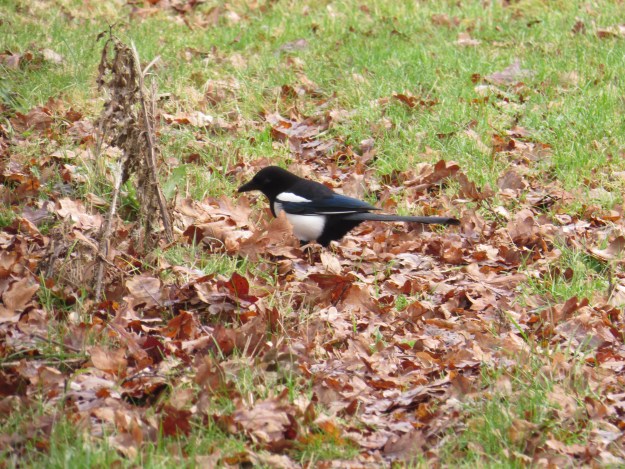
There was lots of crow activity today – this magpie was throwing the leaves about in much the same way that a blackbird does. I think it gives an indication of how many invertebrates use the leaf litter as a place to spend the winter, and how important it is to leave at least some leaf piles in the garden.

The crows are super-curious, and are always investigating the graves to see if there’s anything edible. I sometimes see them picking up the artificial flowers and then throwing them over their shoulders as if in frustration. This one eventually flew off with what looked like a chrysanthemum flower. Maybe there are some seeds or insects inside. The magpies will also take shiny objects and fly off with them, so the old adage about magpies being ‘collectors’ still seems to hold true.

The first primroses are starting to emerge…

And there are still some rather damp-looking fungi around.

Mystery fungus! All suggestions welcome.

But what does this hogweed think it’s doing? It’s at least four months too early. It was flowering away in splendid isolation, with not a single fly to pollinate it. There were a few winter gnats around, but as far as I know they don’t act as pollinators. This is a high risk strategy, but as the winters get milder, who knows whether early-flowering plants might be the winners in the end?

And finally, we were accosted by this enormous squirrel. I am 99% sure that she is pregnant, rather than just well-cushioned – I noticed squirrel mating behaviour back in December, so although she’s a bit early, she’s not that unusual. I imagine that there’s lots to eat in the cemetery, so let’s hope that she gets enough nutrition to provide for her kits. She looks in excellent condition.

And so it’s back home, to get stuck into the chemistry module of my Open University degree. Studying the Periodic Table reminds me of why I loved chemistry at school – what an elegant and precise way of starting to understand the material world it is! No doubt I shall be waxing lyrical about it soon. For now, I’m just grateful for the way that science provides a way of asking questions about the world that is calm and rational. It feels like just the bracing intellectual exercise that I need.

A Winter Walk at Walthamstow Wetlands

Hazel catkins

Dear Readers, today was a perfect time for a walk around Walthamstow Wetlands – it was cold but not too cold, and there was a perfect crispness about the light that made everything so cheerful. Look at those bouncy hazel catkins, which look just like the tails of the lambs that will be born soon.

The twigs of the weeping willows were a perfect mellow yellow colour, and I think that the electricity pylon actually adds something to the scene. We are so lucky to have so much green space in London – the city certainly punches above its weight in terms of biodiversity.

There was a solitary coot rooting amongst the reeds, and not a hint of wind to ruffle the surface of the reservoir.

A tufted duck glided serenely away, before diving and leaving nothing but ripples.

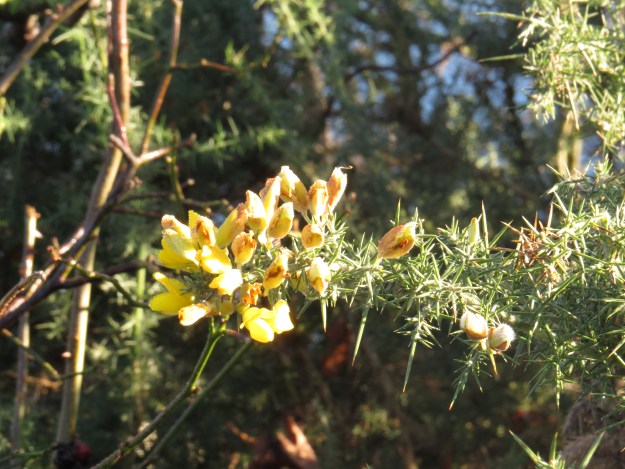
The gorse is in flower (so kissing must still be in fashion, as they say).

Herons glided over the path, looking positively prehistoric. In a few weeks time they will be setting up their nests on one of the islands, and the serenity will be broken by the sounds of heron chicks, but for now the main sound is the chorus of robins. This one was singing, then listening out for a rival, then singing again.

And a great-crested grebe patrolled the water. No sign of a mate today, but probably she or he is very close.

It was one of those days when I feel delighted just to be alive, and clearly I wasn’t the only one – one woman, who had been admiring the view over the water, just turned to us and remarked how beautiful it was. It was a day for pausing, and looking, and soaking it all in. They say that nature is restorative, and today it felt as if every breath was medicine. I felt so lucky and privileged just to be able to enjoy it. I wish the same for all of us.

In Praise of Climbing Hydrangea

Dear Readers, my climbing hydrangea (Hydrangea petiolaris) is really excelling itself this year. The leaves are shades of custard-yellow and lime, and it’s finally beginning to provide some cover for the nest box in the corner.

This is a dark, damp, murky corner of the garden, but this plant just doesn’t seem to care. In the spring it’s covered with big lacy heads of tiny cream-coloured flowers, and I think they’re rather fine even when they’ve gone over.

But it’s the leaves that have really caught my eye.

And while I’ve been standing there photographing the leaves, lots of small birds have been visiting the newly-filled seed feeder. Here’s a rather blurry chaffinch…

And now a great tit….

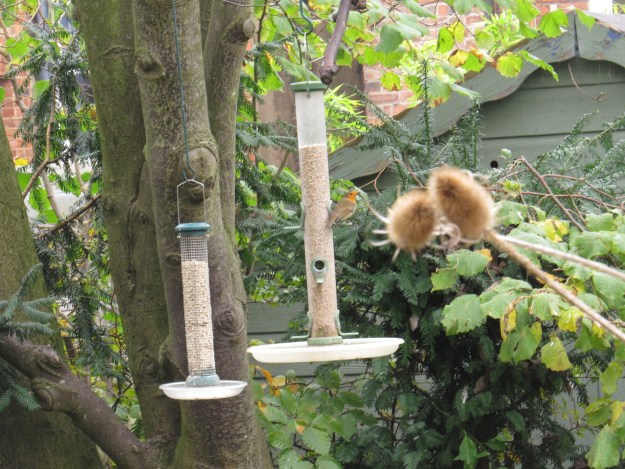
And here’s someone I didn’t expect to see using a bird feeder…..s/he did actually snaffle a quick seed, though I imagine the suet would be more to their taste. Does anyone else have robins using their feeders?

Meanwhile, there is one brave marigold still in flower…

And finally, next door’s hebe has come back into flower for about the third time this year. It is such a boon for bumblebees when they decide they need a nectar top-up during the winter.

And so, spending ten minutes away from my spreadsheets was well worth it! And good for my poor old back, too.

Sunday Quiz – Aliens!

A Martian in Woking (Photo by Colin Smith ) This is a metal sculpture, based on H G Well’s book ‘The War of the Worlds’

Dear Readers, this week we had Claire with 11 1/2 out of 15 and Fran and Bobby Freelove with 13 1/2 out of 15, so well done to all of you! The next quiz will be tomorrow, and I am wondering why I didn’t have the idea for it ages ago…I hope you enjoy it!

‘Alien’ animals can cause a range of reactions, but the history of how they got to the UK, and what their impact has been, fascinates me. In most cases, they arrived because we wanted them, and didn’t realise quite how keen they’d be to get back to the wild. Sometimes, they were hitchhikers, a result of the international trade in plants and artefacts. Very rarely, they flew here of their own accord and found the conditions to their liking. With climate change, and with our inadequate biosecurity regulations, we are going to have to get used to all manner of plants and animals arriving and setting up home. As always, it will be interesting to see how such encounters play out.

Photo One by Bouke ten Cate, CC BY-SA 4.0 <https://creativecommons.org/licenses/by-sa/4.0>, via Wikimedia Commons

1. Edible dormouse (Glis glis)

This attractive little rodent was deliberately released into the wild in 1902 (it comes originally from southern and central Europe). It is considered a menace because it can wreak havoc in lofts and roof spaces, and damages trees by stripping the bark. The Romans used to have special pots for keeping edible dormice until they were fat enough to eat. I must admit I thought that they had brought them to the UK, but it seems that if so they became extinct, and were re-introduced much more recently.

Photo Two by Ryzhkov Sergey, CC BY-SA 4.0 <https://creativecommons.org/licenses/by-sa/4.0>, via Wikimedia Commons

2. American mink (Neovison vison)

Farmed for their fur, some escaped while others were deliberately released, sometimes by well-meaning animal activists. However, these creatures are efficient predators, and their presence has been linked to the decline of the water vole and various ground-nesting birds. Their numbers might be decreasing slightly as the larger otter becomes more common.

Photo Three by Lilly M, CC BY-SA 3.0 <https://creativecommons.org/licenses/by-sa/3.0>, via Wikimedia Commons

3. Sika deer

Originally introduced to populate the grounds of stately homes and estates, the sika was established in the wild by the 1930’s. It interbreeds with native red deer and can cause serious damage to crops, trees and sensitive habitats. There are lots in Dorset, and on our way back from Dorset last week our train nearly ran over two who were on the tracks.

Photo Four by Prue Simmons, CC BY 2.0 <https://creativecommons.org/licenses/by/2.0>, via Wikimedia Commons

4. Racoon Dog (Nyctereutes procyonoides)

This animal (which is a canid not a raccoon) was introduced to the UK from East Asia for its fur. it isn’t established in the UK yet, but it is well established in many other parts of Europe so watch this space. Where it has established a foothold, it is a predator of birds and amphibians, and competes with native carnivores such as the fox and badger.

Photo Five by Bernard Spragg. NZ from Christchurch, New Zealand, CC0, via Wikimedia Commons

5. Ring-necked/rose-ringed parakeet (Psittacula krameri)

Did Jimi Hendrix release a pair of these while he was on an acid trip, resulting in the many thousands of birds that are now common in London? It’s more likely that there were escapes and releases from multiple sites over a period of years. At any rate, the parrot is now moving north and west at an inexorable rate. It strips orchards and may compete with other hole-nesting birds, but personally I think that it brings a touch of the exotic to North London.

Photo Six by By Andreas Trepte - Own work, CC BY-SA 2.5, https://commons.wikimedia.org/w/index.php?curid=788401

6. Egyptian Goose (Alopochen aegyptiacus)

This medium-sized goose has been breeding in the wild after escaping from wild fowl collections since the early 1800’s, but has increased like billy-o since the 1980’s. It is well-established in the wild in Suffolk and Norfolk, and seems to be going west at a rate of knots. It can cause crop damage and pollute water bodies, but to be honest so can most wildfowl at high concentrations. Plus, to be complaining about pollution of water bodies when there’s so much agricultural and industrial run-off seems a bit hypocritical. Interestingly, they often seem to nest in hollow trees, which is quite a feat for a large aquatic bird.

Photo Seven by By Rhondle - Own work, CC BY-SA 3.0, https://commons.wikimedia.org/w/index.php?curid=16504721

7. Red-eared terrapin (Trachemys scripta elegans)

I was only writing about these animals earlier this week. They can’t breed in the UK (yet) because the winters are still too cold, but individuals can live for up to thirty years, and there seems to be no limit to the number of people prepared to throw their pets into the nearest water body when they get too big. They are voracious predators of amphibians and invertebrates, even taking ducklings when they are tiny.

Photo Eight by Charles J. Sharp, CC BY-SA 4.0 <https://creativecommons.org/licenses/by-sa/4.0>, via Wikimedia Commons

8. Marsh Frog  (Pelophylax ridibundus)

Deliberately introduced by the end of the 19th century, this chap is also known as the laughing frog because of his loud call. The frog is now well-established in Romney Marsh in Kent, the Somerset levels and the area around Tamworth. The species is apparently becoming more common, so keep an eye open….

Photo Nine by Dieter Florian (To contact the author, ask the uploader or take a look at tauchshop-florian.de.), CC BY-SA 3.0 DE <https://creativecommons.org/licenses/by-sa/3.0/de/deed.en>, via Wikimedia Commons

9. Wels catfish (Siluris glanis)

This enormous fish, which can grow to 5 metres long and weigh 300kg, was deliberately introduced as a food fish. Hah! By the 1950’s it was swimming happily in managed stillwaters used by fisheries, and in some deep lowland rivers. It eats anything and everything, from frogs to water voles to ducks, and as you can see, there’s nothing in UK rivers that can outcompete it.

Photo Ten by Liquid Art, CC BY-SA 4.0 <https://creativecommons.org/licenses/by-sa/4.0>, via Wikimedia Commons

10. Rainbow Trout (Oncorhyncus mykiss)

The trout that made river fish available to the general public when fish farming really took off in the 1970s in the UK, rainbow trout seem to have problems breeding in the wild in the UK, and are still usually out-competed by the local brown trout. However, climate may be a factor in keeping them in check, and this is changing as we know. Again, watch this space.

Photo Eleven by David Perez, CC BY 3.0 <https://creativecommons.org/licenses/by/3.0>, via Wikimedia Commons

11. Signal Crayfish (Pacifastacus leniusculus)

Introduced from North America in the 1970s, this crayfish quickly found its way into the wild, and has caused the rapid decline of the native white-clawed crayfish through competition for food and other resources. It also spreads crayfish plague (who knew there was such a thing?) As if that wasn’t enough, it makes its burrows in the banks of water bodies, causing them to collapse, and eats the eggs and young of fish. There is a move afoot to persuade the UK public to eat more crayfish.

Photo Twelve by David Short from Windsor, UK, CC BY 2.0 <https://creativecommons.org/licenses/by/2.0>, via Wikimedia Commons

12. Harlequin ladybird

This much-maligned beetle comes originally from Asia, and was deliberately released in Europe as a biological control, presumably against aphids. Sadly, the harlequin ladybird is much more of a generalist predator than that, and when the aphids are gone it will turn its attentions to other insects, including the much smaller native ladybirds. It arrived in the UK in 2004 and made itself very much at home ever since. I think personally that it outcompetes other ladybirds than rather than actually eating them, but that’s anecdotal, based on a couple of years observation of one aphid-infested buddleia.

Photo Thirteen by Charles J. Sharp, CC BY-SA 4.0 <https://creativecommons.org/licenses/by-sa/4.0>, via Wikimedia Commons

13. Asian hornet (Vespa volutina)

Oh lord the column inches devoted to this insect! It is true that it eats honeybees, but I suspect that it has been the cause of the death of more European hornets, hoverflies, wasps and native bees than any other creature. It is seen fairly regularly in the Channel Islands now, and I believe it’s also been spotted in Cornwall. It arrived in south-western France in some pots imported from Asia. It’s most likely to be spotted in areas where honeybees are kept, but it is still very unlikely to be seen in most of the UK. It is much darker in colour than our native hornet.

Photo Fourteen by David Short from Windsor, UK, CC BY 2.0 <https://creativecommons.org/licenses/by/2.0>, via Wikimedia Commons

14. Horse chestnut leaf miner moth (Cameraria ohridella)

This is the tiny creature responsible for our horse chestnut leaves become dry and crinkly and dropping off early every year. Little is known about it, except that it arrived as recently as 2002 on some imported plants, and has been spreading north and west ever since. Though it makes the trees look ugly, it doesn’t yet appear to affect their long-term health.

Photo Fifteen by Kleuske, CC BY-SA 3.0 <https://creativecommons.org/licenses/by-sa/3.0>, via Wikimedia Commons

15. Oak processionary moth caterpillars (Thaumetopoea processionea)

This little darling appeared in 2006 as a contaminant of imported plants and trees – it’s native to northern France. London appears to be the epicentre of its population at the moment, maybe because of a concentration of oak and hornbeam forest, which it seems to like (our local Coldfall and Cherry Tree woods have both had infestations recently). The insect can be a major defoliator of trees, and its hairs can cause allergic reactions and skin irritation. It can also cause the eradication of populations of innocent caterpillars such as those of the ermine moth (which forms nets in bird cherry and some other trees, but causes no long term harm). Don’t just take a flamethrower to your tree, people!

Photo Credits

Photo One by Bouke ten Cate, CC BY-SA 4.0 <https://creativecommons.org/licenses/by-sa/4.0>, via Wikimedia Commons

Photo Two by Ryzhkov Sergey, CC BY-SA 4.0 <https://creativecommons.org/licenses/by-sa/4.0>, via Wikimedia Commons

Photo Three by Lilly M, CC BY-SA 3.0 <https://creativecommons.org/licenses/by-sa/3.0>, via Wikimedia Commons

Photo Four by Prue Simmons, CC BY 2.0 <https://creativecommons.org/licenses/by/2.0>, via Wikimedia Commons

Photo Five by Bernard Spragg. NZ from Christchurch, New Zealand, CC0, via Wikimedia Commons

Photo Six  By Andreas Trepte – Own work, CC BY-SA 2.5, https://commons.wikimedia.org/w/index.php?curid=788401

Photo Seven By Rhondle – Own work, CC BY-SA 3.0, https://commons.wikimedia.org/w/index.php?curid=16504721

Photo Eight by Charles J. Sharp, CC BY-SA 4.0 <https://creativecommons.org/licenses/by-sa/4.0>, via Wikimedia Commons

Photo Nine by Dieter Florian (To contact the author, ask the uploader or take a look at tauchshop-florian.de.), CC BY-SA 3.0 DE <https://creativecommons.org/licenses/by-sa/3.0/de/deed.en>, via Wikimedia Commons

Photo Ten by Liquid Art, CC BY-SA 4.0 <https://creativecommons.org/licenses/by-sa/4.0>, via Wikimedia Commons

Photo Eleven by David Perez, CC BY 3.0 <https://creativecommons.org/licenses/by/3.0>, via Wikimedia Commons

Photo Twelve by David Short from Windsor, UK, CC BY 2.0 <https://creativecommons.org/licenses/by/2.0>, via Wikimedia Commons

Photo Thirteen by Charles J. Sharp, CC BY-SA 4.0 <https://creativecommons.org/licenses/by-sa/4.0>, via Wikimedia Commons

Photo Fourteen by David Short from Windsor, UK, CC BY 2.0 <https://creativecommons.org/licenses/by/2.0>, via Wikimedia Commons

Photo Fifteen by Kleuske, CC BY-SA 3.0 <https://creativecommons.org/licenses/by-sa/3.0>, via Wikimedia Commons

A Late Summer Walk at Walthamstow Wetlands

The Engine Room at Walthamstow Wetlands

Dear Readers, last time I was here with my friend S, the site was closed due to flooding, so it was a relief to actually be able to see the reservoirs and lakes this time. The whole place was full of dragonflies, not one of which sat still long enough for me to get a photo. Still, they are such a delight, zipping about like those toy planes powered by elastic bands that you used to get for about a shilling when I was a girl. 

They currently have a Moomin trail for the children. I was never a great fan of the little critters, but my lovely friend Susie, who died much too young, was an avid collector of all things Moomin, so I had to take a few photos for her.

On the ‘real’ wildlife trail, though, my Birdnet app proved its worth again. I heard some calls coming from what I thought were small birds in one of the goat willows. Well, I was half-right – they were small birds, but they were Little Grebes, or Dabchicks (Tachybaptus ruficollis). According to my Crossley Bird Guide, their ‘very well-known call is like whinny of tiny horse or slightly insane giggle’. I love this book!

The young birds can apparently retain the stripes on their head through their first winter, which I think is what is going on with this bird. It has a fluffy tail too, which leads Crossley to describe the bird as a ‘floating rabbit’. All in all it’s a slightly bedraggled-looking little bird, but it bobs under the water with all the efficiency of its larger relatives and then bounces back up like a cork. Dabchicks eat insects and larvae, so any baby dragonflies had better watch out.

On one of the other lakes, I spotted an adult bird, looking a bit more dapper. That splendid chestnut neck is diagnostic for the species, and I’d have though that the white mark below the bill was a good indicator too.

Adult Little Grebe

What’s going on with the water, though? Although in some places it looks like one of those Venetian marbled papers, it does look a little alarming. It’s not duckweed, and it doesn’t seem to be chemical pollution, so I’m assuming that it’s algae.

And how about this fabulous spider, who was floating in mid-air half way across the path and wasn’t best pleased when we accidentally undid all his/her hard work by walking right through the web…

There’s also some flowering Japanese knotweed (though as we know there are only female plants in the UK so it’s not the seeds that are the problem, but the roots) and! apparently some Giant Hogweed though I couldn’t see it. For those of you who don’t know, the sap of this plant can cause blisters, and it also makes the skin photosensitive so that it becomes red and sore on exposure to sunlight, sometimes for years afterwards.

There are lots of rosehips about too, including this sweetbriar( Rosa rubiginosa) – the hips have much longer sepals than on a dog rose.

A lot of the paths are out of action at the Wetlands at the moment – when ducks moult they lose all their flight feathers at once, and so are extremely vulnerable and need places to hide without disturbance. It’s always a great place to wander around, though, with lots to see if you’re patient. Today felt like summer’s last gasp, with temperatures in the high twenties, and so it was good to make the most of it. Plus, the cafe does the most delicious sandwiches and cakes, so it makes it easy to just ‘hang out’. What a great addition Walthamstow Wetlands is to the green spaces of London!

Falling Down in St Pancras and Islington Cemetery

Swamp cypress leaves

Dear Readers, those who’ve been following me for a while will know that I have a strange tendency to trip over the smallest of imperfections in any surface. Some people think that I could stumble over a misplaced molecule, and they are probably right. However, today I fell in spectacular fashion over a pothole in one of the paths that could have been seen from space. Fortunately both my camera, my knees and my ankles survived, though my hands smarted for a while and I think my poor husband will be traumatised for the rest of the week.

I suppose it’s something to do with the fact that we are finally holding my Dad’s memorial service in a fortnight’s time – I have always found myself rather distracted when significant days that relate to Mum and Dad are coming close. The service will be at St Andrew’s Church in the lovely Dorset village of Milborne St Andrew, and it will be a chance to see some people that I haven’t seen for well over a year. Covid numbers are rising, which is concerning, but the vicar is asking for social distancing and face masks, and I suspect that things will get worse as the year wears on, rather than better. At any rate, while I hate the word ‘closure’ because it implies drawing a line under an event that can only be integrated rather than tidied away, it will feel as if Dad has been honoured properly, and that people who have not had a chance to mourn communally will have been able to do so. I shall keep you all posted on how it goes.

Anyhow, although it’s a very damp, drizzly day, there is much to enjoy in the cemetery today. Everything seems to be on pause, but there is such bounty in the shrubs and trees.

This is why a cherry laurel is called a cherry laurel. Don’t eat these though, they contain cyanide.

I am watching the progress of the conkers and the leaf miners on the horse chestnut trees with equal interest. The conkers are growing nice and fat, but seem to have some kind of rust growing on them.

The leaf miners are having a great time. I’m starting to see the little holes where the tiny moths have exited (as at the end of the long brown streak on the left-hand side of the central leaf). I just hope that some Southern Bush-Crickets find the tree soon.

I was rather taken by this lonely Fox and Cubs (Pilotella auriantica)…

and I love the constellations on the flowers of the ribwort plantain (Plantago lanceolata)…

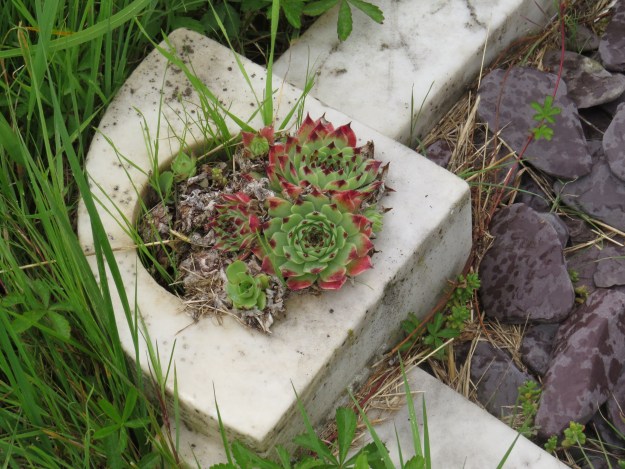
But this plant stopped me in my tracks completely. It’s so perfect that at first I thought it was plastic. It’s a houseleek (Sempervivum tectorum) though I’m not sure which variety. How splendid it is, and how utterly perfect.

There is a smaller plant in the other corner of the grave. Clearly this one isn’t in such a prime location but I have a suspicion that it will do its best to catch up.

It’s going to be a great year for hawthorn, my tree is bowed down with them.

It’s a good year for pyracantha, too.

And finally a long-standing mystery has been solved. I have been puzzling over this shrub for months – it has silvery, strap-like leaves. But finally I’ve seen the berries and all is clear. This is sea buckthorn (Hippophae rhamnoides), rare as hen’s teeth in the wild but flourishing here alongside the North Circular Road. You honestly never know what you’re going to see in this uninspiring little strip of shrubs and wildflowers.

Sea buckthorn berries have featured heavily in the menus created for cookery show ‘The Great British Menu’, where established professional cooks compete to have a dish at a banquet to honour a particular group of people – D-Day veterans, health and care workers, musicians, children’s authors. Sea buckthorn is universally hated by the judges, but the chefs seem to think that if they can only come up with the right dish, they will win. It hasn’t happened yet, sea buckthorn berries being something of an acquired taste – Wikipedia describes them as ‘astringent, sour and oily’, which doesn’t sound like a winning combination. They do have medicinal qualities, however, so all is not lost.

Sea Buckthorn (Hippophae rhamnoides)

Anyhow, by now it’s pouring with rain, and so we turn for home. I’m aware of a sudden chorus of agitated crows and jays screeching and cawing, and turn just in time to see a heron flying over, probably headed for the Dollis Brook or the lakes of Hampstead Heath. It looks more like a prehistoric animal than a bird, but of course birds are basically little dinosaurs so this isn’t surprising. What I need now is a cup of tea and some arnica for my grazes.

Expect the Unexpected

Walthamstow Wetlands – the weir

Dear Readers, I met up with a dear friend for a walk and a coffee at Walthamstow Wetlands yesterday. When we arrived at the main gate, it said that the main part of the wetlands was closed due to flooding. Gosh! Walthamstow was one of the areas badly flooded in the torrential rains last month, but there had been no rain overnight, so we were a bit taken aback. But fortunately, the other, smaller part of the wetlands was still open, so off we went to see what we could

One thing that you can definitely see is the extensive building at Blackhorse Road. I wonder how much of this is on the floodplain from the rivers around the wetlands? Hopefully none of it, as it seems to be on slightly higher ground, so fingers crossed. I’m hoping that at least some of these new flats and townhouses are ‘affordable’, though as affordability = 80% of the market price, they’ll still be out of the reach of most people.

There were lots of men with binoculars walking along the raised reservoir, so I made enquiries. Apparently there were two greenshank on the edge of the water on the other side. I hadn’t brought  my binoculars as a camera is distraction enough when you’re catching up with a friend, but here’s a photo of a greenshank so you can see what we missed.

Photo One by By Charles J. Sharp - Own work, from Sharp Photography, sharpphotography, CC BY-SA 4.0, https://commons.wikimedia.org/w/index.php?curid=41975685

Greenshank (Tringa nebularia) (Photo One)

The edge of the reservoir is a haven for wildflowers, and many a Wednesday Weed has been discovered along this stretch of uninspiring-looking concrete.

Purple loosestrife (Lythrum salicaria)

Tansy (Tanacetum vulgare)

Common toadflax (Linaria vulgaris)

Bladder campion (Silene vulgaris)

Common Ragwort (Senecio jacobaea)

But who else is here?

A fine collection of mute swans, all happily preening and dozing.

These are likely to be young birds or those not yet paired up and territorial – once a pair have a territory they will guard it zealously, as anyone unfortunate enough to accidentally disturb a mute swan on its nest will attest. I was once chased along a country lane for a hundred metres by an irritate bird after I almost fell over its nest.

Apparently mute swans are so-called because their wings make a whistling, humming sound in flight, which means that they don’t need to have a flight call like other swans. Who knew? Not me for sure.

Two swans were swimming in parallel. One would raise its head, then the other one followed suit. One would dip its head under the water, and then the other would do the same. I always wonder what strange and subtle signals birds send to one another that we can’t read. How close are you allowed to stand to one another if you’re not a pair? Do you preen synchronously too?

And so, although it wasn’t quite the morning we’d planned for, it was still a good walk, full of plants and animals and interesting Victorian architecture, like this water tower. Those Victorians didn’t do things by halves.

And as we headed back to Blackhorse Road tube station, I spotted this bush. It’s clearly some kind of vetch, but I’m puzzled by the way that the seedheads seem to have exploded. Can any of you gardeners out there a) identify the plant and b) tell me if the seedheads are supposed to look like that? All information gratefully received..

Mysterious yellow bean-plant

Seed capsules of mysterious yellow bean. Are they supposed to look like deflated balloons?

Photo Credits

Photo One By Charles J. Sharp – Own work, from Sharp Photography, sharpphotography, CC BY-SA 4.0, https://commons.wikimedia.org/w/index.php?curid=41975685


An August Walk in St Pancras and Islington Cemetery

‘My’ swamp cypress

Dear Readers, I didn’t get to the cemetery last week because of the interminable rain, so it was a real pleasure to see what was going on this week. For a start, the swamp cypress was looking extremely fine. I know you’re not meant to have favourites, but this tree is very close to my heart.

But then, how about the trunk on this oak? It seems to have been much-lopped in its early years, and it’s covered in puckers and scars, but is no less characterful for its troubles. It reminds me of one of those many-breasted statues of Artemis that you can see in museums, and, like all oaks, this tree probably has been ‘mother’ to many, many other species. Or maybe it’s just me. See what you think

Photo One by Son of Groucho from Scotland, CC BY 2.0 <https://creativecommons.org/licenses/by/2.0>, via Wikimedia Commons

Statue of Artemis from the Ephesus Museum (Photo One)

In other news, one of the cherry laurels has become a refuge for snails of all kinds. I guess that the waxy leaves provide an excellent protection against drying out, though the snails don’t appear to be eating them. This brown-lipped banded snail (Cepaea nemoralis) reminds me rather of a mint humbug.

I think that this is probably a rather worn garden snail (Cornu aspersum). It looks like an elderly snail to me, battered by life but clinging on.

And this is another brown-lipped snail, though not quite as pristine as the first one. Isn’t it interesting how we (generally) view snails as small characters, rather lovable in their way, but don’t extend the same tolerance to slugs? Maybe the shells help to offset the general sliminess.

Late summer is already shading into autumn, with bountiful supplies of conkers…

Elderberries….

And rosehips….

But there are some new plants in flower as well, such as this musk mallow (Malva moschata)…

and these lovely common toadflax (Linaria vulgaris). I love this plant, with its lemon and orange flowers. In fact, I have a great fondness for all toadflaxes – they are often great for pollinators and their flowers just ask for a bee to land on them.

There has been a whole lot of strimming going on on the banks where I’ve seen green woodpeckers in the past, but at the moment the magpies are there, working over the dried grass for tasty insects.

We take a quick run around the field and have a look at the Himalayan balsam. This is such an attractive, showy plant. I can see why people planted it in the past – it’s like having a giant moth orchid in your back garden. What a shame it’s such a thug – the bees seem to love it.

I spot a sparrowhawk flying overhead. I also see a recently-fledged blackbird, looking very small and vulnerable. Fortunately I could hear at least one adult bird in the tree overhead, so I moved quickly on, keeping my fingers crossed that this little one would soon be fully equipped for life in the cemetery. At least there are very few cats.

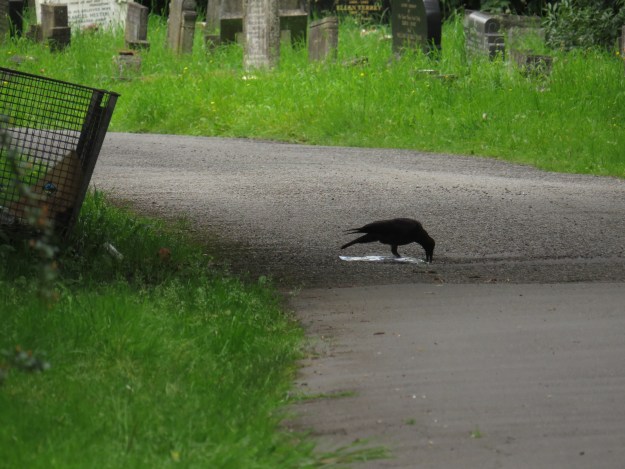
This crow was pecking at a piece of cellophane that had been used to wrap flowers with great determination, and even tried to fly off with it when we approached.

We couldn’t see anything of food value, and so my husband put the cellophane back in the bin. I reminded him that experiments have shown that corvids don’t forget someone who has done them a disservice – it’s been shown that they can identify someone who has wronged them even if they change their clothes and wear a mask. Let’s hope that this act of kindness won’t be misinterpreted, or our walks in the cemetery are about to become much more ‘interesting’.

Photo Credit

Photo One by Son of Groucho from Scotland, CC BY 2.0 <https://creativecommons.org/licenses/by/2.0>, via Wikimedia Commons