Category Archives: London Mammals

Storm Darcy Arrives in East Finchley

Dear Readers, well I’m not having to shovel my way out of the front door, but we do have snow this morning, and so it’s on with the walking boots and woolly hat, and out into the garden to make sure there’s food and water for the birds. A blackbird was pecking over the bird table before it was even light, so the critters are definitely hungry. Sure enough, the robin was down pecking at the mealworms before I’d even left the garden. And then the starlings arrived.


And the chaffinches.

I’ve noticed before how more tolerant birds are of one another in the winter, but even I was surprised when this little gathering on the bird table didn’t end up with ‘pistols at dawn’.

It doesn’t take much to spook them though.

And it turns out that one of the starlings has ‘cracked’ the nut butter feeder. I’ve seen coal tits feeding on the other one (which is hidden away next to the bittersweet) so at least somebody likes them.

But the height of the excitement was spotting a female blackcap working over the bittersweet. At least I’m thinking that it’s a female – juveniles look similar. Some folk have found that these birds are aggressive at the bird table, but this one couldn’t be more reclusive. I love that she’s eating the berries – at one point she hung upside down on a twig to get one. I hung a roosting pouch in the hedge so I wonder if she’s using it?

And it’s still snowing, though just wispy little flakes. The temperature isn’t expected to get above 30 degrees Fahrenheit for the rest of the week, so I’m glad that I stocked up on birdfood. And who knows, maybe we’ll get lucky and see a fox like we did last time.

Winter Comes to East Finchley

Dear Readers, on Sunday the snow that the rest of the country has had for weeks finally arrived in London. I still find something magical about it, the way that it covers up all the imperfections for a while, the way it falls so silently. It seems to put the birds into some confusion though: for a few minutes they disappear, as if trying to work out what this white stuff is, and then they’re back.

Starlings queueing up in the hawthorn

Male chaffinch on the sunflower seeds

Female chaffinch and goldfinch

I had been saying that I hadn’t seen a blackbird in the garden this winter when, as if by magic, one appears in the cherry tree next door.

But then the magic really happens.

This beautiful, well-fed little vixen puts in an appearance. She sniffs out all the suet we’ve thrown down for the birds and then goes for a wander.

Occasionally she spots a bird and decides to try her luck.

But mostly she’s just pottering. How do I know it’s a vixen? Because females squat to scent mark, while males raise a leg. She’s in beautiful condition. Look at that lovely long fur.

I wonder if I’ll get a portrait, and then she looks up. Look at that face. She has absolutely made my day.

A Chilly Walk in St Pancras and Islington Cemetery

Redwing about to fly off

Dear Readers, the cemetery is full to busting with redwings at the moment – these small thrushes are extremely shy, so getting any kind of photo has proven to be a challenge. The one in the photo above headed off as soon as it saw my camera. I wonder if they are hyperalert to people raising metal objects in their direction? I know that the woodpigeons in Dorset were always much more worried when I tried to take a photograph than the ones in London, and I put this down to the fact that the country ones are much more likely to be shot. Anyhow, even seeing a redwing was a nice start to the walk.

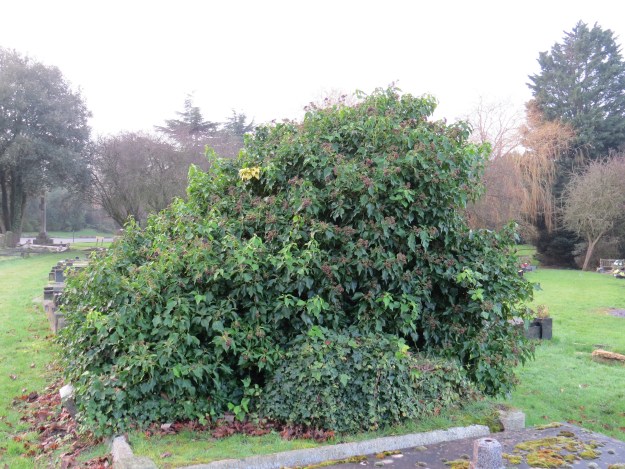
As usual, I suddenly notice things that I’ve been passing every week. This grave, in quite a well-manicured part of the cemetery, is completely covered in ivy. I wonder what’s under there? Quite the conundrum.

We loop through the woodland cemetery site, and I stop to say hello to the swamp cypress, now completely denuded of its leaves. But look, it has buds! Spring will soon be here.

And as we walk along our normal path, I suddenly notice an outbreak of snowdrops. What a particular joy they are this year! They must have been pushing up for ages, but I’ve only paid attention to them now that they’re in flower. Years ago, I imagine someone planted a few bulbs, and now they’re colonising the whole area. I love their delicacy and their strength.

Once I’ve noticed them in this spot, I see them all over the cemetery.

And by the stream, in the usual stand of ash trees, a robin is announcing his territory to the world.

These little puffed-up balls of feistiness are in full song: if you listen above the rumble of the traffic from the North Circular you can hear them challenging one another right through the cemetery.

We head towards the woody part of the cemetery. I hear a buzzard mewing, and crows cawing, but don’t see anyone overhead this week. However, there is a fine gathering of crows and magpies, and they are happily picking up chunks of bread that someone has left them under one of the trees. They are joined by at least two foxes, who are too fast for me to catch properly on camera, though there is the faintest suggestion of one in the photo immediately below.

Fox just to the right of the road sign.

We came into the cemetery at about 10.15 (it opens at 10 o’clock) and a car shot past us on the way out – maybe this was the person who feeds the birds. I’m sure they need it in this cold snap. Anyhow, now we know where to head for. Maybe next time I’ll have more luck getting a photo of the foxes.

I was rather moved by this Victorian cherub, on the grave of a child who died at six years old. It’s easy to forget how far we’ve come in terms of health: my grandmother lost three of her four children, one to scarlet fever, one to diptheria and one to a late miscarriage, before she gave birth to my Mum. This wasn’t unusual in the East End. But just because early death was so common it didn’t make it any easier; my Nan remembered the poems on the remembrance cards for her dead children for her whole life. I suppose that being in a pandemic is, for many of us, our first experience of a disease that curtails our activities and fills us with fear, one where medical science doesn’t immediately have all  the answers. As recently as the 1950’s people lived in dread of their children contracting polio and ending up in an iron lung. We have been very lucky, and you don’t have to walk far in this cemetery before you start to realise how unusual we’ve been. It makes me very humble when I see what previous generations have gone through, and what I’ve taken for granted, at least until now.

The great spotted woodpeckers don’t care about our troubles  though, they’re much too busy drumming and staking their claims to the best trees. I watch two woodpeckers chasing one another past the chestnut trees, and then get this most excellent photo of one. Yet another candidate for Wildlife Photographer of the Year, I feel.

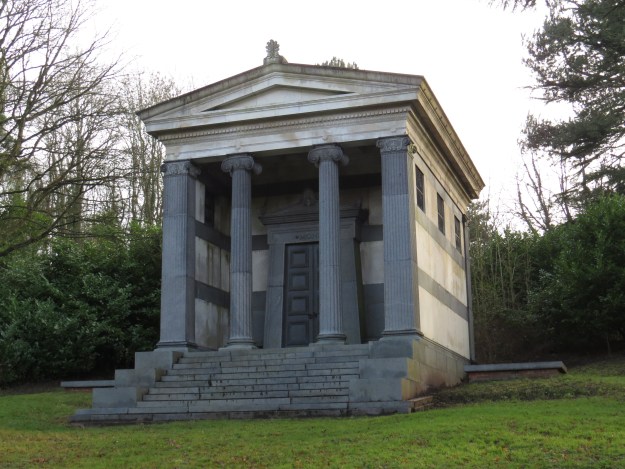
And then I wander down for a quick look at the Mond mauseleum. I’ve mentioned it before, but it really is an extraordinary thing: my book ‘London Cemeteries – An Illustrated Guide and Gazetteer’ by Hugh Meller and Brian Parsons describes it as ‘the finest classical building in any of the London cemeteries (along with the Ralli mortuary chapel at Norwood’). It was designed by Darcy Braddell, later a vice-president of the R.I.B.A, and was built in 1909. I’ve mentioned before that Ludwig Mond was a major industrialist and philanthropist. I must confess that I don’t love this building: it seems a bit overbearing and austere to me.

But I am very fond of this little tree that stands at the road junction opposite. I am thinking that it’s a weeping cultivar of silver birch, maybe ‘Tristis’? No doubt you lovely people will put me right. There was no angle from which I could avoid the sign pointing to the crematorium and pick up the purple of the shoots and the snaky twisting of the branches, so this will have to do. But what a pretty little tree this is! I shall have to pay it more regular visits to see how it’s coming along.

A Busy Walk in Highgate and Queen’s Wood

Bark!

Dear Readers, it’s Boxing Day and all those who have been at home, eating turkey and watching Strictly Come Dancing Christmas Special on the TV have suddenly burst out of their abodes and headed for the woods. We made the mistake of heading to Highgate Wood ‘for a change’ but it was so packed with people that ‘the dance of two metres’ became trickier and trickier, especially as the paths had been so trampled that there was thick mud on either side. It’s wonderful that people feel such a need to get out into nature at the moment (and I’m one of those people) but it does point up how much of ‘nature’ we’ve lost, when the small areas that remain are so overcrowded.

The love of the woods is clear, as seen by this bench, with its bowl providing water for dogs and its bunch of roses. The inscription reads:

I sit here with memories for company

Knowing  that if life were moments 

we’d all have a good time’.

Sean Hughes (1965 – 2017)

Sean Hughes was born in North London but raised in Ireland – he was a very successful comedian (the youngest ever winner of the Perrier Award for stand-up comedy at the Edinburgh Festival) and was one of the team captains in ‘Never Mind the Buzzcocks’, the TV music quiz (not that that exactly sums up the complete anarchy that characterised the show). He was a vegetarian and a lifelong animal rights activist, but had a long struggle with alcohol, ending with his death from cirrhosis of the liver in Whittington Hospital at Archway in 1917. I remember his cheeky grin and his way with a one-liner, and had no idea that this memorial bench was here. RIP Sean. The doggies love their water bowl.

On we go, side-stepping the runners and choosing paths largely based on which large groups are approaching. I do take a detour to admire some fungi. I’m thinking this is probably not the hairy curtain crust that I spotted in Coldfall earlier this week, but maybe something exciting like Stereum ramaele, which is often found on oak.

Anyhow, just after this point we give up and head into the slightly quieter and wilder environs of Queen’s Wood. For some reason this doesn’t attract quite the footfall of Highgate Wood, I guess because there is no children’s playground or grassy area for little ones to play. I like its slightly eerie atmosphere, and I find myself admiring the way that the trees grow into strange contorted shapes in order to reach the light.

There has been a lot of coppicing here over the years, which has helped to bring light into some of the darker areas. I must definitely come back in spring and see what appears (before it’s trampled into the ground anyhow).

And by one of the entrances there’s a warning as to why dumping garden rubbish can introduce all kinds of plants into ancient woodland. I think that this is probably yellow archangel (Lamiastrum galeabdolon ssp argentum), a popular garden plant and one which is widely naturalised in many hedgerows and woodlands across the UK. While the plain-leaved variety of the plant is a native, this variegated garden variety is not and, as it flowers earlier than the native plant it often out competes it. However, I am reserving judgement because I have no idea if the native species grows here, and this is still a useful plant for pollinators. David Bevan, who was the Conservation Officer for Haringey for many years, was relaxed about ‘introduced species’ in his recent LNHS talk, and my instinct is to agree with him.

By this time Queen’s Wood is getting a little busy for my taste as well, and so we head back towards Muswell Hill and home. On our way along Connaught Gardens I spot this street tree, which is covered in pink catkins. I rather think that this is a grey alder (Alnus incana var ‘Ramulis coccineis’) – if so it will have red shoots when spring comes. I must have a wander along and check.

Home we toddle, through Fortis Green, where we meet this very friendly cat. He does that ‘slow blink’ thing that cats do when they’re attempting to be chums, so I stand there like an eejit and do the same until my husband reminds me that it’s lunchtime.

And finally, I notice this single cyclamen in someone’s front garden, glowing like a small candle flame. I know that it’s not a fancy wild one, but it still cheered me up. And then it’s home for toast, and a cup of tea, while we wait for Storm Bella to arrive (70 m.p.h winds! Torrential rain!).

Yep, 2020 has definitely been a year for grabbing pleasures when you find them.


A Christmas Eve Walk in Coldfall Wood

Dear Readers, by the time you read this it will be Christmas Day, so for those of you celebrating I hope you have a peaceful time, especially as for many people it won’t be the kind of Christmas that you were hoping for. I am hoping that 2021 will be a lot less ‘interesting’ than 2020 was.

Onwards!

The temperature dropped overnight to the high 30’s (which is coldish for us – don’t laugh, people in Scotland and Canada and other chilly parts of the world). But it was sunny and DRY hallelujah. We decided to go for a quick mooch around Coldfall Wood, which has saved the sanity of many people this year, including me. Every time I go I notice something new, and I think that lockdown has heightened my appreciation for the gradual changes of nature. How about you?

So, on the way I noticed this little posse of starlings. For once they were eerily silent – normally they’re whistling and clicking and generally making a racket. From the amount of suet that they eat every day I’d say that the inhabitants of East Finchley are single-handedly preventing them from migrating. Who’d want to fly all the way to Africa when there’s an all-you-can-eat buffet in the County Roads?

Is it just me or is this one looking a little portly?

And then we stroll into the woods. We’re a little later than usual, so the place is full of dogwalkers and small children and people going for a walk. For many of us, the Christmas preparations are a lot simpler this year. While for me this is a source of sadness, it’s also rather nice not to be run ragged. It makes me wonder what I could have dropped during previous Christmases to make it a bit easier on myself (and to make me a bit less stressed and easier to be with).  Worth pondering if you’re in the middle of a Christmas frenzy I think. 

I noticed how the holly trees often spring up when a tree has fallen or been pruned – that little bit of light seems to help them to lurch into action. I wonder what seedlings are stirring under the fallen leaves even now?

Little holly and yew trees growing in an unshaded spot.

The cyclamen is doing very well behind its stockade of branches. How sweet that someone has cared enough to try to protect it. I think that it might need a bit more room next year though.

And here is another, more advanced holly tree growing up in a gap.

And here’s some ivy, to complete the picture.

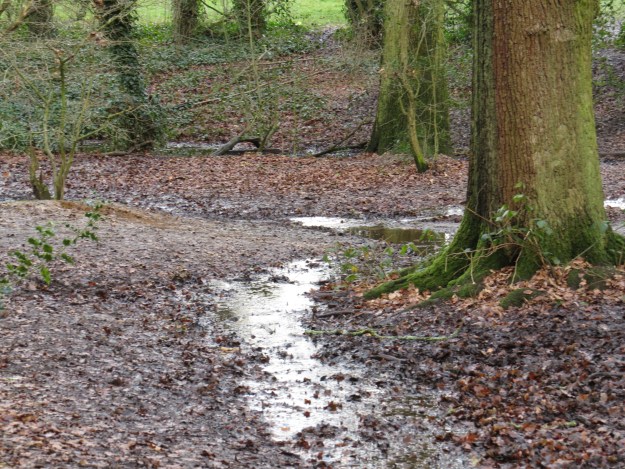
I’ve mentioned the mud before, so here’s a photo to give you an idea of how we’re doing (though it’s much better in the wood than it is on the field – at least in the wood there are lots of trees to drink up the excess water, though they are less thirsty without their leaves).

Some little hoodlum has been graffiti-ing the trees with this time-honoured fertility symbol, though why the testicles appear to have little faces is anybody’s guess.

Does anybody see the face of the elderly man in the trunk of this tree? I suspect he’s annoyed about the phallic symbol.

The little streams that run through the wood are making their way down to the wettest area of the wood. This year, so far, it hasn’t risen too far.

The wet woodland – bulrushes dying back, and the boardwalk well above the surface of the water so far.

I rather liked this completely surreal photo of a crow flying overhead. To some people it might be a blur, but to me it’s abstract art.

The crows are bathing in the stream, and turning over the leaves to find morsels to eat.

Squirrels seem to be chasing one another around and one was investigating the hole in a hollow tree. They don’t normally nest in holes, so I wonder if it was caching food, or looking for something to eat? They are very inquisitive and adaptable animals, so nothing would surprise me.

And when I look at the hornbeams in the wood now I am reminded of David Bevan’s talk about the ancient woodland of North London, in which he speculated that although the oak trees are probably several hundred years old, the hornbeams, cut back year after year for firewood, could easily be much older. When you see a hornbeam ‘stool’ like this one, you get the idea of how long the original tree could have been around, throwing up new stems every year only for them to be regularly cut back.

Hornbeam ‘stool’

And in some places in the wood which have been coppiced, allowing the light to get to the forest floor, young hornbeams are growing up as single-stemmed trees.

And so that was our walk for the day, and we headed back so that I could write the blog. Later we’ll be watching the Festival of Nine Lessons and Carols from Kings College on the television, filmed under social distancing rules and without a congregation. Will I manage to stay dry-eyed as those first notes of ‘Once in Royal David’s City’ sung by the boy soloist soar through the church? I wouldn’t bet on it.

Another Year

Fledgling starling

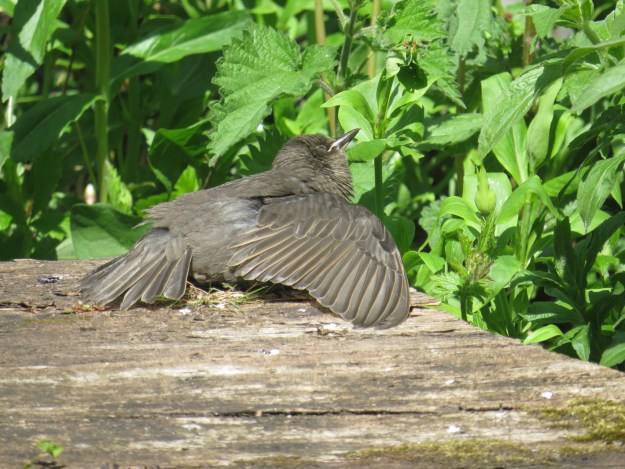
Dear Readers , it seems impossible that I was writing about the new cohort of fledgling starlings a whole year ago, but here we are again. A couple of weekends ago we were woken at stupid o’clock by the insistent, wheezy calls of young starlings, fresh out of the nest and eager to be fed. The sky was alive with parent birds flying fast and low, hotly pursued by their ravenous offspring. I have noted before how the parents ‘park’ their freshly emerged youngsters in a tree, or on the ground, and then fly off to gather food for them. Left to their own devices, even briefly, the youngsters get into all kinds of mischief, and every year there’s something new. For example, I had never seen a starling sunning itself before. This one looked as if s/he was enjoying being able to stretch her wings. Maybe it was a very cramped nest.
Another group decided to bathe in the bird bath.

One fell into the pond and had to be rescued – I fished him out with a leaf-rake and he sat under the hedge looking very bedraggled.

I expected the kerfuffle to attract some predators – in the past I’ve seen fledglings killed by jays, cats and a sparrowhawk. But the afternoon went on, and the parents flew back and forth with mouthfuls of tasty caterpillars and suet pellets. It interests me that the babies will beg from any adult, but the adults are most particular about who they feed. They aren’t going to let all that work of incubating the eggs and feeding the nestlings go to waste now.

The period when the parents look after their offspring is vanishingly short, however. In the course of a few hours, the parents seem to move from feeding their fledglings every ten minutes to returning about once every half hour. I would almost swear that by the end of the day, the youngsters are left largely to their own devices. They certainly seem to pick up this pecking thing pretty quickly. By the end of the week, there were ‘gangs’ of adolescent starlings, but scarcely an adult to be seen. I’m wondering if the adults are just desperate for a break, and to get on with moulting. Nature is nothing if not pragmatic.

How vulnerable the fledglings look, though. I wonder if they feel at all nervous, out in the big wild world? What they seem to resemble most is some Dickensian ingenue, fresh to the Big City and ready to be fleeced by any passing rascal. Let’s hope they’ve learnt at least the minimal street smarts from their parents.

I was extremely surprised by the suddenness of the ‘switch’ in maternal behaviour when I was fostering cats for Cats Protection. We only had one mother cat who gave birth in the house, and this was Rosa.

Rosa

She was the most diligent mother to her four kittens: they were born on the 4th November and on the 5th November there was a massive firework display outside, complete with house-shaking explosions. I was afraid that Rosa would desert the babies in order to find safety for herself (she was nursing right under the window) but not a bit of it. The kittens were the centre of her life for ten weeks, during which time she fed them, cleaned them, protected them and taught them how to behave.

Rosa with her babies

And then, one morning, one of the kittens tried to suckle and she walloped him with a paw, sending him rolling across the floor. She had been moving away and allowing them to suckle less, plus they were all eating solid food by then, but had allowed them to ‘comfort-feed’. From then on, she was grumpy with the kittens, getting away from them whenever she could. She was extremely affectionate with us, though, and it became clear that she was coming back into heat. It was as if she’d decided that her work on this bunch of kittens was done, and she was getting ready to make some more. The kittens were rehomed soon after this, in pairs so that they wouldn’t be lonely, and once Rosa had been through her heat she was spayed and a new home was found for her too. It was a sharp lesson for me in how unsentimental nature is, and how quickly young animals can be ‘cast out’ to fend for themselves.

Incidentally, it also made me think that most kittens are rehomed much too young – 8 weeks feels too early for me, with ten weeks being the ideal. Mothers still have a lot to teach their kittens before they get fed up with them!

And although this isn’t a cat blog, here are the kittens. We gave them descriptive names so that we ‘wouldn’t get too attached to them’. That went well, as you can imagine.

Mostly White at ten days

Mostly White at five weeks

Stripey at six weeks

Stripey Tail at ten days

Mostly Black at eight weeks

Stripey Tail at 2 weeks

The whole gang…

And, of course, all this makes me think about human mothers and their children. I remember how desperately I wanted to be independent when I was in my teens, how hard I fought to break away from what felt like suffocation to me, though my mother saw it as love and protection.I am sure it’s a battle that is repeated in some form or another in most households, with a greater or lesser degree of heartbreak. And yet, when I did remake my relationship with my Mum when I was in my forties, it was all the stronger because of the previous fracture, because the lines had been largely redrawn. We came back together, tentatively at first, as adults meeting and  appreciating one another as if for the first time. Of course Mum was always my mother, and she always told me to put a coat on when she felt cold, but we had a new and enduring respect for one another. She encouraged me to be a writer, and when I was clearing through her things last week, I discovered a plastic file full of the stories that I’d sent to her, pieces that I don’t even remember writing, and yet here they are.She believed in me long before I believed in myself, and it is probably the greatest gift that she gave me.

When animals insist that their youngsters move on, it’s usually permanent – there frequently aren’t the resources to enable two generations to share the same territory. How lucky we are, as humans, to be able to make those decisions for ourselves, and to have the choice to have a new kind of relationship with our parents once we are no longer dependent upon them. The redrawing of boundaries and the conversations that need to be had can be excruciating, but they do open up new possibilities, if (and only if) both parties are willing to try. This is not to say that some relationships  between parents and children are not too toxic, too damaging, to be redeemed. But we often seem so lonely and exposed, so unprepared for what’s to come. As I have learned, there will be a time when there are no ears to hear the things that we meant to say, and the stories of our parents will go with them into the dust.

As the Buddha said, ‘the problem is, you think you have time’.


So That’s Where the Birdfood Went

Dear Readers, I have noticed that the suet pellets and worms and ‘birdy granola’ that I’ve been putting into the ground feeder has been completely demolished every single evening. Someone has been eating the stuff with a thoroughness that no beaked creature could possibly manage. I even had a suspicion that it had all been licked clean. I was blaming the local cats, but then I noticed this handsome creature, munching through it in a leisurely fashion in broad daylight.

When foxes are seen during the day it’s often an indication that they aren’t very well, and so are having to take more risks in order to get food. This one has a poorly left front paw. When I saw him for the first time ten days ago he could barely put any weight on it at all, but by later this week it seemed to be a little better. Foxes are very prone to spraining their limbs, and if this is the fox that I’ve disturbed in the garden on previous occasions, he thinks nothing of jumping six feet onto the shed roof and making his getaway. The leg looks ‘normal’ to me (i.e. nothing is at a strange angle) so I’m hopeful that he will soon be completely fighting fit again. He seems otherwise in very good condition, with no sign of mange or injuries.

Foxes are such exquisite-looking animals that I always feel privileged to see them in the garden. This one hoppity-hopped down to the pond for a drink, watched the frogs with some interest and then investigated under the wooden steps. I’m sure that there are all manner of small creatures lurking under there, and I half expected him to pop up with a wood mouse in his jaws, but all was well for the rodents. Foxes are true omnivores: the local ones seem to have a special fondness for Kentucky Fried Chicken. As the KFC is at the end of the road, the foxes seem to enjoy carrying the chip packets and chicken-wrappings that they find into the side return, leaving them for me to find in the morning. As I think that KFC is an abomination this is a particular trial. But the foxes will also eat anything from bulbs to earthworms, rodents to small birds, and, of course, bird food. I was also holding them responsible for the great frog massacre of a few years ago, but maybe I am wrong on that count. At any rate, this fox seemed to realise that the frogs were not particularly edible, and left them to it.

And so the fox wandered off, through the hedge, past the shed, behind the seating area at the back of the garden and off. I hope that his paw continues to improve, and I wonder if he is provisioning for a vixen holed up somewhere and already pregnant? Suet pellets are expensive, but they’re cheap if they attract animals as handsome and interesting as this. Maybe I’ll start putting down a tiny bit of dog food, just so the fox has something species-appropriate to munch. I have a feeling, though, that all he’ll do is eat the suet and the dog food. Does anyone else feed their foxes? I don’t want to alter the animal’s natural behaviour (foxes that are too dependent on one food source, or too trusting of human beings, often come to a bad end) but I want to give him a little extra support while his damaged leg is recovering. All advice welcomed!

Autumn in Cherry Tree Wood

Dear Readers, those of you who have been following this blog for a while will know that it hasn’t been the easiest of years, what with the gradual decline in my parents’ health, and the recent decision to admit them to a nursing home. In the aftermath of all this, I find myself vulnerable, as if I’ve lost a layer of skin. The downside is that I never know what will make me cry: an advert on the television, a snippet of an old song, a memory conjured out of nowhere. But the upside is that I am seeing things as if anew. I can be caught by a glimpse of sudden beauty that stuns me into stillness. This can make me cry too, but there is less of despair and loss, and more of hope about it. And so I took myself off for a walk in Cherry Tree Wood in East Finchley at this breeziest, sunniest time of the year, just to see what I could see.

A trio of bright pink leaves caught my eye to start with. Nothing natural here, unless you include the tendency of the human to want to mark their territory. Once seen, I noticed it everywhere.

But for the first time I noticed how the hornbeam and oak trees are dancing, their trunks twisting as they reach towards the sun, but on a timescale much slower than our own. What tangos would be captured by a stop motion sequence! They lean back, they swivel, they revolve around their own axis, trying to find a space in the canopy, a dance of years and decades rather than moments, but a dance none the less.

And in the main part of the wood a huge oak rises from a lake of golden  leaves. How many autumns has this giant seen  come and go? And of the eight autumns that I have had in East Finchley, how come this is the first time that I’ve noticed it?

And among the leaves, the squirrels are everywhere. They come in all shapes and sizes, from skinny little runts to great fat imperial squirrels. Most of them are carrying an acorn in their mouths, and they will bury their prize in the ivy or under a layer of oak leaves.  Some tiny proportion of the nuts that they don’t eat during the winter will germinate, some  of them far from their parent tree, and the dance towards the canopy will start all over again.

Turning dizzy laps in the woods is a small  white dog.He skids past me, leaves flying in all directions, and heads back, ears flapping, tongue lolling. He hurtles along the path and increases the diameter of the circle. I don’t know where his owner is, but I sense they are somewhere at the epicentre, like the sun.

I catch glimpses of him as I walk on through the woods. Once, there would have been deer here, but today he seems like the spirit of the place, a dishevelled London pooch, full of life and spirit. And when I stopped to film the falling leaves, there he was.

There is so much to be said for a slow, careful walk in autumn. The colours, the movement, the smell of burning leaves and damp vegetation, the call of crows and the whistle of starlings all serve to remind me that outside my poor, overworked brain there are other lives going on. However lonely we might feel when tough times come to visit, we are part of something so much bigger.


Coming Home at Last

Dear Readers, it’s some indication of how the summer has passed that I have not created a post about East Finchley since June. But this morning was so beautiful that I had to go out with the camera for a stroll around the County Roads. I have been so stressed that I have become completely unmoored, and the cure is to walk, slowly, to pay attention, to breathe and to notice. What better place to start than with the plane trees on the High Street, that seem to be holding the sun in their branches? They are the last species around here to come into leaf, and the last to lose those leaves.

The Bald-Faced Stag gazes towards Cherry Tree Wood, as usual.

There are a lot of tropical Fatsia plants in some of the south-facing front gardens on Lincoln Road. The buds look like little green artichokes, bursting into waxy white flowers.

There are lots of members of the daisy family still coming into flower, loosening those tight-fisted buds one petal at a time.

Michaelmas daisies are everywhere, I love the way that the stamens go from yellow to purple as the flower ages.

Michaelmas daisies

A pumpkin left over from Wednesday’s Trick or Treating gives me the side-eye…

And the autumn berries and hips and fruit are set off by the blue sky.

Each burst of colour feels like a small electric shock. I ask myself where the summer went? Since July every waking moment has been spent organising, planning and worrying about my parents. Now that they are in the nursing home I feel redundant, without purpose. This will pass, I know, but at the moment I feel as if all the grief that has been stored up over the warmer months is exposed by the extravagance of autumn. It all feels just a little too much, beautiful as it is.

I spent a few days with Mum and Dad in the nursing home last week. I had a chance to have a good talk with Mum and to take her through what had happened, step by step. She seemed to understand, finally, that we were unable to look after her at home anymore, and that we wanted to carry out her wishes to be with Dad, and to be close to the friends and neighbours  that she loves. She hasn’t mentioned going home since, though I am not optimistic enough to assume that this will be the end of the conversation. But things look better than they did last week, and that is a bonus.

And now, I have to work out what I want to do when I grow up. As I am nearly sixty, I’d better get a move on. And in the meantime, I am walking the streets with my camera, making friends with the local cats.

There is one garden that I really love. It is a tiny space but absolutely full of nicotiana, borage, and other pollinator-friendly plants. There are a few honeybees even on this chilly day – one of the benefits of a south-facing plot is that it warms up the insects and helps the nectar flow. As I watch, I hear a low-pitched humming, and a queen bumblebee as big as the first joint on my thumb appears. Maybe the warmth of the day has roused her from her hibernation, and she needs a snack. The borage shudders and bows under her weight.

I float along to the High Street again. For a whole hour I haven’t been worrying about whether the nursing home are taking dad’s slight chest infection seriously, or what they will do about the fact that he’s now more or less nocturnal and keeps waking mum up. I realise that though I still have a role to play, the day to day care is not something that I need to meddle in. The home is happy for me to phone whenever I want, but I do think that after being so involved for such a long time, I need to step back from the small stuff. The trouble is, it’s a reflex, and it gave my life purpose.

What do I do now, with my one wild and precious life?

Well, one thing seems to be that I take photos of bollards that have been knocked over. The one on Leicester Road is no sooner concreted into verticality than it’s prone again. This cycle must have been repeated a dozen times since we moved to East Finchley in 2010. And there’s a bollard on the High Street that is similarly afflicted. I could extract some cheesy metaphor about persistence and resilience, but actually it seems a bit Sisyphean, a never-ending task that seems to have no more meaning than a grudge match between bad drivers and some long-suffering council workers.

On Bedford Road there is a rather beautiful tree. It is poised like a heron about to take off, one branch flung back and arching over a garage, the other leaning over the pavement and almost kissing the tops of the cars. What a deeply inconvenient being it is, no doubt blocking out the sun from the front windows and depositing leaves in great russet piles. And yet, it is obviously loved, and encouraged, and valued. There is room on these streets for the strange, the unusual, the awkward. I feel at home here. One day it will be my turn, too, to leave. I hope that I will have planned ahead so that the transition will feel like one that was a choice, rather than imposed on me. And in the meantime I hope to make the most of the harvest, and of the glory that it brings.


Dogs and Cats and Bats

Rt Honourable William Lyon Mackenzie King with one of the Pats

Dear Readers, last week, while I was in Toronto, I visited the home of the first Mayor of Toronto, William Lyon Mackenzie. He was the grandfather of the former Prime Minister of Canada, William Lyon Mackenzie King, who lived from 1874 to 1950. Mackenzie King was a a solitary man, with no close relatives and a small circle of friends. He seems to have distrusted his fellow human beings, and no woman could ever live up to his mother. He lived alone with his dog: he had three Irish Terriers during his lifetime, each one called Pat, and wrote about them in his diary. He described his first ‘Pat’, his constant companion for over 17 years, as ‘a God-sent little angel in the guise of a dog, my dear little saviour’.  It is said that the dog was often asked about matters of foreign and domestic policy, the enthusiasm of his tail-wagging being a clue to how to proceed. When the dog died, Mackenzie King communicated with him by means of seances and a Ouija board.

Every Christmas, Mackenzie King sat down in his armchair beside a glowing fire and read the whole of the Christmas story to his dog, everything from the shepherds to the Magi to the birth in the stable, with special emphasis on the role of the animals around the manger, so that the dog would feel that he, too, was part of the nativity.

I was touched by the image of this man, so isolated from other human beings,  reading aloud to his dog and attempting to make the dog feel that he, too, had his part in the divine plan. I imagine the dog looking up at his master and reacting to his emotions, rather than his words. Who is to say that this is not love of the purest kind? Whatever we pay attention to grows and develops in mysterious ways, but what we sometimes overlook is that this is a two-way process.  The man reads to his dog, and the dog  repays him with unconditional love.

Willow showing relaxed indifference, her normal state.

My cat, on the other hand, had disappeared completely when we got home early on Saturday morning. Sometimes she rushes down the stairs to greet us, wailing the whole way. This time she hid under the bed for two hours before slinking down the stairs and presenting herself to me while I was on the phone catching up with Mum. The cat yowled and demanded to be stroked, tail trembling as she danced in tiny fraught circles. It took a lot of attention to bring her back to her normal state of relaxed indifference.

The cat seems to find me less intimidating when I’m sitting down or laying in bed, which makes me wonder how she actually sees me. Someone once wrote that when they lay down on the floor, their pet rabbit went directly to their hands, the only part of them that was familiar in this new scenario. And Oliver Sacks writes about a man who had been blind from birth, and was then able to have an operation so that he could see. This was not such an unalloyed blessing as you might think, especially at first: we ‘learn’ to see, and to understand the pattern of light and shadow that designates a staircase, for example. But what was most surprising was that, although he could identify his pet dog with his eyes closed, when his eyes were open he had difficulty in identifying his pet from different angles – a dog from the side looks completely different to a dog from the front. So maybe my cat is reacting to my towering, looming height, or maybe she just doesn’t recognise me as the same person when I’m sitting down.

Jackdaw

The garden has exploded into green and white. All the bare twigs are clothed, the reeds and purple loosestrife are three times the height of the plants that we left. The hawthorn is clothed from head to foot in white flowers that smell faintly erotic. The duckweed is advancing across the pond as usual, and is impossible to remove without a genocide of tadpoles. Water hyacinth has popped up, in full flower – I planted it over five years ago and it’s never done anything until now. A jackdaw has been feeding from the bird table, and I wonder if it’s the same one that visited in spring last year. He watches us as we tiptoe around the kitchen, his grey eye attentive, his frosted neck reflecting the sunlight. Sometimes he chases other birds, and once he is in turn pursued by a magpie.

A wood pigeon floats up from the roof and claps his wings, once, twice, before drifting off in a great loop.

And on Sunday evening, at dusk, I stand watching a single bat looping around the narrow side return. My climbing hydrangea is just coming into bloom, and I wonder if the bat is roosting in it during the day, but mostly I just watch, amazed, as she works tight little figures of eight in the confined space, sometimes silhouetted against the turquoise sky, sometimes disappearing against the black of the fence. I see a moth rise, the bat fly past it and then turn sharply and catch it. I see it happen again. I watch and watch, afraid to blink. And then the bat leaves, and the sky is empty, and the insects that have escaped this onslaught start to disperse.

It seems to have been a year for bats: in Costa Rica, in Collingwood, and now outside my own window. And of all of these, it is this homely bat that gives me most pleasure, because it implies that for all the failures, I must be doing something right in the garden. My mind moves to things that I can do to encourage the insects that the bat needs: should I plant a window box full of nicotiana, for example, or is it my pale cream rhododendron that is attracting them? All I know is that a garden is never finished, but that if we pay attention and are humble it will tell us what it needs, and how to work with it.

Maybe ‘home’ is whatever and whoever we pay attention to. And maybe attention is just another word for love.

My birthday rhododendron from my friend J, in full flower.