Category Archives: London Plants

Spring is Sprunging Earlier….

Spring Bulbs at Alnwick Castle in Northumberland (Photo by Rich Tea from https://www.geograph.org.uk/photo/4425798)

Dear Readers, you may remember that last year I ‘attended’ a talk by Alastair Fitter, on Plants and Climate Change. Fitter pointed out that plants were flowering earlier than they had in past years, and he had very good evidence from the studies done by his father Richard Fitter and himself over many years. Now, New Scientist is reporting on a new study by the University of Cambridge, which is showing that the flowering of spring plants has moved forward by a whole month since 1986. This is based on over 420,000 observations of the first flowering of 406 plant species in a citizen science project called ‘Nature’s Calendar’ which is hosted by the Woodland Trust.Ulf Büntgen who headed up the study explains that there are records dating back to 1753, from gardeners and naturalists as well as organisations such as the Royal Meteorological Society. The date of 1986 was chosen because there were as many records before this date as there were afterwards, so it was the midpoint of the data.

The study shows that flowers were opening an average of 26 days earlier than in 1986 (in Fitter’s talk there were wide variations between the different species). The effect seems to have been most marked on small plants, with those less than 20 centimetres high flowering on average 32 days earlier than in 1986.

The average temperature of the months between January and April had a direct correlation with the date of flowering – clearly spring-flowering plants are extremely temperature-sensitive. The scary thing is that the although the maximum average temperature across those four months has only risen by 1 degree Celsius, it’s resulted in a change of a month in flowering time. And this has a knock-on effect on all the insects that pollinate and feed on the plants, and in turn on the birds and other animals that feed on them.

The time is out of joint, as Shakespeare said.

Goings on in East Finchley

Statue of Susanna Wesley the ‘Mother of Malethodism’

Dear Readers, I was on my way to St Pancras and Islington Cemetery for my usual weekend walk when I was stopped in my tracks by this extraordinary statue. It appeared this week in the grounds of East Finchley Methodist Church. Last week, this was a red cedar tree, but this week it has been transformed.

The sculptor is Simon O’Rourke, and the funds for the project were raised after a 103 year-old parishioner died, and left money for something to be created ‘for the children’, with extra funds raised by local people and donated by the Heathfield Trust, a Methodist charity. The design of the sculpture incorporates some lovely details that I’m sure children will love.

Susanna Wesley was born in 1669, the youngest of 25 siblings. Although she never preached a sermon, she was a strong believer in the moral and intellectual education of young people, both boys and girls, and her meditations and commentaries on scripture attracted large crowds to her family services. Susanna and her husband had nineteen children, of whom only eight were alive at her death. Amongst the children were Charles and John Wesley, who went on to found Methodism, which now has about 80 million followers worldwide.

The whole of the area around the sculpture will be transformed into a garden for adults and children.

I rather like the statue, with its intricate details and the sense that Susanna Wesley is both welcoming everyone with open arms and simultaneously jetting off into heaven like a Red Arrow trailing smoke.

There is an explanatory sign hung on the railings.

In spite of this, I was intrigued to hear one male passerby describing Susanna Wesley as ‘John Wesley’s wife’. And this is how women are regularly denied their place in history and relegated to the role of appendages. Our assumptions betray us, every time.

After this, a walk in the cemetery was going to seem a little ordinary, unless the foxes would oblige with a spectacular showing. Alas they were keeping a low profile, but there were lots of more subtle delights on show. For example, my husband said that his hay fever was kicking in, and sure enough, lots of the conifers have their tiny cones just opening.

I love the way that the sun shows off the smooth silver bark of the young ash trees. It’s easy to forget how many there are in the cemetery. If/when ash dieback hits hard, it will be a very different place.

I love the way that horizontal branches develop their own ‘moss gardens’ as well. In the tropics they have bromeliads, in London we have moss.

The lesser celandine are really starting to kick off now….

And whilst in some places the snowdrops are in full flower…

…in other spots the buds are just starting to emerge, like little rockets.

Everything is starting to push up through the soil, and it will only be a few weeks until the cemetery is a riot of birdsong and crocuses. This year the winter has seemed very long to me, and the greyness unrelenting. How lovely to see the days grow longer (at least here in the Northern Hemisphere), and to feel winter losing its grip for another year.

You can read more about the Susanna Wesley statue in the Ham and High article below:

https://www.hamhigh.co.uk/lifestyle/heritage/susanna-wesley-sculpture-in-east-finchley-church-8652556

Snowdrops

Dear Readers here’s a reminder to those of you who, like me, are fed up with what seems like winter’s interminable grey; in just a few weeks the snowdrops will be in full bloom. I took the photo above in the cemetery on 21st of February, and it’s clear that these lovelies had been out for a while. So hold on, folks! In my garden I have one single patch of snowdrops that is looking pretty promising, so shortly I might be able to bring you some homegrown examples. In the meantime, though, here are two very different poems about snowdrops. These two Northern lads, Ted Hughes and William Wordsworth, could not be more different.  Which will you prefer, I wonder? I used to love Ted Hughes rugged machismo – only he could look at a snowdrop and see metal and brutality – but as I grow older, I find myself warming to the lyricism and hope in the Romantics in a way that I never did when I was first studying them.

First, the Ted Hughes.

Snowdrop

Now is the globe shrunk tight
Round the mouse’s dulled wintering heart.
Weasel and crow, as if moulded in brass,
Move through an outer darkness
Not in their right minds,
With the other deaths. She, too, pursues her ends,
Brutal as the stars of this month,
Her pale head heavy as metal.

A garden full of snowdrops in Dorchester

And here’s Wordsworth.

To A Snowdrop
BY WILLIAM WORDSWORTH

Lone Flower, hemmed in with snows and white as they
But hardier far, once more I see thee bend
Thy forehead, as if fearful to offend,
Like an unbidden guest. Though day by day,
Storms, sallying from the mountain-tops, waylay
The rising sun, and on the plains descend;
Yet art thou welcome, welcome as a friend
Whose zeal outruns his promise! Blue-eyed May
Shall soon behold this border thickly set
With bright jonquils, their odours lavishing
On the soft west-wind and his frolic peers;
Nor will I then thy modest grace forget,
Chaste Snowdrop, venturous harbinger of Spring,
And pensive monitor of fleeting years!

And finally, I couldn’t resist adding a third poem. Here’s something ebullient from Alfred, Lord Tennyson, another poet that I’m growing to love more as the years go by.

The Snowdrop
by
Alfred, Lord Tennyson

Many, many welcomes,
February fair-maid,
Ever as of old time,
Solitary firstling,
Coming in the cold time,
Prophet of the gay time,
Prophet of the May time,
Prophet of the roses,
Many, many welcomes,
February fair-maid!

And so say all of us!


A Winter Walk at Walthamstow Wetlands

Hazel catkins

Dear Readers, today was a perfect time for a walk around Walthamstow Wetlands – it was cold but not too cold, and there was a perfect crispness about the light that made everything so cheerful. Look at those bouncy hazel catkins, which look just like the tails of the lambs that will be born soon.

The twigs of the weeping willows were a perfect mellow yellow colour, and I think that the electricity pylon actually adds something to the scene. We are so lucky to have so much green space in London – the city certainly punches above its weight in terms of biodiversity.

There was a solitary coot rooting amongst the reeds, and not a hint of wind to ruffle the surface of the reservoir.

A tufted duck glided serenely away, before diving and leaving nothing but ripples.

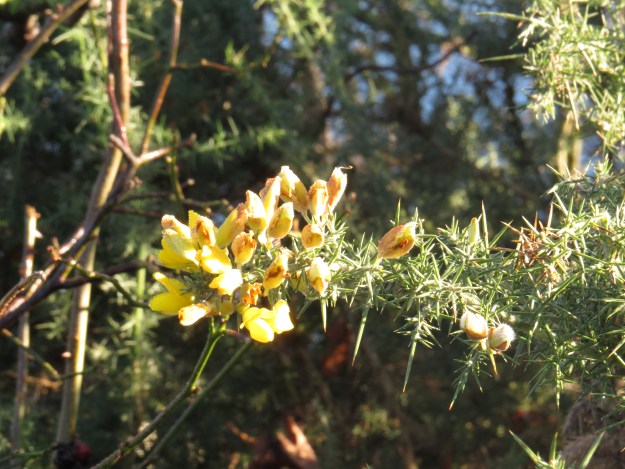
The gorse is in flower (so kissing must still be in fashion, as they say).

Herons glided over the path, looking positively prehistoric. In a few weeks time they will be setting up their nests on one of the islands, and the serenity will be broken by the sounds of heron chicks, but for now the main sound is the chorus of robins. This one was singing, then listening out for a rival, then singing again.

And a great-crested grebe patrolled the water. No sign of a mate today, but probably she or he is very close.

It was one of those days when I feel delighted just to be alive, and clearly I wasn’t the only one – one woman, who had been admiring the view over the water, just turned to us and remarked how beautiful it was. It was a day for pausing, and looking, and soaking it all in. They say that nature is restorative, and today it felt as if every breath was medicine. I felt so lucky and privileged just to be able to enjoy it. I wish the same for all of us.

Wednesday Weed – Chamomile

Photo One by By ianakoz - Own work, CC BY-SA 4.0, https://commons.wikimedia.org/w/index.php?curid=38538888

Chamomile tea (Photo One)

Dear Readers, you might remember that I am giving Veganuary a go this month, and while I am thoroughly enjoying my flat whites with oat milk (and I can heartily recommend drinking chocolate with coconut milk for anyone who remembers Bounty bars), I have not found anything that really works with my builder’s tea. And so, I am mostly drinking chamomile tea, and very delicious it is too – I always think that it smells very slightly of pineapple (not surprising as pineappleweed is a close relative), but the name is actually derived from the Greek words for ‘apple’ and ‘earth’ – you can certainly pick up an apple-y flavour too. This herbal tea doesn’t need the addition of milk, dairy or otherwise, and furthermore it has a long-established reputation for soothing frazzled nerves – Peter Rabbit was given chamomile tea to drink after being chased by Mr McGregor in Beatrix Potter’s ‘The Tale of Peter Rabbit’, and if it’s good enough for him, it’s certainly good enough for me.

As it turns out, lots of different, closely-related plants are known as chamomile (or occasionally camomile). The UK’s chamomile is Chamaemelum nobile, or Roman chamomile, which is considered a native rather than a present from the Romans (they gave us rabbits, horse chestnut trees, fallow deer, indoor plumbing and Hadrian’s wall after all so we shouldn’t be greedy). To look at, this is just a very delicate, daisy-like flower, but sadly it’s listed as Vulnerable – my Harrap’s guide describes it as ‘Very locally abundant in damp turf(especially old commons), on sandy, mildly acid soils, kept short by grazing, mowing, trampling or, on clifftops and other coastal grassland, exposure to the wind’. We will be returning to the theme of ‘trampling’ later in this piece!

The map in the book shows that it’s largely confined to the West Country and areas south and west of London in England, and in the far south-west tip of Ireland. Do let me know if you’ve seen it in your area – it seems such a shame to lose it!

Photo Two by By H. Zell - Own work, CC BY-SA 3.0, https://commons.wikimedia.org/w/index.php?curid=9482794

Roman Chamomile (Chamaemelum nobile) (Photo Two)

In researching this piece, I came across this wonderful post by Marion Mackonochie on the Mecklenburgh Square website – the square is in Islington, just around the corner from where I used to live. Mackonochie explains that in addition to its reputation as a mild sedative and mood-enhancer, chamomile has been widely used for skin inflammation, indigestion, the relief of hysteria and for the easing of muscle spasms. In Germany, the plant was known as ‘Alles Zutraut’, meaning ‘capable of anything’, and in Slovakia people have in the past bowed to the plant when they saw it. However, it can also set off an allergic reaction, particularly in people who are already allergic to ragweed (Ambrosia artemisiifolia) (a North American member of the daisy family, not to be confused with our yellow-flowered ragwort species), so it’s worth being circumspect.

Photo Three by By H. Zell - Own work, CC BY-SA 3.0, https://commons.wikimedia.org/w/index.php?curid=9482809

Roman Chamomile (Photo Three)

Now, you might remember a TV series called ‘The Chamomile Lawn’, based on a book by Mary Wesley (though as it was on television in (gulp) 1984 you’ll have to be in your prime to have seen it). It follows a family meeting up in Cornwall for a family reunion after the Second World War, and the lawn in question formed part of the garden of the aunt who owns the Cornish house. It was a roaring success, and I suspect that a lot of people were so intrigued that they decided that they’d attempt their own chamomile lawn. Alas, such lawns are not really meant for playing football on (pace Shakespeare, who in Henry IV Part I describes the attributes of chamomile as ‘the more it is trodden, the faster it grows’) and they certainly won’t work on heavy soil, or in dry or dingy conditions. You will need 80  – 100 plants per square metre. In a spot where there’s not too much footfall, I imagine that the smell of the lightly-crushed leaves would be delightful.

Incidentally, the variety of Roman chamomile that is recommended for creating a chamomile lawn, called ‘Treneague’, doesn’t flower, which rather defeats the purpose in my eyes. It’s nice to have the smell, but how about the flowers? The one in the photo below would be rather nice, though I do have my doubts about the good intentions of the cat.

A Chamomile lawn as shown on the Morehaven’s Camomile Lawn webpage (https://www.camomilelawns.co.uk/)

And finally, a poem. I love the way that Katherine Mansfield manages to make this both cosy and menacing at the same time, quite a trick to pull off. See what you think. 

Camomile Tea by Katherine Mansfield

Outside the sky is light with stars;
There’s a hollow roaring from the sea.
And, alas! for the little almond flowers,
The wind is shaking the almond tree.

How little I thought, a year ago,
In the horrible cottage upon the Lee
That he and I should be sitting so
And sipping a cup of camomile tea.

Light as feathers the witches fly,
The horn of the moon is plain to see;
By a firefly under a jonquil flower
A goblin toasts a bumble-bee.

We might be fifty, we might be five,
So snug, so compact, so wise are we!
Under the kitchen-table leg
My knee is pressing against his knee.

Our shutters are shut, the fire is low,
The tap is dripping peacefully;
The saucepan shadows on the wall
Are black and round and plain to see.

Photo Credits

Photo One By ianakoz – Own work, CC BY-SA 4.0, https://commons.wikimedia.org/w/index.php?curid=38538888

Photo Two by By H. Zell – Own work, CC BY-SA 3.0, https://commons.wikimedia.org/w/index.php?curid=9482794

Photo Three by By H. Zell – Own work, CC BY-SA 3.0, https://commons.wikimedia.org/w/index.php?curid=9482809

…And Plans

Photo One by Zeynel Cebeci, CC BY-SA 4.0 <https://creativecommons.org/licenses/by-sa/4.0>, via Wikimedia Commons

Winter Honeysuckle (Lonicera fragrantissima) (Photo One)

Dear Readers, I like to think that I’m a well-organised person, but a trip to the garden centre is usually enough to see me coming home with something completely random that I’ve spotted. This week it was a winter honeysuckle shrub – I remember watching the bumblebees feeding on one in February last year, and so I decided that it would be a good addition to the garden. Now it just has to stop raining long enough for me to actually plant the poor thing.

I have also taken advantage of the Royal Horticultural Seed Scheme this year. Seeds are collected in the various RHS gardens, and you can send off for up to 15 packets for a mere £10 if you’re a member. There’s no way that I could use a whole 15 packets, but I shall be sharing my seeds around. I’ve got a nice combination of natives, such as cow parsley, honesty and wild carrot, and some rather more unusual plants.

Photo Two by CC BY-SA 3.0, https://commons.wikimedia.org/w/index.php?curid=107188

Honesty (Lunaria annua) (Photo Two)

Photo Three by Quartl, CC BY-SA 3.0 <https://creativecommons.org/licenses/by-sa/3.0>, via Wikimedia Commons

Wild carrot (Daucus carota) (Photo Three)

One such unusual plant is  this Colour-changing Tobacco Plant (Nicotiana mutabilis), where the flowers start white but gradually change to pink.

Photo Four by scott.zona, CC BY 2.0 <https://creativecommons.org/licenses/by/2.0>, via Wikimedia Commons

Colour-changing Tobacco Plant (Nicotiana mutabilis) (Photo Four)

And how about this Large Yellow Foxglove (Digitalis grandiflora)? It will be interesting to see how this does.

Photo Five by Florian Grossir, CC BY-SA 3.0 <https://creativecommons.org/licenses/by-sa/3.0>, via Wikimedia Commons

Large Yellow Foxglove (Digitalis grandiflora) (Photo Five)

I seem to have also bought some Hairy Foxglove (Digitalis ciliata) seeds – this plant is smaller and more delicate than the Large Yellow Foxglove.  I see a lot of foxgloves in my future, especially as the ‘normal’ foxgloves that I planted last year have probably self-seeded all over the place. Clearly I need a country estate rather than a suburban back garden.

Photo Six by Don McCulley, CC BY-SA 4.0 <https://creativecommons.org/licenses/by-sa/4.0>, via Wikimedia Commons

Hairy Foxglove (Digitalis ciliata) (Photo Six)

Ooh, and before I forget, I also have some seeds for this cyclamen (Cyclamen mirabile). I find that Cyclamen do ok in the garden, so I thought I’d have a bash at another species to complement the Cyclamen hederifolium and Cyclamen coum that I already have.

Photo Seven by By Tejvan Pettinger - Cyclamen, CC BY 2.0, https://commons.wikimedia.org/w/index.php?curid=12226905

Cyclamen mirabile (Photo Seven)

Anyhow, I am fully expecting to have more seeds than I know what to do with, so I will be up to my ears in seed trays for the next few months. I will keep you posted on my progress, which has historically been rather hit and miss. My plan is to improve the shady, woodland part of the garden, which is lovely in spring but then rather sparse, so that will be my focus for 2022. Let’s see how I get on! And let me know if you have any particular plans for your garden/pots/house plants this year.

Photo Credits

Photo One by Zeynel Cebeci, CC BY-SA 4.0 <https://creativecommons.org/licenses/by-sa/4.0>, via Wikimedia Commons

Photo Two by CC BY-SA 3.0, https://commons.wikimedia.org/w/index.php?curid=107188

Photo Three by Quartl, CC BY-SA 3.0 <https://creativecommons.org/licenses/by-sa/3.0>, via Wikimedia Commons

Photo Four by scott.zona, CC BY 2.0 <https://creativecommons.org/licenses/by/2.0>, via Wikimedia Commons

Photo Five by Florian Grossir, CC BY-SA 3.0 <https://creativecommons.org/licenses/by-sa/3.0>, via Wikimedia Commons

Photo Six by Don McCulley, CC BY-SA 4.0 <https://creativecommons.org/licenses/by-sa/4.0>, via Wikimedia Commons

Photo Seven  By Tejvan Pettinger – Cyclamen, CC BY 2.0, https://commons.wikimedia.org/w/index.php?curid=12226905

Wednesday Weed – Christmas Cactus

Christmas Cactus (Schlumbergera x truncata)

Dear Readers, I used to have a bright pink Christmas cactus, that I nurtured for many years until, finally, someone overwatered it and it died. So I was very happy to see a fine selection in the Sunshine Garden Centre this week, and even happier when my lovely friend Jo bought me some as a Christmas present. I love the flowers on these plants – they always look to me a little like a bird leaping into the air. And with the array of buds on this one, I’m hoping that it will be flowering for quite some time.

Plus, I not only got a festive red cactus, but a white one…

and a magenta one, to match this extraordinary magenta cyclamen that I saw.

All cacti (with the exception of Rhipsalis baccifera, which has somehow found its way to Africa) are New World plants, but Christmas cacti are classified as forest cacti. These plants are very different from their desert relations: forest cacti are epiphytic, which means that they grow on the branches of trees or cracks in a rock face in their rainforest homes.  They get water from the humidity of the air or rain, and their nutrients come from organic debris that accumulates around their roots. They therefore hate being waterlogged, as in their native environments the water would just wash away. They live in dappled sunlight, and air circulation around them is also good. All this means that they have to be kept in free-draining soil, and yet like to be sprayed or kept on wet pebbles to keep the humidity up. You often see Christmas cacti in hanging baskets for just this reason – it’s a way to make sure that they get the air circulation that they need, while at the same time being able to spray them for humidity, and admire them from all angles.

In the wild, Schlumbergera grow at altitudes of up to 700 metres (2300 feet) in south-eastern Brazil, and there are six to nine wild species. In Brazil, Christmas cacti can form sizeable shrubs of up to four feet tall. The plants have no leaves, but their modified stems enable them to photosynthesise. The flowers are adapted to be pollinated by hummingbirds (hence the wild-type plant is red, a colour easily visible to birds). Hummingbirds also act to transfer the seeds from one tree to another – as in the post about mistletoe a few weeks ago, the birds wipe their bills to remove the sticky seeds after feeding on the front, hence moving the cactus to a nice new home.

There are two main ‘families’ of Christmas cactus that you’re likely to come across in the stores at this time of year. My plant is Schlumbergera truncata. How can I tell? Mainly because the stems are extremely ‘pointy’ (hence one alternative name of ‘crab cactus’…

and the pollen is yellow.

Christmas Cactus (Schlumbergera truncata)

However, you can also find Schlumbergera x buckleyi in the shops. It is a hybrid of Schlumbergera russeliana and Schlumbergera truncata. The stems of this plant are much less ‘prickly’, and the pollen is bright pink.

Photo One by By Schlumbergera_truncata_02.JPG: Lestat (Jan Mehlich)derivative work: Peter coxhead (talk) - Schlumbergera_truncata_02.JPG, CC BY-SA 2.5, https://commons.wikimedia.org/w/index.php?curid=17191427

Softer, more rounded stems, pink pollen = Schlumbergera buckleyi. (Photo One)

And here’s something rather lovely – the flowers of a Christmas cactus opening in a time-lapse sequence.

https://www.youtube.com/watch?v=Sbvh4GQru7Y

Christmas cacti have been cultivated in Europe since about 1818, with the first hybrid varieties appearing in the mid 1850s. They were very popular in the late Victorian period, but by 1900s they had fallen out of favour, and many varieties were lost. It’s funny how there are fashions in house plants – when I was growing up, everyone had spider plants and aspidistra, and these days these are something of a rarity. However, Christmas cacti staged a comeback: by the 1950s they were popular again, with breeders particularly keen on plants that flowered profusely and which also had more of an upright habit than the trailing habit of the wild plant (though I have noticed that most Christmas cacti revert to a more horizontal growth pattern once they mature). They also started to develop plants with different coloured flowers, such as this yellow one, Gold Charm, which is pretty but infertile.

Photo Two by By Maja Dumat - Weihnachtskaktus (Schlumbergera truncata)Uploaded by uleli, CC BY 2.0, https://commons.wikimedia.org/w/index.php?curid=9728034

‘Gold Charm’, a very unusual yellow Christmas cactus (Truncata group) (Photo Two)

However, colour can be problematic in cultivated varieties: it’s been found that the eventual hue of the flowers is influenced by the temperature during bud formation. A plant that might produce white or yellow flowers can be persuaded to produce pink or red-tinged ones instead if the temperature is above 57 degrees Fahrenheit, and plants that are already pink or red will produce much darker-coloured flowers. Iron is also said to influence flower colour.

If I look after my Christmas cacti properly, they can turn in to really magnificent plants – they don’t like being repotted, they don’t like sitting in water, but apart from that in my experience they are really easy-going plants. You can also propagate them pretty easily by breaking off one of the stem segments after the plant has flowered, letting it dry out for a week  and then potting it up in cactus compost. In this way, a Christmas cactus can be almost immortal, as it will live on its clones even after the parent plant has died. And I have read several stories of Christmas cacti that are decades old, and some which are advancing into their hundreds. I rather like this story of ‘A Christmas Cactus Named Junior‘ by Kathy Keeler at ‘The Wandering Botanist’ for example. ‘Junior’ is certainly looking good after his adventures!

There is a Brazilian legend that a small boy in a Brazilian village prayed for a sign that Christmas had come, and in the morning all the rainforest plants had broken into flower on Christmas Day. Sadly, in Brazil Schlumbergera flowers in May and is in fact known as the ‘May Flower’. Blooming botanists, ruining all the stories.

But here is a poem by Gaia Holmes, discovered in the online version of The Stylist magazine of all things. Gosh, I like this a lot, probably because it makes me uneasy, and that is exactly what this time of year does to me too – the darkness that gathers around all the light and sparkle, like wolves waiting just outside the glow of the fire. Not very festive, I know. Anyway, see what you think, lovely people. There is always a Christmas cactus to admire, with its fantastical flowers and leap of faith.

Shadow Play by Gaia Holmes 

He came in winter
when the house was always dark,
brought red Christmas cacti
fire-crackering from their pots
and a suitcase full of candles,
thickened my gloomy rooms
with light.
I met the shadows he bred
without caution
and did not complain
when he followed me to my bed.
Outside, frost had edged the world
with spite.
The city foxes were howling,
cracking their teeth on the ice.
The sharp scent of January scared me.
His big hands cast wolves on the walls.
Fear made me knot myself
around him.
He had a bristled chin
and smelled of fathers.
‘Tell me a story,’ I said
and he told me how lust
could turn an angel
inside out.

Published in Where The Road Runs Out by Gaia Holmes, Comma Press, £9.99, hive.co.uk

Photo Credits

Photo One by By Schlumbergera_truncata_02.JPG: Lestat (Jan Mehlich)derivative work: Peter coxhead (talk) – Schlumbergera_truncata_02.JPG, CC BY-SA 2.5, https://commons.wikimedia.org/w/index.php?curid=17191427

Photo Two by By Maja Dumat – Weihnachtskaktus (Schlumbergera truncata)Uploaded by uleli, CC BY 2.0, https://commons.wikimedia.org/w/index.php?curid=9728034


In Praise of Climbing Hydrangea

Dear Readers, my climbing hydrangea (Hydrangea petiolaris) is really excelling itself this year. The leaves are shades of custard-yellow and lime, and it’s finally beginning to provide some cover for the nest box in the corner.

This is a dark, damp, murky corner of the garden, but this plant just doesn’t seem to care. In the spring it’s covered with big lacy heads of tiny cream-coloured flowers, and I think they’re rather fine even when they’ve gone over.

But it’s the leaves that have really caught my eye.

And while I’ve been standing there photographing the leaves, lots of small birds have been visiting the newly-filled seed feeder. Here’s a rather blurry chaffinch…

And now a great tit….

And here’s someone I didn’t expect to see using a bird feeder…..s/he did actually snaffle a quick seed, though I imagine the suet would be more to their taste. Does anyone else have robins using their feeders?

Meanwhile, there is one brave marigold still in flower…

And finally, next door’s hebe has come back into flower for about the third time this year. It is such a boon for bumblebees when they decide they need a nectar top-up during the winter.

And so, spending ten minutes away from my spreadsheets was well worth it! And good for my poor old back, too.

Wednesday Weed – Ivy Broomrape

Ivy broomrape (Orobanche hederae)

Dear Readers, I was very excited when I spotted this plant at Camley Street Natural Park in Kings Cross last week. Actually, to be fair I didn’t spot it – it was mentioned on the list of ‘sightings’ by the cafe, but I had to ask the warden where to find it. She was very helpful, and of course once I’d seen it I felt like a right twit because it was everywhere.

Sadly, I’d missed the peak flowering for this most peculiar plant, but this is what it looks like when it’s in its prime – I think it looks like a slightly sinister hyacinth.

Photo One by By No machine-readable author provided. Aroche assumed (based on copyright claims). - No machine-readable source provided. Own work assumed (based on copyright claims)., CC BY 2.5, https://commons.wikimedia.org/w/index.php?curid=1162590

Photo One

Broomrapes are a fascinating family of parasitic plants, and some are very focussed and prey on only one species, while others are a bit less fussy. They have no chlorophyll of their own, hence their rather ghostly appearance, and so they are completely dependent on other plants for their nutrients. The seeds lurk in the soil until they detect the roots of their host plant. At this point they germinate and send out little roots of their own, which attach to, in this case, the ivy. They remind me of fungi, as they disappear altogether once the flower heads have finished.

The name ‘Orobanche’ means ‘bitter-vetch strangler’, not surprising as some species of broomrape are parasitic on various vetches (members of the Fabaceae or bean family). And while broomrape sounds as if it might refer to the plant’s parasitic nature, in fact it comes from the Latin for tuber, rapum – so broomrape actually means ‘tuber growing on broom’ rather than something more awful.

Ivy broomrape is largely a plant of Central and Northern Europe, though there is a single population in the University of Berkeley’s gardens, in California. There is a persistent rumour that the plant was introduced deliberately to try to control the spread of ivy, itself an alien plant. The consensus seems to be, however, that the parasite doesn’t do long-term or extensive damage to ivy, and certainly in Camley Street the whole understorey of the woods was covered in a lush carpet of green.

Photo Two by By Scott Zona from USA - Orobanche hederaeUploaded by pixeltoo, CC BY 2.0, https://commons.wikimedia.org/w/index.php?curid=7513606

More ivy broomrape in flower (Photo Two)

One or two members of the broomrape family can be problematic, however: branched broomrape (Orobanche ramosa) might look as pretty as a picture with its blue flowers, but it is a notorious parasite of food crops such as potatoes and tomatoes, and can cause total crop failure in parts of south-western Europe and North Africa.

Photo Three by By Javier martin - Own work, Public Domain, https://commons.wikimedia.org/w/index.php?curid=3864360

Branched broomrape (Orobanche ramosa) (Photo Three)

However, as revenge, humans eat the stems of the bean broomrape (Orobanche crenata) in the region of Apulia in Italy, where the plant is known as sporchia. 

Photo Four by By © Hans Hillewaert, CC BY-SA 3.0, https://commons.wikimedia.org/w/index.php?curid=6153027

Bean broomrape (Orobanche crenata) (Photo Four)

And here it is cooked, and looking very tasty. You can get the recipe here

Photo Five from https://www.cosedicucina.it/sporchia

Cooked sporchia (Photo Five)

Medicinally, the herbalist Nicolas Culpeper stated that broomrapes could be used as a cure for kidney and bladder stones, normally when decocted in wine. It was also considered efficacious when used in a poultice for ‘fretting ulcers’ and ‘scabby sores’. A strong solution of the flowers was  believed to remove freckles and blemishes.

And finally, a poem. I didn’t expect to find anything on broomrapes, but actually I found two! Here is one by Giles Watson, from a series of poems on plants and their history, folklore and biology. There are some very interesting works on the site here.

Broomrape (Orobanche spp.) by Giles Watson

Blanched as blood-drained flesh,

Broomrapes grow in deepest shade

Despising the sun. Their leaves

Are scales, their racemes rise

From soil, like vampires’ fingers,

The flowers shadowed, bruised

Like vampires’ eyes.

Hidden from sight, roots

Clamp round roots, suck

From the flux of life.

No need to grow green:

Flourish, rather, on others’ juices.

And here is a poem by Fiona Pitt-Kethley, which is rather more about minerals than plants, but fun nonetheless. You can see the stones that she’s writing about here.

The Opal Menilites of Agramón

Fiona Pitt-Kethley

Bright yellow broomrape bursting from the clay,
close to the minerals we’re searching for.
Nothing’s what you’d expect in Agramón.

Blue-grey on grey at first they look discreet
and crisp as sugared almonds in the walls
until we marvel at their varied forms.
This quarry’s the sex-shop of the mineral scene:
Willendorf Venuses, testicles, dicks
beside more toy-like marbles, skittles, ducks
and half-formed pre-pubescent young girls’ breasts.

A heavenly jest, perhaps. Exuberant,
tumescent, waiting in their matrixes.
If stones could speak these ones would say to me:
“Release us on an unsuspecting world…”

Photo Credits

Photo One by By No machine-readable author provided. Aroche assumed (based on copyright claims). – No machine-readable source provided. Own work assumed (based on copyright claims)., CC BY 2.5, https://commons.wikimedia.org/w/index.php?curid=1162590

Photo Two By Scott Zona from USA – Orobanche hederaeUploaded by pixeltoo, CC BY 2.0, https://commons.wikimedia.org/w/index.php?curid=7513606

Photo Three By Javier martin – Own work, Public Domain, https://commons.wikimedia.org/w/index.php?curid=3864360

Photo Four By © Hans Hillewaert, CC BY-SA 3.0, https://commons.wikimedia.org/w/index.php?curid=6153027

Photo Five from https://www.cosedicucina.it/sporchia

Thoughts on Ash

Dear Readers, I am continuing to read through Archie Miles’ book on British trees and thought that today I’d look at the ash tree. It’s one of my favourites, with its elegant leaves and those buds like tiny hooves, and the fact that we are likely to lose most of the species because of ash dieback makes them even more precious.

You might remember that in an earlier post this week, I was hoping that the Australian Raywood ashes in the cemetery might have some resistance to the disease. Alas, it appears not to be so, so even these beauties might not be spared.

An avenue of Raywood ashes in St Pancras and Islington Cemetery

In the cemetery, the ashes pop up all over the place, and Miles suggests that the ash was the tree that colonised most quickly after the hurricane in 1987, and the impact of Dutch elm disease. It is a fast-growing tree, and historically known as the husbandman’s tree, used for agricultural implements and as fuel wood – it is said to burn well even when green. I love its delicacy (which gave rise to the name of ‘Venus of the Woods’) but its very short season (it is one of the last trees to come into leaf and one of the first to lose them) has made it unpopular in gardens, though I suspect that some of the fancier varieties might tickle a gardeners’ fancy.

Although some people think of ash trees as mundance, workaday trees they have a very surprising capacity to change their sex from one year to another. This is particularly confusing because ash trees can produce male, female or hemaphroditic flowers, either on separate trees or all on a single tree. Botanists don’t know why the tree can do this, but speculate that it might give an advantage when the climatic conditions for setting seed are ideal, or when there is a lot of competition. It might also be handy if a space suddenly opens up for colonisation – in this case the more seeds the better! It might well explain why ash is capable of popping up anywhere (I have one in my garden that I have to coppice every year before it takes over completely).

Photo One by Rosser1954, CC BY-SA 4.0 , via Wikimedia Commons

Male Ash flowers and buds (Photo One)

Ash trees flower once they’re thirty to forty years old. The flowers appear on last year’s growth before the leaves appear, but they can bloom anytime from late March to May, and Miles tells us that it’s believed that this allows the tree to compensate for damage to the earliest flowers from the late spring frosts. The male flowers appear first (as in the photo above), then the hermaphrodite flowers and then the female ones. Only the.female flowers will turn into the ash keys (known as samaras).

Photo Two by By Pleple2000 - Own work, CC BY-SA 3.0, https://commons.wikimedia.org/w/index.php?curid=1564105

Ash tree samaras (Photo Two)

When you consider the long associations between ash and humans, it’s not surprising that there is a lot of folklore about the tree. Miles quotes a rhyme that young women said when they were hoping to find a sweetheart:

Even ash, even ash,
I pluck thee off the tree;
The first young man that I do meet
My lover he shall be.

The young woman was supposed to put the ash leaf in her left shoe and wait to see what happened.

Ash was also supposed to be protective against snake bites, and, if you did get bitten, it was said by Dioscorides, first-century Greek physician, to be ‘singularly good against the bitings of viper, adder or other venomous beast’. More usefully in our present day, when we are unlikely to be molested by serpents, Culpeper thought that an extract from the leaves would ‘abate the greatness of those who are too gross or fat‘.

Perhaps most fascinating, however, is the belief that ash could be used to cure a rupture in a child. Miles remarks that the Reverend Gilbert White, writing in 1776, described how parents of a child so afflicted would pass the infant through the trunk of an ash tree that had been split with an axe. The tree would then be bound up again, and once it healed, so would the child. The ritual was still being performed as late as 1902 in Devon.

What a beautiful and useful tree the ash is! A glimmer of hope on the preservation of the species in light of ash dieback is the Ash Archive, which consists of a collection of 3,000 ash trees planted in Hampshire. They comprise cuttings taken from ash dieback tolerant trees observed in the wild and grafted onto ash rootstocks. Their development will be monitored, in the hope that some will have a long-lasting resistance to the fungus that causes the disease. At some point in the future it might then be possible to plant these trees, or the seeds that come from them, back into the wild. Let’s hope that there is a future for this beautiful tree here in the UK.

Photo Three by Willow, CC BY-SA 3.0 <https://creativecommons.org/licenses/by-sa/3.0>, via Wikimedia Commons

Ash tree (Fraxinus excelsior) (Photo Three)

You can buy Archie Miles Book ‘The Trees that Made Britain – An Evergreen History’ here.

Photo Credits

Photo One by Rosser1954, CC BY-SA 4.0 , via Wikimedia Commons

Photo Two by By Pleple2000 – Own work, CC BY-SA 3.0, https://commons.wikimedia.org/w/index.php?curid=1564105

Photo Three by Willow, CC BY-SA 3.0 <https://creativecommons.org/licenses/by-sa/3.0>, via Wikimedia Commons