Category Archives: London Plants

An Early June Walk in St Pancras and Islington Cemetery

Dear Readers, this might not look like much but it gives me hope for the future. Traditionally, cemetery lawns have always been close cut and relatively lifeless, but I noticed that, in the sweeping sward of the green closest to the entrance, some little patches of grass have been left unmown, and the daisies, buttercups, speedwell and cut-leaved geranium were all the happier for it. Well done, L.B. of Islington!

Cut-leaved geranium in the sward.

It’s definitely dog rose time too, with bushes bursting into flower all over the cemetery.

However, I have officially designated this week as buttercup week. Just look at them! And they are popular with bees too, something that I’d never noticed before.

And look at this handsome little chap, sunning himself in the woodland grave area – it’s a small copper (Lycaena phlaeas), and at this time of year the males establish territories close to areas where females might want to lay their eggs (usually on sorrel, of which there is a plentiful supply). The male flies up in the hope of intercepting any passing females, but will also see off other males, and butterflies of other species. This one was particularly brightly coloured, and for a moment I imagined myself amongst the alpine meadows of Austria, which is where I usually see these creatures.

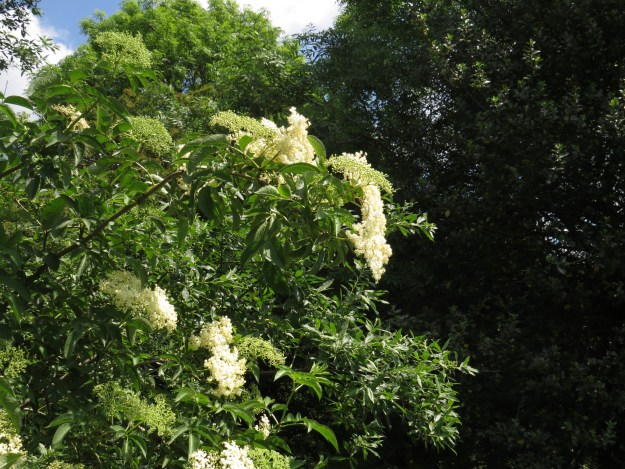
The elder is in flower too, and in the sun there was that faint smell of gooseberry. There seems to be salsify everywhere as well – last year it was just along the path next to the North Circular, but this year it’s busting up all over.
Two other great pollinator favourites are the flowers on the pyracantha (firethorn) which are now studded with bumblebees, and the various forms of comfrey in the damp areas close to the stream.

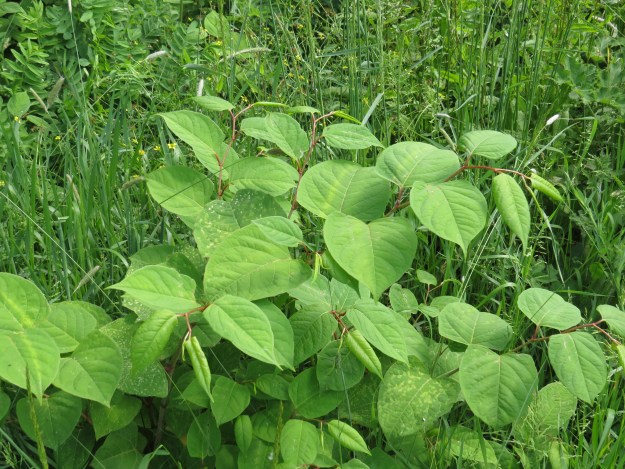
Sadly the Japanese Knotweed continues to gather pace right along the stream and the edge of the playing field. It really is such a thug – there are thickets twenty or thirty feet deep in some places now. I am a little intrigued by the leaf damage on this plant though. Could it be leaf miner damage? I shall do some research and let you know. It would be great if some creature decided that it was dinner and started to bring it into check.
There was a rather tired-looking speckled wood butterfly along one of the walks. I hope that it has done its duty by the next generation and can have a bit of a rest now. It flew up at another butterfly but seemed a bit half-hearted, I thought. Spring is tough on all kinds of animals, and this spring has been colder and harder than many.

As we left a woodland path and started walking in the sunshine, something enormous shot past. At first I wasn’t sure what it was, but then I spotted it perching in the long grass. It wasn’t until it flew up and started quartering the grass again that I realised it was a male broad-bodied chaser, using this spot to survey its kingdom with those enormous eyes before setting off on patrol again. I always get a frisson when in the company of large dragonflies – this one circled us with what I’d describe as curiosity before returning to exactly the same place on a sturdy stem. I like this shot because you can see the way that the wings are stacked on the body.

Now, have you ever noticed the way that teasels develop little ponds at the base of their leaves after it’s rained? I hadn’t this week, but I was very curious about it. I had no idea that an alternative name for the plant is ‘Venus’s Basin’, and that the water was said to have healing properties. In one experiment, where some plants were allowed to ‘keep’ their water and others had it emptied out, the plants where the water was allowed to stay set more seed and were taller.  There is one theory that teasels are on the evolutionary path towards becoming insectivorous although this is usually an attribute of plants that live in extremely inpoverished soils such as bogs. More likely is a second theory that the water acts as a way of stopping insects climbing up the stem, though as aphids in particular can fly I wouldn’t have thought that this was so much of an advantage. What do you think, readers? All theories gratefully considered. If only there was a little frog that could live in the pools, like the tree frogs in the tropics who live in the middle of bromeliads.

Water at the base of teasel leaves.

I am going to make a point of taking a photo of the Scotsman so that I can see how the wood changes during the year, so here is this week’s shot. Lots of tree cover but no lesser celandine or crocuses. The next plant to put in an appearance will be hogweed I suspect.

And so we meander home, past the daisies, pausing only to look at the sculptural form of some ivy working its way up a tree. The cemetery is about the only place round about here where you can walk for a couple of hours and see just a handful of people. Unlike so many of our green places, which have been trampled relentlessly for the past eighteen months, the cemetery retains a kind of serenity that is very pleasing in these fraught times. Long may it remain so.

Wednesday Weed – California Poppy

California poppy (Eschscholzia californica)


Dear Readers, some of the tree pits along the County Roads in East Finchley have been planted up with seeds, and I’m always fascinated to see what ‘escapes’ and starts to grow in the cracks and crevices of the pavement. Poppies seem to be particularly fond of doing this: there are very pretty lemon-yellow Welsh poppies in several locations, and there was an abundance of opium poppies outside my friend A’s house a year or so ago. These are plants of poor soil and disturbed ground, so a north London street is very little problem for them.

Welsh poppies on Trinity Road, East Finchley

Opium poppy (Papaver somniferum)

California poppy is one of those plants that grows from seed without any messing about – throw a handful in the soil and off it goes. This one had attracted a marmalade hoverfly (as you can see from the photo), and cheap and cheerful doesn’t even begin to cover its attractions – it seems perfect for a child’s garden to me, when you want something reliable, bright and long-flowering. The commonest varieties are golden or orange, though I have seen some dusky pink ones too.

As you might expect from the name, California poppies come from the Western United States, from Washington in the north all the way down to Baja California in the south. It’s said that the whole 1745 acres of the Antelope Valley California Poppy Reserve is carpeted in orange when the poppies are in flower. What a sight that must be! It’s said that the early Spanish explorers could navigate by the sight of the orange hills, and that they called the plant ‘Cup of Gold’ (copa de oro). Very appropriate.

Like many flowers, California poppies open up when it’s sunny, and stay closed when it’s chilly. The flowers also close at night time, giving it another Spanish name, ‘Dormidera’, meaning ‘to fall asleep’.

Photo One by By User:Vsion - Own work, CC BY 2.5, https://commons.wikimedia.org/w/index.php?curid=209016

California poppies at the Antelope Valley reserve in California (Photo One)

There is a subspecies of the poppy that can be found in the Monterey Bay area, and is yellow and much lower growing.

Photo Two By Peter D. Tillman - Own work, CC BY 3.0, https://commons.wikimedia.org/w/index.php?curid=38654420

Maritime poppies (E. californica subsp. californica var. maritima) (Photo Two)

Poppies of all kinds are attractive to insects because of their pollen – both the UK’s field poppy and the California poppy produce abundant amounts of this protein-rich bee food. The flowers are edible by humans (in moderation) and are sometimes used as a garnish, though they aren’t much used for their seeds as other species are. In the UK the plant is largely grown as an annual, but as it self-seeds everywhere I suspect that once you have it it will be with you forever. It is drought-tolerant but doesn’t like heavy clay soils, which is a bit of a pity as that’s exactly what I have. No wonder ‘my’ plant is lurking outside my front door in a crack in the pavement.

The golden poppy (another name for the California poppy but the same species) has been the state flower of California since 1903, and can be seen on many of the road signs.

Photo Three by CC BY-SA 2.5, https://commons.wikimedia.org/w/index.php?curid=397719

Route 1 road sign in California (Photo Three)


Medicinally, the plant seems to be associated, like so many poppies, with treatments for various forms of anxiety, from insomnia to bed-wetting. It’s said that it isn’t an opioid like other poppies, and has been used to help those addicted to morphine/heroin to ‘kick the habit‘. Native American peoples thought it gentle enough to be made into a tea to soothe their children. The Plant Lore website reports that

‘My grandfather used to pick and dry California poppies (the whole plant), then grind it all up and roll it into cigarette papers and smoke it. This gave him and his friends a mild euphoric feeling, with no known side effects [Andover, Hampshire, December 2013].’

Was there anything that folk haven’t dried and tried to smoke, I wonder? I remember a friend of mine smoking a cigarette through the shell of a green pepper because he was told that it would make him feel euphoric. I have no idea if it worked, but it certainly ruined my intended stir-fry.

‘My’ California poppy popping up outside the front door.

And finally, a poem. I rather liked this by Sandra McPherson, a poet that I hadn’t come across before. I think she captures the strange cruelty of cutting a flower for our own pleasure – the image of the twitching frog’s legs will stay with me for quite a while. See what you think.

Poppies by Sandra McPherson (1943 – )

Orange is the single-hearted color. I remember
How I found them in a vein beside the railroad,
A bumble-bee fumbling for a foothold
While the poppies' petals flagged beneath his boot.

I brought three poppies home and two buds still sheathed.
I amputated them above the root. They lived on artlessly
Beside the window for a while, blazing orange, bearing me
No malice. Each four-fanned surface opened

To the light. They were bright as any orange grove.
I watched them day and night stretch open and tuck shut
With no roots to grip, like laboratory frogs' legs twitching
Or like red beheaded hens still hopping on sheer nerves.

On the third afternoon one bud tore off its green glove
And burst out brazen as Baby New Year.
Two other poppies dropped their petals, leaving four
Scribbly yellow streamers on a purple-brimmed and green

Conical cadaver like a New Year's hat.
I'd meant to celebrate with them, but they seemed
So suddenly tired, these aging ladies in crocheted
Shawl leaves. They'd once been golden as the streets

Of heaven, now they were as hollow.
They couldn't pull together for a last good-bye.
I had outlived them and had only their letters to read,
Fallen around the vase, saying they were sorry.

Photo Credits

Photo One By User:Vsion – Own work, CC BY 2.5, https://commons.wikimedia.org/w/index.php?curid=209016

Photo Two By Peter D. Tillman – Own work, CC BY 3.0, https://commons.wikimedia.org/w/index.php?curid=38654420

Photo Three by CC BY-SA 2.5, https://commons.wikimedia.org/w/index.php?curid=397719

A Tiny Visitor

Celery Fly (Euleia heraclei)


Dear Readers, I was absolutely fascinated by this tiny fly on my angelica yesterday. I know that it’s a celery fly, and that its larvae will happily mine the leaves on what is currently my favourite pondside plant, but what a performer it is! My photo is far from perfect, but hopefully you can see that it has a shiny black body, wings rippled with chocolate, a bright yellow head and green eyes. All this in a critter smaller than my little fingernail.

It seemed to be displaying, though I couldn’t see anyone apart from me who was enjoying the show. The fly twisted its wings from side to side, hopped from one leaf to another, investigated the fallen pollen from the angelica flowers, disappeared briefly and then hopped back again.

And to my delight, a bit of research showed me that this male fly is actually displaying, and furthermore you can watch it too:

https://en.wikipedia.org/wiki/File:Euleia_heraclei_-_2015-06-17.webm#file

Celery flies lay their eggs on the leaves of the host plant, and the larvae burrow in and mine the inside, leaving a brown or yellow blotch. After four weeks, the larvae drop to the ground and pupate in the soil, with a second generation emerging later in the summer. I found it very interesting that the first generation of larvae burrow to a measly four or five centimetres down into the ground, but the second generation, who have to survive through the winter, will dig down to about 10 centimetres. Nature really is quite remarkable.

I would never have seen this fly if I hadn’t grown my angelica, and so it seems that whenever yo you plant something, you don’t just get the flora, you get the fauna that it attracts too. The angelica is now taller than me, and is attracting not just bees, but an early blue butterfly too – this one is a holly blue, and I hope that it’s found the ivy that’s overtaking my shed for its eggs. I am so delighted with this plant, and if you have a damp patch in the garden and don’t mind something huge, I’d definitely plant this beauty.

The End of May in St Pancras and Islington Cemetery

The highpoint of the cow parsley show?

Dear Readers, I have been fascinated by the speed at which the massed ranks of flowers come and go in the cemetery. One week it’s full of forget-me-nots and the next it’s ablaze with buttercups. This week, the rhododendrons have just opened, and, in spite of the honey made from it being hallucinogenic, the bumblebees were very enthusiastic (see the pollen baskets on the bee on the right of the photo).

The meadow in the woodland grave area is full of red campion…

And the swamp cypress is greening out nicely…..

Under the horse chestnut trees, the masses of ground ivy and violas have been completely submerged under a sea of black medick, a tiny yellow clover.

But what really catches my eye this week are the patches of germander speedwell. I thought that the forget-me-nots were blue, but this plant is an intense lavender-blue colour.

Germander speedwell

Elsewhere, the red clover is coming into flower, and I am wondering if some of these flowers are actually the slighter rarer zigzag clover (Trifolium medium). I should have bent down and had a closer look – the flowers of zigzag clover are on a stalk, whereas those of red clover are more or less stalkless. Maybe next week I’ll have the wit to bend over for a closer look.

On the path next to the North Circular Road the salsify flowers are out in force, and very pretty they look too, though I remain puzzled as to how on earth they got here.

Salsify flowers

The herb Bennett (wood avens) is in flower too.

Herb Bennett (Geum urbanum)

I have this all over my garden, along with herb Robert, greater celandine and green alkanet, and to tell you the truth I’ve rather given up the battle in some of the damper, shadier places. The plants that thrive there are perfectly suited to the habitat, and only this week I got into a gentle Facebook argument with someone who, when told that the plant they’d photographed was herb Robert, said ‘Oh, I thought it was a wild geranium’. It is, of course, a wild geranium, and not only is it very pretty in its place, but it is also often visited by pollinators, like this green-veined white (Pieris napi).

And finally, here is a last burst of germander speedwell blue, to power us through the week. Who knows what will have taken over from it by next week?

Laying in Wait….

Honeybees on angelica

Dear Readers, for about twenty minutes today the sun shone, and so I wandered outside to take a few photos. My angelica flowers are just opening, and are already a hit with the local honeybees, much to my delight. There is such a feeling of accomplishment when you plant something to attract pollinators and it actually does.

I imagine that the recent wet weather has kept all the pollinators at home, so they will all be playing catch-up. The tadpoles have been very happy though – it’s rained so much that it’s raised the level of the pond, and they are able to forage for algae on the parts of the pond that are usually just a beach. They look very fat and happy to me, but I’ll have to make sure that none of them get stuck as the water level goes down (it’s supposed to be much warmer and drier for the next week or so). The water snails are happy too.

But who is this lurking on one of the other angelica flowers?

This is a young male running crab spider (Philodromus sp.) (many thanks to the British Spider Identification Group on Facebook for the ID). This is a group of fast-moving arachnids who hunt flies and other insects, and who also guard their eggs, which are enclosed in what looks like the tip of a medium-sized cotton bud. I shall have to keep my eyes open to see if any females turn up, and also if the male reappears, because when I popped down to see if I could get another photo he had, true to his name, done a runner. If I was a honeybee or a hoverfly, I would be very careful. Incidentally, these spiders spend the winter hibernating beneath loose bark, yet another reason to not be too tidy in the garden.

In other news, I have about 150 honesty seedlings pinging up from the seeds that my friend J gave me last year. I suspect that the good people of the County Roads in East Finchley where I live are going to have an opportunity to put them all over their gardens if the urge takes them. Now all I have to do is prick them out. I know what the bank holiday is going to hold in store for me!


Wednesday Weed – Sorrel

Common Sorrel (Rumex acetosa)

Dear Readers, what an unassuming little plant this is! if you weren’t paying attention you could easily miss it. This is sorrel (Rumex acetosa). Sorrel looks like a grass, but isn’t one. It’s a member of the Polygonaceae or knotgrass family, along with the various persicarias and bistorts and our old friend, Japanese knotweed. The zesty leaves have been eaten throughout the plant’s range, which includes Scandinavia, the rest of Europe and parts of Eurasia. Sorrel is used in spanakopita, the Greek feta, leek and greens pie, in Albanian byrek pies and in Armenian aveluk soup, with walnuts and lentils. In Eastern Europe, it’s turned into soup with hard-boiled eggs. In short, sorrel’s lemon-flavoured leaves are much enjoyed in parts of the world where citrus isn’t grown, or at times of the year when lemons aren’t available.

Photo One By Popo le Chien - Own work, CC0, https://commons.wikimedia.org/w/index.php?curid=69436320

Byrek/borek pie (Photo One)

The flavour of the leaves has given rise to a whole range of vernacular names. My Vickery’s Folk Flora (by Roy Vickery) tells me that in northern England sorrel is known as bitterdabs, in Roxburghshire as Lammie sourocks, in Northern Ireland as red sour-leek and in Ross-shire as sourey souracks, which is probably my favourite. It reminds me rather of Boaty McBoatface, the name selected by the public in the UK when asked to suggest a name for a research ship (subsequently named the David Attenborough, which is more appropriate but rather less fun).

Medicinally, Scottish children used to eat the first leaves of sorrel as a cure for their spots, and John Clare describes how workers in the field would nibble on the plant to slake their thirst. It used to be believed that the plant could ward off scurvy:although the flavour comes from oxalic acid rather than ascorbic acid, it contains some Vitamin C, as do all green plants. While the oxalic acid is associated with kidney stones, you’d have to eat prodigious quantities of the plant to do yourself a damage. Plus oxalic acid is also present in foods like rhubarb, and what is the point of life without rhubarb?

Sorrel was also the source of ‘salts of lemons‘, a concentrated compound of the oxalic acid, which could be used to bleach straw, remove rust stains from linen, and remove ink stains. With the last, however, the chemical reaction only worked if the ink was made from oak galls and salts of iron.

It is eaten by various caterpillars, including those of the fiery clearwing (Pyropteron chrysidiformis), the forester moth (Adscita statices) the blood-vein (Timandra comae) and the scarce vapourer (Orgyia recens), all scarce species that it’s well worth encouraging.

Photo Two by Ferran Pestaña, CC BY-SA 2.0 <https://creativecommons.org/licenses/by-sa/2.0>, via Wikimedia Commons

Fiery Clearwing (Pyropteron chrysidiformis) (Photo Two)

Photo Three AfroBrazilian, CC BY-SA 4.0 <https://creativecommons.org/licenses/by-sa/4.0>, via Wikimedia Commons

Forester Moth (Adscita statices)(Photo Three)

Photo Four by hamon jp, CC BY-SA 3.0 <https://creativecommons.org/licenses/by-sa/3.0>, via Wikimedia Commons

Blood Vein (Timandra Comae) (Photo Four)

Photo Five by Ilia Ustyantsev, CC BY-SA 2.0 <https://creativecommons.org/licenses/by-sa/2.0>, via Wikimedia Commons

Caterpillar of the scarce vapourer (Orgyia recens) (Photo Five)

Sorrel can also be used as a dye, with either the whole plant or the root being used with various mordants to get a whole range of colours. The dyes in the photo come from sorrel’s close relative sheep’s sorrel (Rumex acetosella) but the results should be broadly the same. Who knew you could get so many colours from such a modest little plant? The photo comes from the Forest and the Spirit blog, which is well worth a look.

Photo Six from https://forestandthespirit.wordpress.com/2016/05/31/plant-dyes-sheep-sorrel/

Dye colours from sheep’s sorrel (Photo Six)

And finally, a poem. I love Edna St Vincent Millay, with her streak of cussedness and curmudgeonly attitude. How could I not also love this poem? Why, even the name is appropriate. I’m not exactly sure what the last verse means, so feel free to share!

Weeds by Edna St Vincent Millay (1892 – 1950)

White with daisies and red with sorrel
And empty, empty under the sky!—
Life is a quest and love a quarrel—
Here is a place for me to lie.

Daisies spring from damnèd seeds,
And this red fire that here I see
Is a worthless crop of crimson weeds,
Cursed by farmers thriftily.

But here, unhated for an hour,
The sorrel runs in ragged flame,
The daisy stands, a bastard flower,
Like flowers that bear an honest name.

And here a while, where no wind brings
The baying of a pack athirst,
May sleep the sleep of blessèd things,
The blood too bright, the brow accurst.

Photo Credits

Photo One By Popo le Chien – Own work, CC0, https://commons.wikimedia.org/w/index.php?curid=69436320

Photo Two by Ferran Pestaña, CC BY-SA 2.0 <https://creativecommons.org/licenses/by-sa/2.0>, via Wikimedia Commons

Photo Three AfroBrazilian, CC BY-SA 4.0 <https://creativecommons.org/licenses/by-sa/4.0>, via Wikimedia Commons

Photo Four by hamon jp, CC BY-SA 3.0 <https://creativecommons.org/licenses/by-sa/3.0>, via Wikimedia Commons

Photo Five by Ilia Ustyantsev, CC BY-SA 2.0 <https://creativecommons.org/licenses/by-sa/2.0>, via Wikimedia Commons

Photo Six from https://forestandthespirit.wordpress.com/2016/05/31/plant-dyes-sheep-sorrel/


A Mid May Walk in St Pancras and Islington Cemetery


Dear Readers, this tumbled headstone, complete with its own pond and fine growth of algae, just about sums up this week. It is heading towards being the wettest May on record. What people generally don’t appreciate is that climate change creates weather chaos, not just a gradual rise in temperatures. For the birds who have started breeding the lack of insects will probably increase the rate of nest failure, and for insects trying to complete their reproductive cycles it will lessen the amount of time that they have available. At least we haven’t had snow in London, though it has fallen further north this month.

It’s also been very windy, so the dandelion clocks, so abundant last week, have more or less disappeared, to be replaced by a carpet of daisies and buttercups.

Creeping Buttercup (Ranunculus repens)

There are several species of buttercup in the cemetery: there’s the typical creeping buttercup (Ranunculus repens), with its three-lobed leaves, the poor old Goldilocks buttercup, (Ranunculus auricomus) where the flowers are always missing their petals and it looks as if it’s been nibbled even when it’s pristine, and the delicate meadow buttercup (Ranunculus acris), with its finely-cut leaves. Once you’ve got your eye in for identifying these plants, you notice that the flowers on the meadow buttercup seem to have more separated petals, and the whole plant is a bit taller than the creeping buttercup. My Dad taught me that where there are buttercups of any kind it’s an indicator that the soil is wet, so it’s best to avoid standing near them if you don’t have your Wellington boots on.

Meadow buttercup (Ranunculus acris)

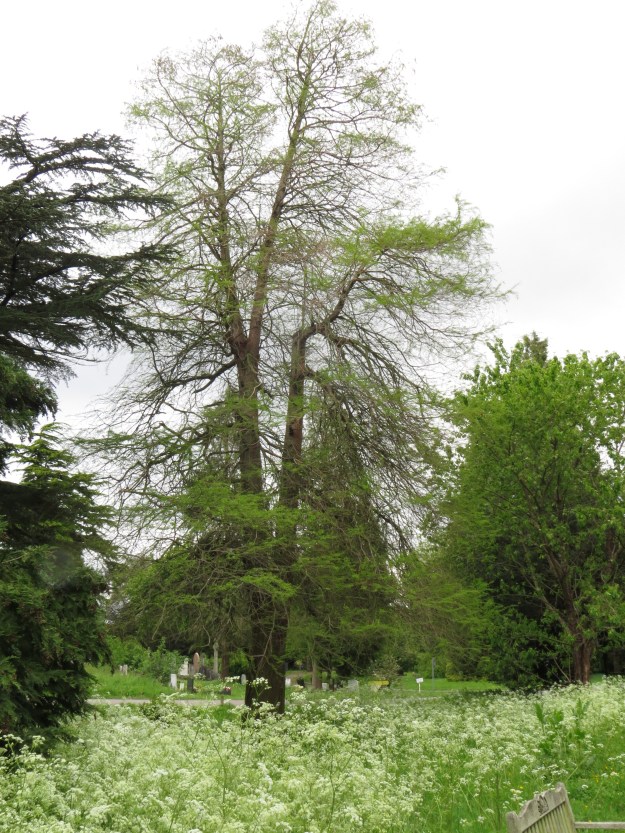
I am pleased to report that ‘my’ swamp cypress is finally getting a coat of green, rather later than I expected. Look at it standing ankle-deep in cow parsley!

I noticed how the flowers on the horse chestnut turn pink when they’re pollinated – you can see the mixture of yellow and pink blossom on this flowerhead. I have seen bumblebees about in the midst of the storms this week, determinedly heading for the dusky cranesbill which is in full flower in the garden. I am a recent convert to species geraniums – some varieties are shade-tolerant, and the bees love them. I imagine that a tree like a horse chestnut must be a powerful bee magnet. So many flowers! So much nectar and pollen!

There is some sorrel just starting to appear too – I horrified my husband by eating a leaf just to make sure. It looks rather like a grass, but it’s actually a member of the knotweed family. The leaves have a delicious lemony tang to them, and if you look at the stem you can see how similar it is to plants like bistort and redshank.

Common sorrel (Rumex acetosa)

When we reach the main path that leads to the North Circular Road entrance, what should we see but a blooming little egret flying past! I apologise for not getting a better photo for you, readers. I promise that the white blob just right of centre towards the top of the photo is actually an egret, not a stray handkerchief whooshing past in the high wind. I wonder where s/he was going?

On we go. I am delighted with the way that the sycamore flowers are already turning into the little ‘helicopters’ as we used to call them.

A rather magnificent crow surveyed the scene from the top of a tree. We’d just watched a crow pick up half a sandwich that someone had dropped, dunk it in a puddle to moisten it and then fly off, presumably back to a nestful of little dinosaurs waiting for their lunch.

And there’s an area completely covered in shining cranesbill (Geranium lucidum). Even allowing for the damp weather, just look how shiny the foliage is! And look at all those fallen horse-chestnut flowers, probably ripped untimely from the tree in this week’s wind, rain and hail.

Shining cranesbill (Geranium lucidum)

Storm damage


More branches down

My friend A told me that there were some whole trees down in other parts of the cemetery. It’s such a large area that they can lay around for quite some time if they haven’t fallen onto a recent grave, and if they aren’t blocking a well-used road.

And, as usual in the cemetery, I notice something that I’ve walked past a hundred times without really seeing it.

The broken column symbolises a life cut short, and was often used to signify the death of a child, as indeed is the case with this memorial. Little John Arthur Winter died at the age of 18 months, and is buried here with who I imagine are his grandparents, judging by the ages.

John Arthur was born in Shoreditch,  to Charles Richard and Amy Jane Winter, and was baptised in St John the Baptist church in Shoreditch. In 1881, 5 years after John Arthur had died, Charles Richard and Amy were living at 164 Southgate Road in Hackney. They had two children, Charles aged 12 and George aged 4, and their 4 year-old niece Alice was visiting them on the day of the census. Charles Richard lists his occupation as ‘clerk/surveyor’, but the section for Amy’s employment is blank. By 1891 the family have moved to Hever in Kent, and it seems as if Charles Richard has gone up in the world, with his occupation now listed as ‘Architect/Surveyor’. The older boy, Charles, is now 22 years old and a stonemason, and the younger, George, is a draughtsman and architect, so it looks as if both children followed in their father’s footsteps. Their niece, Alice, seems to be living with them, and they now have a general servant. In the 1901 census Charles Richard and Amy are still living in Hever, but all the young people have left and they no longer have a servant. The couple are only 55 years old  but by 11th November 1901, Charles Richard is dead, and is buried in St Pancras and Islington Cemetery, though not in the same grave as his infant son. Amy Jane follows him in 1920, and it seems from the burial records that she might have spent her last days in Brighton. Maybe one of her sons lived there?

It is extraordinary what you can find out on the internet these days, but the bare bones of a life give no idea of the really important things – was a person kind? Did they have a sense of humour? What infuriated them, and what got their pulses racing? Did they love their job, or hate it? Did the sons get on with their father? How come the niece was living with them? All these things vanish when the last person who remembers someone, or has heard about them, dies themselves. Nonetheless, I think we often don’t realise what a huge difference we can make to the people around us, for good and for ill, and how those things ripple out into the wider world. My grandmother remembered her two dead sons until her own dying day: one died at eighteen months of scarlet fever, and the other at two years old from diptheria. But the stories that she told me about them live on in me, and so in a way they still live on, though their lives were so short, and so long ago. Let’s never forget to pass on those stories.

A Damp Walk in St Pancras and Islington Cemetery

Dear Readers, we didn’t walk in the cemetery last week because there the rain was blowing horizontally across the garden, but I couldn’t wait to get there this week. A fortnight is a long time when it’s spring, and already most of the dandelions are shedding their seeds. Those ‘dandelion clocks’ really are entrancing, especially if you look closely. I love the way that the seeds detach one at a time and head off to find somewhere to put down their roots…

When all the seeds are gone, I love the spirals of little holes where they were once attached. And I’d never noticed how the ‘parachutes’ of the seeds are angled backwards, maybe so that the plant can produce more seeds per seedhead?

But it was to be a day of floral and avian wonders. A magpie decided to have a bath in a muddy puddle, as one does.

There were germander speedwells….

An ocean of cow parsley…..

Lots of red campion….

Cowslips…..

English bluebells…

And the buttercups have taken over from the lesser celandine in the yellow flower competition.

The flowers on the horse chestnut are pretty much full grown now and how enticing they look!

Even the grasses have gone berserk. That combination of lots of rain and longer day length has really kicked everything off.

We walk along the narrow path that connects two parts of the cemetery, and the cow parsley has sprung up to waist high.

But then there’s one of those moments that make the cemetery so special. I hear a familiar yaffling call, and there, posing on a headstone, is a green woodpecker.

These birds always remind me a bit of tiny dragons. There is a close-mown area nearby where they often search for ants, pounding away into the earth with their beaks. Unlike the great-spotted woodpecker, they don’t drum on dead trees to establish territory. This one was exceptionally obliging. This one is a female – the ‘moustache’ at the side of the face is all black in females, but has a red stripe in males. I found this description a bit confusing as I associate a moustache as being in the middle of the face, but for ornithologists it’s more of the ‘muttonchop’ variety.


Anyhow, this was a real delight, and well worth getting damp for. I normally hear the green woodpeckers, but they rarely stand still long enough for a photo. The wet weather has kept most of the visitors away, which makes the birds bolder.

Next, it was a wander along the road which is right next to the North Circular. The traffic noise is so loud here that it’s hard to make yourself heard, but the flowers are worth it. The ragwort is in full flower…

Last year’s salsify is in flower again….

And how about this lovely tangle of vetch? Some of my favourite plants are in the pea family.

One of the pleasures of a walk like this is seeing familiar plants, but noticing something new about them. Last year I was crunching through acorns as I passed these trees, but today I saw that they were in flower. I’d never even thought about oak trees having flowers (doh). The catkins are the male flowers, and there are tiny female flowers that look like buds amongst the leaves.

The comfrey is in flower, and the bumblebees are delighted. Along by the stream there is creeping comfrey and the larger common comfrey.

Common comfrey


And for some reason, in the middle of all this wildness there is a Japanese acer, just about holding its own.

There is bugle and great stitchwort….

Bugle

Greater stitchwort

Cuckoo flower and shining cranesbill…

Cuckoo flower

And a great big patch of three-cornered garlic, with its triangular stem. I can’t resist having a little nibble as we march on through the woody bits of the cemetery. Overhead a buzzard is mewing and suddenly appears above us, pursued by a huge flock of crows – I count at least thirty, and more are joining from all directions. A sparrowhawk flies over, fast and low, and goes unmolested. The crows take such glee in the mobbing that you’d almost think they enjoyed it. I wonder if it’s one of those visceral reactions to anything that looks like a bird of prey? I always wonder this, and I still have no answers. And neither does the lovely Scotsman statue, standing in the spring woods with the bluebells dying back and the greenery rising all around him.


Wednesday Weed – Bird Cherry

Bird Cherry (Prunus padus)

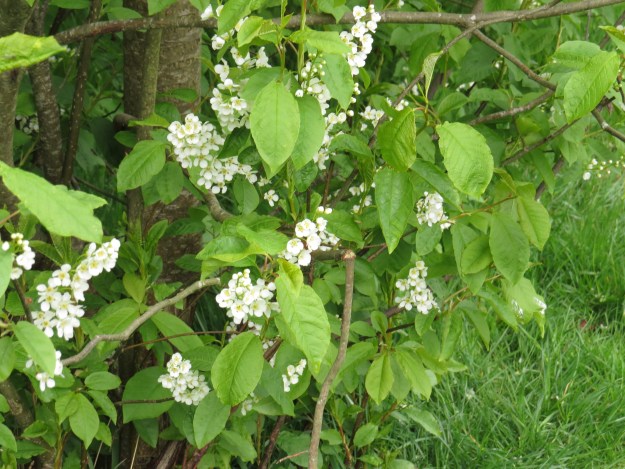
Dear Readers, those of you who read my earlier post about Cherry Tree Wood might have guessed which way my Wednesday Weed was tending this week! I have often walked past these trees without paying them much attention, and yet they are glorious at this time of year, with their spikes of white flowers going off in all directions like little fireworks. The plant likes damp conditions, and there are plenty of streams and rivulets arising in the wood, so I think it feels very at home.

In other parts of the world the tree is known as Hackberry, Hagberry or the Mayday tree. It’s native to Eurasia but has been naturalised all over the world. It was apparently planted by home owners in great quantities in Anchorage, Alaska, which goes to show how hardy it is.

The tree was probably planted for its beauty, but it is popular with bees and other pollinating insects, and although the fruit is generally too tannic for human tastes, birds don’t care (as the name of the plant might suggest).

Photo One by By Anneli Salo - Own work, CC BY-SA 3.0, https://commons.wikimedia.org/w/index.php?curid=5084318

Fruits of the bird cherry (Photo One)

However, it wouldn’t be true to say that no one has ever eaten the fruit. Herodotus, writing 2500 years ago, describes a race of people known as the Agrippeans, who were all bald from birth and appear to have lived in the foothills of the Ural Mountains. They used the fruit of what appears to be the bird cherry as a staple food, pressing the cherries for their juice and then making a kind of cake from the residue. They sound like rather lovely people – in the winter they made their yurts around the bird cherries, using the trunk as a kind of living tentpole. According to Herodotus:

They dwell each man under a tree, covering it in winter with a white felt cloth, but using no felt in summer. These people are wronged by no man, for they are said to be sacred; nor have they any weapon of war. These are they who judge in the quarrels between their neighbours; moreover, whatever banished man has taken refuge with them is wronged by none.

– Herodotus, Ἱστορίαι (The Histories) Book IV, Chapter 23

In Siberia the berries are milled for flour, which is again baked into a kind of cake, and jam is also made from the fruit. For further details of this, I was fascinated by Professor Gordon Hillman’s website ‘Wild Food Plants of Britain’, which explains how the pits of bird cherry contain various toxins (including cyanide), but their preparation by native peoples living in the Amur valley of Far Eastern Russia eliminates the poison – the fruits are pounded in a pestle and mortar and then laid out in the sunshine to dry. Cyanide is a rather unstable compound, and so exposure to the sunlight and air makes it safe to eat. The berries are then turned into a kind of fruit ‘leather’ for consumption right through the winter.

In Scotland, the fruit is sometimes made into brandy.

Photo Two by By Oleg Bor - Own work, CC BY-SA 4.0, https://commons.wikimedia.org/w/index.php?curid=80467614

Bird Cherry Pie from Siberia (Photo Two)

According to my Harrap’s Wild Flower guide, Bird Cherry is largely found in the north of the UK, and it’s here that we find most of the folklore about the plant. In the north-east of the country it was considered to be a witches tree (which is presumably where the common name ‘hagberry’ came from), and this meant that the branches should never be used for staves or walking sticks, and the flowers should never be taken into the house. However, confusingly, in Wester Ross in Scotland, a walking stick made from bird cherry was supposed to mean that you would never get lost in the mist, so I suppose it was a choice between upsetting a witch and falling into a bog. I think falling into the bog was probably the wiser choice, but as I’m getting into my own ‘crone years’, maybe that’s just me.

In Wales, Bird Cherry is said to be considered unlucky, as it’s ‘the tree that the devil hung his mother from‘. Has anybody ever heard the details of this legend? Goodness, even the Kray Twins were good to their mother.

In the north of England, the tree was sometimes known as ‘Yorkshire lilac’, and indeed it does bear a passing resemblance to my white lilac bush, which is in full bloom at the moment.

The bark of bird cherry has an acrid smell, and it used to be believed that nailing it to your front door would keep the plague away. The bark was also used as a pesticide to deter insects and rodents from eating crops, and a dye derived from the bark was used to colour fishing nets brown.

Medicinally, Bird Cherry was used to treat many ailments, including conjunctivitis, fevers, kidney stones, anaemia and bronchitis.

And finally, a poem. Am I the only one who sees a similarity to the ecstatic poetry of Gerard Manley Hopkins here? Let me know, readers.

And I Was Alive

by Osip Mandelstam

And I was alive in the blizzard of the blossoming pear,
Myself I stood in the storm of the bird-cherry tree.
It was all leaflike and starshower, unerring, self-shattering power,
And it was all aimed at me.

What is this dire delight flowering fleeing always earth?
What is being? What is truth?

Blossoms rupture and rapture the air,
All hover and hammer,
Time intensified and time intolerable, sweetness raveling rot.
It is now. It is not.

(4 May 1937)
Translated from the Russian by Christian Wiman.

Photo Credits

Photo One by By Anneli Salo – Own work, CC BY-SA 3.0, https://commons.wikimedia.org/w/index.php?curid=5084318

Photo Two by By Oleg Bor – Own work, CC BY-SA 4.0, https://commons.wikimedia.org/w/index.php?curid=80467614

A May Walk in Highgate Wood and Queen’s Wood

Sunlight through hornbeam leaves

Dear Readers, sometimes when I walk through one of North London’s ancient woodlands, I am reminded of how much I have learned through writing the blog over this last 7 years. Although there is still so much to find out, it makes me happy that I can look at the muscular trunk of a hornbeam and identify it, and that I can imagine it as a younger sapling, a mass of twigs that were probably cut back once or twice when the tree was a baby, before coppicing was abandoned and the tree was left to grow.

The tree above has five distinct trunks growing from the same ‘stool’ – they interweave with one another in a kind of slow-motion dance as they reach towards the light. I love the silvery bark of hornbeam, and the way that it is covered in a web of ‘veins’ and ‘sinews’ like a weight-lifter’s arms.

There is so much to notice, and yet so often we don’t, absorbed in our thoughts or in our phones.

And here’s a horse-chestnut seedling, optimistically growing in a patch of sunlight.

Last time we walked in these woods it was Boxing Day, we were ankle-deep in mud, and there were hundreds if not thousands of people on the paths. But today it’s a weekday, the children are back at school, most folk are at work and it feels as if the woods are breathing again.

There is a new dead-hedge around the little pond, though whether this will keep an enthusiastic golden retriever out of the water remains to be seen.

A pair of great tits have made their nest in this dead tree stump, a great advert for leaving dead wood where it is.

The coppiced areas in the middle of the wood really show off the oaks as they reach for the sky.

But hang on, who is that on the path? My keen-eyed husband spots a creature just past the ‘cross walk’ in the picture.

There are rats in all of the woodlands that I’ve visited this year. There are always a few around, but with more people also in the woods they’ve been noticed a bit more. In Cherry Tree the council have put down poison, so there are now dead rats. Let’s hope that they don’t become food for foxes, dogs, cats, crows, buzzards, magpies, owls etc etc.

Rat populations (like pigeon populations) are almost entirely governed by availability of food. There has been a huge increase in littering in wild places and parks all over the country, with people seeming incapable of taking their rubbish home. Lots of creatures have taken advantage. Plus there is a kind of hysteria about rats. We have become so detached from wildlife that some people seem to feel that if their toddler sees a rat they will keel over with Weil’s disease. I understand that you wouldn’t necessarily want to share your house with wild rats, but in a woodland?

Someone recently posted a short film on our local community Facebook page of an elderly rat being harassed by crows, so let’s not forget that in the natural world these rodents are way down the food chain. However, this crow was rather more interested in something in the stream.

I wonder if the crow is looking for invertebrates in the mud at the bottom of the rivulet? They are such intelligent animals generally, but all members of the crow family seem to be super-attuned to possible food. You can almost see them working out what’s what.

There is a little drift of wood anemones here too, an indicator of ancient woodland because they don’t travel very far over the generations. They are partially protected by the fence, which is probably why they’ve survived the huge growth in footfall in the woods during the lockdown.

And then, there is a patch of hybrid bluebells in the sun, close to where the boundary of the wood meets the local housing. Sometimes people throw their garden rubbish over the fence in these situations, which is why there is often such diverse non-native flora in these places. The evidence seems to show that in a ‘real’ bluebell wood, hybrids can’t outcompete the native bluebells, though they may still make incursions at the edge where there is normally more light. At any rate, these are pretty and have some value to pollinators clearly. In an urban wood such as this I suspect any increase in biodiversity isn’t to be sniffed at.