Sunday Quiz – Monochrome…..

Title Photo by Miraceti, CC BY-SA 3.0 <https://creativecommons.org/licenses/by-sa/3.0>, via Wikimedia Commons

Black-headed gull (Title Photo)

Dear Readers, as winter comes on apace here in the UK, I have been thinking about how many plants are animals have the words ‘white’ or ‘black’ in their names, even when they aren’t either colour. The black-headed gull, for example, has a chocolate-brown head, and doesn’t even have that for most of the year.

So your challenge this week is a) to say whether the organisms depicted in the photos below belong in the ‘white’ or the ‘black’ category, and to make things fair there are eight of each. An extra point if you can name the critter/plant, giving a possible maximum score of 32 points.

All answers in the comments by 5 p.m. UK time on Friday 3rd December please, and the answers will be posted on Saturday December 4th. As usual I will make your answers disappear as soon as I see them, but write them down before looking at the comments if you are easily influenced by other people’s brilliance.

So, if you think the creature in photo 1 belongs in the black category, your answer is 1) Black. If you think that it’s a black-tailed spooglehound, you can put that in as well for an extra point.

Onwards!

1)

2)

3)

4)

5)

6)

7)

8)

9)

10)

11)

12)

13)

14)

15)

16)


Sunday Quiz – Plants Named After Places – The Answers!

London Planes

Dear Readers, we had some splendid results this week! Fran and Bobby Freelove got 29/30 for the tiniest of slips (one too many Canadians and not enough New Zealanders :-() but our winners this week, with 30/30 are Sophie and Claire. Well done to everyone!

A) 2) Paris – Herb Paris (Paris quadrifolia)

B) 9) Wales – Welsh Poppy (Meconopsis cambrica)

C) 8) New Zealand – New Zealand Pigmyweed (Crassula helmsii)

D) 10) Portland – Portland Spurge (Euphorbia portlandica)

E) 14) America – American willowherb (Epilobium ciliatum)

F) 5) Denmark – Danish scurvy grass (Cochlearia danica)

G) 11) Japan – Japanese Knotweed (Fallopia japonica)

H) 3) Nottingham – Nottingham Catchfly (Silene nutans)

I) 12) Russia – Russian Comfrey (Symphytum x uplandicum)

J) 6) Canada – Canadian fleabane (Conyza canadensis)

K) 13) Mexico – Mexican fleabane (Erigeron karvinskianus)

L) 15) Oxford – Oxford Ragwort (Senecio squalidus)

M) 7) Italy – Italian Lords and Ladies (Arum italicum)

N) 1) London – Londonpride (Saxifraga x urbium)

O) 4) Spain – Spanish Bluebells (Hyacinthoides hispanica)

Photo Credits

Photo A by gailhampshire from Cradley, Malvern, U.K, CC BY 2.0 <https://creativecommons.org/licenses/by/2.0>, via Wikimedia Commons

Photo B by Anneli Salo, CC BY-SA 3.0 <https://creativecommons.org/licenses/by-sa/3.0>, via Wikimedia Commons

Photo C by Bas Kers at https://www.flickr.com/photos/21933510@N07/3654571543/

Photo D by Nicholas Turland at https://www.flickr.com/photos/nturland/48035556583/

Photo E by By Gordon Leppig &amp; Andrea J. Pickart – http://www.fws.gov/humboldtbay/plantguide/genus-e.html, Public Domain, https://commons.wikimedia.org/w/index.php?curid=4067441

Photo F by gailhampshire from Cradley, Malvern, U.K, CC BY 2.0 <https://creativecommons.org/licenses/by/2.0>, via Wikimedia Commons

Photo G – author’s own.

Photo H by Arnstein Rønning, CC BY-SA 3.0 <https://creativecommons.org/licenses/by-sa/3.0>, via Wikimedia Commons

Photo I by Evelyn Simak / Russian comfrey (Symphytum x uplandicum)

Photo J by Tico Bassie at https://www.flickr.com/photos/tico_bassie/118358298

Photo K by Robert Flogaus-Faust, CC BY 4.0 <https://creativecommons.org/licenses/by/4.0>, via Wikimedia Commons

Photo L by Rosser1954, CC BY-SA 4.0 <https://creativecommons.org/licenses/by-sa/4.0>, via Wikimedia Commons

Photo M by Photo (c)2006 Derek Ramsey (Ram-Man), CC BY-SA 2.5 <https://creativecommons.org/licenses/by-sa/2.5>, via Wikimedia Commons

Photo N by I, Hugo.arg, CC BY-SA 3.0 <http://creativecommons.org/licenses/by-sa/3.0/>, via Wikimedia Commons

Photo O by Schnobby, CC BY-SA 3.0 <https://creativecommons.org/licenses/by-sa/3.0>, via Wikimedia Commons

Return to Inner Temple Gardens

Plane trees in Inner Temple Gardens

Dear Readers, you might remember that I visited this serene space in the middle of the Inns of Court a few months ago. Since then  I’ve become somewhat evangelical about the gardens, which combine interesting planting with a sense of informality which I find very appealing. I was intrigued to see what would still be in flower in the middle of November, and as I walked up to the gates, I spotted this remarkable plant, which I think is a cup-and-saucer vine (Cobaea scandens).

I’m not sure if these are buds or seedheads, but they are most remarkable structures.

Inside the garden there were salvias a-plenty, still mostly in flower. One of them was even hosting a drowsy bumblebee (not so drowsy that I managed to get a photo of her though).

The gardeners are very fond of ornamental grasses here, and use them to great effect.

Manchurian walnut tree in Inner Temple Gardens

And I rather like this plant, though I have no idea what it is. Help, Readers!

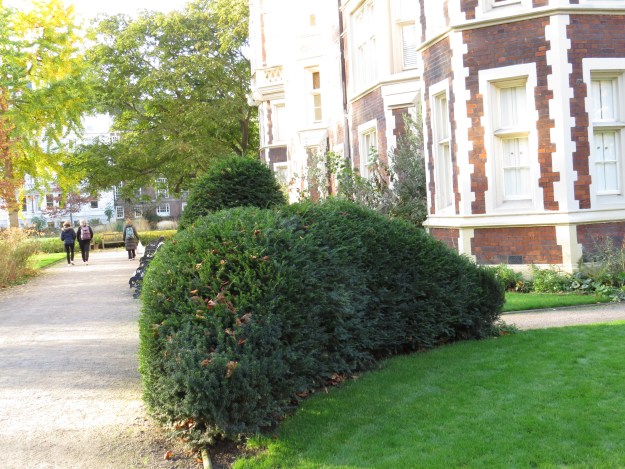
My friend S and I both though that this topiary looked like a duck with its head under its wing…

…..though not from the other side.

And look, a swamp cypress. Not quite as magnificent as *my* swamp cypress in St Pancras and Islington Cemetery, but very fine nonetheless.

And then it’s off for a trot along the plane tree avenue…

And then past the hydrangeas. I had no idea that you could get a scarlet variety, but here it is.

And here’s a more traditional variety. Hydrangeas are not my favourites (apart from my splendid climbing hydrangea of course) but they do have a very long season, and are one of the few plants that look impressive even when the flowers are dead.

But what on earth is this? The leaves on this plant are so interesting, and I love the way that it seems to unfold like a fan. If you know what it is give me a shout, gentle readers. UPDATE:I am mega-embarrassed about this as I’ve actually done a Wednesday Weed about this plant – Melianthus major, the Giant Honey Flower. Thanks to Fran and Bobby Freelove, Anne and Sophie for reminding me about it!. 

So I am still in love with these gardens, even at the turning of the year. It would  almost be worth becoming a lawyer just to have unlimited access. Note that I say ‘almost’ because I am not of a combative nature, and I suspect that that’s a prerequisite, though I guess it depends what part of the law you specialise in. And as I leave, I notice that the steps to the outside world are tumbling with Mexican fleabane, and embedded with wildflowers, as if insistent that our last memories of this special place should be of the potency of nature, which obeys laws of its own.


Good News for Once

Photo One by Björn S..., CC BY-SA 2.0 <https://creativecommons.org/licenses/by-sa/2.0>, via Wikimedia Commons

Red helleborine (Cephalanthera rubens) (Photo One)

Dear Readers, my copy of British Wildlife (which includes all things living, not just animals) often makes sober reading, as habitats change and species decline. This month, however, there are some very bracing success stories and I thought I’d share them here to cheer us all up.

First up is the red helleborine (photo above) – this is a critically endangered orchid in the UK, known from only a handful of sites, so it was a real treat when a new population of the plant was discovered in West Gloucestershire. Orchids are vulnerable to idiots with spades digging them up so the exact location is a secret, but the landowner, the local recorder and those with expertise in managing the habitat of this rare plant have been informed. Let’s hope that it thrives!

And while we’re on the subject of orchids, a small-flowered tongue orchid (Serapias parviflora) has cropped up on the green roof of Nomura Internation in the City of London. The seeds of orchids are incredibly light and can travel a long way, so it might well have been blown here from across the Channel (it’s a plant of the Atlantic coast of mainland Europe generally), and climate change is making the southern part of England much more amenable to plants that require warmer, wetter conditions.

Photo Two by By Luis nunes alberto - Own work, CC BY-SA 3.0, https://commons.wikimedia.org/w/index.php?curid=6497090

Small-flowered tongue-orchid (Serapias parviflora)(Photo Two)

And here’s a very surprising story. Mousetail (Myosurus minimus), a Red-listed threatened species of buttercup, was spotted growing at Reading services on the M4 motorway – the plant was growing in a strip of gravel between two parking bays. The person who spotted it (Simon Leach) contacted a botanist who told him that it had been spotted on the other side of the motorway too so, with the zeal that only a true plant enthusiast can muster, he checked out the grass verges on the return journey, only to find that there were literally tens of thousands of the plant growing in these most inhospitable circumstances. Nature will indeed find a way.

Photo Three by I, Hugo.arg, CC BY-SA 3.0 <http://creativecommons.org/licenses/by-sa/3.0/>, via Wikimedia Commons

Mousetail (Myosurus minimus) (Photo Three)

Moving onto insects, there is exciting news to report from the world of grasshoppers and their relatives. For one thing, the Large Conehead (Ruspolia nitidula) has become very well established in the south of England, and bat detectors have been used to pick up the calls of the males. There is a recording of their high-pitched call below – you might need to turn up your speakers!

Photo Four by Gilles San Martin from Namur, Belgium, CC BY-SA 2.0 <https://creativecommons.org/licenses/by-sa/2.0>, via Wikimedia Commons

Large conehead (Ruspolia nitidula) (Photo Four)

This rather splendid fly was found in Wytham Woods near Oxford – it’s a Forest Silver-Stiletto (Pandivirilia melaleuca) and is vanishingly rare – it needs dead and dying wood and sap runs in which to breed) so any new sighting has to be good news. Most people are not very fond of flies, but this varied group contains insects which are essential to the well-being of the ecosystems in which they lives.

Forest Silver-stiletto (Pandivirilia melaleuca) – Photo by Matthew Harrow

And finally (and for me this is the most exciting news of the month) a population of praying mantises has been found in a garden in Oxfordshire. The insects appear to be breeding – Richard Lewington, who wrote ‘Guide to Garden Wildlife‘, one of my favourite field guides, found several adults and an egg case in 2020. The owners contacted him this year, and he found a nymph, so this appears to be the first record of successful breeding in the wild in Britain.

Photo Four byAlvesgaspar, CC BY-SA 3.0 <https://creativecommons.org/licenses/by-sa/3.0>, via Wikimedia Commons

Praying mantis (Mantis religiosa) (Photo Five)

So, it seems that climate change and a variety of other factors are influencing the make-up of our wild plant and animal communities in a variety of ways. Some could be predicted, but others are totally unexpected. Many species are being pushed to the brink, while others are taking advantage of new opportunities. There can be little doubt that everything is on the move.

Photo Credits

Photo One by Björn S…, CC BY-SA 2.0 <https://creativecommons.org/licenses/by-sa/2.0>, via Wikimedia Commons

Photo Two By Luis nunes alberto – Own work, CC BY-SA 3.0, https://commons.wikimedia.org/w/index.php?curid=6497090

Photo Three by I, Hugo.arg, CC BY-SA 3.0 <http://creativecommons.org/licenses/by-sa/3.0/>, via Wikimedia Commons

Photo Four by Gilles San Martin from Namur, Belgium, CC BY-SA 2.0 <https://creativecommons.org/licenses/by-sa/2.0>, via Wikimedia Commons

Photo Four byAlvesgaspar, CC BY-SA 3.0 <https://creativecommons.org/licenses/by-sa/3.0>, via Wikimedia Commons

Wednesday Weed – Kohlrabi

Dear Readers, was there ever a more characterful vegetable than the kohlrabi? The one on the left looks as if it is grinning maniacally, and the one on the right seems to be waving its little arms or begging to be picked up. What a shame that they taste so much like turnips, a vegetable that fills me with little enthusiasm. Still, these chaps have appeared in my fortnightly organic box, and so I shall find something exciting to do with them.

Gary Rhodes, beloved pointy-haired chef from the 80s, suggests making a remoulade with them – as this features mayonnaise, Dijon mustard, capers and gherkins I am hoping that this will take the edge off the flavour. Rhodes was one of the first chefs to really pioneer British ingredients and recipes (though I remember Mum being very dismissive of his deconstructed steak and kidney pudding). His recipes included steamed syrup puddings, pies, pot roasts and trifles, and they all seemed to work, so I have high hopes for my kohlrabi. Sadly, Rhodes died aged only 59, but he was seen as an inspiration by everyone from Marcus Wareing to Jamie Oliver.

The esteemed Nigel Slater, however, describes the kohlrabi as ‘more or less useless‘. Over to you, readers!

Photo One by By Mecca Ibrahim from Richmond, UK - Me and Gary Rhodes, CC BY 2.0, https://commons.wikimedia.org/w/index.php?curid=4331970

Gary Rhodes (Photo One)

Now, although it looks like a turnip, kohlrabi is actually Brassica olearacea, the wild cabbage. This humble wild plant has given us not only our cultivated versions of cabbage, including the dreaded/revered Brussels sprout, but also the cauliflower, broccoli and collard greens. Although it looks like a turnip it isn’t actually one, although the confusion is long-lived: the name comes from the German Kohl (meaning cabbage) plus Rübe (meaning turnip). The vegetable is eaten right across southern Asia, from India to Vietnam, and is also popular in Eastern Europe. It is also a popular vegetable in Cyprus, where it’s eaten as an appetiser with lemon and salt.

Kohlrabi was first recorded in Europe in 1554, where the botanist Mattioli recorded that it has ‘lately come into Italy’. It was widely grown across Europe by the end of the 16th century, including in the UK – the soil seems to favour a wide range of root crops, from swedes and turnips to carrots and the much beloved (by me at least) potato. In some places, these same roots were used to feed cattle. Just about the only root vegetable that I can think of that hasn’t been used by both humans and animals is the sugar beet: it provides us with most of our sugar these days, but I have never heard of anyone roasting it or popping it into a coleslaw. Do let me know if you’ve heard otherwise.

‘My’ kohlrabi are purple-skinned ( I think the variety is known as Purple Vienna) but the colour doesn’t affect the taste or the colour of the flesh, which is always creamy white. You might be more familiar with the green variety.

Photo Two by By Secretlondon - Own work, CC BY-SA 3.0, https://commons.wikimedia.org/w/index.php?curid=361214

Green kohlrabi (Photo Two)

Kohlrabi is a good source of fibre and Vitamin C and K, and contains trace amounts of potassium, phosphorus and copper. Medicinally it has been used as everything from a cancer preventative to a weight-loss promoter, though studies haven’t proved its efficacy except as part of a well-balanced and varied diet. However, all members of the Brassica family punch above their weight in terms of all-round nutrition – there was a reason that my Mum always told me to ‘eat my greens’.

Now, you might think that a vegetable as striking as a kohlrabi would have appeared in numerous still life paintings, but in fact it is often disregarded in favour of more picturesque vegetables such as the cauliflower. I was very impressed by this work by a contemporary German artist, Manfred W. Jürgens – and as you can see he paints the humble kohlrabi with loving care and attention.

Red Kohlrabi by Manfred W.Jürgens

And here is a slightly menacing kohlrabi.

Still life with kohlrabi by Manfred W.Jürgens

And finally, a poem. I bet you thought that it would be difficult to find something featuring this strange and bulbous plant, but in fact I was spoiled for choice. Here’s the one that I liked best, with its intimations of the abundance of harvest, and the need, sometimes, to trust and to be generous. I hadn’t come across Donna Hilbert before, but I love this!

In Plowboy’s Produce Market
by
Donna Hilbert

I push my cart through Plowboy’s produce market
gleaning this song for the first days of fall:
broccoli cauliflower cabbage kohlrabi The price of red pepper is dropping.
Eggplant shines purple.
Bell pepper is green.
I watch an old couple choose stringbeans:
she fills their sack by handfuls. He frowns,
empties the bag back into the bin,
then turns each bean to the light
before dropping it in.
pattypan crook-neck pumpkin zucchini
A woman wearing a scarf tight at her chin
eats Thompson’s seedless from the grape bin.
Tokay Exotic Muscat Red Flame
At the melons, a man in white shorts, skin brown
as russet potatoes, swings a cantaloupe into his cart.
I think I’m in love.
Winesap Pippin Golden Delicious
where last week there were plums.
Old man, kiss your wife.
Wash your face in the juice of ripe fruit.
Put beans into your sack without looking.
Old man, we’re in Plowboys’s
every bean is perfect, every bean is right.

Photo Credits

Photo One by By Mecca Ibrahim from Richmond, UK – Me and Gary Rhodes, CC BY 2.0, https://commons.wikimedia.org/w/index.php?curid=4331970

Photo Two By Secretlondon – Own work, CC BY-SA 3.0, https://commons.wikimedia.org/w/index.php?curid=361214


Farewell to Somerset (Again)

View of the sunset from our window at the Shrubbery Hotel

Dear Readers, I have already said goodbye to Somerset once, but here we are again, still sorting out my Aunt H’s house. A lifetime of 93 years gives ample opportunity to accumulate ‘stuff’, especially when you are interested in family history and local history and all matters church-related. And so we headed down to Broadway this morning to sort out the kitchen and to prepare for all the paperwork that will need to be signed tomorrow. While John went off to collect the keys, I had a chance for a walk around the garden. I would say a ‘final’ walk around the garden, but clearly that would leave a hostage to fortune.

The foliage on the shrub below is gradually turning scarlet, and there is a fine crop of berries, but what on earth is it? I would have said some kind of berberis, but those long fruits are confusing me somewhat. Let me know what you think, gardening people!

There has been a lot of judicious pruning in the garden and it’s looking in much better shape than it was.This Viburnum is in full flower and I could smell its sweet scent from ten feet away. What a boon to a winter garden this plant is! I wonder if I could squeeze one in.

Viburnum bodnantse

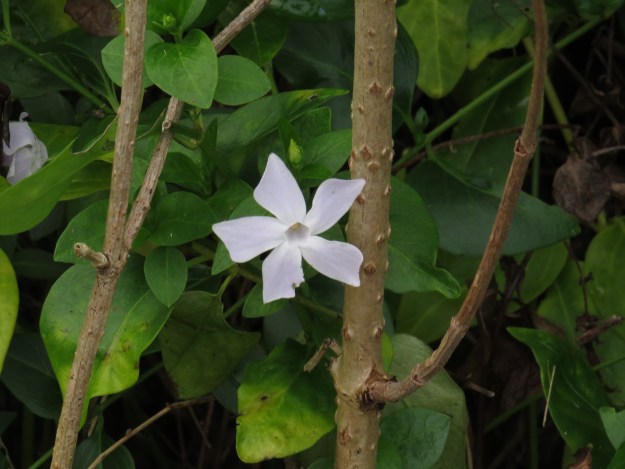
The white periwinkles have come back, having been strangled by the bramble. I love their pale, star-like flowers.

There is a fine Hawkshead fuchsia, another plant that I’ve been thinking about trying – in fact I might nick a cutting and see how it does. I’m sure Aunt H would have approved.

And the cyclamen are in flower. I love the way that they carpet the ground under the shrubs, to be replaced by the snowdrops and primroses and crocuses in the spring.

Whatever happens to the house, I doubt that the garden will be a priority for anyone – the garden is large, the cottage is small, and at the very least I imagine someone will want to extend. Even if they don’t they will probably want to change the garden into something else, as people always do. I hope that they give it a year so that they can see what’s already there, but folk are in such a hurry these days. It makes me think of what might happen to my resolutely idiosyncratic garden when we move, or when I die – no one with small children will want a massive pond, and I suspect that the days of the inconvenient whitebeam and the prickly hawthorn will be numbered too. But if this year has taught us anything it’s that the future is out of our control. Who knows what will happen? It’s certainly not worth worrying about.

As I go through Aunt H’s belongings I am struck by her frugality, and how much it chimes with the mood today – the desire to recycle, to reuse, to save things ‘for a rainy day’. There’s a jar full of bottle tops. There are plastic Stork margarine containers, used and reused over and over again to store soup and stews for freezing. I find jars of chutney from ten years ago, and boxes full of buttons. There’s much to learn from a generation that had to make things last and was reluctant to waste things. If we were all a bit more like Aunt H our beaches might not be full of plastic bottles and crisp packets and wet wipes. I’m pretty sure that Aunt H never utilised a wet wipe in her life, and if she had I have a suspicion that she’d have washed it and hung it out to dry somewhere.

Back in our hotel room, I watch the sun go down, and realise how rarely I allow myself to do such a thing. Tonight, the sun is painting the edge of the clouds with a light as sharp as one of Aunt H’s knives. She had knives for everything, most of them past their best, all of them kept in case they’d be needed again. It is hard, putting aside the remnants of a life. But our things are not us, though they sometimes tell our stories. Aunt H trod more gently on the earth than most of us, though she also trod on the toes of those who didn’t adhere to her standards of behaviour. Like all of us, she was complicated. She drove me to distraction on occasion, but I miss her, and so do many other people. She has left a hole in the village and church community that it will be very hard to fill.

A Damp Weekend in Somerset

Dear Readers, of all the many things that you might expect to see in a medieval market town in Somerset, an eight-foot tall metal giraffe is probably one of the most unlikely. But we are staying in The Shrubbery Hotel in Ilminster and, peering out over the car park is a very fine example of the same. We are here for the final clearing out of our Aunt Hilary’s house, and so it’s a sad occasion (and a pretty dusty one too if the last visit was anything to go by). There has been a house on the site since the late 17th Century but the current building was erected in 1850, and very fine it is too. I love the honey-coloured sandstone of the hotel, and of the houses in the town itself. In the photo below you can see how the bits of the facade that have been cleaned up glow in comparison to the more heavily-soiled parts – The Shrubbery is on an extremely busy road, so I imagine the pollution levels are high.

The entrance to the hotel

Now, I do wonder if we’ve made the right choice of hotel because apparently there has been ‘paranormal activity’, with phones ringing in empty rooms, sightings of a Cavalier in the dining room (not a Cavalier King Charles spaniel which is quite a different thing), and several people being ‘touched in the kitchen and the cellar’. Well, anyone who touches me in the cellar is going to get a clip round the ear’ole as my Dad used to say, and I actually wouldn’t mind seeing a Cavalier, so I am agog. Somerset Paranormal Investigators UK used ‘scientific equipment and some old methods’ to see what was going, and reported disembodied voices coming from their walkie-talkies. You can read the whole story here, and I shall report back if I see anything more unusual than an eight-foot metal giraffe.

The tree outside also has more mistletoe than I have ever seen on a single tree.

Just look at it! The light was really bad but I definitely saw a large thrush chasing a woodpigeon out of one of the balls of mistletoe – probably a fieldfare, but I shall see what I can see in the morning when the weather is supposed to be better.

Ilminster really is a most attractive town – there’s more of that lovely stone and a fantastic wisteria….

The Minster church (technically St Marys) dates back to the 15th Century but has been extensively refurbished and renovated during Victorian times. It’s still a most splendid building.

But as usual it’s the quirky things that I like. The town cackles with jackdaws, these two drinking from a handy gutter.

Someone is selling ‘Tattoo Stones’ from a house on the main road.

I was impressed with these extraordinary planters, again on the main road.

And this splendid scare crow clearly wasn’t upsetting any of the corvids.

So, tonight we dine at the hotel, whilst keeping our eyes peeled for ghostly goings on, and tomorrow it’s off to the village of Broadway for another day of sorting through the remains of a lifetime. At a certain point you have to get past being sad, and just focus on the task in hand, and that’s what we’ll do. Let’s see how we get on.

Sunday Quiz – Plants Named After Places

London Planes

Dear Readers, have you ever noticed how many plants are named after cities or countries? This week, your mission (should you choose to accept it) is to match the name of the country/city to the photo of the plant. One mark for a correct match, one for naming the plant correctly.

As usual, answers in the comments by 17.00 UK time on Friday 26th November please, with the answers published on Saturday 27th November. I shall ‘disappear’ the responses as soon as I see them, but as always, I would counsel you to write down your answers first, in case you might be influenced by the brilliance of those who have gone before.

So, if you think that the name of the first plant indicates that it’s from London, your answer would be A) 1)

Onwards!

Place Names

  1. London
  2. Paris
  3. Nottingham
  4. Spain
  5. Denmark
  6. Canada
  7. Italy
  8. New Zealand
  9. Wales
  10. Portland
  11. Japan
  12. Russia
  13. Mexico
  14. America
  15. Oxford


Plants

A)

B)

C)

D)

E)

F)

G)

H)

I)

J)

K)

L)

M)

N)

O)


Sunday Quiz – Autumn Trees – The Answers!

Autumn trees in St Pancras and Islington Cemetery 13th November 2021

Dear Readers, how did you get on? The answer to the anagram was

Spindle
Yew
Cedar of Lebanon
Alder
Monkey Puzzle
Oak
Rowan
Elm

Claire got all the trees  right – the first tree is a mountain ash, also known as a rowan, and the Araucaria is also known as a monkey puzzle. Rayna got all the answers right (though she doubted her id. on the first tree), but because she did get the anagram right I think she just edged ahead this week. Well done to both of you! Let’s see what’s tomorrow has in store. 

1) Rowan

2) Alder

3) Elm

4) Yew

5) Spindle

6) Oak

7) Monkey Puzzle

8) Cedar of Lebanon


Exciting Times in Cherry Tree Wood

The Coronation Oaks planted in Cherry Tree Wood

Dear Readers, there is nothing like visiting a familiar spot with people who really know it, and so it was a great pleasure to walk around Cherry Tree Wood in East Finchley with Roger Chapman and Kate Brown, who have been involved with the wood for many years. For example, I have strolled past these oaks many times, but Roger was able to tell me that each one was planted on the occasion of a monarch’s coronation – the one on the right for George VI in 1936, and the one on the right for Queen Elizabeth in 1953. Both trees are doing very well, and are mere striplings in terms of age – there’s an oak tree in the grounds of Blenheim Palace which is estimated to be 800 years old, so these have a while to go yet.

Cherry Tree Wood is very different from Coldfall Wood in some ways – it has a café (selling absolutely delicious cakes), tennis courts, public toilets and a playground for children. But it is also part of the same hunting ground as Coldfall Wood, owned in medieval times by the Bishop of London, and like Coldfall Wood it is a hornbeam and oak forest. The hornbeams would have been coppiced (cut to the ground) every year, while the oaks were allowed to grow for up to a hundred years before being harvested for their high-quality timber. The Coronation Oaks must be breathing a sigh of relief that this isn’t what happens these days.

The Friends of Cherry Tree Wood have instigated a number of interesting projects. One is the creation of a small orchard – there is a ‘Core Blimey’ apple tree, which is said to be especially suitable for the clay soil of London, and a cross between a plum and an apricot called a plumcot.

The ‘Core Blimey’ apple

There is a tiny pear tree which is bearing fruit even though it’s just a baby, which is always rather impressive.

The area round about has been planted with some wildflower plugs, and it’s hoped to seed the area in the spring. We’re attempting something similar alongside Muswell Hill Playing Fields, so it was good to discuss the various options.

Around the side of the tennis courts there is a completely unexpected water feature.

This area has always been a bit boggy, but has become impassable this year. There are investigations into drainage, but these things are always tricky. In the meantime, the flag irises are having a lovely time, and it will be interesting to see what else pops up.

There is another pollinator bed just in front of the public conveniences. The walls of the lavatories have a history of being graffitied as soon as a new layer of whitewash is applied, so there is a plan to grow something a thick, resilient and preferably spiky climber. It will be interesting to see how that goes!

Once in the wood itself, you can see the ‘dance’ of the hornbeams, with their twisting trunks indicating that they were coppiced a long, long time ago, and have since been left to run wild.

And how about this oak, that might once have formed part of a hedge boundary? Roger explained how the edge of a field used to run along this line, and that the trees to the left of it are different from the trees to the right.

The colours really are something else. I love the coppers and greens and golds.

And I also loved this fallen tree, which not only looks like a piece of sculpture but will also provide a home for all kinds of beetle larvae and other invertebrates.

At the entrance to the Wood the Friends have planted pollinator beds, which are still in flower now. They are hoping to expand out into what is currently an area of waste space, and to use this to increase their planting and to encourage biodiversity. A plan to introduce Pollinator Pathways around the local area is currently being formulated – there are so many tiny areas of ‘waste space’ across Barnet and the other London Boroughs that could be planted up with sources of food and shelter for bees, butterflies, moths and other invertebrates. I think it’s a great initiative because you wouldn’t need a lot of space – municipal flowerbeds, containers, tiny patches of lawn and lots of corporate ‘gardens’ could be used, with a bit of a nudge and some help and advice.  I’m sure I’ll be writing more about this and other initiatives. I’m finding it all very encouraging.