A Visit From The King of the Cats

Dear Readers, I allowed myself a whole half hour in the garden before the third part of my Zoom Away Day today. What a pleasure it was to see a Big Cat drinking from the pond! I have written about Bailey before – he is a magnificent creature who lives a few houses up the road from me. This year he will be eighteen years old and so he is a little slower and more arthritic than he was when we first moved in, but he is still a Very Fine Cat Indeed.

Bailey has previously drunk water in our kitchen direct from the tap, but today he seemed in the mood for something more ‘natural’. I suspect he is getting a bit deaf, because he didn’t turn a whisker when I crouched down to take his portrait. Or maybe he just doesn’t care. He has always been a most implacable cat, who knows exactly what he wants and where he’s going, regardless of other cats or humans.

He still has the world’s loudest miaow, and after a drink he made it very clear what he wanted.

Sadly, i have a very nervous little cat of my own these days, and so Bailey is no longer allowed in the house. He used to wander in and sit in the armchair for hours. Today, he just looked a little put out, and went to a sunny corner of the garden for a doze.

It is always sad when we see those we love, human or animal, becoming slower and older, but there is a kind of beauty to it too. There is something dignified and thoughtful about this cat, and we could learn much from his calm demeanour and direct but gentle ways. There is no doubt that he is in the autumn of his years, but he is still undeniably himself, a cat with his own way of doing things and no desire to change. I wish for all of us such a peaceful twilight.


Wednesday Weed – Mugwort – An Update

Dear Readers, I have what is officially known as ‘the week from hell’ this week, with another two half-days of Away Day and a whole gamut of ‘stuff’ to sort out. So, having been most intrigued with the mugwort that I found last week, I thought I’d give my post another airing. And, so that you don’t think I’m slacking off completely, here are a few new photos from the weekend. Normal service will be resumed as soon as possible!

Mugwort (Artemisia vulgaris)

Mugwort (Artemisia vulgaris)

Dear Readers, it is always a pleasure to write about a very common and widespread ‘weed’, especially one that may have slipped under our radar. So it is with Mugwort (Artemisia vulgaris), a member of the Daisy (Asteraceae) family. It has sprays of little, unobtrusive flowers, deeply-cut leaves that look silver underneath, and it is said to be faintly aromatic, though as usual I forgot to check out the scent.

Mugwort looks like a quintessential ‘weed’ – not the kind of thing that you’d want to pop up in your garden for its good looks. Indeed, Richard Mabey reports that in Lancashire it’s known as ‘Council Weed’ because it always seems to appear after the local council have sprayed everything else. And yet, it was once known as Mater Herbarum (the Mother of Weeds) and is one of the Nine Sacred Herbs of the Anglo-Saxons:

‘Remember, Mugwort, what you made known,
What you arranged at the Great proclamation.
You were called Una, the oldest of herbs,
you have power against three and against thirty,
you have power against poison and against infection,
you have power against the loathsome foe roving through the land.’

Medicinally, it seems to have been mainly used in two ways: to ease period and childbirth pains, and to lessen the shaking of ‘the palsy’. It was thought in Wales that a bunch of the plant tied to the left thigh of a woman in labour would ease her distress, though the plant had to be removed immediately after delivery to prevent haemorrhage.  The dried leaves were used to ease ‘hysterical fits’, and were also thought to be a cure for epilepsy. It was probably these  medicinal properties that resulted in it being imported into the UK in ancient times (it’s native to mainland Europe, Asia, North Africa and Alaska, and is naturalised throughout North America).

One of Mugwort’s alternative names is ‘Poor Man’s Tobacco’, and the dried flowers have been smoked by young people since time immemorial. Smoking the plant is said to cause vivid dreams. As if being an intoxicating drug wasn’t enough, it has also been used to flavour beer (much like ground ivy), and some think that this is where the name ‘mugwort’ originated, beer being drunk from a pottery mug in those days rather than a glass. If you would like to have a bash at creating your own Mugwort beer, there’s a recipe here.And if you get very keen, there’s a recipe for an ancient gruit beer here: gruit beers predate hops, and so are closer to what our medieval ancestors might have glugged down, just before they fell, singing, into a hedge.

An alternative reason for the name might be that ‘mug’ is a variant on the old word ‘mouchte’, meaning moth – the leaves have long been thought to be efficacious against clothes moths.

In Cornwall, the leaves were used as a tea substitute when ‘real’ tea grew too expensive during World War ii. It is also used as a culinary herb for stuffing roast goose on St Martin’s Day in Germany, although as it is  closely related to that bitterest of herbs, Wormwood, I suspect it may be an acquired taste. Mugwort is used extensively in Korean and Japanese cuisine, but  the plant they use is not ‘our’ mugwort. Some members of the genus Artemisia are much more bitter in flavour than others.

Mugwort has a long association with St John the Baptist, and with travellers. The saint was said to have worn a girdle of the plant for protection when he was in the wilderness, and stuffing your shoes with mugwort is said to be a talisman against everything from fatigue to being attacked by wild beasts. In Holland and Germany, the plant was gathered on St John’s Eve (23rd June) as a protection against misfortune in the year to come. I note that this is very close to the Summer Solstice, and may be yet another example of the blending of Christian and Pagan beliefs.

You might think that the Latin name for Mugwort, Artemisia vulgaris, links the plant back to Artemis/Diana, the goddess of hunting in Greek and Roman traditions. However, there is some thought that it is actually named after Artemis II of Caria, a botanist, medical researcher and naval strategist who died in 350 BC. She managed to hold off the navy of Rhodes, who advanced on the little island of Caria because they thought that a female ruler would be easy to defeat. She soon showed them their marching (sailing) orders. However, she is best known to history as the woman who drank her dead husband’s ashes in a goblet of wine every day as an act of extravagant mourning. The fact that her husband was also her brother adds a salacious frisson to the whole tale. Many artists took to their brushes to depict this scene, rather than her naval victories.. Women are so much less threatening when they’re imbibing their husbands and looking mournful. Especially when their blouse is dropping off.

Artemisia Prepares to Drink the Ashes of her Husband (attributed to Francesco Furini, circa 1630- Public Domain)

And to end, here is one of the last poems of Edward Thomas. I don’t recall the honeycomb smell of ‘mugwort dull’, but there is something about this work that captures that moment, poised between summer and autumn, between hope and despair, that I feel in my bones. I’ve read it once, and then again. It haunts me. Strange days, indeed.

The Brook

Seated once by a brook, watching a child
Chiefly that paddled, I was thus beguiled.
Mellow the blackbird sang and sharp the thrush
Not far off in the oak and hazel brush,
Unseen. There was a scent like honeycomb
From mugwort dull. And down upon the dome
Of the stone the cart-horse kicks against so oft
A butterfly alighted. From aloft
He took the heat of the sun, and from below.
On the hot stone he perched contented so,
As if never a cart would pass again
That way; as if I were the last of men
And he the first of insects to have earth
And sun together and to know their worth.
I was divided between him and the gleam,
The motion, and the voices, of the stream,
The waters running frizzled over gravel,
That never vanish and for ever travel.
A grey flycatcher silent on a fence
And I sat as if we had been there since
The horseman and the horse lying beneath
The fir-tree-covered barrow on the heath,
The horseman and the horse with silver shoes,
Galloped the downs last. All that I could lose
I lost. And then the child’s voice raised the dead.
“No one’s been here before” was what she said
And what I felt, yet never should have found
A word for, while I gathered sight and sound.
Last Poems, 1918.


Sunday Quiz – A Moth Medley – The Answers

White ermine moth ( Spilosoma lubricipeda)

Dear Readers, there are some splendid results from this week’s quiz, with Fran and Bobby Freelove, Leo Smith and OKthislooksbad all getting a handsome 15 out of 15, and with Alittlebitoutoffocus getting a respectable 11 out of 15. Welcome to our first-time posters, and thank you for taking part.

Dear Readers, let’s see how we got on with this little challenge. The answers are below. I hope you had fun! Deciding which moths to include certainly had me thinking about the variety of forms and habits of this fascinating group of insects. I could easily have found another fifteen to include, so sorry if I missed your favourites this time. And I managed to resist the urge to include a clothes moth.

Photo One by user B. Schoenmakers at waarneming.nl, a source of nature observations in the Netherlands. / CC BY (https://creativecommons.org/licenses/by/3.0)

1)h) White plume moth (Pterophorus pentadactyla)

Photo Two by AJC1 from UK / CC BY-SA (https://creativecommons.org/licenses/by-sa/2.0)

2)a) Jersey tiger (Euplagia quadripunctaria)

Photo Three by Rob Mitchell / CC0

3)k) Angle shades (Phlogophora meticulosa)

Photo Four by Rob Mitchell / CC0

4)j) Box tree moth (Cydalima perspectalis)

Photo Five by Yusuf Akgul / CC BY-SA (https://creativecommons.org/licenses/by-sa/4.0)

5)f) Hummingbird hawk moth (Macroglossum stellatarum)

Photo Six by nick goodrum from Catfield in Norfolk, United Kingdom / CC BY (https://creativecommons.org/licenses/by/2.0)

6)d) Buff tip (Phalera bucephala)

Photo Seven by Nzhymenoptera / CC0

7)g) Cinnabar moth (Tyria jacobaeae)

Photo Eight by Tony Hisgett from Birmingham, UK / CC BY (https://creativecommons.org/licenses/by/2.0)

8)c) Mint moth (Pyrausta aurata)

Photo Nine by By Lairich Rig, CC BY-SA 2.0, https://commons.wikimedia.org/w/index.php?curid=13619082

9)o) Six-spot burnet (Zygaena filipendulae)

Photo Ten by nick goodrum from Catfield in Norfolk, United Kingdom / CC BY (https://creativecommons.org/licenses/by/2.0)

10)i) Blood vein (Timandra comae)

Photo Eleven by Rob Mitchell / CC0

11)e) Red underwing ( Catocala nupta)

Photo Twelve by Rob Mitchell / CC0

12)n) Magpie moth (Abraxas grossulariata)

Photo Thirteen by Patrick Clement from West Midlands, England / CC BY (https://creativecommons.org/licenses/by/2.0)

13)b) Brimstone (Opisthograptis luteolata)

Photo Fourteen by nick goodrum from Catfield in Norfolk, United Kingdom / CC BY (https://creativecommons.org/licenses/by/2.0)

14)m) Elephant hawk moth (Deilephila elpenor)

Photo Fifteen by nick goodrum from Catfield in Norfolk, United Kingdom / CC BY (https://creativecommons.org/licenses/by/2.0)

15)l) Large emerald (Geometra papilionaria)

Photo Credits

Photo One by user B. Schoenmakers at waarneming.nl, a source of nature observations in the Netherlands. / CC BY (https://creativecommons.org/licenses/by/3.0)

Photo Two by AJC1 from UK / CC BY-SA (https://creativecommons.org/licenses/by-sa/2.0)

Photo Three by Rob Mitchell / CC0

Photo Four by Rob Mitchell / CC0

Photo Five by Yusuf Akgul / CC BY-SA (https://creativecommons.org/licenses/by-sa/4.0)

Photo Six by nick goodrum from Catfield in Norfolk, United Kingdom / CC BY (https://creativecommons.org/licenses/by/2.0)

Photo Seven by Nzhymenoptera / CC0

Photo Eight by Tony Hisgett from Birmingham, UK / CC BY (https://creativecommons.org/licenses/by/2.0)

Photo Nine by By Lairich Rig, CC BY-SA 2.0, https://commons.wikimedia.org/w/index.php?curid=13619082

Photo Ten by nick goodrum from Catfield in Norfolk, United Kingdom / CC BY (https://creativecommons.org/licenses/by/2.0)

Photo Eleven by Rob Mitchell / CC0

Photo Twelve by Rob Mitchell / CC0

Photo Thirteen by Patrick Clement from West Midlands, England / CC BY (https://creativecommons.org/licenses/by/2.0)

Photo Fourteen by nick goodrum from Catfield in Norfolk, United Kingdom / CC BY (https://creativecommons.org/licenses/by/2.0)

Photo Fifteen by nick goodrum from Catfield in Norfolk, United Kingdom / CC BY (https://creativecommons.org/licenses/by/2.0)

Sunday at Muswell Hill Playing Fields

Greater knapweed (Centaura scabiosa)

Dear Readers, I realise that I forgot to mention the ‘closing date’ for the Moths Quiz yesterday – I will be posting the answers tomorrow morning, and if you want to be ‘marked’, please pop your answers into the comments by 5 p.m. UK time today. As you were!

Dear Readers, Sunday has become the day for visiting my favourite spot for wildflowers along the edge of Muswell Hill Playing Fields. One gift of the current lockdown has been the chance to experience a single place repeatedly over the progress of the seasons, and I am becoming attuned to the way that plants and insects have a natural succession, with one fading as others come into flower. And so it is that the greater knapweed are just starting to go over, although their seeds may attract finches later in the summer.

White Comfrey (Symphytum orientale)

The white comfrey is almost finished too, but there are still common carder bees visiting the flowers.

Creeping thistle (Cirsium arvense)

The creeping thistle has taken over from the greater knapweed as the plant of choice for all the bees at the moment, but even here we can see it going to seed.  The seedheads always remind me of tiny shaving brushes.

I always check the ragwort for cinnabar moth caterpillars, but actually there isn’t much of this plant about – I think it’s out-competed by some of the other plants.

The white deadnettle is in full flower now, and there are little patches along the edge of the ‘border’, as I’ve come to think of it. If you planted up a garden bed for pollinators and other wildlife, you couldn’t do much better than this.

White deadnettle (Lamium album)

There are a few open spots where the birdsfoot trefoil is growing. I love the raindrops on the leaves, and the different colours on the flowers and buds.

Common birdsfoot trefoil (Lotus corniculatus)

The fennel is in flower, and when you look at the shape of the ribs that support the flowerheads, they look just like upside-down umbrellas, hence the old name of the group – umbellifers (from ‘umbel’, a parasol or umbrella). It’s little things like this that help me remember what group a plant belongs to.

Fennel (Foeniculum vulgare)

And now we have some white campion, to succeed the ragged robin and bladder campion that I noticed earlier in the year.

White campion (Silene latifolia)

And here is something really interesting (to me at least). You might remember that when I first discovered this area, I was speculating that it might have been the remains of a cottage garden, and it’s certainly the case that this area was a farm up until the mid 1850’s. Why else, I wonder, would there be a beet plant collapsed in the middle of all the thistles and knapweed? Whether this is a sugar beet or a beetroot I have no idea, but if you have any notion, do let me know. I am still holding onto the idea that this was once the farmhouse garden, but they are unlikely to have been growing sugar beet.

Beetroot or sugar beet?

Beet flowers, but which kind?

Another passing pleasure is the development of the greater burdock flowers. I love the way that, if you look closely, you can see that the buds are covered in tiny hooks. This plant was, after all, the inspiration for Velcro.

Greater burdock (Arctium lappa)

The mugwort is just coming into flower too. This is such an inconspicuous plant that it took me nearly four years of the ‘Wednesday Weed’ to notice it. But it was one of the most powerful of all ‘weeds’ according to Anglo-Saxon lore, and it seems to me that we need those powers now. She was known as the Mother of Weeds, and this is what the Nine Herbs charm has to say about her:

‘Remember, Mugwort, what you made known,
What you arranged at the Great proclamation.
You were called Una, the oldest of herbs,
you have power against three and against thirty,
you have power against poison and against infection,
you have power against the loathsome foe roving through the land.’

Mugwort (Artemisia vulgaris)

And finally, there is the enduring mystery of what on earth some lambs-ear (Stachys byzantina) is doing here. This is a garden plant, much loved by wool carder bees who take the hairs from the silvery leaves for their nests. It looks so out of place here, amidst all the ‘weeds’, but then there’s that beet. This is a most puzzling piece of wild edge, neither one thing nor another, incapable of categorisation. Maybe that’s why I love it so much.

Lambs-ear (Stachy byzantina)

Sunday Quiz – A Moth Medley.

White ermine moth ( Spilosoma lubricipeda)

Dear Readers, there are moths everywhere, but they are amongst our most underappreciated insects. This week, I am aiming to put things right! True, some of them are pests, but all of them have their place in our complex ecosystems. Where would our bats be without a mothy mouthful? Here are fifteen species for you to identify. Have fun!

Choose which moth is which from the list below. So, if you think moth 1) is a Jersey tiger, your answer will be 1) a)

a) Jersey tiger (Euplagia quadripunctaria)

b) Brimstone (Opisthograptis luteolata)

c) Mint moth (Pyrausta aurata)

d) Buff tip (Phalera bucephala)

e) Red underwing ( Catocala nupta)

f) Hummingbird hawk moth (Macroglossum stellatarum)

g) Cinnabar moth (Tyria jacobaeae)

h) White plume moth (Pterophorus pentadactyla)

i) Blood vein (Timandra comae)

j) Box tree moth (Cydalima perspectalis)

k) Angle shades (Phlogophora meticulosa)

l) Large emerald (Geometra papilionaria)

m) Elephant hawk moth (Deilephila elpenor)

n) Magpie moth (Abraxas grossulariata)

o) Six-spot burnet (Zygaena filipendulae)

Photo One by This image is created by user B. Schoenmakers at waarneming.nl, a source of nature observations in the Netherlands. / CC BY (https://creativecommons.org/licenses/by/3.0)

1)

Photo Two by AJC1 from UK / CC BY-SA (https://creativecommons.org/licenses/by-sa/2.0)

2)

Photo Three by Rob Mitchell / CC0

3)

Photo Four by Rob Mitchell / CC0

4)

Photo Five by Yusuf Akgul / CC BY-SA (https://creativecommons.org/licenses/by-sa/4.0)

5)

Photo Six by nick goodrum from Catfield in Norfolk, United Kingdom / CC BY (https://creativecommons.org/licenses/by/2.0)

6)

Photo Seven by Nzhymenoptera / CC0

7)

Photo Eight by Tony Hisgett from Birmingham, UK / CC BY (https://creativecommons.org/licenses/by/2.0)

8)

Photo Nine by By Lairich Rig, CC BY-SA 2.0, https://commons.wikimedia.org/w/index.php?curid=13619082

9)

Photo Ten by nick goodrum from Catfield in Norfolk, United Kingdom / CC BY (https://creativecommons.org/licenses/by/2.0)

10)

Photo Eleven by Rob Mitchell / CC0

11)

Photo Twelve by Rob Mitchell / CC0

12)

Photo Thirteen by Patrick Clement from West Midlands, England / CC BY (https://creativecommons.org/licenses/by/2.0)

13)

Photo Fourteen by nick goodrum from Catfield in Norfolk, United Kingdom / CC BY (https://creativecommons.org/licenses/by/2.0)

14)

Photo Fifteen by nick goodrum from Catfield in Norfolk, United Kingdom / CC BY (https://creativecommons.org/licenses/by/2.0)

15)


A Pleasant Surprise


Dear Readers, as you might remember it was part one of my team’s online Away Day today. It started with a ‘fun activity’. I am usually allergic to ‘fun activities’, because one thing I learned very early in life is that what is ‘fun’ for one person can cause acute embarrassment in somebody else. But, as it happened, this was fine, and the rest of the afternoon was stimulating enough to keep me going. Nonetheless, it was a relief to go and sit out in the sun for twenty minutes midway through. I had been sitting for a bit when I noticed the male blackbird looking quite agitated: he was making a series of soft contact calls. Furthermore, he stuffed his beak full of mealworms. Now, he had my attention.

And then I noticed a small movement in the lilac bush.

The blackbird flew into the hawthorn bush and continued to call.

And then, look who popped out!

Fledgling blackbird

As you might remember, the male blackbird has been hard at work for the past month, gathering mealworms and suet and taking it off to his nest, and here is the result of all his labours – a healthy, almost adult blackbird, who still obviously expects to be fed at the moment, but will hopefully pick up the knack of survival from their hard-working parent.

And, to add to the joy, here is another baby.

Fledgling robin

A new robin – looks like the robins must have successfully reared at least one from their second brood. It really has been a spectacular spring for lots of birds. With all the misery that this year has brought, I find myself taking such solace from new life.

A Little Bundle of Fluff

Fledgling goldfinch

Dear Readers, today we were visited by a single fledgling goldfinch, who sat stuffing their face with sunflower seeds in a most indecorous way. They spent a while trying to work out how to get the seeds out, before realising that they could put their whole heads into the hole and extract a selection of seeds. Then, they munched on them in a most reflective way, with bits of feed dropping to the ground and getting stuck in their feathers. Let’s hope they find a more efficient way of eating before the winter comes.

I’ve spoken before about the naivety of young birds, the way that they just sit there when all the other birds are making alarm calls and generally freaking out. This one just sat there when I went outside with the camera, although the pigeons were exploding from the other feeder with wing claps and general brouhaha. I wondered if this one was unwell, but suddenly it seemed to wake up and flitted off into the lilac.

If Francis Bacon painted a goldfinch it would look a bit like this…

And then it’s back upstairs to get stuck into doing a few more project reports for the climate change organisation that I work for these days. Tomorrow, we are having an online Away Day, and we have to find ourselves a ‘fun accessory’. I think that my leech socks would be ‘fun’, but I don’t want to have to wave my legs about in front of a bunch of folk, so it might have to be my Tilley hat. Let’s see how much ‘fun’ 3 hours on a Zoom call actually turns out to be.

Where Have All the Birdies Gone?

Dear Readers, the hubbub in the garden has stilled, the suet feeders swing empty, the mornings are bereft of birdsong and the most excitement that we have at the moment are a couple of woodpigeons beating one another up on the seed feeder. The change is so sudden, so extraordinary, that it’s easy to forget that this happens every single year, and in a way it’s good news – it’s proof that birds aren’t completely dependent on us, and that they can still find their own food when they want to.

But why does it happen?

Firstly, for most birds, the breeding season is pretty much over, the youngsters have literally ‘left the nest’ and the parents no longer have to worry about provisioning them. Even my live mealworms are left wriggling on the bird table, and I suspect that a fair few escape to freedom which is only fair. I think it’s no coincidence that the only birds who stick around in my garden are the ones who breed all year, such as the collared doves and the aforementioned woodpigeons. These birds can feed their offspring on ‘milk’ that they generate themselves in their crop, so are not so reliant on seasonal food and so can reproduce whenever the fancy takes them (which is frequently judging by ‘my’ birds, who spend most of their time chasing one another around with a lustful glint in their eyes).

Woodpigeons beating one another up.

Secondly, there is a lot of ‘natural’ food around for the next few months. Many insects are out and about, the hedges are already full of brambles, and there will be a positive feast available for younger birds to learn about. Fledglings need to learn where the other food sources are locally (and sometimes not so locally – blackbirds, for example, often have a place where they breed and a place where they overwinter). Plus, many young birds will be off finding territories of their own, which will push them further afield. All in all, it’s holiday-season for many creatures, and unlike us, they don’t have to worry about the impact of Covid-19 on their planned destinations.

But finally, many birds will be in moult at this time of year. Feathers don’t last forever, and they are of such vital importance to everything from insulation to flight that they have to be looked after and eventually replaced. For many birds this is a slow process, as the bird needs to retain enough feathers at any one time to make sure it can keep warm and make an escape if necessary. The birds tend to stick to a well-protected area with plenty of food available, and something like a bramble hedge is perfect. No bird wants to risk fluttering to a feeder if there is insufficient cover to pop back into. Plus, creating new feathers takes a lot of energy, so birds tend to do this after breeding and before the need to migrate or to put on fat for the winter.

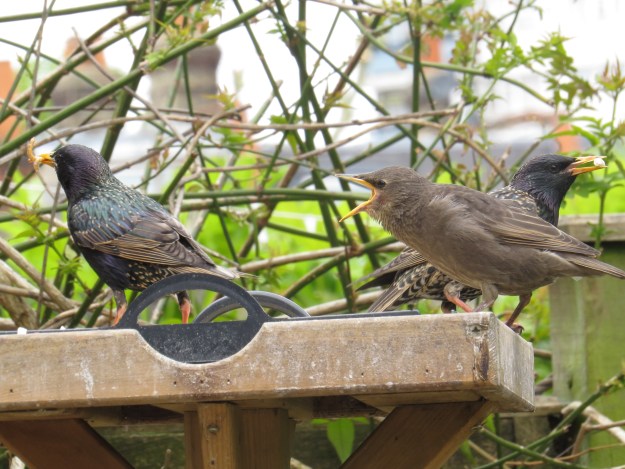
If you are lucky enough to see a baby starling at this time of the year, you might notice that it has some juvenile, dull-brown plumage, and some of the darker, more iridescent adult plumage.

Starling with full adult plumage

One type of bird that has a particularly tough time of it during the moult is the duck. Ducks, geese and swans lose all their feathers at the same time, which means that they can’t fly but have to stick to the safety of the water. To reduce the vulnerability of the more brightly-coloured drakes, they lose their brightest feathers first, which can lead to a variation on our main question: where have all the male ducks gone? The rather dowdier- looking drakes are said to be in their ‘eclipse plumage’ and this, my friends, is why identifying duck species at a wildfowl reserve is something of a challenge in the summer months. Female ducks, who may still have ducklings to care for, often lose their feathers later. One species, the shelduck, actually makes a ‘moult migration’, leaving their breeding grounds all over Europe to descend in vast numbers on the German Waddensea coast. Hundreds of thousands of shelduck arrive in July, and will leave to migrate to their wintering grounds once the process is complete. Although most European shelducks head to Germany, some spend the moulting period much closer to home, in Bridgewater Bay, Somerset.

Shelduck in January looking very pristine!

And so, although our gardens might be empty of birds, it’s a relief to know that they haven’t deserted us because they’re fed up with the quality of the food that we provide, or the way that we always seem to be at home these days. They are going through a perfectly natural process and, believe me, when the weather takes a turn for the worse they’ll be back, en masse, looking for mealworms. We just need to turn our attention to the other, smaller, less obvious critters in our gardens: keep an eye open now for queen bumblebees of many species, fattening themselves up prior to hibernation. And of course, the slow reddening of the berries, and the ripening of the blackberries. It looks as if it might be a bumper year!

Two siskins and a chaffinch in the garden in December 2017


Scene in May

Wednesday Weed – Greater and Common Knapweed

Greater knapweed (Centaurea scabiosa)

Dear Readers, what very fine plants knapweeds are! Greater knapweed is the rarer of the two but it grows in abundance in my newly-discovered ‘meadow’ next to Muswell Hill Playing Fields. It looks almost too exotic to be a native plant, but here it is. A member of the Asteraceae or daisy family, it is closely related to the cornflower, as its flowers suggest, and it is most often seen on chalk grassland, where it is a favourite with bees and butterflies.

Peacock (Aglais io)

Common knapweed (Centaurea nigra) is a much more frequent sight, and there were banks of it growing on Hampstead Heath last week. It has smaller, more thistle-like flowers, and a wide variety of popular names: Roy Vickery’s folk flora mentions chimney sweep in Somerset, drumsticks in Somerset and Nottinghamshire, hurt-sickle in Worcestershire and black soap in Devon and Gloucestershire, among a host of others. Some of the names refer to the strange, medieval-mace shaped buds – I can just imagine a mouse in armour walloping someone with a seed head too. I’m sure there must be a children’s book in there somewhere.

Common knapweed (Centaurea nigra)

Common knapweed is also known as ‘bachelor’s buttons’, as, it seems, are about fifty percent of our native flowers. However, this plant was actually used for a kind of love-divination. Young women would pull out the existing petals, and then put the flower into their bodice. When the as-yet unopened florets began to appear, this would mean that the lover was near. John Clare had a poem about the practice:

They pull the little blossom threads

From out the knapweeds button heads

And put the husk wi many a smile

In their white bosoms for awhile

Who if they guess aright the swain

That loves sweet fancys trys to gain

Tis said that ere its lain an hour

Twill blossom wi a second flower

And from her white breasts handkerchief

Bloom as they had ne’er lost a leaf.

In Guernsey, common knapweed is known as herbe de flon. Vickery points out that flon has two different meanings: it can mean a boil on a human, or a disease of cows that affects the udder after calving. A handful of knapweed is boiled for half an hour, and then used to bathe the affected part. However, knapweed seems to have been used for a variety of human ailments, from sore throats and bruises to ruptures and wounds. In Wales, a combination of knapweed, field scabious and birthwort was used as a cure for the bite of the UK”s only poisonous snake, the adder. Like all the plants in the Centaurea genus (including cornflower), it was named for the half-man half-horse centaur Chiron, who is said to have healed a wound on his hoof with knapweed. The flowers were also eaten with pepper to stimulate appetite.

Knapweed doesn’t lose its value for wildlife once the flowers are gone – the seeds, like those of most thistles, are eaten by finches. Furthermore, the plant is the favoured food of the lime speck pug moth (Eupithecia centaureata), a splendid creature.

Photo One byBy ©entomartIn case of publication or commercial use, Entomart wishes then to be warned (http://www.entomart.be/contact.html), but this without obligation. Thank you., Attribution, https://commons.wikimedia.org/w/index.php?curid=290556

Lime speck pug moth (Photo One)

The caterpillars are rather intriguing as well.

PhotoBy This image is created by user jacques boon at waarneming.nl, a source of nature observations in the Netherlands. - This image is uploaded as image number 3923249 at waarneming.nl, a source of nature observations in the Netherlands.This tag does not indicate the copyright status of the attached work. A normal copyright tag is still required. See Commons:Licensing for more information., CC BY 3.0, https://commons.wikimedia.org/w/index.php?curid=21350936Two by

Lime speck pug moth caterpillar (Photo Two)

I can find little information about the eating of knapweed by humans (except as the aforementioned appetite stimulant) but several people mention using the flowers to brighten up a salad, and I was wondering how else you could use the flowers to prettify the dining table.  I seem to remember making an ice bowl when I was younger as a vessel for some ice cream – you put water in a bowl, put a slightly smaller bowl inside, poke some flowers into the gap, and stick the whole lot in the freezer. The result is very pretty, if messy and ephemeral. Sigh. I sometimes wonder what used to possess me. I once made a five-flavoured jelly with diagonal stripes by setting each layer in a huge glass dish propped up at an angle.

The 1980s have got a lot to answer for.

Photo Three fromhttps://www.pinterest.co.uk/pin/314618723938721729/

An ice bowl. You’re welcome (Photo Three)

Both common and greater knapweed have caused problems when they’ve been taken elsewhere – they are closely related to thistles, with all the free-seeding, deep-rooted habits of their pricklier kin. I note that in the US it’s considered a Noxious Weed in several states, with spotted knapweed (Centaurea stoebe) being the June 2017 Weed of the Month for King County in Washington State. This plant is not either of ‘our’ knapweeds, but it is certainly a vigorous little chap, as the photos on the website show. I rather like the idea of a ‘weed of the month’, though the website does rather concentrate on digging up, blitzing with herbicides and if all else fails, taking a flamethrower to the ‘enemy’, rather than the somewhat gentler appreciation of the Wednesday Weed. Still, it takes all sorts. I just think of all the creatures enjoying the knapweed, and wonder where they will go if we keep destroying things.

And finally, a poem ( a second poem if you count the John Clare earlier). This begs to be read out loud, I think. There is such poetry in the names of plants (and I’m sure a whole epic could be made from the names of moths). If you’d like to hear this read, there is a link here.

Love’s Nosegay – A Poem by Michael Shepherd

Celandine, saxifrage,
buttercup, needle whin,
tormentil, vetchling,
agrimony, cinquefoil,
nipplewort, hawkbit,
ragwort, groundsel,
biting stonecrop, yellow bedstraw,
crosswort, comfrey,
bog asphodel,
tansy, sneezewort,
crowfoot, scurvy grass,
mouse-eared chickweed,
stitchwort, goutweed,
water dropwort, cuckoopint,
bryony, goosegrass,
ramsons, mayweed,
pennywort, wintergreen,
grass of parnassus, burdock,
figwort, lady’s mantle,
heartsease, cinquefoil,
scabious, loosestrife,
plume thistle, knapweed,
bugle, fumitory,
ragged robin, saintfoil,
dove’s- foot crane’s-bill,
lousewort, rattle,
corn cockle, willow herb,
cross-leaved pink heath,
blue bottle, vetch,
milkwort, harebell,
wild succory, speedwell,
viper’s bugloss, alkanet…

there’s poetry in wildflowers
and rightly so.

Photo Credits

Photo One By ©entomartIn case of publication or commercial use, Entomart wishes then to be warned (http://www.entomart.be/contact.html), but this without obligation. Thank you., Attribution, https://commons.wikimedia.org/w/index.php?curid=290556

Photo By by user jacques boon at waarneming.nl, a source of nature observations in the Netherlands. – This image is uploaded as image number 3923249 at waarneming.nl, a source of nature observations in the Netherlands.This tag does not indicate the copyright status of the attached work. A normal copyright tag is still required. See Commons:Licensing for more information., CC BY 3.0, https://commons.wikimedia.org/w/index.php?curid=21350936

Photo Three from https://www.pinterest.co.uk/pin/314618723938721729/

The Sunday Quiz – Daisies!-The Answers

Thick-legged flower beetle on common ragwort (Senecio jacobaea)

Dear Readers, I have a feeling that I might have pitched this quiz just about right – what do you think? The winners this week were Fran and Bobby Freelove, with a perfect score of 15/15, closely followed by Anne with 13/15, Mike with 11/15 and Andrea with 9/15. Many thanks to everybody who had a go, and do let me know how you got on if you didn’t comment. Now, I need to get my thinking cap on for next week 🙂

Daisies

1)c) Feverfew (Tanacetum parthenium)

2).g) Groundsel (Senecio vulgaris)

3).o) Canadian fleabane (Conyza canadensis)

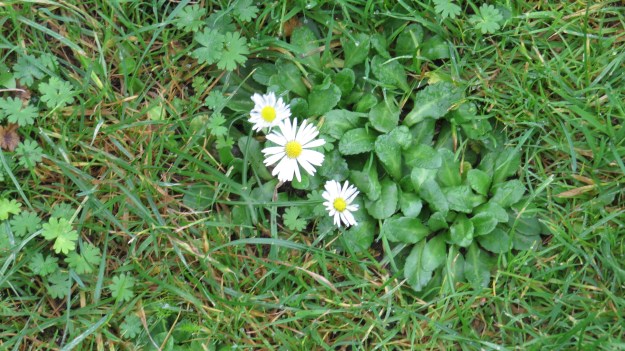
4).m) Daisy (Bellis perennis)

5).h) Lesser burdock (Arctium minus)

6).l) Chicory (Cichorium intybus)

7).i) Creeping thistle (Cirsium arvense)

8)k) Common knapweed (Centaurea nigra)

9)e) Fox-and-cubs (Pilosella aurantiaca)

10)j) Spear thistle (Cirsium vulgare)

11)f) Pineappleweed (Matricaria discoidea)

12).n) Mexican fleabane (Erigeron karvinskianus)

13).b) Mugwort (Artemisia vulgaris)

14).a) Michaelmas daisy (Aster x salignus)

15).d) Yarrow (Achillea millefolium)