Shaking Off the Sunday Blues

Dear Readers, Sunday is the hardest day of the week for me. For years, it was the day when I would give Mum and Dad a call to see how they were doing and to get all the gossip. After Mum had died, it was the day when I would ring the nursing home, to see how Dad was getting on and to have a little chat if he was up for it. He often was: one of the staff nurses told me that Dad was her Personal Assistant, and would often answer the phone if they couldn’t get to it quickly enough.

‘She’s not here!’ he’d say, and put the phone down. Just as well they had a way of retrieving phone numbers so that they could return the call.

But now, of course, Sundays are all my own. No one to check up on, no one to call. Admittedly I don’t have the worry, but I think the emptiness is much worse. And so, I turn to nature as usual, to see what’s going on outside.

The hemp agrimony around the pond is just coming into bloom. The bumblebees could care less, but the honeybees love it, and so do the hoverflies.

Honeybee on hemp agrimony, with hoverfly waiting to land above it.

The hemp agrimony is a deeply scruffy plant. While in tight, pink bud it looks almost respectable, but once the flowers open it looks distinctly blousey and uncoordinated. Still, for a few weeks every year it attracts every hopeful little pollinator, and that’s good enough for me.

Rather neater looking is the meadowsweet, with its creamy-white, sweet-smelling flowers. The hoverflies love this, too.

But my mood still hasn’t shifted enough, and off we go to the cemetery for a walk. St Pancras and Islington Cemetery is only open to the public from 10 a.m. to 3 p.m. at the weekend, though mourners and those tending a grave can also visit during the week. It isn’t until I see these lovely fox-and-cubs orange daisies alongside the yellow nipplewort that I start to cheer up.

Then, a comma butterfly positively poses, and kindly waits for me to take a photo.

I munch on the first ripe blackberry that I’ve seen this year – it’s sour as anything, and obviously needs a bit more time baking in the sun, but it does the job.

The spear thistle flowers are starting to erupt into fluffy seedheads.

Down by the stream, there are some beautiful but unwanted guests – a clump of Himalayan Balsam, a most invasive plant which can clog entire waterways. I think I shall have to mention it to the cemetery authorities, but then they haven’t been too bothered about the Japanese Knotweed which they also have. It is so pretty, and so beloved by pollinators, that it seems something of a shame.

There is a lot of goat’s rue around this year, in both white and lilac. It’s funny how ‘weeds’ go from being unusual to everywhere in the space of a few years. I was delighted when I first saw this plant on Muswell Hill Playing Fields in 2015, and now I’m tripping over the stuff.

Goats rue and spear thistle

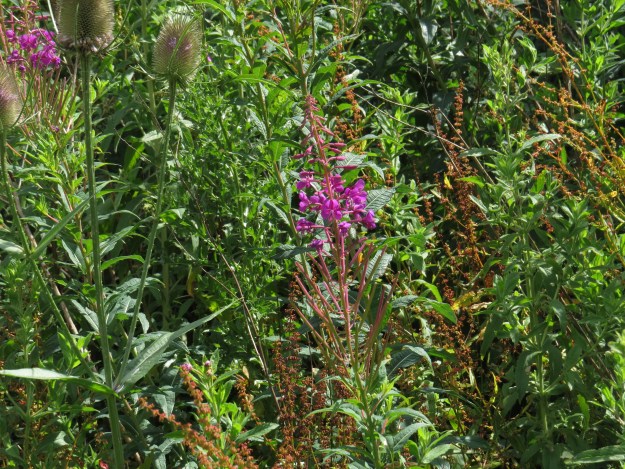
There are fine stands of teasel and rosebay willowherb too.

We wander up the hill so that I can have a look at the Egyptian cat, one of the most distinctive grave markers in the cemetery.

And then we pass the statue of this fine Scotsman, with a bunch of fresh flowers in his hand.

And a speckled wood butterfly is waiting as we head back out into the sunshine.

But as I get home, the things that I’m trying to run away from are still there. I go upstairs to start writing this blog, and as I gaze out of the window trying to think how to begin, my eye is caught by the sheer volume of activity outside on the buddleia.

Some of those little specks of life are bees, but a lot of them are flying ants, taking advantage of this still, warm day to leave their nests and found new colonies. The females with their swollen abdomens and the smaller males have wings, and fly off together.

Male

Queen with wings

Once the queen has been mated, she bites off her own wings and tries to find a space underground to start laying her eggs. If she is successful, she will never see the light again, but will have thousands of children. However, many birds, including sparrows, love eating the ants, and only a tiny proportion of those who emerge will found new colonies.

Queen without wings

And the sight of all these insects reminds me, again, of my childhood. When we lived in our house in Stratford, East London, the flying ants would take on the quality of a Biblical plague, invading the houses in their hundreds. I remember becoming almost hysterical on one occasion, but Mum smartly calmed me down.

‘They’re only ants’, she said. ‘They’ll be gone tomorrow’.

And so they were, and all that was left were their wings, like tiny shards of broken glass.

The Sunday Quiz – Daisies!

Thick-legged flower beetle on ????

Dear Readers, the Asteraceae or daisy family is surprisingly diverse, and is one of the most important flower families for all those little unsung pollinator heroes, such as hoverflies and beetles. So, for this week’s quiz I wanted to see how easy they were to identify when we gathered a bunch of them together. I have avoided some of the most difficult flowers – when I was doing my biology degree at Birkbeck, we didn’t have to identify ‘yellow compositae’ (all those hawksbeards and hawkbits and hawkweeds) because they were too confusing, and because they often hybridised. Maybe when I retire I’ll make them a priority.

Personally, I have always been fond of daisies of all kinds – there is a daisy in flower pretty much every day of the year, and the early dandelions are a vital source of pollen for many insects that are emerging in the spring. Plus, I have a lovely friend called Daisy, and the song ‘Daisy, Daisy’ was a family favourite – Mum always sung it to me when I was sick as a child with a ‘bilious attack’. Who has ‘bilious attacks’ these days? Like ‘nerves’ and ‘hardening of the arteries’ such diseases seem to have been re-badged.

Oops, this was going to be a cheerful post, but I seem to have gotten waylaid. The song ‘Daisy, Daisy’ was about riding on a tandem bicycle, something that Mum and Dad did when they were young. They explored all over Essex on their ‘bicycle made for two’. I wonder whether the tandem will make a comeback?

So, here are fifteen ‘daisies’ for you to identify. Normal rules apply, i.e. please get your answers in by 5 p.m. UK time on Monday if you want to be marked, and if you don’t want to be influenced by speedy responders, write your answers down before you pop them in the comments. Have fun!

Daisies

Which members of the daisy family are these? Choose from the list below. So, if you think plant 1 is Michaelmas daisy, your answer is 1)a)

a) Michaelmas daisy (Aster x salignus)

b) Mugwort (Artemisia vulgaris)

c) Feverfew (Tanacetum parthenium)

d) Yarrow (Achillea millefolium)

e) Fox-and-cubs (Pilosella aurantiaca)

f) Pineappleweed (Matricaria discoidea)

g) Groundsel (Senecio vulgaris)

h) Lesser burdock (Arctium minus)

i) Creeping thistle (Cirsium arvense)

j) Spear thistle (Cirsium vulgare)

k) Common knapweed (Centaurea nigra)

l) Chicory (Cichorium intybus)

m) Daisy (Bellis perennis)

n) Mexican fleabane (Erigeron karvinskianus)

o) Canadian fleabane (Conyza canadensis)

1)

2).

3).

4).

5).

6).

7).

8)

9)

10)

11)

12).


13).

14).

15).


Insects of Muswell Hill Playing Fields

Common carder bee (Bombus pascuorum)

Dear Readers, today I made a return visit to the amazing array of wildflowers growing alongside Muswell Hill Playing Field. As the year moves on, the cast of insect characters changes, and this summer I’ve really noticed the way that new players appear on the scene as others head back to the dressing room. Common carder bees now outnumber the other bumbles : these little ginger bees make their nests out of moss and dry grass, which they ‘comb’ together using special structures on their back legs. They are very adept at ‘buzz-pollinating’, and you can hear them vibrating away on the last remaining bittersweet flowers in my impromptu hedge. The one in the photo was a fairly large individual so she could well be a new queen – common carders have tiny nests of just 60-150 workers, and may have two generations per year.

Small tortoiseshell (Aglais urtica)

The creeping thistle is very popular with butterflies, such as this small tortoiseshell. I was struck by how pale the vertical bands on the forewing were – usually the one closest to the wingtip is white, but the other two are sunshine yellow. There is a website called British Butterfly Aberrations, so I’ve sent off some photos. Let’s see what they say.

And how about this beauty? Adult peacock butterflies emerge in July, and can live for a whole year, hibernating over the winter. This one looks new-minted. I love the way that the ‘eyes’ look as if they have been blended with pastels, with the white dots even  making them look moist. There are eye-spots on the lower wings too, but this butterfly was far too busy feeding on nectar from the greater knapweed to show them off. Apparently peacocks can also produce a hissing noise by rubbing their wings together if they are particularly irate.

Peacock (Aglais io)

And back to the bees. This magnificent red-tailed bee was feasting on the common mallow – the queens are completely black and red (like the first photo), but the males have a bit of yellow ‘fur’ on the face and thorax, as in the second photo. These are very fine bees, with colonies that live underground and can contain up to 600 individuals. Alas, by August the colonies are in decline, though the big queens (described in my bee book as ‘rectangular’) can be on the wing until October, before retiring to hibernate.

Red-tailed bee (Bombus lapidarius)

What is always interesting to me is the number of small, unobtrusive insects that the yellow ‘daisies’ (in this case I am hazarding a guess at smooth hawksbeard(Crepis capillaris)) always seem to attract. There is a fine mixture of beetles, tiny flies, small wasps and all kinds of miniature invertebrates rolling about in the pollen and squirming between the petals.

Some marmalade hoverflies

This is such a singular spot for wild plants and their insect attendants that I find myself drawn back every week. I suspect that when the thistle heads mature, it will be a good spot for finches as well. And the surprises weren’t over yet.

Small skipper (female) (Thymelicus sylvestris)

Small skippers (Thymelicus sylvestris) are little golden-brown harbingers of summer – adults emerge from June until August, mate, and lay their eggs on grasses such as Yorkshire fog or creeping soft-grass. This is a creature of rough grassland, and you will be very lucky to see it in your garden unless you have untrimmed road verges or uncut fields nearby. Incidentally, the male small skipper has a black line on each forewing, which is apparently known as the ‘sex brand’. I loved the fluffy white edges to this butterfly’s wings, and the way that it buzzed about: at one point it met up with another small skipper and the pair circled one another in a busy spiral until ‘our’ butterfly went back to feeding.

Small skipper on ragweed

This time of year is also a reminder that, for many insects, the summer is already over. This male meadow brown (Maniola jurtina) already looks faded and bleached out, like an old Kodak photo left in the sun. Still, he was enjoying the yarrow, and hopefully he has already passed on his genes to a female who has dropped her eggs in the long grass and gone on her way rejoicing. Maybe there are some hairy green caterpillars who emerge at night to feed on the long grass.

Whatever the story, I wish him sunny days.

And as if on cue, here is a female meadow brown, getting stuck into the spear thistle.

What an extraordinary resource this little bit of rough ground is! It just makes me wonder what it could be like if the whole of the edge of the cemetery was this varied and insect-friendly. Nowhere close to home feels as much like an Austrian Alpine meadow, and if it hadn’t been for the lockdown I probably wouldn’t have found it. There is so much to be said for exploring your home territory, however ‘familiar’ it initially seems. I have found, during this few months, that there is always something extraordinary to see.


Not Austria Day Fourteen – The People Who Came Before

Earthwork in Highgate Wood

Dear Readers, it’s easy to forget that the ancient woodlands are just that – ancient. In Austria, it’s possible to see the remains of fenced enclosures where pastoralists kept their sheep as far back as 4500 BC, and in Coldfall Wood and Highgate Wood there are the remains of earthworks, such as the ones in the photo above. While these ditches and mounds undoubtedly existed in the Medieval period, and were used to prevent the domestic animals belonging to Commoners from straying into the wood, they may also have been built on top of prehistoric boundary markers. Humans are very keen on taking what already exists, and repurposing it; we have been recycling for millenia. It’s only in the last hundred years that we’ve started to be so lackadaisical about the things that we own; throwaway culture is a very recent phenomenon, and even now it isn’t universal. When I was in Cameroon I was impressed by the way that cars that we would have given up as write-offs were repaired and regenerated, though I doubt that many of them would have passed their MOT.

Whenever I walk through ancient woodland like Highgate or Coldfall wood, I always half expect to see a deer silently lift its head, or hear the rustle of wild boar. Sadly, both woods are far too urban and well-used for anything more exciting than a squirrel to put in an appearance, though occasionally I glimpse a German Shepherd trotting past and remember that there would once have been wolves here. The whole area was once part of the Bishop of London’s estate, and would have been used for hunting. It is largely made up of hornbeam with oak ‘standards’ – the hornbeams would have been cut back for firewood, while the oaks would have been allowed to grow. This makes for some strangely contorted hornbeams, who were maybe cut a few times in their early lives before the practice was discontinued, and they were allowed to grow to maturity. In Medieval times the wood have been much more open, and much more diverse, with a varied understorey of different plants. Today, such woods always remind me of an underwater world. I feel like a little fish swimming through stands of kelp.

If I was on my usual holiday, today would have been the day for a quick walk, and then some packing up. We often walked down to Sölden through a very different wood, made up of Arolla pine trees, but there was something of the same sense of an enclosed world. The flora was very different, but there was something very comforting about being so contained, by the forest and the steep sides of the canyon on one side, and the river rushing down hill on the other.

Small Yellow Foxglove (Digitalis lutea)

Houseleek

And so, whilst on a normal year I would be preparing to come home, this year I am already home. So much of being on holiday seems to be about a state of mind, a willingness to let go of day to day worries and to be curious and open. I have found a lot of pleasure in exploring my local habitat with a holiday state-of-mind. Many of the things that I love about Obergurgl, from Hugo Cocktails to the pleasure of taking a break and reading a book are still available here in East Finchley. Do I miss the mountains? Of course. Do I hope to go to Austria next year? Yes please! Am I sorry that I took two weeks off, even though I had to stay put? Not a bit of it.  It’s been a lovely few weeks, and I’ve enjoyed having the time to let the emotions of this tumultuous year catch up with me a bit. I hope to jump back into work refreshed on Monday, and to have taken myself just a little bit further along the path of bereavement. But just to finish, here are a few of my favourite photos from the last few years in Obergurgl. I hope you enjoy them!

The Smugglers’ statue on the Timmelsjoch Road

Melancholy thistle with fritillaries and rose chafer beetle

Swallowtail butterfly on white clover

Alpine ‘blue’ cow

The view towards Hangerer

The Rotmoos and Gaisberg valleys

Alpenrose (Rhododendron ferrugineum)

Obergurgl

Not Austria Day Thirteen – Lakes and Mountains

View of London from Kenwood on Hampstead Heath

Dear Readers, there has been something noticeable missing from my attempt to replicate my annual holiday in Austria here in London under lockdown.

‘Why, Bugwoman’, I hear you ask, ‘Has there not been more walking uphill?’

And in order to correct this, today I headed off to Hampstead Heath to see if I could conjure up some vistas. The one above shows the City of London in all its splendour. You can see the Gherkin, the Walkie-Talkie, and a small forest of cranes. Admittedly it’s not quite the same as the snow-capped peaks of the Dolomites as seen from the top of the Hochgurgl lift, but Dear Readers, it’s home. This is probably the longest period of time in my adult life that I have not ventured into central London, and I miss it sorely, but am still reluctant to risk public transport while the number of new infections is still so high. Hey ho. Hopefully things will improve at some point.

Hampstead is a hot spot for dog watching – there was a Bernese Mountain Dog and a bear-sized chocolate Newfoundland – but what I loved was the smell of linden blossom from a nearby lime tree. It always takes me back to the magnificent tree in Mum and Dad’s village, and the brief moments I would spend underneath it, inhaling the scent, as I took a few moments between errands. I think it might turn out to be my ‘signature scent’.

Linden blossom

And then, to balance out the mountain, we headed off to the ‘Lake’ – the model boating lake to be exact. I wasn’t expecting to see this, though!

This fine model ferry was chugging along, and we got talking to its creator, John. The ship is a scale model of the Vecta, which was a Red Funnel ferry sailing from Southampton to Cowes in the Isle of Wight during the 1950’s. John grew up in Southampton, and used to take the ferry as a child, so he got the plans from Thorneycroft (the boat builders) and created this wonderful ship, complete with passengers.

What a lovely man! He only lives around the corner from the Heath, and so I imagine he pops the Vesta under his arm and brings her down to the lake for an airing every so often. I do so love an enthusiast.

As we watched, swifts were circling around and diving down to the surface of the water to snatch a drink. There was a great crested grebe or two on the other side of the lake too.

Great crested grebe

There has been a lot of work on the lakes at Hampstead recently to reduce the risk of flooding, but one fortunate side-effect has been extensive planting at the edges of this formally rather bare place. I am in love with wild carrot, and there was plenty of it coming into flower. I love the way that the early blooms look like little nests.

Carrot flower just opening

And then, when they unfurl, they often have a single red flower in the centre – it’s believed that this mimics the appearance of a pollinator, encouraging other hoverflies and bees to pop down for something to eat.

We wandered around the back of some of the smaller ponds – there’s a lot in flower at the moment, and the lesser knapweed is looking particularly splendid.

Lesser knapweed

Plus I love the drifts of purple loosestrife and lesser knapweed and various hawkbits. As you know from previous posts, I do love a good drift.

And it is going to be a sensational year for acorns. If I was a jay I would be getting very excited.

More than anything, today felt like the smallest of steps back towards some kind of normality – the cafe was open, the toilets were open, and people seemed a tiny bit more relaxed in themselves, though the vast majority of folk were still being scrupulous about social distancing. Of course, it’s a weekday, and I have no doubt that on a sunny Sunday the place will be heaving. But today, it was nice to just sit on a bench and watch an emperor dragonfly hawking for insects. We were briefly accosted by a small, fluffy magpie, who gave us a hopeful look though sadly we were all out of sandwich.

And then, as the clouds were gathering, we headed home, trying to keep a few steps ahead of the rain, just as we do in Obergurgl. We don’t always manage it, but usually we stay dry. And if you think there’s a metaphor in there, you’re probably right.

Not Austria Day Twelve – Wednesday Weed – Five Favourites

Alpenrose (Rhododendron ferrugineum)

Dear Readers, I know that you are not supposed to have favourites, but I must admit that there are five Alpine flowers that always lift my spirits when I see them on my annual ‘pilgrimage’ to Obergurgl. They are plants that I don’t see at home, and so, in an age when there is so much homogenisation, they remind me that some flora are so superbly adapted to their surroundings, so in harmony with the soil and the climate, that they cannot be moved anywhere else. I would no more think of trying to grow these plants at home than an Austrian would think of importing fish and chips.

One of these plants is the alpenrose, which is not a rose at all but a rhododendron, albeit a well-behaved miniature one. It grows in acid soils just above the tree line, and I can always tell what kind of winter Obergurgl has had by the condition of the plant. Some years, after a mild-ish winter, the flowering is almost finished when I arrive in early July. In other years, the alpenrose is still in bud. It has a close relative, the hairy alpenrose (Rhododendron hirsutum) that grows higher up and thrives on limestone.

Now, I know that the alpenrose has a special place in the hearts of the people of the Tyrol, but what I didn’t know was that the song ‘Alpenrose’, by Swiss singer Polo Hofer, was voted the ‘most popular Swiss song of all time’ in 2006. You can watch it at the link below, and I recommend you hang on until at least 38 seconds in when Mr Hofer does his modern dance interpretation of the song. See what you think.

https://www.youtube.com/watch?v=HHPkyiOUE9c

Arnica (Arnica montana)

The Austrians have a fine, long tradition of herbalism, particularly in mountain regions where getting to a doctor would be expensive and difficult. Much as in the UK Comfrey was used as a poultice for all manner of bruises and sprains, in the Austrian Alps this plant was extensively used for the same complaints in both animals and humans. Arnica likes very poor, acid soils, and it is not common anywhere – I know of one or two spots around Obergurgl where it can be found, but it is grown commercially in France and Romania to make the ointments that you can buy in the chemist. The plant is also (like the alpenrose) moderately toxic.

One of the places that I’ve found arnica is also a reliable spot for marmots. You can often see these hare-sized rodents sunning themselves outside their burrows.

Marmot

You can often also hear them telling the local Haflinger horses off. Not that the horses pay a lot of attention.

Now, my next plant is definitely not the prettiest thing that you can find in the Alps, though from a distance it does look like a small pool of concentrated sunlight. Close up, unfortunately, it is generally covered in flies. It is a plant of the bleakest, stoniest slopes. And the fact that it’s Latin name means ‘the most spiny’ just about sums it up. Whenever I see spiniest thistle, I know that I’m in the mountains. I notice it most when I start heading towards the scree slopes of the side valleys at Obergurgl. I reckon that once I’ve seen a spiniest thistle, I’m at least 45 minutes walk from a Almdudler and an apfel strudel.

Spiniest Thistle (Cirsium spinosissimum)

The Rotmoos valley, home of many spiniest thistles

And of course, it wouldn’t be the mountains if I didn’t mention a gentian. There is nothing in nature that I’ve ever seen that is a truer blue. There are various species of gentian, but this one, the spring gentian, makes me stop in my tracks every year. It puts me in mind of the tenacity that is needed to survive harsh conditions, and how these plants have evolved to not just live through the snow and wind, but to thrive, turning their faces to the sun the instant that it appears. If there is one single reason why I love the Alps, the gentians are it.

Spring gentian (Gentiana verna)

But when I come to think about it, there is one plant that I love even more. It is found for just a few weeks when the snow starts to melt. Some years, when the spring is late, I find it in abundance in the valleys that are still blocked with snow drift. Where the edges of the snow are starting to melt, they reveal the sodden, yellow grass underneath, but these flowers are just opening. These are Alpine snowbells (Soldanella alpina), and with their fringed cups they remind me of the hats that elves are often pictured wearing, though their Latin name actually means ‘little coin’. If the winter has been mild, and the snow is already gone, I won’t see these flowers  – they will have already bloomed and died back. But on a late year, they will be found in some of the side valleys, their heads nodding in the freezing breeze, waiting for pollination by some intrepid passing bee. They make the climb worth the effort, and they relieve the anxiety that crossing a snowfield always causes me. There are tiny, low-growing rewards everywhere in the Alps, scattered across the scree like a handful of precious stones.

Alpine snowbells (Soldanella alpina)

Do you have a favourite flower? Now I’ve started thinking about it, I could list at least a dozen UK plants that I love, and I’m sure it would always be changing. Plants can be so charged with memories of places and people. Some people love the flowers of their childhood, some love the plants of their homeland, and some see something in a plant that seems to capture a value that they hold, or a quality that they admire. Let me know! I love the connections that we make with the natural world, and with one another, through plants.

Not Austria Day Eleven – The Sunday (Alpine) Quiz – The Answers

Photo One by By Original author and uploader was MurrayBHenson at en.wikipedia - Transferred from en.wikipedia, Public Domain, https://commons.wikimedia.org/w/index.php?curid=3708573

Dear Readers, this was obviously a busy week for everyone – no one had the time to attempt the whole quiz, but hats off to Anne, who managed to get all ten of the Alpine birds correct! Next week I shall go for something a little more user friendly. Do have a listen to the song of the wallcreeper though, it’s extraordinary….

Dear Readers, here are the answers to Sunday’s quiz.

Part One – Name the Bird

Photo One by By Lefteris Stavrakas - Βουνοσταχτάρα Alpine Swift Tachymarptis melba, CC BY-SA 2.0, https://commons.wikimedia.org/w/index.php?curid=66012392

1)f) Alpine swift (Apus melba)

Photo Two by By Jarkko Järvinen - Flickr, CC BY-SA 2.0, https://commons.wikimedia.org/w/index.php?curid=44848627

2)i) Golden eagle (Aquila chrysaetos)

Photo Three by By Shah Jahan - Own work, CC BY-SA 4.0, https://commons.wikimedia.org/w/index.php?curid=66045424

3)g) Lesser kestrel (Falco naumanni)

Photo Four by By Original author and uploader was MurrayBHenson at en.wikipedia - Transferred from en.wikipedia, Public Domain, https://commons.wikimedia.org/w/index.php?curid=3708573

4)j) Eurasian nutcracker (Nucifraga caryocatactes)

Photo Five by By I, Malene, CC BY 2.5, https://commons.wikimedia.org/w/index.php?curid=20612

5)b) Barn swallow (Hirundo rustica)

Photo Six by By Kookaburra 81 - Own work, CC BY-SA 4.0, https://commons.wikimedia.org/w/index.php?curid=59192174

6)c) Wallcreeper (Tichodroma muraria)

Photo Seven by By Paco Gómez from Castellón, Spain - Acentor alpino (Prunella collaris)-2, CC BY-SA 2.0, https://commons.wikimedia.org/w/index.php?curid=10653904

7)e) Alpine accentor (Prunella collaris)

Photo Eight By Andreas Trepte - Own work, CC BY-SA 2.5, https://commons.wikimedia.org/w/index.php?curid=8256392

8)h) White-winged snow finch (Montifringilla nivalis)

Photo Nine by Public Domain, https://commons.wikimedia.org/w/index.php?curid=276361

9)a) Snow bunting (Plectrophenax nivalis)

Photo Ten by By Cuculus_canorus_vogelartinfo_chris_romeiks_CHR0791.jpg: Vogelartinfoderivative work: Bogbumper (talk) - Cuculus_canorus_vogelartinfo_chris_romeiks_CHR0791.jpg, GFDL 1.2, https://commons.wikimedia.org/w/index.php?curid=16077960

10)d) Common Cuckoo (Cuculus canorus)

Part Two – Bird calls

I think I’d have recognised the cuckoo, the lesser kestrel and the barn swallow out of this lot, but the rest would have been really tricky. I think the snow ‘finch’ sounds pretty sparrow-y, and the Alpine swift sounds a bit swift-y, but I’d have been stumped by the wallcreeper’s haunting call if I hadn’t been lucky enough to hear it in real life. And don’t eagles always sound a bit feeble considering their size? I always expect them to roar.

i) Photo 2 – Golden eagle

ii) Photo 9 – Snow bunting

iii) Photo 10 – Common cuckoo

iv) Photo 1 – Alpine swift

v) Photo 6 – Wallcreeper

vi) Photo 5 – Barn swallow

vii) Photo 7 – Alpine accentor

viii) Photo 3 – Lesser kestrel

ix) Photo 8 – White-winged snow ‘finch’

x) Photo 10 – Eurasian nutcracker.

Credits

Photo One by By Lefteris Stavrakas – Βουνοσταχτάρα Alpine Swift Tachymarptis melba, CC BY-SA 2.0, https://commons.wikimedia.org/w/index.php?curid=66012392

Photo Two by By Jarkko Järvinen – Flickr, CC BY-SA 2.0, https://commons.wikimedia.org/w/index.php?curid=44848627

Photo Three by By Shah Jahan – Own work, CC BY-SA 4.0, https://commons.wikimedia.org/w/index.php?curid=66045424

Photo Four by By Original author and uploader was MurrayBHenson at en.wikipedia – Transferred from en.wikipedia, Public Domain, https://commons.wikimedia.org/w/index.php?curid=3708573

Photo Five by By I, Malene, CC BY 2.5, https://commons.wikimedia.org/w/index.php?curid=20612

Photo Six by By Kookaburra 81 – Own work, CC BY-SA 4.0, https://commons.wikimedia.org/w/index.php?curid=59192174

Photo Seven by By Paco Gómez from Castellón, Spain – Acentor alpino (Prunella collaris)-2, CC BY-SA 2.0, https://commons.wikimedia.org/w/index.php?curid=10653904

Photo Eight By Andreas Trepte – Own work, CC BY-SA 2.5, https://commons.wikimedia.org/w/index.php?curid=8256392

Photo Nine by Public Domain, https://commons.wikimedia.org/w/index.php?curid=276361

Photo Ten by By Cuculus_canorus_vogelartinfo_chris_romeiks_CHR0791.jpg: Vogelartinfoderivative work: Bogbumper (talk) – Cuculus_canorus_vogelartinfo_chris_romeiks_CHR0791.jpg, GFDL 1.2, https://commons.wikimedia.org/w/index.php?curid=16077960

Sound File i) by Stelian Bodnari, XC504827. Accessible at www.xeno-canto.org/504827.

Sound File ii) by Timo Janhonen, XC514050. Accessible at www.xeno-canto.org/514050.

Sound file iii) from Bodo Sonnenburg, XC572326. Accessible at www.xeno-canto.org/572326.

Sound file iv) by Jordi Calvet, XC544109. Accessible at www.xeno-canto.org/544109.

Sound file v) by Stanislas Wroza, XC569274. Accessible at www.xeno-canto.org/569274.

Sound file vi) by Alain Verneau, XC560258. Accessible at www.xeno-canto.org/560258.

Sound file vii) by Jarek Matusiak, XC531036. Accessible at www.xeno-canto.org/531036.

Sound file viii) by José Carlos Sires, XC388647. Accessible at www.xeno-canto.org/388647.

Sound file ix) by Stanislas Wroza, XC569246. Accessible at www.xeno-canto.org/569246.

Sound File x) by Vincent Palomares, XC545508. Accessible at www.xeno-canto.org/545508.

Not Austria Day Ten – A Return to Barnwood

Teasel

Dear Readers, one of the great pleasures of walking in Austria is finding a little patch of woodland as you come down from the higher, sunnier, more exposed slopes. I am lucky in living close to two small areas of ancient woodland , but there is a special place in my heart for one tiny patch of trees that was, until recently, a wilderness of brambles hidden away behind a fence. You might remember that back in November 2018 I paid a visit to Barnwood, a community forest garden just off Tarling Road in East Finchley. I had heard that there had been a lot of new planting, and that the site had been the scene of numerous community events since then, so I jumped at the chance for a visit when the opportunity presented itself last week. As the gate was unlocked, it was like stepping into another world. There have been new paths laid all around the site, a new hedge containing over a dozen wildlife-friendly shrubs has been planted, and the air was full of the buzzing of bees. The teasel has certainly set up home, and I have no doubt that in the autumn it will be covered in goldfinches.

There are a number of well-established fruit trees and shrubs, and there are plans to have foraging events for families, and maybe even a jam-making workshop at some point. There are some lovely old plums:

And the beech tree is full of nuts (either hazelnuts or cobnuts, depending on your view), though if it’s anything like the small saplings in my garden, the squirrels will be after them with great enthusiasm.

Cobnuts!

The volunteers at Barnwood have planted lots of berry bushes too, everything from exotic Goji berry to raspberries via loganberries and jostaberries. There’s a black mulberry  to honour London’s long association with the silk trade. This is especially welcome as these venerable trees are being grubbed up all over London to make room for luxury flat developments.

The oak tree is covered in acorns this year too, and I’m told that jays breed in the wood.

Look at all those acorns!

The site attracts a lot of insects: we saw a fresh-minted comma butterfly sunning itself on the brambles.

And a beautiful red-tailed  bumblebee (Bombus lapidarius) seemed especially drawn to the bristly oxtongue, evidence that the best plants for pollinators are not always the showiest.

I loved seeing the smaller flowers too: there was some cut-leaved geranium with its tiny cerise flowers, and the tomato-red faces of scarlet pimpernel.

Cut-leaved geranium (Geranium dissectum)

I also love finding a plant that I haven’t seen before, and this one went to prove that although I’ve learned a lot through researching the Wednesday Weed, I still have a long way to go.

I saw this poor plant, which had been blown over, and cheerfully declared that it was caper spurge. 

And then I had a look at the flowers, and was so taken aback that I actually picked it up because I couldn’t believe that there were yellow daisy flowers attached to what I was so convinced was a euphorbia. Hah! That’ll teach me. It’s actually a prickly lettuce (Latuca serriola) and I definitely feel a Wednesday Weed coming on.

Barnwood manages to squeeze an extraordinary variety of plants into a small space. There is a fabulous guelder rose which is absolutely covered in hips this year.

Guelder rose

There are some Indian bean trees (Catalpa bignoniodes) in full flower – the friend who was showing me round said that they reminded him of foxgloves, and I can see exactly what he means.

And among the interesting shrubs that are being grown there is a medlar (Mespilus germanica). This close relative of the hawthorn has been eaten since Roman times, but the fruit needs to be ‘bletted’, either by frost or by being left in storage until the flesh becomes as soft as apple sauce. Apparently this isn’t the same as letting the medlar rot, though those unfamilar with the process often think that this is what has happened. In fact, the sugars in the fruit act as a preservative. The medlars can then be used to make jelly or medlar ‘cheese’, which resembles lemon curd.

Medlar fruit

So, it was lovely to revisit Barnwood, and to hear about the different events that have taken place. Holocaust Memorial Day has been honoured both with the planting of spring bulbs and fruit trees. There was a petting zoo event, which has led to a fine crop of oats and other cereals. There has been a mindfulness and relaxation event, and the socially-distanced trustees meeting took place in the woodland circle in the middle of the site. A flower-meadow is planned, and all in all it feels as if Barnwood is becoming a fantastic resource for the community. I shall certainly be reporting back on how things are going in the future.

Leftover grains from the petting zoo.

You can read about Barnwood on their Facebook page here or on Twitter here.


Not Austria Day Nine – The Sunday (Alpine) Quiz

Photo One by By Original author and uploader was MurrayBHenson at en.wikipedia - Transferred from en.wikipedia, Public Domain, https://commons.wikimedia.org/w/index.php?curid=3708573

Dear Readers, although the Alps are a wonderful place for plants and invertebrates, other animals can be few and far between because the conditions are so harsh. So, this week I’m concentrating on birds that you might see during a walk in the mountains. And, to add an additional frisson, I’d like you to match the bird calls to the birds too (you all did much too well last week). So, here we go.

Part One – Name the Bird

All the birds pictured below can be found in the Alps for at least part of the year. Can you match the name to the photo? So, if you think bird 1 is a snow bunting, your answer is 1) a)

Hint: there are three little brown-ish birds here. Maybe the beak shape will help you out?

a) Snow bunting (Plectrophenax nivalis)

b) Barn swallow (Hirundo rustica)

c) Wallcreeper (Tichodroma muraria)

d) Common Cuckoo (Cuculus canorus)

e) Alpine accentor (Prunella collaris)

f) Alpine swift (Apus melba)

g) Lesser kestrel (Falco naumanni)

h) White-winged snow finch (Montifringilla nivalis) NB this bird is actually in the sparrow family, so is not really a finch. If that helps. NB 2 It might also help you with the bird calls 🙂

i) Golden eagle (Aquila chrysaetos)

j) Eurasian nutcracker (Nucifraga caryocatactes)

Photo One by By Lefteris Stavrakas - Βουνοσταχτάρα Alpine Swift Tachymarptis melba, CC BY-SA 2.0, https://commons.wikimedia.org/w/index.php?curid=66012392

1)

Photo Two by By Jarkko Järvinen - Flickr, CC BY-SA 2.0, https://commons.wikimedia.org/w/index.php?curid=44848627

2)

Photo Three by By Shah Jahan - Own work, CC BY-SA 4.0, https://commons.wikimedia.org/w/index.php?curid=66045424

3)

Photo Four by By Original author and uploader was MurrayBHenson at en.wikipedia - Transferred from en.wikipedia, Public Domain, https://commons.wikimedia.org/w/index.php?curid=3708573

4)

Photo Five by By I, Malene, CC BY 2.5, https://commons.wikimedia.org/w/index.php?curid=20612

5)

Photo Six by By Kookaburra 81 - Own work, CC BY-SA 4.0, https://commons.wikimedia.org/w/index.php?curid=59192174

6)

Photo Seven by By Paco Gómez from Castellón, Spain - Acentor alpino (Prunella collaris)-2, CC BY-SA 2.0, https://commons.wikimedia.org/w/index.php?curid=10653904

7)

Photo Eight By Andreas Trepte - Own work, CC BY-SA 2.5, https://commons.wikimedia.org/w/index.php?curid=8256392

8)

Photo Nine by Public Domain, https://commons.wikimedia.org/w/index.php?curid=276361

9)

Photo Ten by By Cuculus_canorus_vogelartinfo_chris_romeiks_CHR0791.jpg: Vogelartinfoderivative work: Bogbumper (talk) - Cuculus_canorus_vogelartinfo_chris_romeiks_CHR0791.jpg, GFDL 1.2, https://commons.wikimedia.org/w/index.php?curid=16077960

10)

Part Two – Bird calls

Now, I love you all but I think it was a wee bit too easy last week, so have a bash at this. If you manage to get three out of ten I think you’ll be doing well 🙂

So, if you think bird 1) is responsible for call i), your answer will be 1)i). That way even if you didn’t match the right species to the photos, you could still get a mark if you manage to match up the song.

Good luck people! I think this really is a stinker.

i)

ii)

iii)

iv)

v)

vi)

vii)

viii)

ix)

x)


Not Austria Day Eight – Going Out

View along the Gaisbergtal valley, Obergurgl

Dear Readers, at this time of year, I would normally be gearing up for some of the harder walks in Obergurgl (having run out of all the easier ones). The walk in the photo, for example, is a long, punishing walk, uphill all the way. Some years it’s difficult to find the path because of all the snow, and we’ve crossed icy snowfields while listening to the rush of the hidden river underneath. In the middle of the photo you can see a little hut – this was where the customs post was, so that people entering Austria from Italy could ( in theory) pay their customs taxes. It is well documented that sometimes entire herds of sheep would pass this point without being ‘noticed’, and I do wonder how many bottles of schnaps passed hands in order to enable this to happen. 

Splendid Italian Tyrolean sheep

These sheep can hear the rustle of a lunch pack from a kilometre away, and think nothing of sticking their heads under your arm to grab an apple or a cheese sandwich. They sometimes give birth up here too – you sometimes see the most delicate of lambs leaping from rock to rock.

But this year, I am finding that I have become extremely nervous about going anywhere new, even as the country is being urged to come out of lockdown, and I am wondering if anyone else is feeling the same. I have gone from intrepid traveller who went off to Borneo only a few months ago to someone who is feeling ill at ease at the prospect of a trip to Kentish Town this afternoon, just a few tube stops from East Finchley.

In some ways, this fear is perfectly reasonable – I have no confidence that Covid-19 is under anything like control. It will mean going on public transport, something that I’ve been avoiding. I haven’t technically been shielding but I do recognise that, at 60 years old and with a genetic propensity to developing deep vein thrombosis, I am at more risk than some other people. Since I travelled to Weymouth for Dad’s cremation, I haven’t been further than the High Street and our local woods. But in the absence of anything like sensible guidance, we in the UK  will all be having to make our own risk assessments over the next weeks and months. For me, there are dangers associated with staying in while my world gets smaller and smaller, just as there are risks in going out. I do not want my world to shrink to the point where I only really feel safe at home. I want to travel again and to explore my city once the dangers posed by Covid-19 have reduced to a manageable level (whenever that is). But I need to be able to make short journeys without having palpitations, and so, mask on and social-distancing radar in place, I shall do this little trip, and then later next week I’ll be doing some others.

My Mum became, to all intents and purposes, housebound for the last few years of her life. A trip to the doctor’s surgery became an event. Dad was no longer really capable of driving safely. And so, her world shrank and shrank. She became terrified of going outside. Once, we went to a local DIY store to buy tiles for the wet room that they were having installed (neither Mum nor Dad could stand up in the shower anymore, and it was too small for a seat). Mum had a full-blown panic attack, felt dizzy and breathless and had to sit in the little office with a cup of tea to calm down.

‘All the walls seemed to be coming in’, she said, when trying to explain how she felt.

Dad, meantime, announced that he liked sitting in his reclining chair and watching endless re-runs of ‘Last of the Summer Wine’ because it made him feel ‘safe’. If he had a doctor’s visit on the calendar he would worry about it for days, checking the date and making sure that transport was in place. I remember him sitting in his chair, tapping his fingers endlessly as if playing some Mozart piece. When he came home after an appointment he would tumble into the house like a rabbit disappearing into its warren – in fact he had more falls tripping over the step on the way in than in any other place in the house, such was his panic and his relief at returning.

And so, one of the first things that occurred to me when ‘shielding’ was announced that there was going to be an epidemic of something like agoraphobia when people were finally allowed to go out.

I am lucky – I am feeling trepidation, but I have no doubt that I will push through it, however uncomfortable I feel. This is not the same as the real panic and distress that my Mum and Dad felt. People who have been shielding for months and who are truly vulnerable to the virus may well need support if they feel that they want to start venturing out. We must not underestimate the effect that the pandemic has had, and will continue to have,  on people’s mental health. I feel as if our society is fragile, with divisions between those who have seen or experienced Covid-19 first hand, and those who still think that it’s ‘not worse than the flu’. Some people will bust out and go to the pub at the first opportunity that they get, and others will continue to shield, terrified of the implications if they get the virus, and sensing that the world is full of dangers. Plus, with 65,000 excess deaths in the UK alone, with jobs lost and businesses ruined, with hopes dashed and plans in tatters,  we are a nation of mourners, and we are raw and exposed and full of grief.

If ever there was a time for being gentle with one another, for being kind, this is it.