Bugwoman’s Annual Report Part Two

A wet August

Dear Readers, here is my belated report for August 2019 to January 2020. If all goes according to plan (and that’s a big ‘if’ at the moment) I will be on the other side of the world when this is published, gathering some new experiences to share with you all. But for today, let’s go back in time and celebrate the goings-on of last year. It started with a very wet and humid August, and on one morning I sat on my doorstep and watched the snails going about their business. I rather enjoyed just plonking down and taking the time to really breathe and notice. The time to do this was just about to get rather shorter, as I started work in September, but August was full of memories of coleus, and admiration of cardoons.

Autumnal red coleus

Cardoons abuzz with bees

September saw a trip to Walthamstow Wetlands, where the great crested grebes were already courting. It was a great spot for Wednesday Weeds as well, with tansy and bladder campion. And as I started work in the City, I found myself on a hunt for a green space, without much initial luck.

Courting great crested grebes at Walthamstow Wetlands

Tansy (Tanacetum vulgare)

Bladder Campion (Silene vulgaris)

The ‘garden’ on the site of St Martin Orgar church, with its artificial turf.

October saw my first ever ivy bees, in the grounds of the National Archive at Kew. I found a more promising green space in the Cleary Garden in the City, and remembered how it had been a favourite spot for Mum, too. It was in the Cleary Garden that I became enamoured of the magnificent swamp cypress, too. And, on a visit to see Dad in his nursing home, I heard about his escapades as ‘Captain Tom‘, steering a boat from Weymouth to Portland. Seeing Dad so happy and excited as he told me about the trip was one of my highlights of the year.

Ivy bee (Colletes hederae)

The memorial to Fred Cleary, who helped to found the Cleary Gardens

Swamp Cypress (Taxodium distichum)

Cones on the swamp cypress. What a wonderful tree.

Dad aka Captain Tom. One of my favourite humans

November saw a rumination on the things that Mum taught me, and all the things that I owe to her. It would have been her 84th birthday, and I am learning that as the time goes by the grief is not as all-consuming, but there are still tender spots and emotional bruises. I suspect there always will be, and in a way I’m glad. The measure of what someone meant to us is how much we miss them when they’re gone. Life continues, but is never the same again.

A cabbage with a demon trapped inside it?

I revisited the swamp cypress, and glory hallulujah, what an extraordinary sight it was.

Swamp cypress at the Cleary Garden in the City of London. My favourite tree.

There were Dutch elm disease-resistant elms planted in the heart of the City, and a lot of autumn beauty much closer to home in East Finchley.

New Horizon elms on Queen Victoria Street

Autumn in East Finchley

Autumn in East Finchley

December saw cranberries, kale, an intrepid squirrel and a visit to Dorchester to see Dad.

Cranberries (Vaccinium macrocarpon)

Curly kale (Brassica oleraceae)

Dad in his new hat, wearing his Christmas tie.

And then it was January. Work was crazy, with year end and an audit to contend with. Some of the load was taken off by the loan of a trail camera, which enabled me to see exactly what went on in the garden when I wasn’t there. I had a couple of trips to cemeteries, which always cheers me up. And it gave me a chance to ruminate on almonds, which was something that I’d never considered before. Finally, it was my sixtieth birthday, which gave me a chance to wax philosophical on all manner of things.

Night One

Night Two

Islington and St Pancras cemetery

East Finchley Cemetery

And here, for no particular reason, is a photo of the dog fox who visited every day for a few weeks back in September. He was the most confident animal, and one day I found him sitting on the wall as if he was waiting for me to turn up. He’d have gone into the house if I’d let him. He had no fear of anything, and this was his undoing, as a few weeks after this picture was taken he was run down by a car and killed. However, there are foxes around here who look a lot like him, and I would love to think that his offspring are still trotting about, although hopefully they have a little more road sense. He was much loved in the County Roads, and was as much part of the community as some of the people. Long may his genes continue.

Another handsome fox. Just because….


Wednesday Weed – Yellow Corydalis Revisited

Every Wednesday, I hope to find a new ‘weed’ to investigate. My only criterion will be that I will not have deliberately planted the subject of our inquiry. Who knows what we will find…..

Yellow Corydalis (Pseudofumaria lutea)

Yellow Corydalis (Pseudofumaria lutea)

Dear Readers, I will shortly be jetting off on an adventure for my sixtieth birthday which will involve travelling to a part of the world that I’ve never visited before. But, while I am away, I thought I would revisit some of the ‘weeds’ that grow in my street in East Finchley. The piece below made its debut in October 2014. What a lot has happened since then! This is still a favourite plant, and in spite of many, many sprayings of weedkiller it is still present on the wall in the picture (though the graffiti is gone). It is, like many ‘weeds’, originally an alpine plant, but has been known in the UK as a garden plant since 1596. Mortared walls are a very specific environment, and few native plants have learned to colonise a habitat with sparse soil, high pH and a lot of exposure. In fact, some of the plants that we now think of as native (such as ivy-leaved toadflax ) came originally from the rocky places of mainland Europe.

In London, it is now the twentieth most common alien plant, putting it just behind trailing bellflower and just ahead of horse chestnut. In ‘Alien Plants’, Clive Stace describes how the black, shiny seeds of yellow corydalis are covered with an ‘oil body’ which ants are fond of – they often carry the seeds into their nests for future sustenance, and the seeds germinate once the oil has been consumed, a very handy symbiotic relationship.

Stace also makes some interesting comments about the relative affluence of housing and the alien ‘weeds’ that pop up. When I lived in Islington I was forever peering into the basements of the attractive Georgian houses round about, and these were often a mass of yellow corydalis, pale-lilac trailing bellflower, and baby trees-of-heaven or sycamore, all pushing up uninvited. On the other hand, the house that I lived in when growing up in Stratford had no basement and no front garden (and indeed, no bathroom and an outside toilet), but was often infiltrated by groundsel and sow-thistle, which Mum and Nan would pull up as soon as they showed their innocent heads for fear of what the neighbours might say. You don’t have to go very far in London to see a completely different array of plants, and I find it fascinating how local they can be. Where, for example, can I find some pellitory-of-the-wall, a plant that I’ve been dying to write about? If you live in London, give me a shout and I might come visit with my camera when I get back from my Secret Trip.

Anyhow, here were my thoughts six years ago. See what you think!

Just as the cold nights are coming in,  Yellow Corydalis is putting on a last display of its yellow tubular flowers, which remind me  of the muzzles of Chinese dragons. It grows very happily in this dark corner, and the lack of soil seems to present no problem – after all, this is a plant which came originally from the Alps and is therefore well adapted for infiltrating its tiny roots into the gaps in ramshackle walls and footpaths. As it has been recorded in the wild in the  UK since 1796, however, I think we can consider it as being at home. Yellow Corydalis 003

The plant is a member of the Fumitory family, and I was delighted to discover that the word ‘Fumitory’ comes from ‘Fumus terrae’ – Smoke of the Earth, in tribute to the fineness of the foliage. The leaves remind me a little of the Maidenhair Fern that I had as a houseplant when I was a student. That too, was one tough plant, surviving beer, cigarettes, being accidentally upended and, on one sad occasion, being pooed in by the newly acquired kitten. Yellow Corydalis is also tough, putting up with all manner of pollution and trampling, and still bouncing back. It is also poisonous, but doesn’t have the seductive qualities of many toxic plants, with their delicious-looking red berries and interesting seeds.

Yellow Corydalis 006This is one of those plants that is so attractive that, if it were not for its omnipresence in the scabbier spots of the capital, would undoubtedly be on sale in garden centres. As usual, once something is designated as a ‘weed’, it is seen, in general, as having no redeeming features whatsoever. Here at the Wednesday Weed, of course, we have no truck with such silliness.

Yellow flowers, yellow graffiti

Yellow flowers, yellow graffiti

This plant flowers more prolifically and grows more vigorously than anything else in the alley by the side of my house, and I am grateful to it for covering up the extremely uninspiring concrete path and the gravelly bit at the bottom of the fence. Plus, it provides cover for the froglets as they make their long and dangerous journey out into the big wide world. I could spend a lot of money buying ‘shade tolerant plants’ and be wholly disappointed with the results. Sometimes, we fail to see the beauty of what’s right there in front of us in our perverse desire for improvement and novelty. Certainly I’ve been guilty of grubbing up perfectly happy native plants and replacing them with showier organisms who were miserable from the second that they were planted, and faded away to a few pathetic leaves by the end of the season. But not this time! I am learning from nature, and it will be a life-long endeavour I’m sure. If something is perfectly adapted to its environment, covered in yellow flowers and dainty foliage,  why not treasure it?

A frog corridor?


Among the Trees at the Hayward Gallery

Eva Jospin, Foret Palatine 2019-20

I do love an exhibition that centres on the natural world, and way that artists have responded to it. ‘Among the Trees’, which just opened at the Hayward Gallery on London’s Southbank, aims to ‘bring together artworks that ask us to think about trees and forests in different ways’. I found the show a bit of a jumble of ideas, trying to cram a bit too much into a few small spaces, but there is some great stuff here, and lots of food for thought.Take Eva Jospin’s ‘Foret Palatine’ for example. The sculpture takes up an entire wall, and looks like a forest from a (rather Grimm) fairy tale. What makes it fascinating is that it is made entirely from cardboard – trees made out of trees. Few things here are exactly what they seem.

I love sculpture, and there are several interesting examples here. ‘Cold Moon’, by Ugo Rodinone, is one of a series of twelve casts of ancient trees, between 1500 and 2000 years old. This particular cast is from an olive tree, twisted and contorted by years of sun, wind and water. It’s beautiful in the way that an elderly person’s face is beautiful, shaped by the experiences of their lives.

Cold Moon (2011) Ugo Rondinone

This work is called ‘Plastic Tree II’, by Pascale Marthine Tayou, from Cameroon. The artist likes to work with the juxtaposition of natural and man-made materials, and between the living and the artificial. This is a bright and happy piece, but like several pieces here, it feels as if it misses the mark a bit – surely something so dangerous as single-use plastic shouldn’t be so joyful? Or maybe I’m just being a curmudgeon. It has been known.

I rather liked the piece below, however. It’s by the German artist Mariele Neudecker, and it’s called ‘And Then the World Changed Colour: Breathing Yellow’. The sculpture is in a tank, underwater – close up, you can see the bubbles appearing along the branches. It is lit with an unearthly queasy yellow-green light, and I felt as if I was being invited in, but that the invitation would not necessarily be to my advantage. This was something that I could have looked at for a long time. There is a sense of the ‘drowned world’ about it that seems appropriate considering the way that it doesn’t seem to have stopped raining since about October.

There are lots of paintings too, old school though they are. Here is a piece by American artist Kirsten Everberg called ‘White Birch Grove, South (After Tarkovsky). The piece was inspired by Tarkovsky’s film ‘Ivan’s Childhood’, in which the birch forest is a place of both enchantment and entrapment for young Ivan. I found the painting claustrophobic, and the longer I looked, the more human faces and eyes I was able to see. The trees feel like soldiers, or lost spirits.

The natural resilience of trees was illustrated in a series of photos taken by Zoe Leonard, of trees in New York City. The bark of these trees is growing through and around the fences that confine them, absorbing and covering the barbed wire and the mesh. The result is a scar, but an honourable one.

In another photograph by Rachel Sussman (who has a series of photos of ancient trees in the exhibition) we see an old friend: the Jomon Sugi, a Japanese Cedar estimated to be between 2000 and 7200 years old. It is interesting to see the twisted thorny twig fence, probably intended to protect the tree from the inevitable souvenir hunters.

I really liked these two paintings as well. What appears at first to be a simple depiction of a rainforest scene becomes, on closer study, an incredibly detailed depiction of the ecosystem. The artist, Abel Rodriguez, is an elder of the Nonuya people, who live on the Cahuinairi river in the Colombian Amazon.  He learned everything he knows about plants and animals from his uncle, and taught himself to draw. In the 1990’s, he and his family had to leave the region due to armed conflict, but he has continued to make images of his forest home, showing the landscape in different conditions and at different times of year.

There were also two video installations. I was intrigued by Jennifer Steinkamp’s animated trees, which sway and grow and drop their leaves in spite of being made of nothing but pixels. A whole year is compressed into three minutes, but this feels a bit like the way we’re going – artificiality and speed seem to be everything.

Jennifer Steinkamp’s Blind Eye

The exhibit that I enjoyed most, though, was the giant horizontal spruce tree depicted by Eija-Liisa Ahtila’s Horizontal-Vaakasuora. This is a real tree, and the soundtrack is full of the sounds of the wind and the chirping of birds. The decision by Ahtila to show the tree on its side was a practical one: few venues would have a room high enough to show the tree vertically. Cutting it into sections means that the tree sways in different directions and at different rates, meaning that every time you think you are watching something ‘real’, there is a disconnect and it becomes clear that you are not.

So, ‘Among the Trees’ is well worth a look, even though it is a bit of a jumble. Some have commented that it doesn’t say enough about the relationship between trees and human beings, and how that relationship has lost its way. Others have said that the exhibition feels ‘scattergun‘. For me, it feels as if someone has said ‘let’s put together a lot of varied and interesting work about trees’ without any overweening view of what those works should say. It sometimes feels as if the exhibits are shouting at one another across the gallery, but there is much to enjoy here. I could sit and watch the horizontal tree for half an hour and feel better at the end of it, for one thing.

Among the Trees‘ is at the Hayward Gallery until 17th May.


Wednesday Weed – Giant Honey Flower

Giant Honey Flower (Melianthus major)

Dear Readers, I am being completely self-indulgent this week. I was so taken by this plant when I walked past it at the Business Design Centre in Islington that I had to find out some more about it. I have never seen anything quite like it: look at those flowers, which remind me of feather dusters or possibly one of the late Ken Dodd’s tickling sticks.

Photo One by By Rodhullandemu - Own work, CC BY-SA 3.0, https://commons.wikimedia.org/w/index.php?curid=17822845

Statue of Ken Dodd with his tickling stick at Liverpool Lime Street station (Photo One)

Giant Honeyplant comes originally from South Africa (home to so many interesting plants) where it is known as kruidjie-roer-my-nie (herb touch me not) in Afrikaans. It is a member of the Francoaceae family, a wholly new family to me – another member of the group are the Bridal Wreathes from Chile, which are also splendid plants but are clearly not quite as extravagant as our Wednesday Weed.

Photo Two by By Stan Shebs, CC BY-SA 3.0, https://commons.wikimedia.org/w/index.php?curid=301268

Bridal Wreath (Francoa sonchifolia) (Photo Two)

Now, our plant looks fairly inoffensive sitting outside the Business Design Centre, but in South Africa it is apparently also known as ‘Smellyanthus’, for the  distinctive musky odour of the flowers. However, the crushed leaves are also said to have the perfume of salted peanut butter, which is surely a good thing? South African readers, help me out here! At least the plant doesn’t smell of liquorice which would be the end of the story as far as I’m concerned. I suspect that the cold, wet, windy weather that we’ve been having doesn’t encourage any odours, pleasant or otherwise, to reveal themselves to my poor cold nose. I shall have to have another sniff when/if summer comes.

In the UK, the plant is usually grown for its rather beautiful foliage: popular TV gardener Monty Don says that he has had a specimen for many years that has never flowered, so I don’t know how ‘my’ plants have been persuaded into bloom (probably by being raised in a greenhouse I imagine). They need lots of water but also free-draining soil (so no chance for me then), and are said to not be frost-hardy. Mr Don recommends cutting the plant back hard in early spring rather than trying to nurse them through the winter, and says that new shoots will pop up like magic.

Photo Three by By JMK - Own work, CC BY-SA 3.0, https://commons.wikimedia.org/w/index.php?curid=34476738

Photo Three

In South Africa the bright red flowers are bird-pollinated, as so many blooms of this kind are. Sun birds are particularly fond of the copious nectar, and a female or juvenile bird is pictured below getting stuck in.

Photo Four by By Bernard DUPONT from FRANCE - Southern Double-collared Sunbird (Cinnyris chalibeus) female or juvenile on Honey Flower (Melianthus major), CC BY-SA 2.0, https://commons.wikimedia.org/w/index.php?curid=56466815

Southern double-collared sunbird (Cinnyris chalybeus) on giant honey flower (Photo Four)

I cannot resist showing you what the male looks like too.

Photo Five from By Mikegoulding - Own work, CC BY-SA 3.0, https://commons.wikimedia.org/w/index.php?curid=10874504

Male double-collared sunbird (Photo Five)

For all this musky honey and peanut butter, however, giant honey flower is poisonous: it contains bufadienolides, named for the Bufo genus of toads (which includes our European toad, Bufo bufo). The skin of toads exudes a toxic slime which means that animals that pick up one of the amphibians in the hope of a quick meal often back off, foaming at the mouth and clawing at their jaws. The chemical in giant honey flower acts directly on the heart, causing tachycardia, or fibrillation, or a lethal heart attack. Goodness. As if this wasn’t enough, it also contains cardiac glycosides, which are also found in foxgloves (hence digitalis) and lily-of-the-valley.

However, the black nectar that is fed on by sunbirds is also feasted on by bees, and the Plants Africa website mentions that it makes good honey. The plant has also been used extensively in African traditional medicine, for abscesses and boils, sore throats and backache, painful feet and aching joints. It is also considered a cure for snake bite. Being toxic presumably means that the plant has a lot of active chemical compounds, and maybe local people have learned to harness the power of the plant. Anyone without such skills should be definitely be wary.

And finally, a poem. This is by Sean Borodale, a poet that I haven’t come across before, but I really like his work: this poem is from Bee Journal, a year in the life of an apiarist. . When I read about this honey, I think of the black nectar oozing from the flowers of Melianthus major. Although from a sunnier place, I wonder if it, too, would have a feral tang.

12th November: Winter Honey by Sean Borodale

To be honest, this is dark stuff; mud, tang
of bitter battery-tasting honey. The woods are in it.

Rot, decayed conglomerates, old garlic leaf, tongue
wretched
by dead tastes, stubborn crystal, like rock. Ingredients:

ivy, sweat, testosterone, the blood of mites. Something
human
in this flavour surely.

Had all the clamber, twist and grip
of light-starved roots, and beetle borehole dust.

Deciduous flare of dead leaf,
bright lights leached out like gypsum almost, alabaster
ghost.

Do not think this unkind, the effect is slow
and salty in the mouth. A body’s widow in her dying
year.

It is bleak with taste and like meat, gamey.

This is the offal of the flowers’ nectar.
The sleep of ancient insects runs on this.

Giant’s Causeway hexagons we smeared on buttered toast
or just the pellets gouged straight from wax to mouth.

Try this addiction:
compounds of starched-cold, lichen-grey light. What else seeps
out?

Much work, one bee, ten thousand flowers a day,
to make three teaspoons-worth of this
disconcerting
solid broth
of forest flora full of fox. Immune to wood shade now.

Photo Credits

Photo One by By Rodhullandemu – Own work, CC BY-SA 3.0, https://commons.wikimedia.org/w/index.php?curid=17822845

Photo Two by By Stan Shebs, CC BY-SA 3.0, https://commons.wikimedia.org/w/index.php?curid=301268

Photo Three by By JMK – Own work, CC BY-SA 3.0, https://commons.wikimedia.org/w/index.php?curid=34476738

Photo Four by By Bernard DUPONT from FRANCE – Southern Double-collared Sunbird (Cinnyris chalibeus) female or juvenile on Honey Flower (Melianthus major), CC BY-SA 2.0, https://commons.wikimedia.org/w/index.php?curid=56466815

Photo Five from By Mikegoulding – Own work, CC BY-SA 3.0, https://commons.wikimedia.org/w/index.php?curid=10874504

Dorchester – A Walk by the River, and a visit to ‘Spain’

How much is that doggie in the window?

Dear Readers, this week I was in Dorchester, visiting my Dad. Regular readers will know that he has vascular dementia, and that he is in a wonderful nursing home. I am grateful that I can be so confident that he is being looked after, but nonetheless I am always filled with trepidation when I go to see him, as I never know whether he will be wide awake and full of stories or out for the count. To ease my nerves before a visit, I have taken to having an early morning walk before I pop into the home. For this visit, I explored part of the ‘Walks’ and took a wander down by the land that used to be the water meadows.

But first, I spot a doggie in the window. I remember my Mum singing the song to me when I was a little girl, and so seeing this hound made me smile. He or she was less impressed when I got my camera out, however, and so I hurried on, past the ‘Top O’ The Town’ roundabout and along the ‘Walks’.

There is a statue of Thomas Hardy on the corner. You are never allowed to forget that ‘The Mayor of Casterbridge’ was set in Dorchester and indeed, in January I am lucky to get a bed in my favourite B&B because it is taken over by a professor and group of Hardy students from the US. There is a pub called Hardys, and many plaques about the town commemorating the author and his works. I rather prefer Trollope meself, but I do confess to a lasting fondness for Jude the Obscure, with its unforgettable child character ‘Little Father Time’ who murders his sibllings and himself, and leaves a message ‘Done because we are too menny’, an incident that teeters on the very edge between gothic horror and black comedy. For me anyway.

And here is a close-up of Hardy with his hat.

The walks were originally the boundary of the old Roman city of Durnovaria (and I pass the remains of a Roman town house, currently off limits to the public while some restoration work is done). During the English Civil War, the walls were fortified again: Dorchester was a hotbed of Puritanism but found it expedient to change sides several times during the conflict, earning it the title ‘the southern capital of coat turning’. However, in Victorian times the tops of the Walks were levelled and trees were planted, providing the splendid shady avenues that we see today.
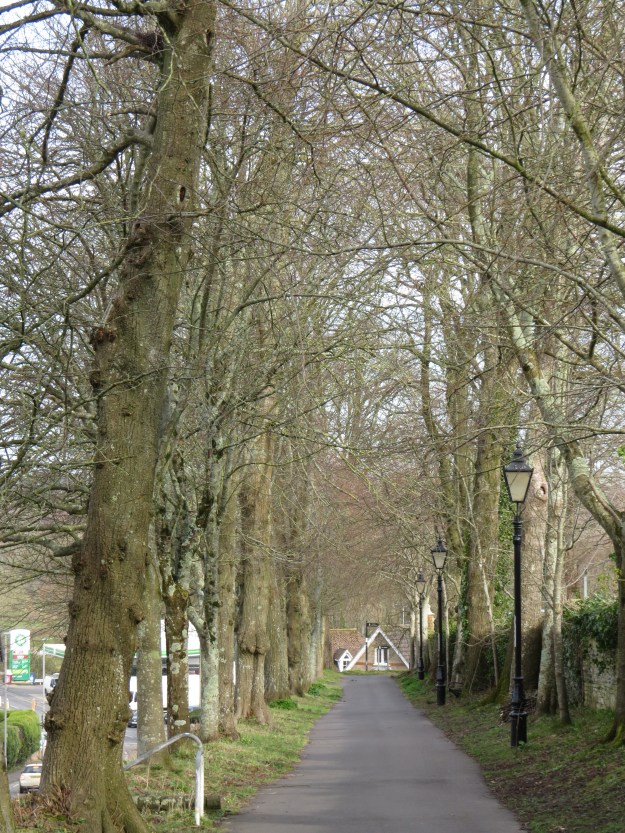
There are some Victorian walls studded with the local flints, and I love the way that these so easily turn into rock gardens.

Lesser celandines nestle in the crooks of the tree roots.

And there are some lush patches of the cuckoopint that I noticed last time I was here, though still no flowers.
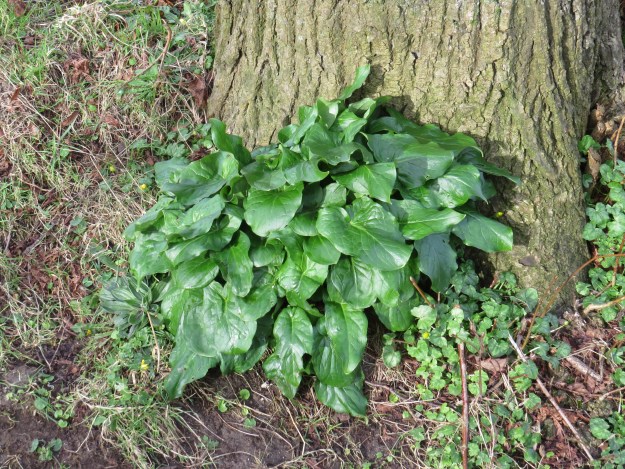
I cross the road and head steeply downhill towards the river Frome – this is where I finished my walk last time I was here. There is a plaque giving a bit of history about the area: the land round about was once flooded seasonally to provide a much longer season of grass, In Dorset, the water was diverted from the meadows back into the river in late February and early March so that sheep could graze. Once the sheep left, the fields were flooded again until it was time for the hay crop to be harvested, after which cows were put onto the fields again. The key factor was that the water was kept moving, so it didn’t form stagnant pools that might damage the grass, but instead encouraged it to thrive.  The pond below, known as John’s pond, was part of the system for regulating the water, but might also have been used as a sheep dip. The water from the Frome and its tributaries also powered a number of mills up and down the river. It all seems like a most sensible and sustainable way of using the natural cycles of ebb and flow to make the most of the land without destroying it. What a shame we no longer do this: only 3% of the UK’s ancient meadows survive.

John’s Pond

Hatches for diverting water out of the Frome and into John’s Pond

The ‘water meadows’, no longer routinely flooded

I stride on down the path, but as usual things start to catch my eye, and my pace slows. Look at the fresh new growth on this willow, for example.

And as I tune in, I notice birds singing heartily about every ten metres. I have not been paying attention and concluded that they were robins. Not so! These are male chaffinches, and they are vigorous songsters, belting out their message of desirability with raised crest and open bill.

Male chaffinch

I even captured a snippet of song.

I cross the Blue Bridge (built in 1877) and pause for a moment to watch the water tumble underneath. There is plenty of it: folk that I’ve spoken to say they can’t remember a winter like it, with so much rain. This, I fear, is the pattern of things for the south of England under global warming, at least as far as we can tell: wet, mild winters and hot, humid summers.

The Blue Bridge

I like this little bridge too, and the way that it makes a perfect circle with its reflection. Bridges like this were once used by horse-drawn vehicles to bring the hay in, but this seems rather too narrow for such an enterprise.

I am also training myself to focus on reflections, they can turn a churned-up muddy pathway into something rather magical.

In the field opposite there are some magnificent specimen trees, presumably spared because they provided shade for sheep or cattle in summer. Some older trees might also have provided a spot for the farmer and his team of plough animals to have a rest and eat their lunch. I love it when they’re left, although I imagine with the larger farm machinery that some people have now they can be a bit of a pain. In an online forum where I was asking about this, nearly all the respondents said that they would leave the trees in their fields because they loved to see them. There is hope, people.

And at the end of the walk I find a field full of sheep, with many of them happily resting under a tree. Maybe the roots provide a bed for animals as well as for lesser celandine.

And look at this magnificent semi-wild bed at the bottom of the lane, full of primroses and narcissi, winter heliotrope and cuckoo pint, forget-me-nots and ferns.

Back I go towards Dorchester. I meet a very nice lady who is walking her dog, and she tells me that the locals are currently fighting a plan to build 250 houses on the water meadow site. We need new homes, I know, but building them on an area which is at the confluence of three separate streams seems ludicrous in view of all the flooding that we’re currently having. Doesn’t anybody care, or is it all just about making a quick buck?

And then it’s back along the lane…...past this cut branch, which reminds me a bit of a screaming face in profile…

and back to the centre of Dorchester. When I get into the nursing home, Dad is sitting up looking very dapper. I notice that he’s very breathless, though – he has COPD, and has had one chest infection after another this year. I had been planning to take him out, but then I notice that today is Spanish Day in the home. We decide to have lunch in the home, sitting at the nice table for two looking over the gardens. Spanish music is playing, but for Dad, Spanish music can only ever be Julio Iglesias. After all, he spent more than ten years travelling to and working in Spain, so he knows what he’s on about.

‘What do you think of the music, Tom?’ asks J, one of Dad’s favourite carers. She is wearing a flower in her hair in honour of the occasion.

Dad grimaces and considers being polite, then decides against it in favour of honesty.

‘It’s a bit ropey’, he says.

‘Never mind’, says J, plonking down a bottle of white wine and bottle of red wine. ‘This’ll cheer you up’.

Dad looks at the wine.

‘Pinot grigio’, he says to me. ‘That’s not Spanish, it’s Italian’.

This dementia journey is quite a thing. Dad isn’t quite sure who I am, but he knows when he wine isn’t Spanish.

Fortunately, he likes it when it’s served, in plastic wine glasses with tops and bottoms that snap together.

‘I’m going to take that bottle back  to the room’, says Dad with a twinkle.

‘I think it’s for everyone, Dad’, I say.

‘Most of them won’t want any’, he says, looking around at the rest of the residents. He has a point. Many of them are asleep, everyone is on medication and a lot of folk gave up drinking a long time ago. Fortunately J comes round to provide a second glass and all is well.

We have soup with paprika and chickpeas and spinach, chicken with actual black olives, and. most delightful of all, a churros, though with the chocolate inside rather than for dipping. I eat the lot, and Dad makes a good fist of it.

‘They’ve put Syb in a separate room’, says Dad. Sybil was my Mum, who died in 2018. Dad hasn’t mentioned her for ages.

‘Have they, Dad?’ I ask. It’s painful when he talks about Mum like this, but for me rather than for him. I wait to see what he’ll say next.

‘And I can’t seem to find her’, he says. But then he throws his hands up in his typical gesture of stoical acceptance. ‘I’ll see her eventually’, he says. ‘But now, I need to go to the toilet’.

We walk back to his room.

‘Do you want me to wait?’ I ask.

‘No,’ he says. ‘I’m going to the toilet and then I’m going to have a rest’.

After a three-course meal and two glasses of wine, that’s how I feel too. I love that he dismisses me so gently, and that he isn’t concerned when I go. Gradually I am learning to be with this new way of being – nothing to do, no problems to fix. It’s a bit like relaxing into a hot bath, just letting go of my preconceptions and being with Dad wherever he is in the moment, joining him there. It’s a hard lesson for someone like me, who is so determined to try to control everything, but it’s a good one. I enjoy being with Dad, seeing the world through his eyes.

J told me a lovely story. Her Mum is very sick, and she had to take a few days off. When she came back to the home, the first thing that Dad asked her was ‘how’s your Mum?’ Dad has so little memory for the day to day, but he remembered that she had been distressed, and cared enough to ask. It’s so important not to make assumptions about what someone with dementia can and can’t understand. Being with Dad requires me to use all my faculties – my empathy, my imagination and my creativity – and I know that he is trying to connect and make sense of the world too. Strangely, this time with him might be the period when I most get to know the real Dad, the man that he’s been trying to cover up all these years, in all his late glory. It is a privilege to have the opportunity.

Wednesday Weed – Heavenly Bamboo

Heavenly bamboo (Nandina)

Dear Readers, I have always loved bright colours, and I come by it honestly: my Mum was always clad in shades of pink or turquoise or purple right up until the last months of her life. But she used to get very frustrated, because what she could buy was often largely dictated by what was ‘in fashion’.

‘It’s all mucky colours’ she would complain when the shops were full of camel and beige and taupe. She had a particular loathing for khaki, because it combined the attributes of ‘being green’ (an unlucky colour apparently), being militaristic (if there was one thing that Mum loathed it was an epaulette or a pair of cargo pants) and being neither green nor brown.

And what, you might ask, has this to do with heavenly bamboo? Well, there are fashions too in garden plants, and for many people, what they buy is limited to what the garden centre has in. Not everyone goes to specialist nurseries, or trusts the quality of the plants that they can buy online, and so if the garden centre is wall to wall petunias/Clematis montana/heavenly bamboo, then that is what they will have to buy.

In this past week, I have been falling over this plant in a variety of locations – in the gardens of East Finchley, in the municipal beds of Islington and in the planting at Coal Drops Yard in Kings Cross. It is undoubtedly an attractive plant, but what, I wonder, is making it so ubiquitous? And does it have any of the pitfalls of ‘true’ bamboo (some varieties of which can take over your entire garden while you are hanging out the washing).

First things first. As mentioned in a previous post, heavenly bamboo is not a bamboo at all, but a member of the barberry (Berberis) family. It comes from East Asia, from the Himalayas to Japan, and its Latin name ‘Nandina‘ comes from the Japanese word ‘nanten‘, or ‘domesticated’. It has indeed been grown as a garden plant in Japan for hundreds of years, and there are many cultivars: the early spring foliage is pink in colour in some varieties, and it can also display scarlet autumn colour, which makes it a plant that punches well above its weight in a small garden. It arrived in the UK in 1804 but seems to have only become popular as a garden plant in the last few years – I don’t remember it at all when I was growing up, but feel free to correct me, as always!

Photo One from CC BY-SA 3.0, https://commons.wikimedia.org/w/index.php?curid=658395

Heavenly bamboo – spring foliage (Photo One)

Another reason for growing this plant might be its berries, which look most inviting, but herein lies a problem. Heavenly bamboo is toxic to birds and animals – the fruit contains compounds that can decompose to hydrogen cyanide, and in North America, cedar waxwings, those voracious gobblers of berries, have been poisoned by the plant, where it is often used to provide rabbit and deer-proof fencing. To read about one such incident, have a read here. I hope that we don’t start using the plant so extensively here in the UK, because I would fear for our berry-eating birds such as fieldfares and redwings, plus our occasional visitors the Bohemian waxwings. Fortunately, at the moment we tend to stick to pyracantha for municipal planting which has no such problems.  For my North American readers, suggested alternatives to heavenly bamboo include American beautyberry (Callicarpa Americana) and Northern spicebush (Lindera benzoin), and there are some other ideas (plus a good explanation of why waxwings are particularly threatened by this plant) in the article here.

Heavenly bamboo is also considered to be an invasive plant in several parts of Florida and other southern states of the US. In spite of its toxicity birds often spread the seeds (presumably it’s only toxic if lots of berries are eaten) and the plant has rhizomatous roots that spread vigorously in the right conditions. It’s yet another example of a plant that is revered in its native habitat, and becomes a right old pain in the backside when it’s introduced somewhere else.

Photo Two by By KENPEI - KENPEI's photo, CC BY-SA 3.0, https://commons.wikimedia.org/w/index.php?curid=1508991

Wild heavenly bamboo (Photo Two)

In Japan and in China, heavenly bamboo is a plant associated with New Year – the foliage and berries are brought into the house and placed on the domestic altar. The stems were put around the necks of children to ward off whooping cough, and the plant was often grown close to the house to ward off fire and to bring good luck, and near to outdoor wash basins to ward off the evil eye. In Japan, it was said that if you shared your nightmares with heavenly bamboo, it will protect you from your darkest fears. More pragmatically, in China the stems have been used to make chopsticks. 

Medicinally, all parts of heavenly bamboo have been used by practitioners, particularly for coughs, asthma and malaria. I note with some interest that it was also used to ‘quieten drunkards’, which is quite an attribute. It was also used as an antidote for food poisoning from fish, although that does feel a little bit ‘out of the frying pan and into the fire’ for my liking. The berries are also said to enhance virility, presumably if they don’t kill you first. You can read all about the medicinal uses of the plant on Steven Foster’s Herbalblog, and very interesting it is too.

I was rather intrigued by another use for heavenly bamboo, which is exclusively Japanese. For over 250 years, ‘snow hares’ or ‘snow bunnies’ have been made out of snow, with ears made from the leaves and eyes made from the berries of the plant. The results are very cute, as you can see. They were often made for ‘snow viewing parties’, along with other sculptures, in a similar vein to the snow men that we build but originally rather more formally. The advantage of something so small is that it can be brought into the house to be admired too.

Photo Three from https://www.mamalisa.com/images/blog/maxresdefault-youtube.jpg

Snow bunnies (Photo Three)

If you look at the picture below you will see a snow hare in the bottom left of the painting, which is from Utagawa, Toyoharu, who lived from 1735-1814. The painting was probably made in 1772-4. There is a very interesting blog about the derivation of the ‘snow hare’ and its importance in Japanese and Asian folklore here.

Snow viewing party (Utagawa, Toyoharu, 1735-1814- painted 1772-4) (Public Domain)

Now, at this point I would usually be looking for a painting to share with you all, and, as you imagine, there are many lovely portrayals of heavenly bamboo, usually weighed down with snow and with innocent birds feasting on the berries (let’s hope they aren’t going to eat too many). But instead, howsabout this. This is a Noh costume, probably worn by an actor depicting an upper class woman, and dating to the second half of the eighteenth century. It is decorated with depictions of books (suggesting the rise in literacy of the period) and yes, those auspicious heavenly bamboo branches. Just look at that beautiful embroidery. I am awestruck.

Now, try as I might I cannot find us a poem this week, but as I think we’re all in need of as much beauty as we can muster, here are some more exquisite objects. Firstly, there is a fan depicting heavenly bamboo and two little flying insects (Bugwoman approves, of course). It was made in the first third of the Eighteenth century, by Jiang Tingxi, who lived from 1669 to 1732. Then there is a second fan, displaying a rather less happy outcome for at least one of the invertebrates but there’s nature for you. The fans came in a beautiful case, and are part of the Harvard Art Museums collection.

Photo Four from https://www.harvardartmuseums.org/collections/object/49269?position=2

First Fan showing heavenly bamboo and flying insects (Photo Four)

Photo Five from https://www.harvardartmuseums.org/collections/object/211238?position=1

Second Fan. Oh dear. (Photo Five)

Photo Six from https://ids.lib.harvard.edu/ids/view/408605743?width=3000&height=3000

The fan case. What a beautiful set of objects (Photo Six)

Whenever I despair of the stupidity, cupidity and sheer cruelty of human beings, our short-sightedness, our inability to do the right thing in the face of overwhelming evidence, our fearfulness and small-mindedness, two things help. Firstly, I think on the kindness and bravery of ‘ordinary’ human beings, who are often overcoming personal difficulties of the most extreme kind while seeking to make the world a better place for the rest of the extended community, human and animal alike. And secondly, I look at the beautiful things that people have made over the centuries and I feel the act of generosity that goes into any creativity, the way that people have always wanted to share their unique vision with others, and how greatly the world has been enriched and enlarged by these acts. Maybe, just maybe, we are not finished yet.

Photo Credits

Photo One from CC BY-SA 3.0, https://commons.wikimedia.org/w/index.php?curid=658395

Photo Two by By KENPEI – KENPEI’s photo, CC BY-SA 3.0, https://commons.wikimedia.org/w/index.php?curid=1508991

Photo Three from https://www.mamalisa.com/images/blog/maxresdefault-youtube.jpg

Photo Four from https://www.harvardartmuseums.org/collections/object/49269?position=2

Photo Five from https://www.harvardartmuseums.org/collections/object/211238?position=1

Photo Six from https://ids.lib.harvard.edu/ids/view/408605743?width=3000&height=3000


At East India Dock Basin

The O2 Centre as seen from East India Dock

Dear Readers, it isn’t until I reach the water that I really start looking upwards. There are few places in central London where you can get a good view of the clouds, but as I start walking along the Thames on my way to the nature reserve at East India Dock Basin, I am struck by the ever-changing tumble and fluff of this late-winter sky. I stand for a bit, watching it change minute by minute, and am entranced.

A plane taking off from London City Airport, plus the Emirates Cable Car, the only one in London

It’s a brisk day, and I can almost hear the groaning of the ropes that once tethered ships to the quayside here, and the chink of rigging. It’s all in my imagination though, as although East India Docks could once handle 250 ships at a time (and played an important part in the construction of the Mulberry Harbours that were used during the D-Day landings), they have been closed since 1967.

Earlier than this, the wharf just along from the dock was the embarkation point for ships taking settlers to Virginia in 1606. Three small ships, the Godspeed, Susan Constant and the Discovery made the voyage with 105 people on board. It was an eventful trip, including periods when the ships were becalmed, and a mutiny by one Captain John Smith, who later married Pocahontas. The settlers founded Jamestown, but suffered famine, disease, and attacks by the local population – by 1609 only 60 of the original travellers were left. However, Captain John Rolfe arrived in 1610 bearing tobacco seeds, and the colony prospered when these were found to do well in the climate.

While the memorial is rather striking, I was more moved by the remaining wharfside furniture, now overgrown with moss and wildflowers.

The crows were playing in the breeze, plucking at one another’s feathers and generally being hooligans. Not a thing gets past them.

And here we are!

There is a little copse of alder and blackthorn, with the cow parsley already coming into flower and robins singing from every tree.

And then the basin opens up. I wonder if the birds will be nervous, but not a bit of it. There are mudflats, and shelduck (Tadorna tadorna) are sieving the water and looking for little bits of edible stuff. These are magnificent ducks, and they have a rather lovely call – my Crossley Guide describes it thus:

Quite noisy, the female making a series of belly laughs with a sarcastic ring, often accompanied by the fast, breathy whistles of the male‘.

Indeed.

The most noticeable noise, however, is the wailing and complaining  of the black-headed gulls (Chroicocephalus ridibundus). These gulls are never ‘black-headed’, even in summer when their plumage features a chocolate-brown balaclava, but in mid-winter they simply have a little half-circle of black where you might expect their ears to be. At this time of year there’s a whole spectrum of ‘headgear’.

But I have really come to see one particular species. One of my very favourite ducks is the common teal (Anser crecca), and in midwinter up to 400 roost here at night. I am hoping that there will be a few stragglers this morning, and so there are. It’s hard to get a decent picture of a teal, because they are not known as ‘dabbling ducks’ for nothing – those little heads are down most of the time, so it’s difficult  to get a photo of the russet, green and gold feathers on the head of the male, and the subtle beauty of the body feathers.

I walk around  the edge of the basin, and am much taken by some of the industrial history. Here are the only listed lock gates in London, for example,

And here is one of the beacons lit on 31st December 1999 to mark the new millenium.

There is a stand of palm trees in the middle of a disused car park, which I find a little confusing.

And the less than illustrious history of the Docklands is illustrated on the wall behind.

But as I walk around I get a better view of the teal. It does my heart good to know that this little bit of London is being reclaimed by the wildlife, providing a haven for bird travellers on their way north and south.

On the other side of the basin, a young heron is standing by the reeds, surrounded by stray plastic sheeting.

As I get to the end of the path, I turn back to see the panorama of water and cranes and new buildings rising and dereliction.

And a shelduck heads across the pond, trailing a long contrail like a passing plane.

I adore these little local nature reserves. They seem manageable, somehow: much as I love Walthamstow and Woodberry wetlands they are full day trips with lots of walking and lots of people. East India Dock Basin, and its neighbour Greenwich Peninsula Ecology Park, feel like the kinds of places where you can sit in one place and take in everything. Maybe as I’m getting older, I am preferring to deep dive rather than skim the surface, and a small ‘patch’ makes that easier. I just know that I’ve had a couple of hours here, and am already a little bit in love with the place. Maybe one day I’ll come back at 3 p.m. on a darkening winter afternoon, and see if the tales of the roosting teal are true.


Wednesday Weed – Liquorice

Chinese licorice (Glycorrhiza yunnanensis)

Dear Readers, I do not consider myself to be a fussy eater, but if I have a nemesis in the confectionary world it is liquorice (or licorice if you are North American). When I was a child I remember peeling all the sugar paste off of my Liquorice Allsorts and leaving that unholy black stuff for my mum, who loved it. The very worst were those sweets that not only contained liquorice but were coated in aniseed, my second most-hated sweetmeat ingredient. I take my hat off to anyone who actually enjoys them, you must have the stomach and tastebuds of a megatherium.

Photo One by By David Edgar - Own work, CC BY-SA 4.0, https://commons.wikimedia.org/w/index.php?curid=56641498

Liquorice Allsorts (Photo One)

Photo Two by By en:User:Ballista - from English Wikipedia[1], CC BY-SA 3.0, https://commons.wikimedia.org/w/index.php?curid=1334460

Megatherium americanum (Photo Two)

So, it was during my visit to Coal Drops Yard last week that I find myself thinking about liquorice, for the first time in many, many years. The plant that intrigued me was the Chinese species Glychorriza yunnanensis, but like all of the liquorice plants its Latin genus name means ‘sweet root’. The species normally used to create the sweets is British or American Liquorice (Glychorriza glabra), and it is a member of the pea family (Fabaceae) – as I mentioned last week, the seedheads of ‘our’ plant reminded me of a giant clover, but the ‘real’ liquorice plant looks even more leguminous.

British/American liquorice (Glycorrhiza glabra) (Public Domain)

All of the liquorice plants contain a substance called glycyrrhizin, which can cause adverse effects if more than 2mg of the pure active ingredient are eaten in a day. The chemical can wreak havoc with your blood pressure and give you diarrhoea – unfortunately it is one of the substances sometimes used as a purgative (along with senna and rhubarb) by those with anorexia/bulimia (see here for a most interesting article). Glycyrrhizin is 30 times as sweet as sugar, and so there is actually very little of it in liquorice sweets, with aniseed being used to produce most of the flavour, so you would have to eat a lot before you were poisoned (though a 56 year-old woman was admitted to hospital with muscle failure after eating 200g of Pontefract cakes (of which more later)).

I once had a spell working in the Netherlands (Rotterdam to be precise) and liquorice-flavoured sweets were a great favourite. Most reception desks had a bowl of wrapped sweeties to munch on while you waited to be admitted to the offices of the great and the good and many times I was caught out, throwing what I thought was a mint into my mouth only to discover that it was most definitely not. The worst occasion involved a salty-liquorice hard candy which I subsequently learned was called a zoute drop. I had just discovered my mistake when I spotted  the Finance Director descending in a glass lift like some kind of corporate angel. There being no time to deposit the sweet in a plant pot or wrap it in a tissue, I just had to swallow it. My face must have been a picture.

The romance of business travel is much overstated in my opinion.

If you are unfortunate, you may also come across salty liquorice in the Nordic countries.

Photo Three By Marcin Floryan - Own work, CC BY-SA 2.5, https://commons.wikimedia.org/w/index.php?curid=1300952

Swedish salty liquorice (Photo Three)

In many cultures, the root of the liquorice plant is eaten without any preparation, as a breath-sweetener and an aid to digestion. I imagine that chewing on the fibrous bit of the plant gently releases the sweetness, but without the danger to the teeth. In the UK the first liquorice sweets were probably the Pontefract cakes made in Yorkshire: Spanish monks apparently brought the plant to Rievaulx Abbey near Thirsk, and the confectionary is still known as ‘Spanish’ in the area. Have a look at these little tarry tablets of pure hell. You’re welcome.

Photo Four By Dave Spellman from Lancashire, England - Flickr, CC BY 2.0, https://commons.wikimedia.org/w/index.php?curid=2210468

Pontefract cakes (Photo Four)

In the wild, British liquorice grows in a great swathe of Eastern Mediterranean countries, right the way through Central Asia and as far east as Mongolia. It loves well-drained soils and sunshine, and if cultivated, is harvested three years after planting. For a long time it was used as a flavouring for tobacco, particularly pipe tobacco. Our ‘insurance man’, Mr Sawtell, used to visit the house once a month to collect the payments on Mum and Dad’s life insurance, and I remember that his teeth were worn into a perfect inverse-V shape by his constant pipe smoking. I also remember a certain sickly-sweet smell to the miasma that hung around him constantly, these being the days before worries about passive smoking (or indeed active smoking). I wonder if that is one of the factors in my life-long loathing of this apparently innocuous substance?

Photo Five By Sjschen (Sjschen) - Own work, CC BY 2.5, https://commons.wikimedia.org/w/index.php?curid=1951252

Pipe tobacco (Photo Five)

Liquorice is also used as an ingredient in Traditional Chinese Medicine, being believed to harmonize the different elements of a prescription. Some studies consider it effective in the treatment of psoriasis-related infections and in the killing of the bacteria Helicobacter pylori, which is associated with stomach ulcers. It could possibly also be useful in the treatment of Hepatitis C.

And now, a poem. As we have seen, liquorice was once grown commercially in Yorkshire, but those days are largely gone (though one intrepid farmer decided to plant some liquorice to provide ‘chewing sticks’ for visiting children back in 2012). However, that lover of British Amazons Sir John Betjeman was moved to write about wooing one of his paramours in a liquorice field. The results are much what you’d expect from this poet who had a remarkable sense of rhythm and rhyme, even though, for me, he never really rose above the whimsical. I do love the line about the sturdy, flannel-slack’d legs however. It’s not that easy to find rhymes for ‘Pontefract’.

The Licorice Fields at Pontefract by John Betjeman

In the licorice fields at Pontefract
My love and I did meet
And many a burdened licorice bush
Was blooming round our feet;
Red hair she had and golden skin,
Her sulky lips were shaped for sin,
Her sturdy legs were flannel-slack’d
The strongest legs in Pontefract.

The light and dangling licorice flowers
Gave off the sweetest smells;
From various black Victorian towers
The Sunday evening bells
Came pealing over dales and hills
And tanneries and silent mills
And lowly streets where country stops
And little shuttered corner shops.

She cast her blazing eyes on me
And plucked a licorice leaf;
I was her captive slave and she
My red-haired robber chief.
Oh love! for love I could not speak,
It left me winded, wilting, weak,
And held in brown arms strong and bare
And wound with flaming ropes of hair.

Chinese licorice (Glycyrrhiza yunnanensis)

Photo Credits

Photo One by By David Edgar – Own work, CC BY-SA 4.0, https://commons.wikimedia.org/w/index.php?curid=56641498

Photo Two by By en:User:Ballista – from English Wikipedia[1], CC BY-SA 3.0, https://commons.wikimedia.org/w/index.php?curid=1334460

Photo Three By Marcin Floryan – Own work, CC BY-SA 2.5, https://commons.wikimedia.org/w/index.php?curid=1300952

Photo Four By Dave Spellman from Lancashire, England – Flickr, CC BY 2.0, https://commons.wikimedia.org/w/index.php?curid=2210468

Photo Five By Sjschen (Sjschen) – Own work, CC BY 2.5, https://commons.wikimedia.org/w/index.php?curid=1951252


At Coal Drops Yard

The roof at Coal Drops Yard, designed by Thomas Heatherwick

Dear Readers, it would be fair to say that Kings Cross, so long a combination of railwaylands, derelict buildings, architectural gems and dodgy kebab shops, has become something of a chichi destination. Take Coal Drops Yard, for example. There is an Alain Ducasse chocolate shop, an outpost of designer outlet Wolf and Badger and a branch of Miller Harris, the upmarket perfume emporium, on the site of what were once the warehouses for coal from South Yorkshire, transported to the station by train and then distributed via the Regent’s Canal. Bagley’s nightclub was also here, and many a loud and leery night was experienced here by a younger version of Bugwoman. But these days, I am here with camera in hand to give the landscaping a once over, before retreating to the relative affordability of East Finchley.

First things first though. I wanted to see what had happened to the gasholders that were once such a feature, just along the canal. The metal frames were carted off to North Yorkshire for restoration, and have now been reinstated. Three of the gasholders have been converted into luxury flats, while the fourth is left as just a frame, with a ‘park’ inside. Standing inside is a rather disconcerting experience – mirrors multiply the metalwork, and amplify and distort the landscape.

Someone clearly appreciates the park as a backdrop, as the grass is scattered with red rose petals, maybe from a wedding photographic session.

The flat conversions look very luxurious, as indeed they might ( I note that one is on the market, with Savilles, for £2.75m). But surely they must be very small, and awkwardly shaped? There are allegedly 145 flats in these three gasholders, and not a jot of affordable housing. Some folk, methinks, have more money than sense. Though if you work at Google it’s just a short jog to work, as the company is headquartered just across the canal.

However, I am here to look at the planting, and I find it very interesting, in a Piet Oudolf, swathes of grasses kind of way. I do like a seedhead at this time of year, and there are some truly spectacular ones on offer here. I would argue, however, that one of the loveliest plants that I saw was the magnificent alder tree on the other side of the canal – I was so impressed that it was my Wednesday Weed last week. This is a tree completely in keeping with its boggy, workaday surroundings, and none the worst for it.

Alder ( Alnus glutinosa) catkins and cones, Kings Cross London

But back to the actual gardens. Acclaimed plantsman and garden designer Dan  Pearson was responsible for the choice of plants – he has form in Coal Drops Yard, having created an installation called ‘Colourstream’ last year. Pretty, but not much here for pollinators, and I’ve come to the conclusion that it’s a moral duty to help invertebrates when given an opportunity like this in a public place.

Photo One from http://danpearsonstudio.com/colourstream-at-coal-drops-yard/

‘Colourstream’ from Coal Drops Yard last year, designed by Dan Pearson Studios (Photo One)

Still, Dan Pearson’s planting has more than made up for this with his planting in the gardens themselves, as you can see from the images on his website here, giving an impression of what it will all look like when it’s grown up a bit. At the moment, it’s still full of interest. There are several varieties of witch hazel, with its highly-scented, spidery flowers.

Lavender-blue irises are unpeeling their petals, exposing the tiniest hint of the egg-yolk yellow at their heart.

There are some magnificent seedheads. These below remind me of the reedmace in the pond, but I’m happy to be told otherwise, so don’t be shy!

Reed mace?

And look at these truly magnificent thorns. I thought that this was something desperately exotic, maybe from Australia, but I am now persuaded that it might be a winged-thorn rose (Rosa sericea subsp omeiensis). This variety is known as ‘pterocantha’, which might mean ‘winged thorn’ (think ‘pterosaur’ and ‘pyracantha’).  The plant is grown specifically for its thorns, which apparently glow scarlet when backlit. Who knew? It apparently also has small white flowers and bright red hips, so it is definitely a plant for all seasons. It looks more like razor wire than any plant I’ve ever seen, and might be just the thing if burglars are regularly hopping into your garden and pyracantha hasn’t put them off.

The king (or queen) of the seedheads though is probably this plant – Chinese licorice (Glycyrrhiza yunnanensis). This is a member of the pea family, and the flowers look rather like giant mauve clover. If you had a big enough garden it would be worth growing just for that mass of brown, spiky seedcases though – they remind me of a cross between an ancient weapon, a hedgehog and a Sputnik. They were rustling most delightfully in the pre-Storm Dennis wind too, reminding me that a garden can be a complete sensory experience.

Chinese licorice (Glycyrrhiza yunnanensis)

To round off the experience I decided that I would have a proper look in Coal Drops Yard. As usual, my eyes were drawn to the plants, and in particular the pots of heavenly bamboo (Nandina). Contrary to the name, this is not a bamboo but a member of the barberry family. What I love is the combination of bright crimson berries and the delicate foliage, and I’m not the only one – the plant seems to be having a ‘moment’ in the County Roads of East Finchley where I live, with several peeking out of pots and hedges.

Heavenly bamboo (Nandina)

And so, it’s time to wend my way back to Kings Cross station and to head home. Overall, I’m pretty impressed with what’s going on at Coal Drops Yard and round about – there are some interesting and unusual plants with year-round interest, and it certainly makes a change from alyssum and lobelia. I shall have to take a trip back in a month or so to see how it’s all developing, and to admire some of these plants in their summer garb.

And somehow, I manage to avoid buying anything in the shops. Sometimes, a bit of time spent with plants is more satisfying than anything that money can buy.

Photo Credits

Photo One from http://danpearsonstudio.com/colourstream-at-coal-drops-yard/


Wednesday Weed – Alder

Alder ( Alnus glutinosa) catkins and cones, Kings Cross London

Dear Readers, last week I was in Kings Cross, scouting about for a blogpost on the landscaping that has been done around the old gasholders and the new Coal Drops Yard, when I spotted this magnificent alder on the opposite side of the canal. It was absolutely dripping with catkins and tiny cones, and it reminded me how much I have always liked this native tree. I remember watching the blue and great tits feeding on the cones of an alder in Culpeper Garden in Islington: it was the first time that I’d noticed how the two species portioned out the tree, with the blue tits seeming to stick to the more delicate twigs and the great tits going for the cones on the more robust branches. It might not be the most elegant tree, nor the most august, but as it is a pioneer that grows in boggy ground which most other trees wouldn’t endure, it will always have a place in my heart.

Photo One By No machine-readable author provided. MPF assumed (based on copyright claims). - No machine-readable source provided. Own work assumed (based on copyright claims)., CC BY 2.5, https://commons.wikimedia.org/w/index.php?curid=430484

Alder foliage (Photo One)

The buds and young leaves of alder are sticky, and the bark exudes a thick resin, hence the Latin species name ‘glutinosa’. The tree is a member of the birch family (Betulaceae), and it is found across Europe, Central Asia and North Africa. It has been introduced to North America, New Zealand and Australia but because it can thrive in waterlogged and nutrient-poor soils, it is not usually seen as a major problem. The main reason for alder’s resilience is  its symbiotic relationship with a fungus, Frankia alnii, which forms nodules on the plant’s roots and fixes nitrogen from the air in a form that the plant can use, in return for the carbon produced by the tree. This relationship improves the fertility of the soil, making it available to other plants.

Photo Two by By Cwmhiraeth - Own work, CC BY-SA 3.0, https://commons.wikimedia.org/w/index.php?curid=21965251

Alder ‘nodules’ caused by symbiotic fungi Frankia alnii (Photo Two)

However, the seedlings of alder cannot survive overshadowing and so, as the wood that the alder and its fungal ‘friend’ have helped to create becomes more extensive, the alder itself is limited to the forest edges, or to the places which are too wet for other trees to grow. This kind of wet woodland is known as a ‘carr’ (which comes from the Old Norse ‘kvarr’, meaning ‘swamp’).

Photo Three By Bernd Schade - Own work, CC BY-SA 3.0, https://commons.wikimedia.org/w/index.php?curid=2138464

Alder carr in Germany (Photo Three)

As you might expect from a tree that already has a healthy relationship with one fungus, there are several other species that are also only associated with alders. One is Russula alnetorum, with its magenta cap and pure white underside.

Photo Four By This image was created by user Irene Andersson (irenea) at Mushroom Observer, a source for mycological images.You can contact this user here. - This image is Image Number 197907 at Mushroom Observer, a source for mycological images., CC BY-SA 3.0, https://commons.wikimedia.org/w/index.php?curid=18254339

Russula sp (Photo Four)

Another is the Alder Roll-Rim, which to my untutored eye has a decidedly chanterelle-ish look about it. This is why you should never send me out foraging for fungi.

Photo Five by By Irene Andersson - This image is Image Number 25465 at Mushroom Observer, a source for mycological images., CC BY-SA 3.0, https://commons.wikimedia.org/w/index.php?curid=15986154

Alder Roll-Rim (Paxillus filamentosus) (Photo Five)

There is even a fungus, catkin cup (Ciboria amentacea), that grows only on the fallen catkins of alder and willow. Don’t they look like the most exquisite miniature wine glasses? Truly, the world is full of wonders.

Photo Six by By Andreas Kunze - Own work, CC BY-SA 3.0, https://commons.wikimedia.org/w/index.php?curid=14896380

Catkin cup (Ciboria amentacea) growing on a fallen alder catkin (Photo Six)

But sadly, another fungus has been having a most deleterious effect on the poor old alder – Phytophthora alnii, a recently evolved species, causes a lethal rotting disease, and has been spreading across Europe. It sometimes seems as if all of our trees are under constant threat from pathogens, which makes the need for better plant hygiene in nurseries and when shipping plant products even more important. Although the native alder is not a popular street tree the Italian alder, a close relative, is, especially in the City where the pollution, poor quality of the soil and general disturbance require a robust and resilient tree. Let’s hope that our alders, wild and ‘tame’  are able to survive this latest onslaught.

Photo Six by By User:Gerhard Elsner - Own work, CC BY-SA 3.0, https://commons.wikimedia.org/w/index.php?curid=2435628

An alder infected by the Phytophthora alnii fungus (Photo Six)

Alder is extremely useful to wildlife – we have seen how birds eat the cones, but the tree also attracts over 140 species of leaf-eating insect, and the caterpillars of many moths and butterflies feed on the tree, including the delightfully-named alder kitten (Furcula bicuspis) which is a most attractive moth.

Photo Seven by Ben Sale from UK [CC BY (https://creativecommons.org/licenses/by/2.0)]

Alder kitten (Furcula bicuspis) (Photo Seven)

Humans have also used alder extensively. The wood from alder trees is often used in marshy conditions: many of the piles under the city of Venice are made of alder timber, and the Roman engineer Vetruvius mentions that the causeway across the marshes of Ravenna was also made from the tree. The wood is not particularly hard, so it has also been used for coppicing, charcoal making (particularly for use in gunpowder factories)  and for paper. However, alder is also the wood of choice for the bodies of most Fender Stratocaster guitars, both because of its tonal qualities and because the light colour of the wood means that it can take a variety of finishes. If you are thinking of buying an electric guitar and aren’t sure what wood to get it in, there’s an interesting article here, though I suspect that the biological origin of something like a guitar is often overlooked (I certainly hadn’t given it much thought until now).

Photo Eight from https://www.fender.com/articles/tech-talk/ash-vs-alder-whats-the-diff

A Fender Telecaster guitar with alder body (Photo Eight)

Alder was also said to be the wood of choice for woodworm larvae, and so branches of the tree were sometimes brought into houses so that the insects could munch harmlessly away on their favourite food instead of gnawing their way through the weight-bearing beams.

The various parts of alder produce a variety of different dye colours: the catkins produce a green dye, which has been associated with the ‘Lincoln green’ hue of the clothing of Robin Hood and his Merry Men. The bark contains a high degree of tannin, and can be used to dye clothes brown. The fresh-cut wood can produce a pinkish dye: when the tree is injured the exposed wood quickly turns brownish-red and looks as if it is bleeding, which may be why there is an Irish legend that it is unlucky to pass an alder tree when on a journey.

The photo below shows wool dyed with madder (orange), weld (yellow) and alder (brown).

Photo Nine from https://medieval-colours.co.uk/products/autumn-set-of-yarns-alder-madder-weld

Wool dyed with weld (yellow), madder (orange) and alder (brown) from Medieval Wools (see below for link) (Photo Nine)

Medicinally, the bark has been used in a decoction to treat burns, inflammation and sore throats. It was believed that alder leaves placed into the shoes before a long walk would soothe tired feet (and alder wood was also used to make clogs in the industrial North of England during Victorian times). The bark has also been used as a toothpaste. In the Alps, peasants would warm up bags of alder leaves and use them to relieve the pain of arthritis during the long, cold winter nights.

Although in the UK the alder is often viewed as something of a ‘weed tree’, it featured in one of the most important works of the Dutch Golden Age of landscape painting. ‘The Avenue at Middelharnis’ by Meindert Hobbema was created in 1689, and is thought to be an extremely accurate portrayal of this avenue of alders, which were planted in 1664. This was an unusual departure for Hobbema, who usually painted idealised landscapes made up of several different locations. The man working amongst the saplings on the lower right of the painting is also unusual – there had previously been a sense that these landscapes had just sprung into being, rather than being intensely man-made. Hobbema was largely thought to have stopped painting some twenty years before this work was made: he had a lucrative job as a ‘wine-gauger’, someone who collected the taxes on locally-produced wine. This is a particularly successful late work, described by the American Dutch art specialist Seymour Sleve as ‘the swan song of Holland’s great period of landscape painting which fully deserves its high reputation’. I am not a great fan of landscape painting, but there is something rather enigmatic about this work – it beckons me on, between those rather lanky alders, towards the church.

The Avenue at Middelharnis by Meindert Hobbema (1689) (Public Domain)

And oh, how happy I am to find this poem by Seamus Heaney, with which to end my celebration of the alder. To hear the man himself reading the poem, click here. How deeply he loved the land that he grew up in, and how poignantly it comes through in his work.

PLANTING THE ALDER

For the bark, dulled argent, roundly wrapped
And pigeon-collared.

For the splitter-splatter, guttering
Rain-flirt leaves.

For the snub and clot of the first green cones,
Smelted emerald, chlorophyll.

For the scut and scat of cones in winter,
So rattle-skinned, so fossil-brittle.

For the alder-wood, flame-red when torn
Branch from branch.

But mostly for the swinging locks
Of yellow catkins.

Plant it, plant it,
Streel-head in the rain.

© 2006, Seamus Heaney
From: District and Circle
Publisher: Faber & Faber, London, 2006


Photo Credits

Photo One By No machine-readable author provided. MPF assumed (based on copyright claims). – No machine-readable source provided. Own work assumed (based on copyright claims)., CC BY 2.5, https://commons.wikimedia.org/w/index.php?curid=430484

Photo Two by By Cwmhiraeth – Own work, CC BY-SA 3.0, https://commons.wikimedia.org/w/index.php?curid=21965251

Photo Three By Bernd Schade – Own work, CC BY-SA 3.0, https://commons.wikimedia.org/w/index.php?curid=2138464

Photo Four By This image was created by user Irene Andersson (irenea) at Mushroom Observer, a source for mycological images.You can contact this user here. – This image is Image Number 197907 at Mushroom Observer, a source for mycological images., CC BY-SA 3.0, https://commons.wikimedia.org/w/index.php?curid=18254339

Photo Five by By Irene Andersson – This image is Image Number 25465 at Mushroom Observer, a source for mycological images., CC BY-SA 3.0, https://commons.wikimedia.org/w/index.php?curid=15986154

Photo Six by By Andreas Kunze – Own work, CC BY-SA 3.0, https://commons.wikimedia.org/w/index.php?curid=14896380

Photo Seven by Ben Sale from UK [CC BY (https://creativecommons.org/licenses/by/2.0)]

Photo Eight from https://www.fender.com/articles/tech-talk/ash-vs-alder-whats-the-diff

Photo Nine from https://medieval-colours.co.uk/products/autumn-set-of-yarns-alder-madder-weld