Category Archives: London Plants

Christmas on the County Roads

Dear Readers, it’s fair to say that Christmas has broken out all over the County Roads here in East Finchley, so, on a particularly damp and misty morning I went out for a walk to see what was going on. I am going to be away from home for Christmas for the first time since I moved here in 2010, and it feels a little strange: I haven’t put up the Christmas tree, the pink velvet reindeers are still in the box in the eaves, and several Father Christmases will be feeling very irritable if I don’t fish them out soon. But, somehow, I feel a need to let go of expectation and to simplify this year, and to that end I thought I’d enjoy what everyone else was doing rather than feel as if I had to do it myself.

The door wreathes, for example, are particularly splendid this year, and very varied. As with the Christmas trees, there are those who favour natural materials, and those who have an artificial one that lasts for many seasons.

  And then there are the decorations. I am very taken with the little glass creatures in the photo directly below.

But as I walked around, I quickly became aware that although much of nature is quiescent at this time of year, there is still a surprising amount going on. After all the snow I was surprised to see fresh spiders’ webs, bejewelled with mist.

And what is more festive than a shrub full of fruit?

The cotoneaster below was a mass of berries

The black fruits of ivy promise some respite for the thrushes if the weather turns cold again.

And I shall need a hand with this one, gardening friends. The fruit reminds me very much of spindle   but the leaves are different. Maybe it’s from the same family.

A relative of the spindle?

There is a strange beauty to the decay of plants. For example, I think I prefer the browning heads of the hydrangeas to the blooms in their fresher, more pristine state.

And in the insect-damaged leaves of mahonia and holly there is a flame of colour that the perfect ones lack. It reminds me that the beauty of a face that has been through trouble is often more profound than the picture-perfect features of someone who has not yet been tested by life.

And who should pop up when I was walking down Bedford Road but Bailey, the King of the Cats? He didn’t want to stop for a chat, but headed off down the road at a brisk trot, yowling all the way. He is a most determined puss cat.

To my surprise, some things are in flower, like the pink camellia and the clematis below. Although there are less blooms about at this time of year, the ones that there are seem all the more precious.

But what lifted my heart most today was not one of the more obvious things, but a tiny seedling. A few months ago, I captured a green oasis at the bottom of a wall along from Kentucky Fried Chicken. There were approximately ten species growing there, all ‘weeds’ to be sure, but tiny spiders were making their homes between the leaves, and there was even a caterpillar.

Then came the paving improvements, and, whilst the new paving slabs are delightfully even, there is not a blade of grass to be seen.

Until today.

I love that the natural world never gives up. Where there is a teaspoonful of soil, and a spot of rain, some plant will put down roots and throw up flowers. it gives me such hope to see that whatever we do, nature can circumvent us.

So, by the time this is published I’ll be heading off to Dorset for Christmas with Mum and Dad. It will be a different kind of celebration, but none the worst for that, and I’m actually rather looking forward to it. At least the parents will be snug and warm in their own home, and won’t have to worry about braving the Christmas traffic, or coping with the air quality in London. I wish all of you a peaceful and happy holiday, and hope that 2018 brings you everything that you long for most.


Wednesday Weed – Nordmann Fir

Every Wednesday, I hope to find a new ‘weed’ to investigate. My only criterion will be that I will not have deliberately planted the subject of our inquiry. Who knows what we will find…..

Nordmann Fir (Abies nordmanniana)

Dear Readers, when you see the Christmas trees stacked up outside Tony’s Continental in East Finchley, you know that Christmas is well and truly on its way. Another indication is when you see Michael with an axe in his hand, ready to pare down the trunks and fit them into a Christmas tree holder. One conversation with a customer went like this:

Customer: ‘Careful with that axe, you’ll cut your leg off!’

Michael: ‘I’ve been doing this for forty years and I haven’t cut one off yet! But even if I did, I’ve got another one’.

Here is a photo of Michael at work. To be honest, it’s not his legs I’m worried about.

I am also much impressed by the Christmas tree wrapping contraption that is brought out every festive season. Just pop a tree into the metal tube, push it through and it comes out wrapped in a netting bag. It’s a kind of Christmas tree sausage machine.

60% of the Christmas trees that are sold in the UK are Nordmann firs, and I can see why – the tree has soft, child-friendly needles that don’t drop, and it is a good-value, long-lived tree. What it doesn’t have is any fragrance so you won’t get that delicious piney smell, but as this scent makes some people’s noses twitch, it’s not necessarily a bad thing.

Nordmann firs come originally from the mountains to the south and east of the Black Sea, and so are native to Turkey, Georgia, the Russian Caucasus and parts of Azerbaijan. They live in mountainous areas from 900-2200 metres and grow to a terrific height  – one tree in the Western Caucasus reserve has been reported to be 279 feet tall, the largest tree in Europe. They also live in regions which have a rainfall of over 1000 mm per year, which is a reminder to keep them well-watered while they’re in the house.

Photo One (Wild Nordmann Firs) by By Acidka on Flickr - Flickr, CC BY 2.0, https://commons.wikimedia.org/w/index.php?curid=5988580

‘Wild’ Nordmann Fir trees in Karachayevo-Cherkesiya, Caucasus (Photo One)

The trees at Tony’s are typically about six to seven feet high, and would be between eight and twelve years of age. The seed is normally taken from older trees, grown on in nurseries and then sold to Christmas tree farms when the saplings are three to four years old. Once harvested, they will have a brief life of a couple of weeks in the house, before being put outside to be recycled by the council. Here in Barnet, the trees are chipped and used as a weed suppressant on municipal beds, or on paths. The chippings can also be heat-treated and then used as a soil conditioner (in their native state, the needles produce a chemical which inhibits the growth of other plants, which is one reason for the almost sterile under canopy of fir plantations).

The debate about whether to have a live tree or a cut one, or an artificial tree, depends, as usual, on a variety of factors. A live tree in a pot, that can be used year after a year, is probably the most environmentally-friendly option, but the trees often don’t survive the sudden change in environment. A cut tree is the next best choice, but only if it’s recycled: if it ends up in landfill, it generates about 16kg carbon due to the methane released as it decomposes. ‘Real’ Christmas trees also provide a habitat for a variety of birds and insects as they grow, including goldcrests, firecrests and crested tits, although the serried ranks of fir trees, row on row, are much less biodiverse than mixed woodland.

Photo Two (Crested Tit) by By Ron Knight from Seaford, East Sussex, United Kingdom (Crested Tit (Parus cristatus)) [CC BY 2.0 (http://creativecommons.org/licenses/by/2.0)], via Wikimedia Commons

A crested tit (Parus cristatus) (Photo Two)

An artificial tree takes ten years of use to become carbon-neutral, due the the plastics and oils used in its creation. I have an artificial tree that I’ve been using for twenty-three years this year, and in typical Bugwoman style the only decorations allowed are ones that relate to animals. I shall have to post a photo once it’s up.

Another way of dealing with your Christmas tree once the festivities are over could be to eat it, but sadly not if you’ve opted for a Nordmann fir. In the article here the authors describe their attempts to turn their tree into a delicious feast.  The authors describe their Nordmann fir mayonnaise as

‘….the worst of all our experiments. It It seriously made us question our abilities and the whole concept!’

The tree was quickly replaced by the more fragrant blue spruce (Picea pungens).

Interestingly, the needles from Christmas trees of all kinds can be used in the manufacture of the anti-viral Tamiflu, which was in the news during recent worries about a bird flu pandemic. In Toronto in 2006, residents donated no less than half a million Christmas trees, and the needles were treated and powdered, ready to create up to a million Tamiflu tablets a day in the event of an outbreak. Let’s just hope that they’re never needed.

The Nordmann fir didn’t always have such a grasp on the UK Christmas tree market. When I was growing up, the favourite was the Norway spruce (Picea abies) which had little sharp pointed needles which seemed to drop off as soon as the tree came through the front door. I remember picking the needles out of the pads of our dog, Spock, who was the most accident-prone hound that I ever met. He once set fire to himself by leaning up against the electric bar heater, and was only rescued when someone caught a whiff of burning fur.

Christmas seems to be the time of the year when, in the UK at least, people yearn to bring plants into the house. For a month or so, our homes are staggering under the weight of poinsettias and amaryllises, Christmas cacti and hyacinth bulbs, holly wreaths and bunches of mistletoe, and that’s even before the tree arrives. Although the origins of the Christmas tree itself are said to be from Germany in the 16th Century, it feels as if something much older is going on, and indeed evergreen branches were brought into the house for centuries before the tree itself made an appearance. It seems to me that something very profound is going on: a need to remind ourselves that the darkness of winter is not forever, and that under the soil, life is still stirring. Plus there is something about a fir tree that reminds us of the resilience needed to survive outside in the harshest of weathers. I am curious about the choice of tree in other countries that celebrate Christmas. What’s the tree of choice in Australia, for example, or in California? Do tell, I am intrigued.

As you know, dear friends, I love to close these pieces with a poem.  I find that I am ambivalent about the folksy poetry of Robert Frost, although I love the one about riding through the woods with ‘promises to keep/And miles to go before I sleep’ and I can even tolerate ‘The Road Less Travelled’. And so, here is something thought-provoking from the poet, which speaks of town and country, rich and poor, and the worth that we put on living things.

Christmas Trees

By Robert Frost
(A Christmas Circular Letter)
The city had withdrawn into itself
And left at last the country to the country;
When between whirls of snow not come to lie
And whirls of foliage not yet laid, there drove
A stranger to our yard, who looked the city,
Yet did in country fashion in that there
He sat and waited till he drew us out
A-buttoning coats to ask him who he was.
He proved to be the city come again
To look for something it had left behind
And could not do without and keep its Christmas.
He asked if I would sell my Christmas trees;
My woods—the young fir balsams like a place
Where houses all are churches and have spires.
I hadn’t thought of them as Christmas Trees.
I doubt if I was tempted for a moment
To sell them off their feet to go in cars
And leave the slope behind the house all bare,
Where the sun shines now no warmer than the moon.
I’d hate to have them know it if I was.
Yet more I’d hate to hold my trees except
As others hold theirs or refuse for them,
Beyond the time of profitable growth,
The trial by market everything must come to.
I dallied so much with the thought of selling.
Then whether from mistaken courtesy
And fear of seeming short of speech, or whether
From hope of hearing good of what was mine, I said,
“There aren’t enough to be worth while.”
“I could soon tell how many they would cut,
You let me look them over.”
                                                     “You could look.
But don’t expect I’m going to let you have them.”
Pasture they spring in, some in clumps too close
That lop each other of boughs, but not a few
Quite solitary and having equal boughs
All round and round. The latter he nodded “Yes” to,
Or paused to say beneath some lovelier one,
With a buyer’s moderation, “That would do.”
I thought so too, but wasn’t there to say so.
We climbed the pasture on the south, crossed over,
And came down on the north. He said, “A thousand.”
“A thousand Christmas trees!—at what apiece?”
He felt some need of softening that to me:
“A thousand trees would come to thirty dollars.”
Then I was certain I had never meant
To let him have them. Never show surprise!
But thirty dollars seemed so small beside
The extent of pasture I should strip, three cents
(For that was all they figured out apiece),
Three cents so small beside the dollar friends
I should be writing to within the hour
Would pay in cities for good trees like those,
Regular vestry-trees whole Sunday Schools
Could hang enough on to pick off enough.
A thousand Christmas trees I didn’t know I had!
Worth three cents more to give away than sell,
As may be shown by a simple calculation.
Too bad I couldn’t lay one in a letter.
I can’t help wishing I could send you one,
In wishing you herewith a Merry Christmas.
Photo Credits
Photo One (Wild Nordmann Firs) by By Acidka on Flickr – Flickr, CC BY 2.0, https://commons.wikimedia.org/w/index.php?curid=5988580
Photo Two (Crested Tit) by By Ron Knight from Seaford, East Sussex, United Kingdom (Crested Tit (Parus cristatus)) [CC BY 2.0 (http://creativecommons.org/licenses/by/2.0)], via Wikimedia Commons

A Surprise

Dear Readers, we were expecting snow in the UK last weekend, but not in London, so it was a bit of a surprise to be woken by the strange light that snow produces seeping through the curtains. It’s been seven years since the last substantial fall, and so there were little children  who had never seen it before. But we woke up early, and everything was hushed.

My first thought was ‘the birds!’ and so we squeaked through the fresh snow to fill up the seed feeders and the suet feeders and the bird table. By the time we went out for a walk to get breakfast, a few children were already running about, their cheeks pinched pink from the cold. They were scraping the snow from the cars to make snowballs, but this year’s fashion seems to be for plastic sledges. A well-wrapped toddler sat like a little princeling surveying his kingdom while his father dragged him along the road.

On East Finchley High Street there were no buses, and just an occasional car travelling slowly and carefully. Michael at Tony’s Continental (the best greengrocer in London in my opinion) was relating how the North Circular Road had come to a complete standstill. An elderly lady was standing at the bus stop in conversation with a woman who was explaining that the bus garages had closed, and offering to walk her home if she wanted.

The red-hot pokers from the Wednesday Weed were wearing little hats of snow.

The various berries looked particularly festive.

I love the way the snow gathers on the undulations in the bark of the plane trees.

And here is a particularly fine festive doorway.

Back in East Finchley after eating my blueberry pancakes and drinking several Flat Whites, I noticed that the Bald-Faced Stag statue above the eponymous pub had turned from gold to white.

On the corner outside Kentucky Fried Chicken there was a single, very friendly pied wagtail. He or she has been there for several days now, and I suspect is living on a diet of discarded chips. Lots of birds hang out here: the crows wait around for discarded bones, the pigeons throw the debris about, and the foxes crunch up anything that’s left. I’m tempted to throw some food down for the wagtail but I suspect everyone else would get there first.

Pied wagtail

Back in the garden, every scrap of food had gone, so out I went again. Although the weather is unkind to animals, it does bring some unexpected visitors, and it also increases their tolerance of both humans and one another.

A small flock of goldfinches have been regular visitors for weeks, so no surprises here.

Goldfinch

But I was delighted to see a family of siskins.In the south-east we only see these birds in the winter, but they are year-round residents in the rest of the country. They are much smaller than the other finches, and flash citrus yellow against the snow.

And then some real excitement – a new species for the garden, a brambling (Fringilla montifringilla), another winter visitor and normally a bird of beech woodland. It is said to be ‘orange-washed’, and this is what helped me to see that this wasn’t ‘just’ another chaffinch. Sadly, she only stayed for a few brief minutes and then headed off. These are shy birds, and the rough-and-tumble of the garden can be a bit much for them.

A brambling (to the left of the picture)

There was a fine collection of birds pecking up the mealworms and suet that we’d scattered – not all birds are comfortable on feeders. The robins, for one, don’t seem to like them, although they are very happy on the bird table.

Robin and Chaffinch

Chaffinch (right) and two siskins.

I should have guessed that it would’t take long for the big guns to move in. I don’t mind, though. These creatures need to eat too. And then I tried to ring Mum and Dad, and got no answer from their telephone. What could have happened? Had it snowed so much in Dorset that the lines were down? Why couldn’t I reach Dad on his mobile? I had a spell of serious catastrophising. Regular readers will know that my parents are not very well, and both are currently recovering (very slowly) from a horrible chest infection.

And then, of course, it turned out that Dad had just knocked the phone off the hook,  and that they were well, without a single flake of snow, and my heart went back to its normal tempo.

I am sure that anyone who has been a carer, or who has had a family member who isn’t well, will recognise this syndrome – a kind of hypervigilance, an expectation that every phone call will require a springing into action. It takes some time to come down from the adrenaline rush, and to accept that all those little internal emergency workers can stand down. But having a garden full of hungry mouths to feed certainly helps take the mind off such things, because this is something that I can do, a way in which I can help. In a world of uncontrollable happenings, I can at least top up the feeders and make sure that there’s fresh water. I am repaid by beauty and interest and a sense of connection with the animal members of the local community.

In other news, Mum and Dad seem to like their new carers, which is a great relief. And the preparations for the Great Western Christmas Migration are more or less in place. This time next week we will (hopefully) be in Dorset, doing the final preparations for 25th December. And while I was sorting out the Tesco food delivery for the parents for next week, I glanced up and saw this.

And then, a few moments later, this.

I love the florid sunsets of winter, their drama and their fleetingness. In five minutes, the light show was gone, and darkness overwhelmed the colours. But for a few moments, it was glorious, and I felt privileged to have been lucky enough to see it. I wish for quiet moments of witness for all of us in the busyness of the next few weeks, moments when we can take a breath and remember what really matters: love, truth, and everyday beauty,

Wednesday Weed – Hebe

Every Wednesday, I hope to find a new ‘weed’ to investigate. My only criterion will be that I will not have deliberately planted the subject of our inquiry. Who knows what we will find…..

Hebe

Dear Readers, it has been snowing a blizzard here in East Finchley today (and for more on this, and some unexpected visitors, have a look at the blog on Saturday). So, I am looking through my photos for a Wednesday Weed, and realise that this evergreen New Zealand native has not yet been featured. There is a magnificent bush in the front garden of one of the houses at the end of my road, and I would estimate that it’s in flower for ten months of the year. It is a boon to early-rising bumblebee queens, hoverflies and honeybees, and even on a warm November day there will be insects buzzing about.

Spot the bumble!

In Greek mythology, Hebe was the goddess of youth, and Canova made a rather fine marble statue of her, which is currently in the Hermitage Museum. Hebe dispensed the ambrosia of eternal youth to the gods, hence the jug and cup, and I wonder if the nectar-rich flowers of the plant inspired the name. Why the woman in the statue is  carrying a jug up by her ear, and why she seems to have forgotten her blouse I will leave for you to judge. Hebe was the daughter of Zeus and Hera, and in some legends Hera became pregnant after eating a wild lettuce sandwich, so take care when feasting on any unidentified brassicas, ladies. Later, Hebe became the wife of Hercules after he had defeated Geras, the personification of old age, and become an immortal god himself. These ideas about being ‘forever young’ have a long pedigree. Personally I think that youth, while lovely at the time, is somewhat overrated – give me wisdom and experience any time.

Hebe by Antonio Canova (created 1800-1805) (Public Domain)

Hebe is also often shown with an eagle, which, in the way of the Classical gods, is the form taken by her father Zeus.

Hebe and the Eagle of Jupiter by Frederic Westin (1782 – 1862) (Public Domain)

There are between 90-100 species of Hebe,(which is a member of the Veronica family) and all of them (except one which lives only on the island of Rapa Nui) can be found in New Zealand, which has  unique and fascinating floral, invertebrate and bird populations. The Hebes vary from trees up to 7 metres tall to little sprawling shrubs, and they can be found everywhere from alpine to coastal regions. On islands, sometimes a particular group of organisms will proliferate, taking advantages of niches that are normally taken by very different kinds of species: think of the varied lemurs of Madagascar, for example. Hebes have taken advantage of their geographical isolation, and now gardeners are taking advantage too. They come in shades of white, blue and purple, all excellent colours for attracting pollinating insects.

Photo One (Hebe albicans) by By Alan Pascoe - Own work, CC BY-SA 3.0, https://commons.wikimedia.org/w/index.php?curid=881878

Hebe albicans (Photo One)

Photo Two by By Kurt Stüber [1] [GFDL (http://www.gnu.org/copyleft/fdl.html) or CC-BY-SA-3.0 (http://creativecommons.org/licenses/by-sa/3.0/)], via Wikimedia Commons

Hebe pinguifolia (Photo Two)

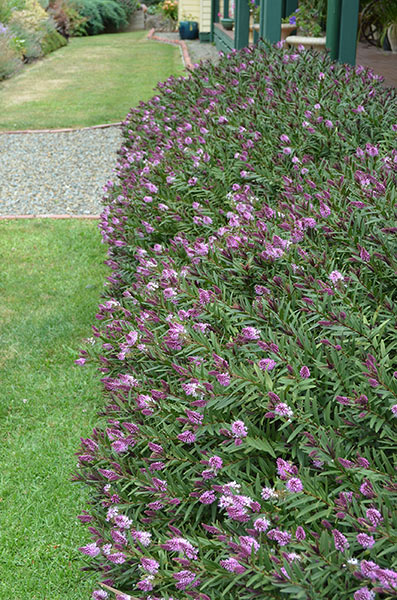
Hebes are resilient souls: they are resistant to salt-laden sea breezes, and so are sometimes planted as hedges in the coastal regions of the south-west of England and Australia. However ,the larger plants are only half-hardy, and won’t survive prolonged freezing. On the other hand, I have several in pots in my garden that have shrugged off a few sub-zero nights, so it may depend on how exposed they are.

Photo Three by https://plantgrowers.blob.core.windows.net/files/Garden/lbi-h-hedge-withan-edge-003.jpg

A very fine Hebe hedge in Australia (Photo Three)

As you might expect, a plant that is so varied and wide-spread has many uses in its native country. In New Zealand Hebe stricta is known as Koromiko and the unopened leaves and buds were chewed as a cure for dysentery by the Maori people. Dried leaves were apparently sent to New Zealand soldiers during both World Wars as a cure for stomach problems. The plant is said to contain a chemical that reduces peristalsis: this would combat the water loss that is the real killer in diseases such as cholera and dysentery. However, as diarrhoea is the body’s way of ridding itself of the toxins created by the bacteria, the use of the plant would need to be coupled with something that would attack the problem at source. I’m always slightly alarmed when people use drugs such as Immodium as a ‘cure’ for diarrhoea, when what they do is stop the need to go to the toilet without tackling the bugs that are causing the problem in the first place. I remember someone taking them like sweeties on one of my more exotic trips, and being unable  to go to the toilet for a week as a result, so be warned…

There is a rather lovely children’s song in the Maori language called ‘Koromiko’, which you can hear here. The lyrics in English are as follows:

Koromiko, Karaka, Tī Kouka
The trees of the forest
Tarata, Ngaio, Tōtara
The trees of the forest

Look at the flowers
Look at the leaves
This one is different from that one
They all differ, they all differ.

The Karaka is the New Zealand Laurel tree, and is endemic to that country. The Ti Kouka is the cabbage tree or cordyline, a popular pot plant in the UK. The Tarata is the lemonwood (Pittosporum eugenioides) and a very fine plant it is too.

Photo Five (Tarata) by By Rudolph89 - Own work, CC BY-SA 3.0, https://commons.wikimedia.org/w/index.php?curid=15773056

The leaves of the lemonwood, or Tarata (Photo Four)

The Ngaio is also called the mousehole tree (Myoporum laetum) and the New Zealand writer Ngaio Marsh was named for the plant.

Photo Five (Ngaio flower) by By Avenue - Own work, CC BY-SA 3.0, https://commons.wikimedia.org/w/index.php?curid=13534790

Flower of the Ngaio (Photo Five)

And, finally, the Totara is a magnificent tree that grows only in New Zealand.

Totara tree (Podocarpus totara) (Public Domain)

All this has made me very eager to pack a bag and head for the Antipodes. What a magnificent and varied flora.

It occurs to me that  I’ve had Hebes in my garden for years without knowing about their cultural importance in New Zealand (or indeed that they even came from that country). Our gardens can be such rich sources of interest and wonder. My patch is a veritable United Nations of plants, all getting along and providing nectar and food for my invertebrate and ornithological visitors. If only all humans could be as good natured and useful.

But, back to the Hebe.

I have not been able to find any culinary uses for Hebe, but there is a variety called ‘Rhubarb and Custard’, so that will have to do for now.

Photo Six (Rhubarb and Custard) by https://www.rhs.org.uk/Plants/320219/Hebe-Rhubarb-and-Custard/

Hebe Rhubarb and Custard (Photo Six)

And to round up the post today, I present to you a poem that fairly drips homesickness. The poet, Dora Wilcox, was born in Christchurch, New Zealand, but spent the years leading up to and including the First World War in London, where she obviously didn’t feel at home. Later, she lived in Sydney Australia. Wilcox died in 1953, having won an award for a poem commemorating the opening of the Commonwealth Parliament in 1927. While it is undoubtedly not the best poem I have ever featured here (I find it rather mannered and in need of a good editor), it does have a sense of poignant yearning that I find rather appealing. See what you think.

In London

When I look out on London’s teeming streets,
On grim grey houses, and on leaden skies,
My courage fails me, and my heart grows sick,
And I remember that fair heritage
Barter’d by me for what your London gives.
This is not Nature’s city: I am kin
To whatsoever is of free and wild,
And here I pine between these narrow walls,
And London’s smoke hides all the stars from me,
Light from mine eyes, and Heaven from my heart.

For in an island of those Southern seas
That lie behind me, guarded by the Cross
That looks all night from out our splendid skies,
I know a valley opening to the East.
There, hour by hour, the lazy tide creeps in
Upon the sands I shall not pace again —
Save in a dream, — and, hour by hour, the tide
Creeps lazily out, and I behold it not,
Nor the young moon slow sinking to her rest
Behind the hills; nor yet the dead white trees
Glimmering in the starlight: they are ghosts
Of what has been, and shall be never more.
No, never more!

Nor shall I hear again
The wind that rises at the dead of night
Suddenly, and sweeps inward from the sea,
Rustling the tussock, nor the wekas’ wail
Echoing at evening from the tawny hills.
In that deserted garden that I lov’d
Day after day, my flowers drop unseen;
And as your Summer slips away in tears,
Spring wakes our lovely Lady of the Bush,
The Kowhai, and she hastes to wrap herself
All in a mantle wrought of living gold;
Then come the birds, who are her worshippers,
To hover round her; tuis swift of wing,
And bell-birds flashing sudden in the sun,
Carolling: Ah! what English nightingale,
Heard in the stillness of a summer eve,
From out the shadow of historic elms,
Sings sweeter than our Bell-bird of the Bush?
And Spring is here: now the Veronica,
Our Koromiko, whitens on the cliff,
The honey-sweet Manuka buds, and bursts
In bloom, and the divine Convolvulus,
Most fair and frail of all our forest flowers,
Stars every covert, running riotous.
O quiet valley, opening to the East,
How far from this thy peacefulness am I!
Ah me, how far! and far this stream of Life
From thy clear creek fast falling to the sea!

Yet let me not lament that these things are
In that lov’d country I shall see no more;
All that has been is mine inviolate,
Lock’d in the secret book of memory.
And though I change, my valley knows no change.
And when I look on London’s teeming streets,
On grim grey houses, and on leaden skies,
When speech seems but the babble of a crowd,
And music fails me, and my lamp of life
Burns low, and Art, my mistress, turns from me, —
Then do I pass beyond the Gate of Dreams
Into my kingdom, walking unconstrained
By ways familiar under Southern skies;
Nor unaccompanied; the dear dumb things
I lov’d once, have their immortality.
There too is all fulfilment of desire:
In this the valley of my Paradise
I find again lost ideals, dreams too fair
For lasting; there I meet once more mine own
Whom Death has stolen, or Life estranged from me, —
And thither, with the coming of the dark,
Thou comest, and the night is full of stars.

Dora Wilcox (1873-1953)

Photo Credits

Photo One (Hebe albicans) by By Alan Pascoe – Own work, CC BY-SA 3.0, https://commons.wikimedia.org/w/index.php?curid=881878

Photo Two by By Kurt Stüber [1] [GFDL (http://www.gnu.org/copyleft/fdl.html) or CC-BY-SA-3.0 (http://creativecommons.org/licenses/by-sa/3.0/)], via Wikimedia Commons

Photo Three by https://plantgrowers.blob.core.windows.net/files/Garden/lbi-h-hedge-withan-edge-003.jpg

Photo Four (Tarata) by By Rudolph89 – Own work, CC BY-SA 3.0, https://commons.wikimedia.org/w/index.php?curid=15773056

Photo Five (Ngaio flower) by By Avenue – Own work, CC BY-SA 3.0, https://commons.wikimedia.org/w/index.php?curid=13534790

Photo Six (Rhubarb and Custard) by https://www.rhs.org.uk/Plants/320219/Hebe-Rhubarb-and-Custard/

Wednesday Weed – Red-Hot Poker

Every Wednesday, I hope to find a new ‘weed’ to investigate. My only criterion will be that I will not have deliberately planted the subject of our inquiry. Who knows what we will find…..

Red Hot Poker (Kniphofia uvaria)

Dear Readers, this week I was delighted to spot this red-hot poker growing in a garden in Muswell Hill, and looking about as exotic as any plant has a right to do. I love the way that the orange colour complements the red brick wall of the rather splendid house behind it, and the way that the flowers were beaded with rain didn’t hurt either.

In its native South Africa, this plant is known as torch lily, and the flowerheads can reach up to five feet in height.Red-coloured flowers are often bird-pollinated, and in South Africa sunbirds are common visitors, but in the UK bumblebees also love the long trumpet-shaped flowers.

Photo One by By Alandmanson (Own work) [CC BY-SA 4.0 (https://creativecommons.org/licenses/by-sa/4.0)], via Wikimedia Commons

Malachite sunbird (Nectarinia famosa) on red hot poker (Photo One)

The Table Mountain Beauty butterfly (Aeropetes tulbaghia) also pollinates the flower, particularly in the Fynbos region of South Africa, and is unusual in preferring red flowers over the usual paler blooms. In his lovely blog ‘The Fynbos Guy’, the author mentions that wearing a red shirt will result in you being ‘buzzed’ by these beautiful insects.

Photo Two by The Fymbos Guy at http://thefynbosguy.com/summer-time-table-mountain-beauty/

A Table Mountain Beauty (Aeropetes tulbaghia) Photo Two

The plant has been introduced all over the world: in the New World, orioles and hummingbirds have taken a shine to it, and in Australia it has become something of an environmental hazard to the native wild plants. It is clump-forming and vigorous, and I can imagine how it could easily dominate in a fragile habitat.

Photo One by By Toby Hudson - Own work, CC BY-SA 3.0, https://commons.wikimedia.org/w/index.php?curid=9374718

Clump of red hot pokers on Lake Jindabyne in Australia (Photo One)

Red-hot pokers belong to the subfamily Asphodeloideae , which includes such plants as aloes and asphodels. There has been much debate about where exactly the plant belongs, however, and it is something of a puzzle. It certainly doesn’t share much of a superficial resemblance to its close relatives: it’s not a succulent, like the aloes, and it doesn’t have the flowers of the asphodels. What defines the subfamily is a chemical compound called anthraquinone, which is used in laxatives and in batteries. I suspect you’d have to be very careful to make sure you were taking the correct version of the compound.

As you would expect for such a stunning plant, there are many cultivated varieties, in a range of colours. However, it’s the gradation of colour that gives the plant its common name, pale yellow at the bottom through to peachy-red at the top. The other colours don’t have the same effect, pretty as they are. I suspect that they may not have the same hardiness either: we’ve had snow and sub-zero temperatures for several days here in London, but the Muswell Hill plant is still going strong. Once established, red-hot pokers have a reputation as being tough plants to kill, but an article in The Telegraph suggests that although Kniphofia was popular before the Second World War, many interesting varieties of red-hot poker were  destroyed during the Dig For Victory campaign, when people dug up their flower gardens to grow food. It’s interesting to see that it is now back ‘in fashion’.

By the way, the tricky Latin name Kniphofia is pronounced ‘Nee-FOF-ee-a’ and is named after Johann Hieronymous Kniphof, an 18th century German physicist and botanist.

Photo Three by By Mork the delayer at en.wikipedia - Transferred from en.wikipedia to Commons by User:Kelly using CommonsHelper., Attribution, https://commons.wikimedia.org/w/index.php?curid=16044760

A yellow kniphofia. Pretty, but not a red-hot poker (Photo Three)

In South Africa the nectar-filled blooms are sometimes eaten by humans, and are said to taste like honey.

Medicinally, the flowers of some Kniphofia species have been used to repel snakes and an infusion of the roots has been used to treat chest disorders. In Zimbabwe the powdered roots of Kniphofia are mixed with food to treat infertility in women.

In Lesotho, the plant was considered to be a charm against lightning, and was therefore grown close to habitation. However, in the UK at least one person believes that they are unlucky according to the Plant Lore website, and according to Plant Lives, it’s believed that if red-hot poker flowers in the autumn it means a death in the family. Then again, my Mum believes that green is an unlucky colour, and my Nan believed that putting new shoes on the table would bring misfortune, so I guess there’s always something.

It strikes me that superstitions grow from our fundamental need to explain either bad luck (in order to prevent it from happening again) or good luck (to make sure we get more of it). But this behaviour is not limited to humans. In some of his experiments, the behaviourist B.F Skinner provided pigeons with food that dropped out of a container at purely random intervals. He noted that the pigeons would repeat the behaviour that occurred when the food arrived in an attempt to get more. So, if a bird happened to be preening when a pellet dropped, it would preen obsessively to see if it could generate more food. Many other species of animal, from pigs to dogs to poor imprisoned primates, demonstrate the same tendencies. I wonder if this is the root of all religion: the need to find a reason for our mixed fortunes in a volatile, uncertain world.

But, as usual, I digress.

Now, as you know I like to finish my pieces with an artwork, or a poem, or preferably both, and this week my search has led me back to Les Murray (I featured his poem ‘The Cows on Killing Day’ in my piece on lucerne a few months ago). What a remarkable poet he is! As you know, I don’t cut and paste the complete poems of living authors, but here is a taste of ‘The Cowladder Stanzas’ from ‘New Selected Poems’. For the rest of it, you (and I ) will need to buy the book.

The Cowladder Stanzas

Not from a weather direction

black cockatoos come crying over

as unflapping as Bleriot monoplanes

to crash in pine tops for the cones.


Young dogs, neighbours’ dogs

across the creek, bark, chained

off the cows, choked off play, bark

untiring as a nightsick baby, yap

milking times to dark, plead

ute-dancing dope-eye dogs.


Red-hot pokers up and out

of their tussock. Kniphofia flowers

overlapping many scarlet jubes

form rockets on a stick.

Ignition’s mimed by yellow petticoats.


Like all its kind

Python has a hare lip

through which it aims its tongue

at eye-bursting Hare.

And if this hasn’t whetted your appetite for more of this precise, explosive poetry, nothing will.

Photo Credits

Photo One by  Alandmanson (Own work) [CC BY-SA 4.0 (https://creativecommons.org/licenses/by-sa/4.0)], via Wikimedia Commons

Photo Two by The Fymbos Guy at http://thefynbosguy.com/summer-time-table-mountain-beauty/

Photo Three by By Mork the delayer at en.wikipedia – Transferred from en.wikipedia to Commons by User:Kelly using CommonsHelper., Attribution, https://commons.wikimedia.org/w/index.php?curid=16044760


Wednesday Weed – Japanese Aralia

Every Wednesday, I hope to find a new ‘weed’ to investigate. My only criterion will be that I will not have deliberately planted the subject of our inquiry. Who knows what we will find…..

Japanese Aralia(Fatsia japonica)

Dear Readers, as I walked home  through Muswell Hill on a cold Sunday morning, I was surprised to hear the sound of buzzing, and to see not one but three bumblebees feeding from these sputnik-shaped flowers. Japanese aralia is an exotic, but as more and more bumblebee nests are surviving the winter it has become a valuable source of nectar and pollen. A  glance at the flowers put me in mind of ivy, which is not surprising as both are members of the Araliaceae family, and there is at least one hybrid between  this plant and an ivy.

Fruit of Japanese Aralia

The genus name ‘Fatsia’ comes from an old Japanese word for ‘eight’, and if you look at the leaves you’ll see that they usually have eight ‘fingers’ (though they can have seven, or nine). As you might guess from this, the plant is native to southern Japan and South Korea. The Japanese name for the plant is ‘Yatsude’, meaning ‘eight-hand’. Whatever the number of lobes, the leaves are evergreen, shiny, and rather attractive. However, as you can see in the photo below, even evergreens may have an ‘autumn’, when older leaves turn yellow and drop off – I have a viburnum in a pot which did this this year, to my horror. However, it’s now doing well, so I can breathe again.

A Fatsia leaf (one of the eight lobes is hidden, honest!)

Japanese aralia is a great plant for shady conditions and heavy soils, and so it should be a shoo-in for my north-facing, claggy-soiled garden, if only I had a bit more room. However, I have a very dark side-return which is currently home to potted camellias, a daphne and a climbing hydrangea, so maybe I will find a spot for one here (they’re hardy down to -14 degrees, so hopefully that should be ok). I am somewhat tempted by this new variety, though in my experience you’re often better off with the old faithfuls.

Fatsia japonica 'Spiders Web'

Fatsia japonica ‘Spider’s Web’ (Photo One)

I absolutely see the point of raising native flowers in some habitats: I have friends in the US and in Australia who do this, and I think that there’s a real need to support wildlife by growing the plants that evolved with them to be the perfect source of food and shelter. In London, though, there are already so many foreign species that I think it’s a case of deciding which will benefit creatures such as pollinators when no native plants are in flower, or available as food for larvae. For example, winter-flowering plants such as Mahonia and Fatsia fill a feeding gap for over-wintering bumblebee queens and for the nests that survive these days.

IMG_2356

Although Japanese aralia is sometimes known as the castor-oil plant, it is not related to the actual castor-oil plant (Ricinus communis), although the leaves are similar. This is important for several reasons, particularly because the ‘true’ castor-oil plant is extremely poisonous. You will sometimes find Fatsia japonica labelled as ‘false castor-oil plant’, to add to the confusion. This is why Latin names are so important -at least we all know that we’re talking about the same thing.

In Japan, the shoots of Fatsia japonica are harvested and used as a vegetable, and very tasty they look too…

By Alvesgaspar - Own work, CC BY-SA 3.0, https://commons.wikimedia.org/w/index.php?curid=9781610

An actual castor-oil plant(Ricinus communis) (Photo Two)

Japanese aralia has been used as an anti-inflammatory in Japan and Taiwan, and hence in the treatment of such conditions as osteoarthritis and rheumatism. In folklore those huge eight-pointed hand-shaped leaves were thought to repel devils, and the plant was grown on the north side of the house from whence these enemies were thought to come (though as this is presumably also the coldest side it seems like a bit of a risk for the plant.).

IMG_2364

Dear Readers, last week I described how the ginkgo trees in Japan were among the few to survive the bombings of Hiroshima and Nagasaki, and today I found this photo essay on the effects of those bombs. And here is a photo of the shadow of Fatsia japonica leaves left on a telegraph pole following the flash from the bomb at Hiroshima. What happened to the plant eventually is not recorded. At a time when the idea of nuclear war, so long considered unthinkable, has become a ‘viable option’ for some leaders of the Free World, it’s as well to stop to consider what it really means. Some of the other photos in the essay show exactly what happens when you drop a nuclear device on other human beings.

shadow2.gif (107026 bytes)

This photo was taken by the US Army following the bombing of Hiroshima. Note the shadow of the leaves on the telegraph pole.

And, following the disaster at Fukoshima, Japanese poets have also been concerned with the effects of the radiation released by natural forces. In the collection ‘Reverberations from Fukushima: 50 Japanese Poets Speak Out’, Setsuko Okubu, who lived in Fukushima, considers the effect of this devastating event on her home:

In “To My Home,” Setsuko Okubo affirms, “Our prime blessing is brought by the soil..inherited and guarded.” In the first and last stanzas, the repetition of the names of wild plants they used to gather serves as a litany.

To My Home

Butterbur sprouts, five-leaf aralia, fatsia sprouts, bracken, and parsley.
When the mountains are ready
for the sprouting of plants,
the rice fields are dug, and the fields are cultivated,
calves are born,
horses are pastured,
and chickens lay eggs.
It’s a season full of life.
In the fall
Ears of rice rustle.
The smell of rice heralds the harvest.

. . . . . . . . . . .

Then, “In a twinkle it vanished../ life-taking radiation —/ contaminated my home”

We had to slaughter the cows that we had tenderly watched over.
We abandoned our racehorses that we had raised with the utmost care,
left our houses, fields, and livestock, and evacuated.
We drift from shelter to shelter as refugees.

. . . . . . . . . . .

Spring has rolled around again.
Butterbur sprouts, five-leaf aralia, fatsia sprouts, bracken, and parsley.
They are waiting to be picked
on the desolate land.

My heart goes out to people everywhere who have to leave everything that they know and leave their homes, whether through natural disaster or war, drought or famine. It sometimes seems as if the whole world is on the move, and this will only increase as climate change makes areas uninhabitable. Building walls against others is no solution. We need to learn to live with people who are different from us, and we need to learn fast. We have always been the adaptable ape, and I hope this will stand us in good stead in the future, though some days I despair. But not today, because the bees are feeding on the Japanese aralia, and will go home with full stomachs to survive another day.

IMG_2348


Wednesday Weed – Ginkgo

Every Wednesday, I hope to find a new ‘weed’ to investigate. My only criterion will be that I will not have deliberately planted the subject of our inquiry. Who knows what we will find…..

Ginkgo (Maidenhair) tree in East Finchley cemetery

Dear Readers, my visit to East Finchley cemetery last week was the gift that just keeps on giving. I felt that this venerable tree deserved more than a few lines in a longer piece, and so this week I want to look at the ginkgo, a popular street and cemetery tree here in North London, and yet one which I have often hurried past. Before anyone gets over-excited, this is quite clearly not a ‘weed’ by any normal definition, but have you ever tried finding a ‘weed’ in mid-November which, after nearly four years of weekly posts, hasn’t been covered? Flexibility will be required from hereon in, I suspect.

Gingko is immediately identifiable from its leaves. No other living tree has fan-shaped foliage, but fossilised ginkgo leaves have been found from 270 million years ago. The tree existed at the same time as mare’s tail, which was a Wednesday Weed a few weeks ago, but, unlike that plant, poor ginkgo really is the last of its kind. There is nothing else alive that is remotely like it.

Once I spotted one ginkgo, I found them everywhere: at the end of Archway Road, in St Pancras and Islington Cemetery, and on Durham Road. But they are, in some ways, problematic. Ginkgo trees have separate sexes ( the technical term is dioecious), but each sex has some disadvantages as a street tree. The female trees produce a fruit which looks a little like an apricot (the name ‘ginkgo’ is said to come from a misspelling of the Japanese name for the plant, which means ‘silver apricot’) but if this falls and starts to rot, it is said to produce a smell that combines the odour of vomit with the stench of rancid butter. The pollen of the male trees, which naturally produce no fruit, is highly allergenic, and so not good for hay fever sufferers. Nonetheless, the tree is beautiful enough for groundskeepers everywhere to keep planting it.

Incidentally, among its many peculiarities is the fact that the male ginkgo produces sperm which is covered in tiny mobile hairs that enable it to move. In this, ginkgo is similar to mosses and algae, but completely different from flowering plants. It has several adaptations to a time before these competitors came along: for example, it grows very quickly to a  height of about 10 meters before extending any side shoots, which was probably because most plants at this time were ferns and horsetails, and so the need was to get as high as possible as quickly as possible, and then to shade out everybody else.

Photo One (Fossil gingko) by By User:SNP(upload to en:wikipedia) ; User:tangopaso (transfer to Commons) (English Wikipedia) [GFDL (http://www.gnu.org/copyleft/fdl.html) or CC-BY-SA-3.0 (http://creativecommons.org/licenses/by-sa/3.0/)], via Wikimedia Commons

A fossilised gingko leaf from the Eocene (56-33.9 million years ago) (Photo One)

Not only is the ginkgo a very ancient species, but individual trees are both resilient and long-lived. Six ginkgos which were within 2 kms of the epicentre of the Hiroshima atomic bomb blast survived, and are given the honorable name of ‘hibakujumoku’, or ‘survivor trees’.

At the Tsurugaoka Hachimangu Shinto shrine in Japan a giant ginkgo which had stood beside the staircase since the creation of the building in 1063 finally collapsed in 2010. A botanist who examined it declared that the trunk had rotted. It was thought that that was the end, until both the original tree stump and a piece of the tree planted nearby started to produce a fine crop of new leaves.

Ginkgo-reborn-2.jpg

Never write off a ginkgo! (Photo Two)

If you go into any chemist, you are likely to see herbal preparations with pictures of that distinctive fan-shaped leaf on the box. It is often marketed as a way of delaying the effects of old age, perhaps because the tree itself is so sprightly, and we hope to acquire some of its characteristics. It is said to be beneficial for macular degeneration, dementia, forgetfulness generally, ‘post-menopausal cognitive decline’ ( I guess that’s when I start a sentence and have no idea what I meant to say by the time I get to the end), post-stroke recovery, arterial disease and tinnitus. Oh that it did half of what it says on the packet, but sadly scientific trials have all currently drawn a blank. There is also some fear that if you are taking a blood-thinner such as warfarin or coumadin, overdoing it with the gingko will result in rather thinner blood than you were hoping for. On the other hand, Chinese doctors have been using ginkgo since 2800 BC, so I refuse to lose hope. The plant is certainly full of interesting chemicals such as amentoflavone (which can inhibit the uptake of certain medications) and ginkgolic acid, which is highly allergenic, so maybe these can be turned from ‘the dark side’.

IMG_2290

You might think that there would be nothing edible to be found on a ginkgo tree, what with all that talk of the smell of the fruit, but the seeds of the ginkgo (once the smelly stuff is removed) are a traditional food in both China and Japan. In particular, they form part of a celebratory dish called ‘Buddha’s Delight’ which is served at Chinese New Year, a time when a vegetarian diet is thought to bring good luck. And very tasty it looks too.

Boeddha's_Delight.jpg

Whilst researching this piece, I came across this painting by the Japanese artist Watanabe Shotei, and promptly fell in love with it. I like the way that the crow is framed, and the way that the autumn-yellow ginkgo leaves are scattering as she flies through them. This is very different from his other, more formal work, and I think that it sums up the mischievousness of the bird as it ploughs through the august foliage. Or maybe it’s just me.

Bloemen_en_vogels_door_Seitei

Flower and bird by Watanabe Shotei (Public Domain)

And finally, there is a belief that even in the shedding of its leaves, the ginkgo is not like other trees. Whilst the oak leaves and the maple leaves drop off one at a time, all the leaves from a ginkgo are said to fall in one night. I can’t say I’ve seen much evidence of that happening with the trees that I know, but maybe this is the case in harsher climates. The poet Howard Nemerov had this to say on the subject:

Late in November, on a single night

Not even near to freezing, the ginkgo trees

That stand along the walk drop all their leaves

In one consent, and neither to rain nor to wind

But as though to time alone: the golden and green

Leaves litter the lawn today, that yesterday

Had spread aloft their fluttering fans of light.

What strange communication occurs between these ancient trees, I wonder, and what complex combination of chemical signals would give rise to such a thing? The more I learn about trees, the less I know.


A Street Tree Harvest

IMG_2308

Dear Readers, the man a few doors along from me gets very frustrated with the crab apple street tree outside his house. In October and November you can see him sweeping up all the rotten fruit , and if you pause he will explain why he hates it.

  1. The fruit, when freshly fallen, is as hard as a ball-bearing, just waiting to catch out the unwary.
  2. The fruit quickly degenerates into a squishy mush, which is even more slippery  than the ball-bearing stage, and is rather unpleasant to walk on even if you don’t fall onto your derriere.
  3. If you leave the rotten and fermenting fruit, it attracts clouds of drowsy wasps.
  4. While the fruit is still on the tree, it attracts noisy and badly-behaved parakeets who add to the mess with their droppings.
What are you looking at?

A noisy and badly-behaved parakeet

Fruit trees as street trees can be problematic, because the fruit is attractive to all kinds of creatures that some people wouldn’t want on their doorstep.  I have no problem with the poor wasps, who are imbibing the last sweet thing that they’ll ever taste, and who could blame them for wanting to get a bit tipsy after a hard year of caterpillar-catching and grub-grooming. And I don’t have a problem with the parakeets either, who bring a touch of exotic beauty to the street.

IMG_2304

But then there’s the mess. It’s not a problem, generally, with cherry trees, because the fruit appears early and the thrushes and blackbirds eat every last morsel. But the autumn fruits can be something of a problem. After all, how much crab apple jelly can anybody eat? And even the more edible fruits can prove difficult to handle in their sheer abundance and generosity.  When I went on a street tree walk earlier this year, I visited a group of sand pear trees whose fruit was so succulent and heavy that it was bombarding the pavement and any cars that were parked underneath with a deluge of sticky-sweet puree. As you might remember from that piece, half the street wanted the trees cut down, and the other half wanted them preserved. Peace broke out when it was decided to do something radical and harvest the fruit to be turned into perry (the pear-based version of cider). It’s almost as if we have forgotten what fruit trees were originally planted for.

https://bugwomanlondon.com/wp-content/uploads/2017/05/img_0622.jpg

A sand pear tree off Holloway Road in North London

I was very heartened to read in Time Out this week that a group of people are harvesting the apples from street trees, and trees growing on public land, to make cider and to give the fruit to foodbanks and organisations that prepare meals for isolated people. Although crab apples are not immediately edible(at least for humans), tons of perfectly good fruit are wasted every year because nobody picks it. There must be a better, more connected way to bring the hungry together with their food, and to make good use of nature’s bounty, and there are a lot of interesting experiments going on to do just that.

IMG_2296

The fruit on my garden crab apple – popular with the thrushes (when everything else has been eaten)

And it occurs to me that where a tree is just plain messy at certain times of the year, it wouldn’t hurt me to dig out my broom and give the man who lives a few houses down a hand. It’s so easy to become territorial in a row of houses, and to think that your responsibility ends at the edge of your garden wall. That might be strictly true, but it’s not a community I’d want to live in. When we had snow a few years ago, my husband cleared a path not just in front of our house, but for a good distance in either direction. He grew up in Canada and knows how to clear snow, but also recognises that it’s easier for some of us to do heavy work than it is for others. And yes, I know the old story that you can be sued if you clear your snow and someone falls over anyway, but from my research that seems only to apply if you’ve done something really stupid (like try to wash it away so that it freezes into an ice-rink).

IMG_2309

So, as autumn turns into winter, and the sun seems to be low on the horizon all day, I’m determined to be more aware of the bounty around me. There are some handy maps that you can use, in London at least, to look out where your local fruit trees might be, and to keep an eye open for any seasonal bonanzas – here, for example, is one for Hackney, provided by the organisation Hackney Harvest. For a general map of street trees in London, have a look here: you can enter your postcode, and it will tell you what’s growing in your area. All the usual provisos about health and safety apply, but I’d be willing to bet that if you passed by some of these trees in the autumn, the fruit would be literally dropping off. Wash it well though, you know how keen some councils are on spraying things.

IMG_2307

I’ve written before about how ‘plant-blind’ many of us have become. Whereas a generation or two back plants were in relationship with us, whether as medicines, or food, or as food for the imagination, nowadays it’s so easy to barely notice them. Writing the blog has opened my eyes a bit, but there is still so much more to notice and to learn about. I have grown to love the diverse plant community around my home, and to value it for the way that it roots me in place, and in history. If you are feeling a bit stale or lacklustre, put on your coat and hat and gloves and go for a fifteen minute walk. I guarantee that, if you walk slowly and pay attention, you’ll see something that piques your interest and takes you out of yourself. And maybe you’ll even find something to take home and turn into a crumble.

IMG_2292


Wednesday Weed – Strawberry Tree

Every Wednesday, I hope to find a new ‘weed’ to investigate. My only criterion will be that I will not have deliberately planted the subject of our inquiry. Who knows what we will find…..

Fruit of the strawberry tree (Arbutus unedo)

Dear Readers, I spotted this tree in East Finchley cemetery last week and, although it is most definitely not a weed, I decided to indulge myself and find out a bit more about it. After all, it is native to Great Britain (albeit only in a tiny corner of south-western Ireland, where it seems to have survived the last ice age) and is a popular street tree – in ‘London’s Street Trees‘ Paul Wood points out that it can be found in Bermondsey, Haggerston, Vauxhall and Holloway, and that there is even an Arbutus Street in Dalston. The Irish connection gave it its alternate names of ‘Irish strawberry tree’ or ‘cane apple’ (from caithne, the Irish name for the tree). Elsewhere, it can be found around the Mediterranean and Western Europe.

The tree is not related in any way to the strawberry that we have for dessert: in fact, it’s a member of the heather family (Ericaceae), something that can be seen more clearly in the flowers than in the fruits. The tree bears both simultaenously, which makes for an attractive and long-lasting display.

Photo One (Flowers) by By muffinn from Worcester, UK (Ameixial - strawberry tree Arbutus unedo flowers) [CC BY 2.0 (http://creativecommons.org/licenses/by/2.0)], via Wikimedia Commons

Strawberry Tree flowers (Photo One)

The fruits are edible, but, much like the avocados that I sometimes buy, they take twelve months to ripen and then spoil very quickly. The species name unedo means ‘I eat only one’, and is attributed to Pliny the Elder. Whether he meant that one was enough, or that one was so delicious that no more were required is open for debate. I now regret that, in the interests of citizen science, I didn’t try one. There were certainly enough of them about.

IMG_2287

The fruit is can be used in a variety of ways: here is a rather attractive crumble cake, for example.

Photo Two (Cake) by By Nzfauna - Own work, CC BY-SA 4.0, https://commons.wikimedia.org/w/index.php?curid=39656416

Strawberrry tree crumble cake (Photo Two)

However, as is so often the case, the main use of the fruit turns out to be in the making of alcoholic beverages. In Portugal, the wild fruit is used to make Medronho a 48% proof brandy that is drunk at breakfast to ‘waken the spirits’. In Albania it’s used to make rakia (not to be confused with the aniseed flavoured raki) and can be up to 90% proof. All I can say is that these folk are made of much stronger stuff than me. One glass of prosecco and I’m dancing on the table.

For something slightly less alcoholic, here is a recipe for Irish Strawberry Liquer from the splendid Talk of Tomatoes blog.

The fruit can also be used to make jam, and here is a recipe from the Maremma region of Italy which sounds rather splendid.

IMG_2284

What with its fruit and flowers and evergreen foliage, the strawberry tree is a great tree for a small garden, where every plant has to earn its keep. The flowers are pollinated by bees, birds like the fruit (even if we are wary of it) and it has a variety of ecosystem advantages: it can grow in very poor soil, and helps to stabilise it: it is salt-tolerant, and so useful for coastal gardens:it’s fire-resistant: and the thick leaf-cover helps to protect birds and insects during the winter.

Pliny did, however, note that it should not be kept close to bee-hives, for the nectar gives a bitter flavour to honey.

The strawberry tree forms part of the coat of arms of the Spanish city of Madrid, which shows a bear eating the fruits from the plant. There are still about 230 brown bears in the Cantabrian mountains of Spain, and I love to think of them stretching up to eat the berries. There is some indication that the bears may also eat the fermented fruit and collapse in an alcoholic stupor, much as they do in other places where such bounty is available.

In a complete digression, I remember seeing the paw prints of a sloth bear in a forest in India, and being amazed at how human they looked, just like the bare feet of a small child. These creatures resemble us in many ways.

Photo Three (coat of arms) by By Valadrem (http://valadrem.blogspot.com) [GFDL (http://www.gnu.org/copyleft/fdl.html), CC-BY-SA-3.0 (http://creativecommons.org/licenses/by-sa/3.0/) or CC BY-SA 2.5-2.0-1.0 (https://creativecommons.org/licenses/by-sa/2.5-2.0-1.0)], via Wikimedia Commons

Coat of arms of Madrid (Photo Three)

In Italy, the tree, with its red fruit, white flowers and green leaves (the colours of the Italian flag), was seen as a symbol of the unification of the country during the 19th Century.

Medicinally, the leaves of the  strawberry tree have been used for a wide variety of purposes – they are said to be astringent, diuretic, urinary anti-septic, antiseptic, intoxicant, rheumatism, tonic, and have more recently been used in the therapy of hypertension and diabetes. The leaves certainly contain quercetin, which is an anti-oxidant, and are said to have anti-inflammatory properties.

IMG_2285

Now, I have referred previously to Hieronymos Bosch’s painting ‘The Garden of Earthly Delights’, and the way that folk can be seen to be wrestling with strawberries, carrying strawberries, and even eating strawberries. I took it for granted that the fruit in question was from the wild strawberry. However, the painting was recorded in the inventory of the Spanish monarch as ‘La Pintura del Madroño‘ – ‘the painting of the strawberry tree’. Have a  look at those giant fruits and see what you think. I suspect that I was right the first time.

https://bugwomanlondon.com/wp-content/uploads/2017/05/bosch_hieronymus_-_the_garden_of_earthly_delights_central_panel_-_detail_strawberry.jpg

Wild Strawberry or fruit from Strawberry Tree? I think the former….(Public Domain)

And finally to our poem. I am indebted to Greene Deane at the Eat the Weeds website for finding this Irish folk song on the subject of the Arbutus, or strawberry tree. Do pop over to the blog for fascinating information on all things foragable (this may be a new word). Like so many folk songs, it starts well enough, but gets rather less pleasant as we approach the end.

My Love’s An Arbutus

My love’s an arbutus
By the borders of Lene,
So slender and shapely
In her girdle of green.
And I measure the pleasure
Of her eye’s sapphire sheen
By the blue skies that sparkle
Through the soft branching screen.

But though ruddy the berry
And snowy the flower
That brighten together
The arbutus bower,
Perfuming and blooming
Through sunshine and shower,
Give me her bright lips
And her laugh’s pearly dower.

Alas, fruit and blossom
Shall lie dead on the lea,
And Time’s jealous fingers
Dim your young charms, Machree.
But unranging, unchanging,
You’ll still cling to me,
Like the evergreen leaf
To the arbutus tree.

Photo Credits

Photo One (Flowers) by By muffinn from Worcester, UK (Ameixial – strawberry tree Arbutus unedo flowers) [CC BY 2.0 (http://creativecommons.org/licenses/by/2.0)], via Wikimedia Commons

Photo Two (Cake) by By Nzfauna – Own work, CC BY-SA 4.0, https://commons.wikimedia.org/w/index.php?curid=39656416

Photo Three (coat of arms) by By Valadrem (http://valadrem.blogspot.com) [GFDL (http://www.gnu.org/copyleft/fdl.html), CC-BY-SA-3.0 (http://creativecommons.org/licenses/by-sa/3.0/) or CC BY-SA 2.5-2.0-1.0 (https://creativecommons.org/licenses/by-sa/2.5-2.0-1.0)], via Wikimedia Commons


In East Finchley Cemetery

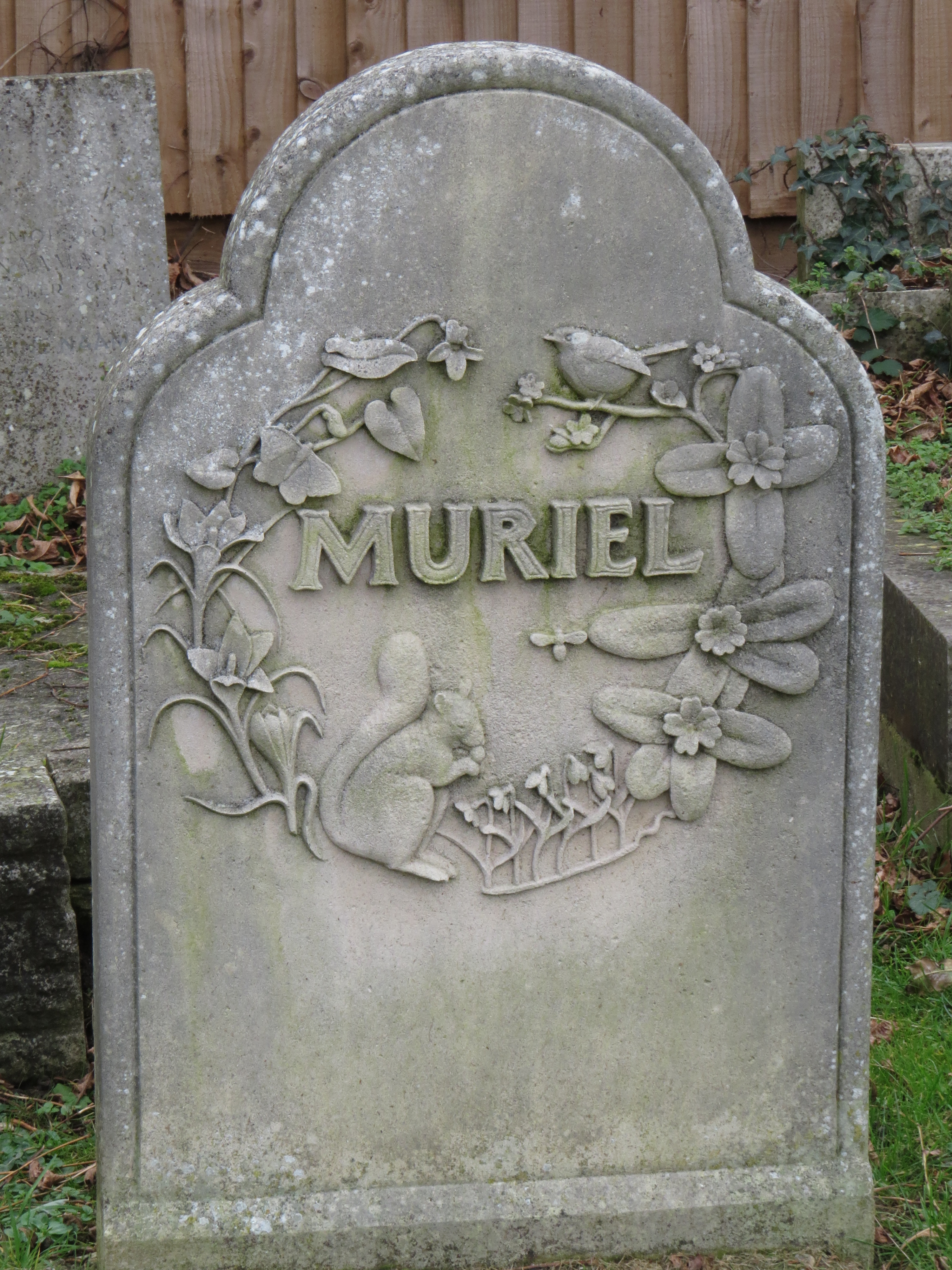
My favourite gravestone


Dear Readers, those of you who have been following this blog for a while will know that I’m a great fan of cemeteries. My heart is already given to St Pancras and Islington Cemetery with its Victorian trees, tumbledown tombs and colony of feral foxes, but I occasionally like to walk in East Finchley cemetery. This is a much more manicured, controlled space, but it has some spectacular specimen trees, and is a haven for birds.

I spend a lot of time listening as I walk – I find it helps me to tune in to what’s going on. There are lots of conifers: cypresses and spruces, pines and fir trees. They vibrate with the twitterings of small birds. I see goldcrests and long-tailed tits, and hear the scolding of blue tits. None of them stay long enough for me to get a photo, but it’s enough to know that they’re there, working their way through the needles.

There’s the sing-song squawking of ring-necked parakeets, the cackling of magpies, the cawing of ever-present crows. The goldfinches sound like little bells. There’s a flight of finches at the top of one of the big, bare trees, but they’re too far away for me to see what they are. When I get home, I see that they are most probably greenfinches, at least judging from the heavy beaks and the gold wing bar that I can see on one of the wings. These birds were hit very hard by a parasitic disease (Trichomonosis) a few years ago, and the British Trust for Ornithology noted a decrease in the number of gardens who were visited by the birds of 40%. So, it’s cause for celebration if they’re recovering. Fingers crossed.

There’s a theme of wings in the cemetery. Secretly, I always wished that I could fly, and our myths and legends are full of humans who took to the air, from Icarus to the angels. We seem to want the freedom of the air, and perhaps also a release from our heavy, earthbound bodies.

I find the garden of remembrance, where the sound of running water is added to the bird calls. There are still a few last roses in bloom, but mostly they are now well-pruned and dormant, waiting for spring. I sit on one of the benches and wait to see what will happen. Nothing does, except that I notice how the golden of the leaves on some silver birch is offset by the darkness of the firs behind it, and how the yellow foliage on the topiary box bushes make them look as if they’re touched by sunshine.

When I am walking, I often think that something will happen, and then I’ll know that it’s time to go home. There’s often a moment when I think ‘Aha, this what I was meant to see/hear/smell’. I am, I suppose, waiting for a sense of completion, and permission, a sense of closure. But what will it be this time?

I walk along a path towards the crematorium, and am stopped in my tracks by the waves of scent coming from a most modest little bush on one of the graves. I have to stop, bend down, and take a good long sniff. We think we know what a rose smells like, but there are subtle differences: some perfumes have a lemony edge, some are deep and spicy. This little rose is pure floral, essence of rose.

I take a little path along the very edge of the cemetery and, as I meander along, I have a feeling of being watched. Who, or what, is it? And there, perched stock-still on one of the gravestones is a squirrel. I laugh out loud, because he looks so much like a glove puppet. And there he sits, unmoving, as I walk along the path and then away. While every other squirrel scurries away at my approach, this one seems to believe that if he sits still, I won’t see him. As he looks plump and confident, it seems to be a strategy that’s served him well.

Once I’ve laughed with delight, I know that my job here is done and I can head home, but my eyes are attracted (much like a magpie’s) to some bright red fruit on the ground. I have found a strawberry tree (Arbutus unedo), a member of the heather family. The fruits look delicious, and are apparently edible fresh, although they bruise very easily. I love the tableau that they make amidst the sedum and the grasses.

And then, just as I turn for home, I see a jay perched on another gravestone. How I love these brownish-pink crows with their electric-blue wing feathers.They are everywhere in the cemetery, gathering acorns that they’ll bury for the winter. This one watches me and then flies off on rounded wings, emitting an alarming cackle.

So now I’m surfeited with wonders and can head for home. As I cross the road outside the cemetery I see a 143 bus in the distance and head towards the bus stop at a brisk but sensible trot – I still have my camera round my neck and so I don’t want to do anything foolish like fall flat on my face. Just as I reach the stop the bus pulls away, and I plump down onto a seat, defeated.

An elderly man passes me a few minutes later, and smiles.

‘Next time’, he says, ‘you’ll have to fly’.