Wednesday Weed – Ginkgo

Every Wednesday, I hope to find a new ‘weed’ to investigate. My only criterion will be that I will not have deliberately planted the subject of our inquiry. Who knows what we will find…..

Ginkgo (Maidenhair) tree in East Finchley cemetery

Dear Readers, my visit to East Finchley cemetery last week was the gift that just keeps on giving. I felt that this venerable tree deserved more than a few lines in a longer piece, and so this week I want to look at the ginkgo, a popular street and cemetery tree here in North London, and yet one which I have often hurried past. Before anyone gets over-excited, this is quite clearly not a ‘weed’ by any normal definition, but have you ever tried finding a ‘weed’ in mid-November which, after nearly four years of weekly posts, hasn’t been covered? Flexibility will be required from hereon in, I suspect.

Gingko is immediately identifiable from its leaves. No other living tree has fan-shaped foliage, but fossilised ginkgo leaves have been found from 270 million years ago. The tree existed at the same time as mare’s tail, which was a Wednesday Weed a few weeks ago, but, unlike that plant, poor ginkgo really is the last of its kind. There is nothing else alive that is remotely like it.

Once I spotted one ginkgo, I found them everywhere: at the end of Archway Road, in St Pancras and Islington Cemetery, and on Durham Road. But they are, in some ways, problematic. Ginkgo trees have separate sexes ( the technical term is dioecious), but each sex has some disadvantages as a street tree. The female trees produce a fruit which looks a little like an apricot (the name ‘ginkgo’ is said to come from a misspelling of the Japanese name for the plant, which means ‘silver apricot’) but if this falls and starts to rot, it is said to produce a smell that combines the odour of vomit with the stench of rancid butter. The pollen of the male trees, which naturally produce no fruit, is highly allergenic, and so not good for hay fever sufferers. Nonetheless, the tree is beautiful enough for groundskeepers everywhere to keep planting it.

Incidentally, among its many peculiarities is the fact that the male ginkgo produces sperm which is covered in tiny mobile hairs that enable it to move. In this, ginkgo is similar to mosses and algae, but completely different from flowering plants. It has several adaptations to a time before these competitors came along: for example, it grows very quickly to a  height of about 10 meters before extending any side shoots, which was probably because most plants at this time were ferns and horsetails, and so the need was to get as high as possible as quickly as possible, and then to shade out everybody else.

Photo One (Fossil gingko) by By User:SNP(upload to en:wikipedia) ; User:tangopaso (transfer to Commons) (English Wikipedia) [GFDL (http://www.gnu.org/copyleft/fdl.html) or CC-BY-SA-3.0 (http://creativecommons.org/licenses/by-sa/3.0/)], via Wikimedia Commons

A fossilised gingko leaf from the Eocene (56-33.9 million years ago) (Photo One)

Not only is the ginkgo a very ancient species, but individual trees are both resilient and long-lived. Six ginkgos which were within 2 kms of the epicentre of the Hiroshima atomic bomb blast survived, and are given the honorable name of ‘hibakujumoku’, or ‘survivor trees’.

At the Tsurugaoka Hachimangu Shinto shrine in Japan a giant ginkgo which had stood beside the staircase since the creation of the building in 1063 finally collapsed in 2010. A botanist who examined it declared that the trunk had rotted. It was thought that that was the end, until both the original tree stump and a piece of the tree planted nearby started to produce a fine crop of new leaves.

Ginkgo-reborn-2.jpg

Never write off a ginkgo! (Photo Two)

If you go into any chemist, you are likely to see herbal preparations with pictures of that distinctive fan-shaped leaf on the box. It is often marketed as a way of delaying the effects of old age, perhaps because the tree itself is so sprightly, and we hope to acquire some of its characteristics. It is said to be beneficial for macular degeneration, dementia, forgetfulness generally, ‘post-menopausal cognitive decline’ ( I guess that’s when I start a sentence and have no idea what I meant to say by the time I get to the end), post-stroke recovery, arterial disease and tinnitus. Oh that it did half of what it says on the packet, but sadly scientific trials have all currently drawn a blank. There is also some fear that if you are taking a blood-thinner such as warfarin or coumadin, overdoing it with the gingko will result in rather thinner blood than you were hoping for. On the other hand, Chinese doctors have been using ginkgo since 2800 BC, so I refuse to lose hope. The plant is certainly full of interesting chemicals such as amentoflavone (which can inhibit the uptake of certain medications) and ginkgolic acid, which is highly allergenic, so maybe these can be turned from ‘the dark side’.

IMG_2290

You might think that there would be nothing edible to be found on a ginkgo tree, what with all that talk of the smell of the fruit, but the seeds of the ginkgo (once the smelly stuff is removed) are a traditional food in both China and Japan. In particular, they form part of a celebratory dish called ‘Buddha’s Delight’ which is served at Chinese New Year, a time when a vegetarian diet is thought to bring good luck. And very tasty it looks too.

Boeddha's_Delight.jpg

Whilst researching this piece, I came across this painting by the Japanese artist Watanabe Shotei, and promptly fell in love with it. I like the way that the crow is framed, and the way that the autumn-yellow ginkgo leaves are scattering as she flies through them. This is very different from his other, more formal work, and I think that it sums up the mischievousness of the bird as it ploughs through the august foliage. Or maybe it’s just me.

Bloemen_en_vogels_door_Seitei

Flower and bird by Watanabe Shotei (Public Domain)

And finally, there is a belief that even in the shedding of its leaves, the ginkgo is not like other trees. Whilst the oak leaves and the maple leaves drop off one at a time, all the leaves from a ginkgo are said to fall in one night. I can’t say I’ve seen much evidence of that happening with the trees that I know, but maybe this is the case in harsher climates. The poet Howard Nemerov had this to say on the subject:

Late in November, on a single night

Not even near to freezing, the ginkgo trees

That stand along the walk drop all their leaves

In one consent, and neither to rain nor to wind

But as though to time alone: the golden and green

Leaves litter the lawn today, that yesterday

Had spread aloft their fluttering fans of light.

What strange communication occurs between these ancient trees, I wonder, and what complex combination of chemical signals would give rise to such a thing? The more I learn about trees, the less I know.


A Street Tree Harvest

IMG_2308

Dear Readers, the man a few doors along from me gets very frustrated with the crab apple street tree outside his house. In October and November you can see him sweeping up all the rotten fruit , and if you pause he will explain why he hates it.

  1. The fruit, when freshly fallen, is as hard as a ball-bearing, just waiting to catch out the unwary.
  2. The fruit quickly degenerates into a squishy mush, which is even more slippery  than the ball-bearing stage, and is rather unpleasant to walk on even if you don’t fall onto your derriere.
  3. If you leave the rotten and fermenting fruit, it attracts clouds of drowsy wasps.
  4. While the fruit is still on the tree, it attracts noisy and badly-behaved parakeets who add to the mess with their droppings.
What are you looking at?

A noisy and badly-behaved parakeet

Fruit trees as street trees can be problematic, because the fruit is attractive to all kinds of creatures that some people wouldn’t want on their doorstep.  I have no problem with the poor wasps, who are imbibing the last sweet thing that they’ll ever taste, and who could blame them for wanting to get a bit tipsy after a hard year of caterpillar-catching and grub-grooming. And I don’t have a problem with the parakeets either, who bring a touch of exotic beauty to the street.

IMG_2304

But then there’s the mess. It’s not a problem, generally, with cherry trees, because the fruit appears early and the thrushes and blackbirds eat every last morsel. But the autumn fruits can be something of a problem. After all, how much crab apple jelly can anybody eat? And even the more edible fruits can prove difficult to handle in their sheer abundance and generosity.  When I went on a street tree walk earlier this year, I visited a group of sand pear trees whose fruit was so succulent and heavy that it was bombarding the pavement and any cars that were parked underneath with a deluge of sticky-sweet puree. As you might remember from that piece, half the street wanted the trees cut down, and the other half wanted them preserved. Peace broke out when it was decided to do something radical and harvest the fruit to be turned into perry (the pear-based version of cider). It’s almost as if we have forgotten what fruit trees were originally planted for.

https://bugwomanlondon.com/wp-content/uploads/2017/05/img_0622.jpg

A sand pear tree off Holloway Road in North London

I was very heartened to read in Time Out this week that a group of people are harvesting the apples from street trees, and trees growing on public land, to make cider and to give the fruit to foodbanks and organisations that prepare meals for isolated people. Although crab apples are not immediately edible(at least for humans), tons of perfectly good fruit are wasted every year because nobody picks it. There must be a better, more connected way to bring the hungry together with their food, and to make good use of nature’s bounty, and there are a lot of interesting experiments going on to do just that.

IMG_2296

The fruit on my garden crab apple – popular with the thrushes (when everything else has been eaten)

And it occurs to me that where a tree is just plain messy at certain times of the year, it wouldn’t hurt me to dig out my broom and give the man who lives a few houses down a hand. It’s so easy to become territorial in a row of houses, and to think that your responsibility ends at the edge of your garden wall. That might be strictly true, but it’s not a community I’d want to live in. When we had snow a few years ago, my husband cleared a path not just in front of our house, but for a good distance in either direction. He grew up in Canada and knows how to clear snow, but also recognises that it’s easier for some of us to do heavy work than it is for others. And yes, I know the old story that you can be sued if you clear your snow and someone falls over anyway, but from my research that seems only to apply if you’ve done something really stupid (like try to wash it away so that it freezes into an ice-rink).

IMG_2309

So, as autumn turns into winter, and the sun seems to be low on the horizon all day, I’m determined to be more aware of the bounty around me. There are some handy maps that you can use, in London at least, to look out where your local fruit trees might be, and to keep an eye open for any seasonal bonanzas – here, for example, is one for Hackney, provided by the organisation Hackney Harvest. For a general map of street trees in London, have a look here: you can enter your postcode, and it will tell you what’s growing in your area. All the usual provisos about health and safety apply, but I’d be willing to bet that if you passed by some of these trees in the autumn, the fruit would be literally dropping off. Wash it well though, you know how keen some councils are on spraying things.

IMG_2307

I’ve written before about how ‘plant-blind’ many of us have become. Whereas a generation or two back plants were in relationship with us, whether as medicines, or food, or as food for the imagination, nowadays it’s so easy to barely notice them. Writing the blog has opened my eyes a bit, but there is still so much more to notice and to learn about. I have grown to love the diverse plant community around my home, and to value it for the way that it roots me in place, and in history. If you are feeling a bit stale or lacklustre, put on your coat and hat and gloves and go for a fifteen minute walk. I guarantee that, if you walk slowly and pay attention, you’ll see something that piques your interest and takes you out of yourself. And maybe you’ll even find something to take home and turn into a crumble.

IMG_2292


Wednesday Weed – Strawberry Tree

Every Wednesday, I hope to find a new ‘weed’ to investigate. My only criterion will be that I will not have deliberately planted the subject of our inquiry. Who knows what we will find…..

Fruit of the strawberry tree (Arbutus unedo)

Dear Readers, I spotted this tree in East Finchley cemetery last week and, although it is most definitely not a weed, I decided to indulge myself and find out a bit more about it. After all, it is native to Great Britain (albeit only in a tiny corner of south-western Ireland, where it seems to have survived the last ice age) and is a popular street tree – in ‘London’s Street Trees‘ Paul Wood points out that it can be found in Bermondsey, Haggerston, Vauxhall and Holloway, and that there is even an Arbutus Street in Dalston. The Irish connection gave it its alternate names of ‘Irish strawberry tree’ or ‘cane apple’ (from caithne, the Irish name for the tree). Elsewhere, it can be found around the Mediterranean and Western Europe.

The tree is not related in any way to the strawberry that we have for dessert: in fact, it’s a member of the heather family (Ericaceae), something that can be seen more clearly in the flowers than in the fruits. The tree bears both simultaenously, which makes for an attractive and long-lasting display.

Photo One (Flowers) by By muffinn from Worcester, UK (Ameixial - strawberry tree Arbutus unedo flowers) [CC BY 2.0 (http://creativecommons.org/licenses/by/2.0)], via Wikimedia Commons

Strawberry Tree flowers (Photo One)

The fruits are edible, but, much like the avocados that I sometimes buy, they take twelve months to ripen and then spoil very quickly. The species name unedo means ‘I eat only one’, and is attributed to Pliny the Elder. Whether he meant that one was enough, or that one was so delicious that no more were required is open for debate. I now regret that, in the interests of citizen science, I didn’t try one. There were certainly enough of them about.

IMG_2287

The fruit is can be used in a variety of ways: here is a rather attractive crumble cake, for example.

Photo Two (Cake) by By Nzfauna - Own work, CC BY-SA 4.0, https://commons.wikimedia.org/w/index.php?curid=39656416

Strawberrry tree crumble cake (Photo Two)

However, as is so often the case, the main use of the fruit turns out to be in the making of alcoholic beverages. In Portugal, the wild fruit is used to make Medronho a 48% proof brandy that is drunk at breakfast to ‘waken the spirits’. In Albania it’s used to make rakia (not to be confused with the aniseed flavoured raki) and can be up to 90% proof. All I can say is that these folk are made of much stronger stuff than me. One glass of prosecco and I’m dancing on the table.

For something slightly less alcoholic, here is a recipe for Irish Strawberry Liquer from the splendid Talk of Tomatoes blog.

The fruit can also be used to make jam, and here is a recipe from the Maremma region of Italy which sounds rather splendid.

IMG_2284

What with its fruit and flowers and evergreen foliage, the strawberry tree is a great tree for a small garden, where every plant has to earn its keep. The flowers are pollinated by bees, birds like the fruit (even if we are wary of it) and it has a variety of ecosystem advantages: it can grow in very poor soil, and helps to stabilise it: it is salt-tolerant, and so useful for coastal gardens:it’s fire-resistant: and the thick leaf-cover helps to protect birds and insects during the winter.

Pliny did, however, note that it should not be kept close to bee-hives, for the nectar gives a bitter flavour to honey.

The strawberry tree forms part of the coat of arms of the Spanish city of Madrid, which shows a bear eating the fruits from the plant. There are still about 230 brown bears in the Cantabrian mountains of Spain, and I love to think of them stretching up to eat the berries. There is some indication that the bears may also eat the fermented fruit and collapse in an alcoholic stupor, much as they do in other places where such bounty is available.

In a complete digression, I remember seeing the paw prints of a sloth bear in a forest in India, and being amazed at how human they looked, just like the bare feet of a small child. These creatures resemble us in many ways.

Photo Three (coat of arms) by By Valadrem (http://valadrem.blogspot.com) [GFDL (http://www.gnu.org/copyleft/fdl.html), CC-BY-SA-3.0 (http://creativecommons.org/licenses/by-sa/3.0/) or CC BY-SA 2.5-2.0-1.0 (https://creativecommons.org/licenses/by-sa/2.5-2.0-1.0)], via Wikimedia Commons

Coat of arms of Madrid (Photo Three)

In Italy, the tree, with its red fruit, white flowers and green leaves (the colours of the Italian flag), was seen as a symbol of the unification of the country during the 19th Century.

Medicinally, the leaves of the  strawberry tree have been used for a wide variety of purposes – they are said to be astringent, diuretic, urinary anti-septic, antiseptic, intoxicant, rheumatism, tonic, and have more recently been used in the therapy of hypertension and diabetes. The leaves certainly contain quercetin, which is an anti-oxidant, and are said to have anti-inflammatory properties.

IMG_2285

Now, I have referred previously to Hieronymos Bosch’s painting ‘The Garden of Earthly Delights’, and the way that folk can be seen to be wrestling with strawberries, carrying strawberries, and even eating strawberries. I took it for granted that the fruit in question was from the wild strawberry. However, the painting was recorded in the inventory of the Spanish monarch as ‘La Pintura del Madroño‘ – ‘the painting of the strawberry tree’. Have a  look at those giant fruits and see what you think. I suspect that I was right the first time.

https://bugwomanlondon.com/wp-content/uploads/2017/05/bosch_hieronymus_-_the_garden_of_earthly_delights_central_panel_-_detail_strawberry.jpg

Wild Strawberry or fruit from Strawberry Tree? I think the former….(Public Domain)

And finally to our poem. I am indebted to Greene Deane at the Eat the Weeds website for finding this Irish folk song on the subject of the Arbutus, or strawberry tree. Do pop over to the blog for fascinating information on all things foragable (this may be a new word). Like so many folk songs, it starts well enough, but gets rather less pleasant as we approach the end.

My Love’s An Arbutus

My love’s an arbutus
By the borders of Lene,
So slender and shapely
In her girdle of green.
And I measure the pleasure
Of her eye’s sapphire sheen
By the blue skies that sparkle
Through the soft branching screen.

But though ruddy the berry
And snowy the flower
That brighten together
The arbutus bower,
Perfuming and blooming
Through sunshine and shower,
Give me her bright lips
And her laugh’s pearly dower.

Alas, fruit and blossom
Shall lie dead on the lea,
And Time’s jealous fingers
Dim your young charms, Machree.
But unranging, unchanging,
You’ll still cling to me,
Like the evergreen leaf
To the arbutus tree.

Photo Credits

Photo One (Flowers) by By muffinn from Worcester, UK (Ameixial – strawberry tree Arbutus unedo flowers) [CC BY 2.0 (http://creativecommons.org/licenses/by/2.0)], via Wikimedia Commons

Photo Two (Cake) by By Nzfauna – Own work, CC BY-SA 4.0, https://commons.wikimedia.org/w/index.php?curid=39656416

Photo Three (coat of arms) by By Valadrem (http://valadrem.blogspot.com) [GFDL (http://www.gnu.org/copyleft/fdl.html), CC-BY-SA-3.0 (http://creativecommons.org/licenses/by-sa/3.0/) or CC BY-SA 2.5-2.0-1.0 (https://creativecommons.org/licenses/by-sa/2.5-2.0-1.0)], via Wikimedia Commons


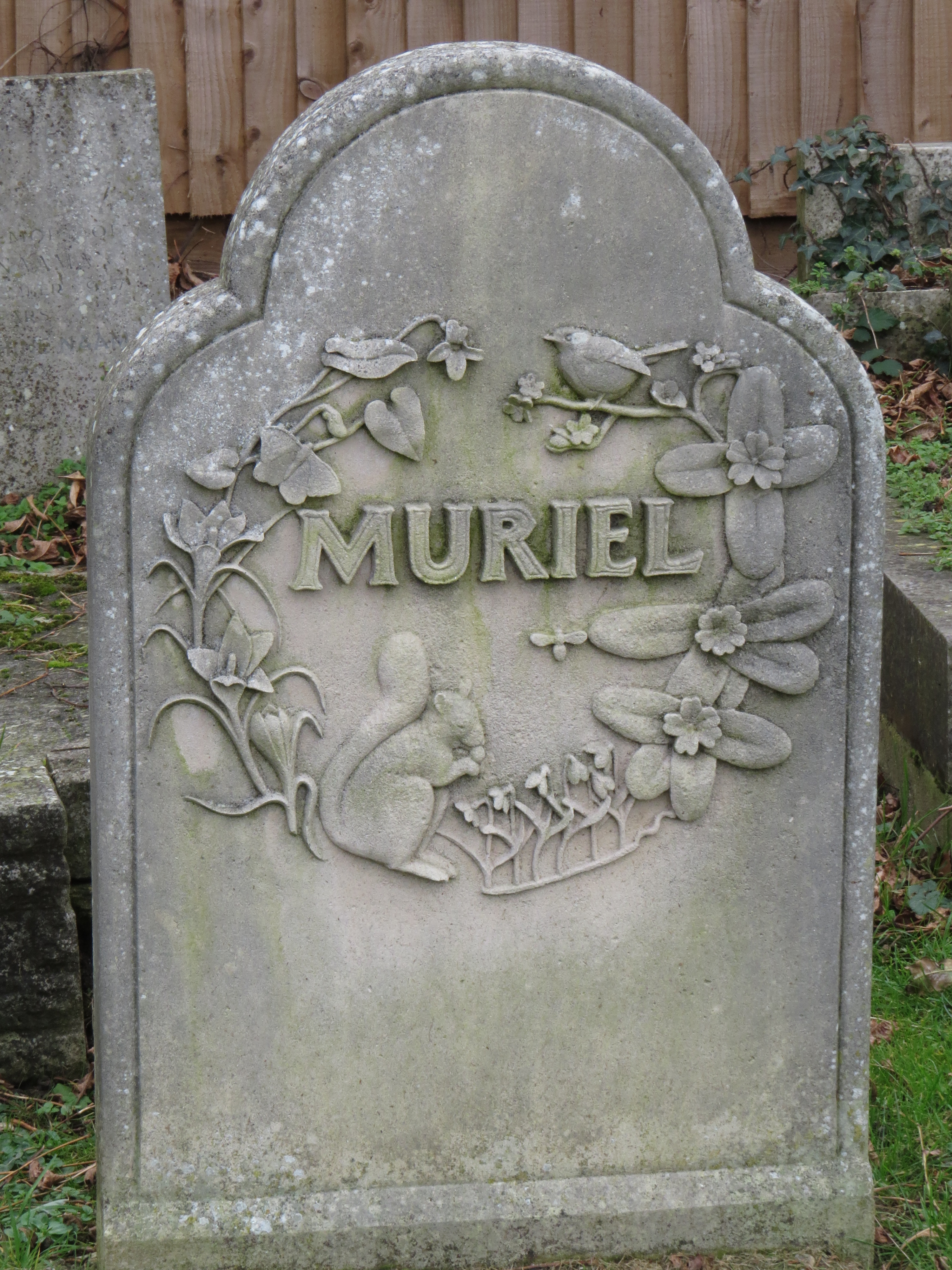
In East Finchley Cemetery

My favourite gravestone


Dear Readers, those of you who have been following this blog for a while will know that I’m a great fan of cemeteries. My heart is already given to St Pancras and Islington Cemetery with its Victorian trees, tumbledown tombs and colony of feral foxes, but I occasionally like to walk in East Finchley cemetery. This is a much more manicured, controlled space, but it has some spectacular specimen trees, and is a haven for birds.

I spend a lot of time listening as I walk – I find it helps me to tune in to what’s going on. There are lots of conifers: cypresses and spruces, pines and fir trees. They vibrate with the twitterings of small birds. I see goldcrests and long-tailed tits, and hear the scolding of blue tits. None of them stay long enough for me to get a photo, but it’s enough to know that they’re there, working their way through the needles.

There’s the sing-song squawking of ring-necked parakeets, the cackling of magpies, the cawing of ever-present crows. The goldfinches sound like little bells. There’s a flight of finches at the top of one of the big, bare trees, but they’re too far away for me to see what they are. When I get home, I see that they are most probably greenfinches, at least judging from the heavy beaks and the gold wing bar that I can see on one of the wings. These birds were hit very hard by a parasitic disease (Trichomonosis) a few years ago, and the British Trust for Ornithology noted a decrease in the number of gardens who were visited by the birds of 40%. So, it’s cause for celebration if they’re recovering. Fingers crossed.

There’s a theme of wings in the cemetery. Secretly, I always wished that I could fly, and our myths and legends are full of humans who took to the air, from Icarus to the angels. We seem to want the freedom of the air, and perhaps also a release from our heavy, earthbound bodies.

I find the garden of remembrance, where the sound of running water is added to the bird calls. There are still a few last roses in bloom, but mostly they are now well-pruned and dormant, waiting for spring. I sit on one of the benches and wait to see what will happen. Nothing does, except that I notice how the golden of the leaves on some silver birch is offset by the darkness of the firs behind it, and how the yellow foliage on the topiary box bushes make them look as if they’re touched by sunshine.

When I am walking, I often think that something will happen, and then I’ll know that it’s time to go home. There’s often a moment when I think ‘Aha, this what I was meant to see/hear/smell’. I am, I suppose, waiting for a sense of completion, and permission, a sense of closure. But what will it be this time?

I walk along a path towards the crematorium, and am stopped in my tracks by the waves of scent coming from a most modest little bush on one of the graves. I have to stop, bend down, and take a good long sniff. We think we know what a rose smells like, but there are subtle differences: some perfumes have a lemony edge, some are deep and spicy. This little rose is pure floral, essence of rose.

I take a little path along the very edge of the cemetery and, as I meander along, I have a feeling of being watched. Who, or what, is it? And there, perched stock-still on one of the gravestones is a squirrel. I laugh out loud, because he looks so much like a glove puppet. And there he sits, unmoving, as I walk along the path and then away. While every other squirrel scurries away at my approach, this one seems to believe that if he sits still, I won’t see him. As he looks plump and confident, it seems to be a strategy that’s served him well.

Once I’ve laughed with delight, I know that my job here is done and I can head home, but my eyes are attracted (much like a magpie’s) to some bright red fruit on the ground. I have found a strawberry tree (Arbutus unedo), a member of the heather family. The fruits look delicious, and are apparently edible fresh, although they bruise very easily. I love the tableau that they make amidst the sedum and the grasses.

And then, just as I turn for home, I see a jay perched on another gravestone. How I love these brownish-pink crows with their electric-blue wing feathers.They are everywhere in the cemetery, gathering acorns that they’ll bury for the winter. This one watches me and then flies off on rounded wings, emitting an alarming cackle.

So now I’m surfeited with wonders and can head for home. As I cross the road outside the cemetery I see a 143 bus in the distance and head towards the bus stop at a brisk but sensible trot – I still have my camera round my neck and so I don’t want to do anything foolish like fall flat on my face. Just as I reach the stop the bus pulls away, and I plump down onto a seat, defeated.

An elderly man passes me a few minutes later, and smiles.

‘Next time’, he says, ‘you’ll have to fly’.


Wednesday Weed – Scarlet Pimpernel

Every Wednesday, I hope to find a new ‘weed’ to investigate. My only criterion will be that I will not have deliberately planted the subject of our inquiry. Who knows what we will find…..

Scarlet pimpernel (Anagalllis arvensis)

Dear Readers, if there is one lesson in life that I should have learned by now, it’s ‘don’t put off till tomorrow what you can do today’. When I was in Milborne St Andrew in Dorset last week, I spotted this delightful patch of scarlet pimpernel, every flower open in the sunshine. But, alas, I had milk and rich tea biscuits to buy, and a copy of Woman’s Weekly to pick up, so I hurried past instead of stopping to take a photograph.

For the next three days,  the flowers were closed up tight, what with the fog, and the cold, and the afternoon shadows. And so I’m afraid my photos show them in their ‘coy mode’. However, here is what they look like when they’re in full sun. The plant has alternative names like ‘poor man’s weather glass’ and ‘shepherd’s clock’; the flowers are said to open at 8 a.m. and close at about 2 p.m. unless there’s cloudy or damp weather, in which case they may not bother to put in an appearance at all. I don’t blame them. Now that the clocks have gone back and it’s dark before 5 I often feel like huddling under the duvet with a hot chocolate and a good book.

Photo One (Scarlet Pimpernel flowers) by Pauline Eccles [CC BY-SA 2.0 (https://creativecommons.org/licenses/by-sa/2.0)], via Wikimedia Commons

Scarlet pimpernel (Photo One)

This plant is a member of the primrose family (Primulaceae) but as far as I know it’s the only  red species. Scarlet seems to be pushing it a bit though – it’s more of an orangey-red. But I am very fond of it – it’s small and unobtrusive, but repays close attention. It’s a plant of arable farmland and seaside environments, such as dunes and cliffs. It is native to the UK and to the whole of Europe, North Africa and Western Asia, but has ended up being transported to almost everywhere else in the world, probably with grain crops.

In the Mediterranean area (and, I’ve learned, in some parts of the UK)  there is a rather lovely blue form, which gives rise to yet another alternative name, ‘blue-scarlet pimpernel’.

Photo Two (blue scarlet pimpernel ) by By Zachi Evenor, cropped by User:MathKnight - File:Anagallis-arvensis-Horashim2014-Zachi-Evenor.jpg, CC BY 4.0, https://commons.wikimedia.org/w/index.php?curid=39109428

Blue form of scarlet pimpernel (Photo Two)

Despite its demure appearance, however, scarlet pimpernel has a fearsome reputation. It is said that it causes gastroenteritis in dogs and horses, rabbits and poultry, and the seed is said to be poisonous to birds. Fortunately, it also apparently has a very acrid and unpleasant taste, and so most animals avoid it. The plant can also be used as an insecticide (which is probably why it developed the toxins in the first place). However, scarlet pimpernel has also been used medicinally, and in Germany it’s known as Gauchheil (‘Fool heal’) and used to be made into a treatment for those who were melancholy or otherwise mentally indisposed.The  genus name, Anagallis, comes from the Greek ‘to laugh’, and was said to indicate the mood of someone when their depression was lifted.

Of course, many people unfamiliar with this small red flower will be well aware of the novels of Baroness Orczy, who wrote the first of many books featuring The Scarlet Pimpernel in 1905. The Scarlet Pimpernel was a chivalrous gentleman who, with his band of loyal followers (‘ one to command and nineteen to obey’) worked to rescue French aristocrats who were destined for the guillotine. As you might expect from the name, the Scarlet Pimpernel left a flower at the scene of his rescues, and also used the symbol in his correspondence. Even if you are unfamiliar with the Pimpernel himself, you might be familiar with some of the parodies that his derring-do inspired, such as the Bugs Bunny episode featuring The Scarlet Pumpernickel, or the programme ‘Nob and Nobility’ in the third series of Blackadder that featured the eponymous hero’s disgust with the adulation accorded to the ‘bloody Pimpernel’.

Photo Three (Nob and Nobility) by By Source, Fair use, https://en.wikipedia.org/w/index.php?curid=28399167

The title card from Nob and Nobility (Photo Three)

This action-packed series of novels was the inspiration for many films and television series and radio plays, with probably the most famous cinematic version being the 1934 film starring Leslie Howard and and Merle Oberon.

Photo Four (Film 1934) by https://en.wikipedia.org/w/index.php?curid=9780067

The Scarlet Pimpernel (and very exciting it sounds too) (Photo Four)

A poem from the novel has passed surreptitiously into common usage:

‘We seek him here, we seek him there,
Those Frenchies seek him everywhere.
Is he in heaven?—Is he in hell?
That demmed, elusive Pimpernel.’

You might recognise the first line from The Kinks 1966 song ‘Dedicated Follower of Fashion’.

Anyhow, enough excitement! Let’s get back to the plant.

It was believed that holding scarlet pimpernel in the hand would confer the gift of second sight, and also that the plant could give protection from enchantment and spells. I imagine that much of what we now see as mental illness might have been seen as the effect of witchcraft or demonic possession in earlier times, and so the plant’s use has remained consistent – if you are not ‘in your right mind’ for whatever reason, scarlet pimpernel seems to have been the go-to remedy.

It was used to make ‘pimpernel water’, which was considered to be a remedy for freckles (though as they are rather delightful I hardly think they need a ‘remedy’), and also for rough and discoloured skin.

In spite of their allegedly acrid flavour and rich collection of toxins, the leaves have been used in salads, especially in Germany and France. They certainly look very toothsome, but I would be a bit careful if I was you.

This blog often leads me to some very interesting places. In the search for art associated with The Scarlet Pimpernel, I discovered the wonderful illustrator Luisa Rivera, who is originally from Chile but is now based in London. She has recently illustrated a Spanish language edition of the novel by Baroness Orczy, and the cover illustration is below. For more of her dreamy, folkloric illustrations, have a look here. I particularly like the lady with the owl, but they are all haunting and original.

Photo Five (Cover illustration from The Scarlet Pimpernel) from http://www.luisarivera.cl/la-pimpinela-escarlata/

The Scarlet Pimpernel, illustrated by Luisa Rivera (Photo Five)

And finally, as you might expect, my search for a scarlet pimpernel poem has been somewhat hindered by about five hundred separate references to ‘They seek him here, they seek him there’ etc etc etc ad nauseum. But then, peeping through the rough grassland of the Google ads comes this tiny gem, by the Irish poet Paula Meehan. It’s called ‘Death of a Field’ and I think it’s both deeply poignant and beautifully observed. We need more homes, but let’s not forget what’s lost. To read it, click here. I will be looking out for Paula Meehan in future.

Photo Credits

Photo One (Scarlet Pimpernel flowers) by Pauline Eccles [CC BY-SA 2.0 (https://creativecommons.org/licenses/by-sa/2.0)], via Wikimedia Commons

Photo Two (blue scarlet pimpernel ) by  Zachi Evenor, cropped by User:MathKnight – File:Anagallis-arvensis-Horashim2014-Zachi-Evenor.jpg, CC BY 4.0, https://commons.wikimedia.org/w/index.php?curid=39109428

Photo Three (Nob and Nobility) by By Source, Fair use, https://en.wikipedia.org/w/index.php?curid=28399167

Photo Four (Film 1934) by https://en.wikipedia.org/w/index.php?curid=9780067

Photo Five (Cover illustration from The Scarlet Pimpernel) from http://www.luisarivera.cl/la-pimpinela-escarlata/ 


Bugwoman on Location – Cake-Making and Bird Spotting in Milborne St Andrew.

IMG_2182

Dear Readers, it has been something of an exciting week for Mum and Dad. On Sunday, they were walking up the steps to their front door (which have two very sturdy handrails) when it appears that one of them slipped, and the other one tried to save them (the story varies somewhat according to who you talk to). The end result was that they both ended up laying in the front garden, unable to get up. Fortunately Dad had his mobile in his pocket, and was able to ring a) an ambulance and b) one of their neighbours/carers who lives just down the road. Dad had hit his head, and Mum had a bad pain in her hip, but Dad managed to get himself up with some help. Mum, however, was stranded in the garden, because no one wanted her to get up if she’d potentially fractured something. The lovely neighbour wrapped Mum up in blankets and made her as comfortable as possible.

Two and a half hours and several calls to the ambulance service later, an ambulance arrived from Swanage (some distance away), and took Mum and Dad to the hospital for observation. A few hours, an X-Ray and a CT scan later, they were released and got home for a well-earned cup of tea, and a rest.

So it was no surprise that when it came to making this year’s Christmas cake, Mum wanted to supervise rather than stand up and actually make it.

‘And then you’ll know the recipe’, she said, ‘And it can pass on down to you’.

And so I creamed the sugar and butter, taking Mum’s advice and using a fork (‘Much quicker’). I added the eggs and the flour a bit at a time, taking the mixture in for Mum’s approval (‘Add a bit of milk, that looks too dense’). And then in with the fruit (‘Cut the cherries in half!’). And then, into the oven at 140 degrees (‘It’s supposed to take four hours, but it never does, so let’s check on it in two’).

Just enough time for Mum and Dad to have a nap in their reclining chairs, and for me to go out for a walk. The fog had finally lifted, and the sun streamed in through the window of the bungalow.

I felt a bit sad. All these years Mum had been making the Christmas cake, and she prides herself on being the one to bring it to the Christmas feast. It felt like a bit of a defeat, but at least we’d have a cake. I put on my walking shoes. A trot through the countryside always cheers me up.

I noticed a fine spider’s web on the doorway of their house as I went out.

IMG_2141

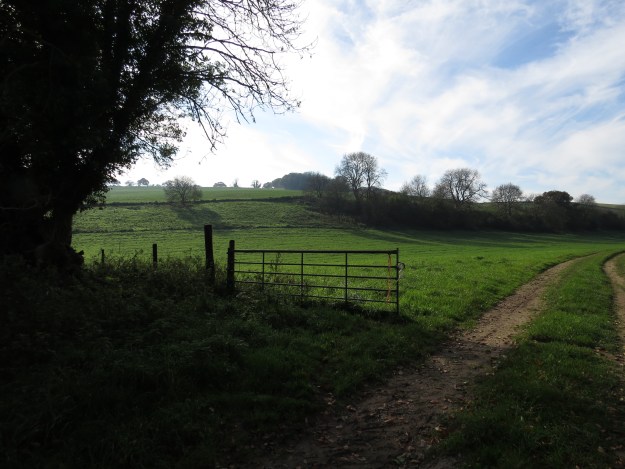
I headed down towards the church on the other side of the main road through Milborne St Andrew. I had done this walk back in September, before Mum and Dad’s party, and I wanted to see what difference six weeks had made.

The spiders’ webs were thick in the hedges, and so white that I had to check them  to make sure that they weren’t something leftover from Halloween.

IMG_2152

One of the houses is for sale, and very fine it is too. I loved the hanging basket holders, shaped like a wren and a robin. If anyone is looking for a house in Milborne I would definitely have a peep at this one.

IMG_2154

The horses were in the field, as usual.

IMG_2161

But there were some new inhabitants in the field opposite.

IMG_2163

They looked like so many clouds scattered about the hill.

IMG_2164


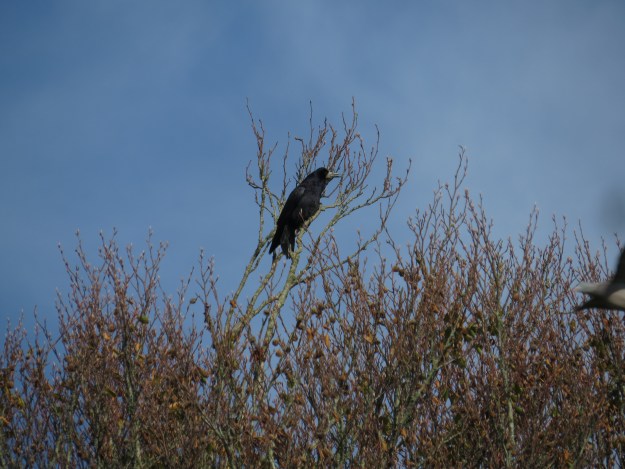
A rook called out from the top of a tree.

IMG_2166

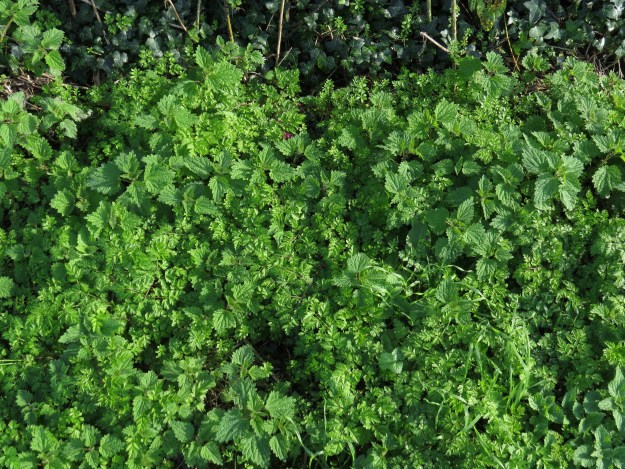
Last time I did this walk, there was Himalayan Balsam and Comfrey in full flower. But today, the prevalent colour was green, from new nettles and goosegrass and feverfew.

IMG_2168

All the plants by the little river had been cut back, but the hedgerow was alive with wrens and flocks of tits.

IMG_2170


The cabbages on the field on the other side of the track were gone, but something new had already been planted.

IMG_2174

The last of the cabbages, missed in harvesting

IMG_2178

New crop. Of what, I have no idea. Maybe it will be clearer next time I visit.

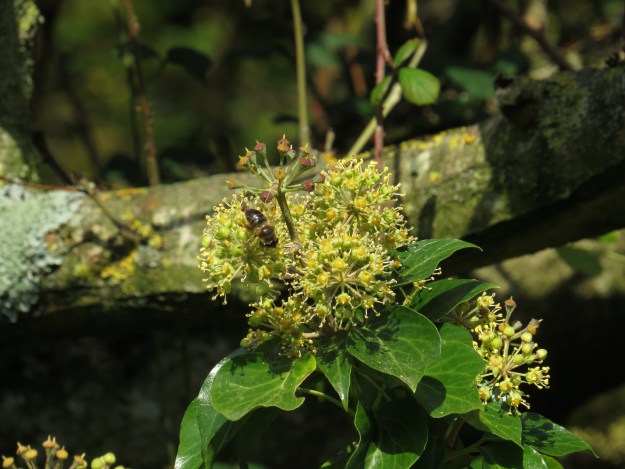
At last, at the top of the field, I find a few things in flower. There is the odd dandelion and hogweed still blooming, but then there is the ivy. It’s the main nectar source at this time of year and I must have seen a dozen red admirals stopping for a quick sip and then hurrying on as I did this walk, not one of them hanging around long enough for a photo.

IMG_2180

A lonely dandelion

IMG_2193

The Sputnik-shaped flowers of ivy, with a lone honeybee

At the end of the track I stop, and look at my watch. Still an hour and a quarter before the cake needs to be looked at. I have three choices: right, diagonally right, and left. I decide to go up the hill to the right, and just see where it goes.

IMG_2182

The first thing I notice is how hot it is on this south-facing hedgerow – I’m sorry I’ve worn a scarf. And then I notice the sound of insects, a persistent drone every time I get close to the abundant ivy. I look around for bumblebees (and do see an enormous queen disappearing back into her hibernation burrow in the grass) but the noise is actually coming from some hoverflies.

IMG_2190

This is a drone fly (Eristalis pertinax), and its resemblance to a male bumblebee is supposed to give it some measure of protection from predators. It certainly sounds like a bee, although its big eyes and shiny body are much more fly-like. It loves farmland: the larva is known as a ‘long-tailed maggot’, and it thrives in nutrient-rich, polluted water, which can often be found where there is nitrate run-off. The larva breathes via a breathing tube, which is how it got its name. The adult lives on nectar and is one of the few hoverflies that can be found all year round. A tough creature, indeed.

IMG_2187

A drone fly on yarrow. In this photo you can just about make out the rust-coloured patches on the fly’s ‘hips’ which identify it as Eristalis pertinax

And then I look up.

IMG_2198

I have been waiting for years to actually get some photos of a buzzard (Buteo buteo). They are not rare in Dorset, but I still find them magnificent as they ride the thermals, searching for a rabbit to pounce on or a carcass to investigate. They are adaptable animals, able to hunt for themselves or scavenge, and they’ve even been seen marching over a ploughed field and pulling up worms.

IMG_2195

This one is an adult (you can tell from the mostly cream-coloured underwings). Last time I did this walk I got a distant view of three buzzards, an adult and two juveniles. Today, it was just this one bird, effortlessly soaring over the fields, changing direction with the merest twist of a tail. I wondered if it was enjoying its freedom now that the fledglings were off-hand. There certainly seemed to be a kind of joy in its flight.

IMG_2196

I realise that the track isn’t actually going to give me a short-cut home, and so I turn to retrace my steps. At the bottom, I decide to take a chance on another track, which seems to head back towards Milborne.

IMG_2205

And who is this handsome chap/pess, perched on the telephone wires?

IMG_2208

I wonder if it’s some kind of thrush, but it’s not until I get home that I am able to blow the photo up and identify this as my first ever meadow pipit (Anthus pratensis). How do I know? Well, the general look of the bird, but the clincher for me was the description of the bird as having a ‘long back claw’. Furthermore, the bird is described as ‘near-threatened’. I have a new spring in my step.

IMG_2208 (2)

I pass a derelict barn hidden  in the woods. How I would love to explore it! I bet it’s home to bats, or owls.

IMG_2214

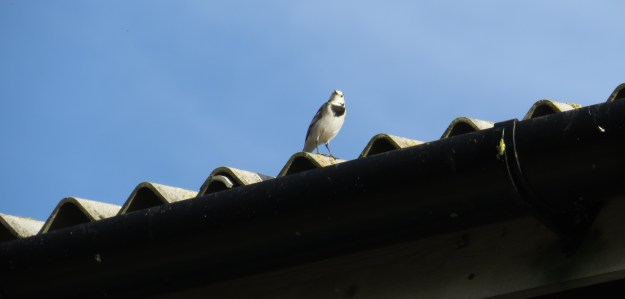
The farm buildings and machinery are a playground for pied wagtails and sparrows.

IMG_2218

IMG_2220

And a horse looks like he or she wants a chat. Or an apple.

IMG_2226

I know I’m nearly home when I see the stag on Stag House, a private dwelling that was once the house of a Mr Cole. The stag was a gift from Earl Drax, for ‘support during an election campaign’. The Drax estate is still a major land owner in these parts.

IMG_2228

As I reach Mum and Dad’s house, the smell of baking cake and mixed spice reminds me that I’ve had no lunch. I put my key in the door, and something catches my eye. The sunshine is low, shining through the spider’s web that I spotted on the way out. It is making rainbows.

IMG_2134

It reminds me that there is always more than one way to look at a situation. Looked at one way, this is a simple spider’s web. With a tilt of the head, it becomes magical, a scintillating interplay of colour and light.

IMG_2137

I am sad that Mum is no longer well enough to make the Christmas cake on her own, but how good it is to work together to create something. I am reminded that I don’t know everything, and that I could, if I chose, be a little less inclined to try to do everything for Mum and Dad, as if they were helpless. Instead, I could allow myself to receive the many things that they still have to offer – wisdom, experience, love.

The cake looks as if it will be delicious. We’ve pricked the top so that Mum and Dad can feed it with brandy over the next month, until I return in December, and then we’ll put on the marzipan and the icing. Together.

IMG_2231


Wednesday Weed – Mare’s Tail

Every Wednesday, I hope to find a new ‘weed’ to investigate. My only criterion will be that I will not have deliberately planted the subject of our inquiry. Who knows what we will find…..

Mare’s tail (Equisetum arvensis)

Dear Readers, during a long-overdue walk through St Pancras and Islington Cemetery last week, I spotted some mare’s tail (Equisetum arvensis) growing on a single grave. I wonder what the conditions were to produce such a crop, but only on this one site? Truly, the ways of the plant kingdom are a mystery, although I note that mare’s tail was once said to be an indicator of underground water. The cemetery is studded with such streams, so perhaps this is an explanation

At first glance mare’s tail resembles grass or a rush, but closer inspection shows that it is actually a living fossil that has been in existence for over 100 million years. Its structure is unique to this family of plants, with a whirl of spikey ‘leaves’ around each stem. Back in the good old days of the Carboniferous period, mare’s tail could grow into a magnificent tree 30 metres tall, and the fossils from these plants can sometimes be found in coal deposits, for Equisetum species formed a large part of this fossil fuel. These days Equisetum plants are of more modest stature, but are still worth a close look, because nothing else like them still exists. The giant dragonflies that I mentioned in my post last week would have been very familiar with these plants.

Photo One by By Alex Lomas - Equisetum arvense, CC BY 2.0, https://commons.wikimedia.org/w/index.php?curid=44451880

The branching stems of mare’s tail (Photo One)

In German, mare’s tail is known as Zinkraut or tin-herb, because the stems contain silicate, absorbed from the soil in a way that is very unusual in plants. Mare’s tail is useful as an abrasive and cleaning-agent for metal, especially tin, and another English name is scouring-rush. A member of the Equisetum family is used in Japan in the last stage of woodworking, producing a finer finish than any sandpaper.

Photo Two by By Namazu-tron - Self shot by mobile phone, CC BY-SA 3.0, https://commons.wikimedia.org/w/index.php?curid=2935195

In this micoscopic view of an Equisetum, the white dots are the silica nodules that produce the abrasive effect (Photo Two)

This is one of those plants that looks very different as the seasons pass, and this is because it produces two different kinds of growth. In spring, the fertile shoots look more like fungi than plants: in fact although I’m familiar with the summer foliage of mare’s tail, I was completely flummoxed by the buds when I visited Canada last year. These are what enable the plant to reproduce, but don’t photosynthesise.

Photo Three by By F. Lamiot (Own work) [GFDL (http://www.gnu.org/copyleft/fdl.html), CC-BY-SA-3.0 (http://creativecommons.org/licenses/by-sa/3.0/) or CC BY 2.5 (http://creativecommons.org/licenses/by/2.5)], via Wikimedia Commons

Spring mare’s tail buds (Photo Three)

As the year goes on, the plant develops photosynthetic foliage, both to survive and to create the conditions for reproduction during the following spring. Both kinds of shoot come from a complicated network of rhizomes under the soil.

Photo Four by By MPF (Own work) [CC BY-SA 3.0 (https://creativecommons.org/licenses/by-sa/3.0) or GFDL (http://www.gnu.org/copyleft/fdl.html)], via Wikimedia Commons

Lush summer mare’s tail foliage (Photo Four)

But by autumn, all that’s left are a few of the main whorls of stems.

The plant proved to be an inspiration to the father of logarithms, John Napier. I remember using my logarithmic tables for O level Maths way back in 1976, but these days I imagine it’s all done with computers, and logarithms have gone the way of the slide rule. As you will probably remember, a logarithmic scale is a nonlinear way of describing something which has a very wide range of values. For example, the Richter Scale for measuring earthquakes is a logarithmic scale: an earthquake with a value on the Richter Scale of 6 is ten times stronger than one with a value of 5.

Napier noticed the way that the nodes on the mare’s tail got closer together as they approached the tip of the plant. That’s difficult to see on the older plants in my photos, but have a look at these fresh young greater horsetails, and you’ll see what caught his eye. I love the way that patterns in nature influence both scientists and artists.

Photo Five by By Rror (Own work) [CC BY-SA 3.0 (https://creativecommons.org/licenses/by-sa/3.0) or GFDL (http://www.gnu.org/copyleft/fdl.html)], via Wikimedia Commons

Greater horsetail – note how the black lines (the nodes) are much further apart at the bottom of the plant than at the top (Photo Five)

Incidentally, Richard Mabey (in Flora Britannica) reports that in some places, mare’s tail is known as ‘Lego Plant’ because it comes apart at the nodes, and can be put back together again. It can also be used as a fungicide – mare’s tail boiled in water has been used with some success against rose mildew.

In herbal medicine only the photosynthetic summer parts of the plant are used, usually as an astringent or for the treatment of nosebleed.

I would be remiss if I didn’t note that mare’s tail is sometimes considered to be a most pernicious weed. The RHS describe it as a plant that is ‘ is an invasive, deep-rooted perennial weed that will spread quickly to form a dense carpet of foliage, crowding out less vigorous plants in beds and borders’. Those rhizomes have got a lot to answer for! The RHS notes that simply pulling the plant up will just make things worse, as the plant can regenerate from the tiniest bits of root, (although if you are going to attempt this, the best time is when the fertile shoots appear in April) and suggests a range of chemical options. It also suggests battering the plant with a rake before applying the weedkiller, which could be therapeutic if nothing else. I have rather a ‘live and let live’ attitude to perennial weeds in my garden, which involves pulling them up or cutting them back if they get too enthusiastic, but tolerating them in small numbers. Life is too short for all-out war, surely.

I have been unable to find any works by the Old Masters (or indeed Old Mistresses) of mare’s tail, but here is an illustration of the Cretaceous period, featuring a most splendid equisetum on the right hand side, plus various assorted reptiles sunning themselves on the bank. I note some Gingko trees as well, which could well be another Wednesday ‘weed’ at some point in the future. You’ll note that my definition of ‘weed’ is becoming more and more expansive as I tick off the actual ‘weeds’ in my half-mile territory. Well, after almost four years I have already featured nearly 200 of the little darlings.

Evolution in the past by Knipe (Public Domain)

And for the poem? I have a humdinger this week by Anne Stevenson, who traces the path from mare’s tail through coal to the mining communities that extracted it and are now gone. As you know, I don’t cut and paste poems from living writers, because this is how they earn their crust. But please do click through here to read the poem, which is full of wonders. You won’t be disappointed, I promise.

Photo Credits

Photo One by By Alex Lomas – Equisetum arvense, CC BY 2.0, https://commons.wikimedia.org/w/index.php?curid=44451880

Photo Two by By Namazu-tron – Self shot by mobile phone, CC BY-SA 3.0, https://commons.wikimedia.org/w/index.php?curid=2935195

Photo Three by By F. Lamiot (Own work) [GFDL (http://www.gnu.org/copyleft/fdl.html), CC-BY-SA-3.0 (http://creativecommons.org/licenses/by-sa/3.0/) or CC BY 2.5 (http://creativecommons.org/licenses/by/2.5)], via Wikimedia Commons

Photo Four by By MPF (Own work) [CC BY-SA 3.0 (https://creativecommons.org/licenses/by-sa/3.0) or GFDL (http://www.gnu.org/copyleft/fdl.html)], via Wikimedia Commons

Photo Five by By Rror (Own work) [CC BY-SA 3.0 (https://creativecommons.org/licenses/by-sa/3.0) or GFDL (http://www.gnu.org/copyleft/fdl.html)], via Wikimedia Commons

A Certain Hush

Dear Readers, there is a feeling of urgency in the autumn that differs from the tumult of the spring. In autumn, it’s all about fattening up, putting on the layers of insulation that will fuel a migration, or get a small, inexperienced fledgling through the winter. The feeders are busy from first light, with half a dozen  collared doves queued up on the branches of the whitebeam while the woodpigeons hog the feeder. And then, earlier this week, I looked out of my upstairs window and there was not a single bird in sight. Except one, on the roof ridge of the houses opposite.


IMG_2103

Sparrowhawk. What boldness it takes to just sit there, in full view. Those yellow feet look so tiny from this distance, but I know from a previous encounter with a  bird very like this one how her talons are used to hold down and pierce her prey while her curved beak plucks out the feathers and rips into the flesh. No wonder the garden was so quiet.

I have noticed that the appearance of a predator sends a certain ripple through the ether. In India, you could track the tiger through the forest by the chorus of barks and squeals as each deer and each langur spotted him, the sound getting louder and louder as he got nearer. Like the sparrowhawk he was utterly unconcerned, walking out onto the path, turning to look at us and then spraying urine on to a nearby tree as if to say ‘that’s what I think of you lot’. And then he sashayed away up the path at his own pace, and he never looked at us again.

IMG_0814

Tiger in Panna National Park


I imagine the birds buried deep in the shrubs. Do mothers teach their nestlings to stay silent when that shadow is seen against the skyline? I notice no alarm calls. No one wants to draw attention to themselves.

IMG_2104

I am remembering a few things that separately made no sense. A few weeks ago I noticed the soft dusty impression of a bird the glass of my writing-room window. There were lots of feathers on the ground, under my kitchen window. Had a panicked bird crashed into the pane and stunned itself, making it easier for the sparrowhawk?

The hunter looks around. She seems to have all the time in the world. No hawklings in the nest at this time of year – she is hunting for herself.

IMG_2105

What is stirring? What tiny motion alerts her? We know that birds of prey have eyes that are alert to the smallest rustling and excellent hearing. Maybe she is not even hunting, but just scanning her territory. I watch her for a while through the binoculars. The wind ruffles her feathers a little. I raise the camera to take a few photos, though I don’t hope for much through my dirty windows (well, I can’t get the window cleaner in until the spiders have moved on).

And then, two things happen.

A feral pigeon flies at the window out of nowhere, and swerves at the very last second to avoid the glass.

And the sparrowhawk swoops.

IMG_2106

And then both disappear.
Within two minutes, the doves are back on the feeder, and a swarm of long-tailed tits is clambering through the hawthorn with a chorus of soft tseeping calls. It’s as if every bird is discussing their close escape, and celebrating that they are still here.
And that, of course, is anthropomorphism, but I make no apology for it. We evolved from non-human ancestors, and everything that we are had its roots in them. I know what it is to feel my heart beat a little more quickly at the sound of heavy footsteps behind me on a dark winter’s evening, and to utter a sigh of relief when the door shuts securely behind me. I would be arrogant to assume that, of all the animals on this planet, humans are the only ones to experience such feelings. We are all on this little blue boat together, and there is more capacity for joy and grief than people alone can muster.


Wednesday Weed – Prickly Sowthistle

Every Wednesday, I hope to find a new ‘weed’ to investigate. My only criterion will be that I will not have deliberately planted the subject of our inquiry. Who knows what we will find…..

Prickly Sowthistle (Sonchus asper)

Dear Readers, I wanted to find a ‘proper’ weed for you this week, and here it is. Way back when I started this blog, one of the very first plants I wrote about was Smooth Sowthistle and I have been looking out since then for the prickly variety. I shouldn’t have needed to look very hard because goodness knows it’s everywhere in the UK except for in the very far north of Scotland, but it has proved elusive until today. How delighted I was to find it lurking in a little alleyway close to Fortismere School here in East Finchley, and how surprised all the passersby were to see me taking its portrait.

The diagnostic basal lobe

First things first. Both sowthistles are members of the Asteraceae (Daisy) family. Both have yellow flowers, though those of the prickly species are said to be darker in colour.  Both bleed white sap, but that of the prickly sowthistle quickly turns a dirty orange colour, while that of the smooth sowthistle takes longer. However, the leaves of the prickly sowthistle are decidedly more thistle-like, and where the leaves emerge from the stem there is a kind of rounded prickly spiral called a basal lobe (see above). The leaves are also shinier and darker green. I would hazard an opinion that the prickly sowthistle is a slightly more handsome plant than it’s smooth relative, but not by much.

https://bugwomanlondon.com/wp-content/uploads/2014/05/sow-thistle-2.jpg

A rather sad smooth sowthistle (Sonchus oleraceus)

Both sowthistles are native,and both are annuals. They are extraordinarily tough plants and require next to no soil to produce an extraordinary quantity of biomass, and a fine crop of seeds. There is one in the tree pit just up the road from my house that must be nearly a metre tall. How I admire these city-dwellers for their resilience in tough times! No amount of drought, dog urine, litter or polluted rain puts them off their stride. They remind me of Dickensian urchins, cheeky and adaptable. The only thing that slows them up is a biannual dousing with weed-killer, administered by a man from Barnet Council with a backpack full of biocide and a hose. He wears ear-buds so that he can listen to music while he sprays, but no face mask to protect his lungs, and no gloves to protect his skin. I fear that the chemicals are more prone to damage him than the plants for, although the weeds wither and die, they or their offspring are generally back within the month.

Of the two species the prickly sowthistle is, surprisingly, the one that is preferred for eating – luminaries such as Rose Gray of the River Cafe are said to have gathered the fresh young leaves in March and April for salads. According to Pliny, Theseus was treated to a dish of sow-thistles before he headed off to fight the Bull of Marathon. The plant was also fed to lactating sows (hence the name) to encourage their milk production – the white sap was thought to be indicative that this was the best use for the plant. In fact, many grazing animals love sowthistle, although farmers generally view it as a pernicious weed. In Germany, it is believed that a fleeing  hare can hide safely under the leaves of sowthistle as the plant will protect the animal (hence another alternative name for the plant, ‘hare-lettuce’).

The older leaves of sowthistle are often decorated with the white tracery of leaf-miners – usually these are the tiny caterpillars of micromoths that live between the two layers of the leaf and spend their lives munching little tunnels. I often wonder what leads to the shapes of the patterns – did the caterpillar meet another caterpillar coming in the opposite direction and have to back up? The filigree is rather attractive, I think, if not particularly advantageous to the plant. Other moth species eat the leaves and the buds, and the plant invariably attracts lots of aphids, which make it useful for attracting predatory insects such as ladybirds and lacewings.

Prickly sowthistle with a few late blackfly.

Amongst the moths that feed on prickly sowthistle are the Broad-barred white (Hecatera bicolorata), whose caterpillars feed on the buds and flowers:

Photo One by By User:Fvlamoen - Own work, CC BY-SA 3.0, https://commons.wikimedia.org/w/index.php?curid=2340791

Broad-barred white (Hecatera bicolorata)

the grey chi (Antitype chi) whose caterpillar feeds on the leaves:

Photo Two by By André Karwath aka Aka - Own work, CC BY-SA 2.5, https://commons.wikimedia.org/w/index.php?curid=7661593

Grey chi moth (Antitype chi)

and the rather elegant shark moth (Cucullia umbratica). Although most UK moths are not as brightly coloured as their tropical counterparts, they have a subtle and delicate beauty that repays close attention.

Photo Three (Shark moth) by By ©entomart, Attribution, https://commons.wikimedia.org/w/index.php?curid=1250728

Shark moth (Cucillia umbratica)

Prickly sowthistle has a wide native range, encompassing Europe, North Africa and Western Asia, and has been imported into North America, probably with grains used for food. Across its native range it has been used medicinally as a poultice for wounds and skin complaints, though many herbals consider smooth sowthistle to be slightly more efficacious.

As I feared, the common-or-garden nature of the poor old prickly sowthistle has meant that it has not featured widely in art. Even the Sowthistle Fairy of our old friend, Cicely Mary Barker, is standing on a smooth sowthistle, not a prickly one (have a look at those basal lobes, friends).

Photo Four (Flower Fairy) by Jan Willemsen (https://www.flickr.com/photos/8725928@N02/8503425551)

Sowthistle Fairy by Cicely Mary Barker

Nor is there a superabundance of sowthistle poetry. However, I hope you’ll forgive the tenuous link to this extraordinary poem by Sylvia Plath. After all, sowthistle was fed to lactating pigs, as we know. Maybe it was also used to fatten them up.

Sow

God knows how our neighbor managed to breed
His great sow:
Whatever his shrewd secret, he kept it hid

In the same way
He kept the sow–impounded from public stare,
Prize ribbon and pig show.

But one dusk our questions commended us to a tour
Through his lantern-lit
Maze of barns to the lintel of the sunk sty door

To gape at it:
This was no rose-and-larkspurred china suckling
With a penny slot

For thrift children, nor dolt pig ripe for heckling,
About to be
Glorified for prime flesh and golden crackling

In a parsley halo;
Nor even one of the common barnyard sows,
Mire-smirched, blowzy,

Maunching thistle and knotweed on her snout-
cruise–
Bloat tun of milk
On the move, hedged by a litter of feat-foot ninnies

Shrilling her hulk
To halt for a swig at the pink teats. No. This vast
Brobdingnag bulk

Of a sow lounged belly-bedded on that black
compost,
Fat-rutted eyes
Dream-filmed. What a vision of ancient hoghood
must

Thus wholly engross
The great grandam!–our marvel blazoned a knight,
Helmed, in cuirass,

Unhorsed and shredded in the grove of combat
By a grisly-bristled
Boar, fabulous enough to straddle that sow’s heat.

But our farmer whistled,
Then, with a jocular fist thwacked the barrel nape,
And the green-copse-castled

Pig hove, letting legend like dried mud drop,
Slowly, grunt
On grunt, up in the flickering light to shape

A monument
Prodigious in gluttonies as that hog whose want
Made lean Lent

Of kitchen slops and, stomaching no constraint,
Proceeded to swill
The seven troughed seas and every earthquaking
continent.

Sylvia Plath

Photo Credits

Photo One (Broad-barred white moth) by By User:Fvlamoen – Own work, CC BY-SA 3.0, https://commons.wikimedia.org/w/index.php?curid=2340791

Photo Two (Grey chi moth) by By André Karwath aka Aka – Own work, CC BY-SA 2.5, https://commons.wikimedia.org/w/index.php?curid=7661593

Photo Three (Shark moth) by By ©entomart, Attribution, https://commons.wikimedia.org/w/index.php?curid=1250728

Photo Four (Flower Fairy) from Jan Willemsen (https://www.flickr.com/photos/8725928@N02/8503425551)


The Empress

Emperor Dragonfly (Anax imperator)

Dear Readers, sometimes I get mildly irritated with my pond. It’s true that, because I replaced my lawn,  I don’t have to do any mowing. However, I do have to spend time cutting back the reeds and pulling endless leaves and debris out of the water especially at this time of year when a whole whitebeam’s worth seemed to descend in twenty minutes. But then, something happens that reminds me what it’s there for. It might be a whole bunch of singing frogs in the spring time. It might be a wagtail popping down for a drink. Or, as on Sunday, it might be an emperor dragonfly (Anax imperator) looking for somewhere to lay her eggs. I know that she is female not only by her behaviour, but by her colour – female emperors are green and brown, males are electric blue.

What an extraordinary animal she is, as long as my finger and with wings like smoked glass. Her lower left wing has a triangular section missing, possibly following a close encounter with a bird, or even an amorous male. Her eyes cover most of her head like a bifurcated helmet, and each eye has 30,000 individual lenses. They can see all the colours that we can see, plus ultraviolet and polarised light from the surface of water. She is, I know, a ferocious hunter, catching her prey on the wing by outmanoeuvering it. I once watched an emperor dragonfly hawking for speckled wood butterflies in Coldfall Wood, and wondered at his speed and the way that he popped up from underneath the butterfly, snatching it in his jaws and bearing it away with sublime efficiency.

Dragonflies seem to have a streak of curiosity, and to be keen to investigate unknown phenomena. I met a male emperor dragonfly in a Scottish woodland once, and he hovered a few feet from my face at head height. As I turned, he turned with me. I had the most curious sense of being weighed up: friend, foe, or just unimportant feature of the landscape? After a few moments he rattled away like a toy plane, leaving me covered in goosebumps and full of wonder.

But I was worried about this female. She was frantic in her search for somewhere to deposit her eggs, probing the ground with her lime green and chocolate striped abdomen. Most of the time, she seemed to be keen to lay between the wooden slats on the boardwalk beside the pond. This felt like a most unsatisfactory site to me, but how to convince her to lay them somewhere else? She seemed very single-minded.

I went to the kitchen and got a medium sized glass mixing bowl, and a side plate. For all her keen eyesight she was not the least bothered when I covered her up, and only slightly perturbed when I slid the plate under her, gently, to avoid damaging that sensitive abdomen. When she realised she was trapped she tried to fly up, her wings rattling alarmingly against the glass. I carried her a few steps and she turned to face me under the dome. I held the bowl out over the water and lifted it a few inches. She darted out straight at me, and paused a hands-width from my nose. Then she landed on my skirt, explored it as an egg-laying substrate, abandoned it and flew out over the pond, only to return to the boardwalk again. Emperors (or should  it be empresses) usually lay their eggs on pond weed, so I think the moss was confusing her, though I have plenty of pond weed left.

If any of her eggs do survive, the nymphs will become the terror of the pond, laying in wait to grasp creatures up to the size of small tadpoles in their forearms. The jaws of the creature in ‘Alien’ were modelled on the complex extending jaws of the dragonfly. These are creatures that are predatory in every part of their lives and they exude the confidence of an animal that is rarely preyed upon, at least in this country. A dragonfly  sat happily sunning himself on my bare arm for ten minutes one sunny day a few years ago, enabling me to look at his curious little face to my heart’s content.

Flight has evolved separately at least three times in the insects, and dragonflies were among the first to develop the skill (possibly only preceded by the weak flight of mayflies). Some of the ancestral dragonflies had wingspans of 30 inches. The wings are powered directly by the muscles – in the photo above you can see the bulges where the wings are attached to the body, and the depth of the thorax indicates how large these muscles are. The dragonfly needs to warm these muscles up before it can fly, which explains why you will often see dragonflies perched in south-facing bushes early in the morning. Once ready for action the dragonfly can fly at approximately 30 miles per hour, and has been estimated to accelerate at 4 g in normal flight, and up to 9 g when pursuing prey. Bear in mind that the Space Shuttle only reaches 3 g during launch and re-entry. These animals can also fly in six different directions (including backwards) and have four flight modes for different situations, from static hovering to pursuit of prey. They are, in short, the masters and mistresses of insect flight.

So often, I wish that I could talk to animals. I would have loved to persuade this beauty that she was wasting her precious eggs, but nothing I could do would dissuade her, and so eventually it started to rain, and I left her to it. And also, do I really know better? It’s a kind of hubris to think that I really understand what’s good for this creature and her offspring. I am reminded that interfering has unexpected consequences, and that often it’s better to leave off our meddling, however well intended. So, I shall have to wait and see if any dragonfly larvae turn up next year. In the meantime, travel well, empress. I am delighted to have met you.