Friday Book – ‘Native’ by Patrick Laurie

Dear Readers, I am certainly getting about a bit on my quest to read through the books on the Wainwright Prize shortlist. This week, I am in Galloway in Scotland with Patrick Laurie, who is exploring the land of his birth as he farms his small herd of Galloway cattle and tries to create habitat to seduce the curlews he remembers from his childhood:

My entire family would rush to the kitchen door at night to hear curlews passing between our chimney and the wide, dusty moon.’

But Galloway has been through many changes – there was a rush to plant conifer plantations on the hills, and a later rush to windfarms. Laurie conjures up the sense of walking into one of the ‘forests’ perfectly;

Follow tracks into those new forests and you walk in the slot of black gutter’.

The forests brought money, but they also brought destruction;

We’ve lost our mountain hares, our black grouse and our eagles as the forests grew. Golden plovers are no more, and now salmon fade into silence. Years pass and the trees become easier to stomach because we can’t remember a time before them’.

Laurie wants to farm in a way that is gentler on the land, though he still wants to be a ‘real’ farmer, not a hobbyist. He wants to buy the local, native cattle because they are superbly adapted to the tussocky grassland:

Galloway cows have a particular knack for digesting rough grass. They’re born hungry, and they’ll fatten on feed which many other breeds would refuse to sleep on’.

And furthermore he is attracted to the ‘riggit’ Galloway breed, with its white line along the spine and variety of colours. I’m familiar with the Belted Galloway, which has black hind and forequarters with a white band around its belly, but these riggit cows look tough enough to handle anything that the weather throws at them.

Galloways have a long, curly, double coat which can turn away the rain. I watch the water running off their backs and down their sides like a straw raincoat. Their only concession to this weather is to stand with their arses to the wind. They form a corral and the weather breaks upon them as if they were rocks on the shore‘.

Photo One from https://www.riggitgallowaycattlesociety.co.uk/cattle-for-sale

Riggit Galloways (Photo One)

But it’s the curlews that Laurie’s mind returns to, again and again.

That’s the curlew’s special gift; they’ll wake you to a web of old feelings and it doesn’t matter if they’re not your own. You smile and shudder in one fell swoop, and the day is changed‘.

Photo Two by Mike Pennington / CC BY-SA (https://creativecommons.org/licenses/by-sa/2.0)

Curlew (Numenius arquata) (Photo Two)

You can hear their call below.

He waits to see if a pair of the birds who return will nest, and so they do, but even after chicks appear they are quickly taken by predators, usually foxes. Laurie is often tempted to shoot them, but recognises how pointless this is; a new fox will move in to take the territory in a whisper. But he often encounters them;

He winds along the tops and only sees me when he is quite close. He freezes. Cold light makes him seem dull and dark, but I know every jammy note in that pelt. There is purple and grey, marmalade and smoke in his mane. He looks to the cattle as if they should have warned him I was here, then drops quietly away into the thickness of deep grass’. 

I think what I enjoyed most about this book was the way that Laurie conjures up the quiet moments when he is alone with the cattle, or out on the hills. He has a gift for the telling simile: he imagines a man who has been attacked by one of his cows

lying in the long grass with his ribs stoved in like a smashed accordion and grand clouds rolling by without a shrug’.

The beasts gather to drink from a deep steel trough and gurgle up threads of drool which blow in the wind like gossamer‘.

‘Listen to a cow eating rushes: it’s a murderous squeak of destruction like the sound of trainers in a squash court‘.

Interwoven with this story of cattle and curlew, of ancient farm machinery brought back to life and local characters with their advice and tales is a personal story of trying to have a child, and the struggle with infertility, the indignities of clinics and the disappointments and sadness. But by the end, the author seems to have come to a kind of peace:

I’m drunk on the sight of byre dust swirling in a shaft of sunlight or the rasp of a brush on a granite floor. That kind of pleasure can make the hours sing, and I reach to be better at it because then I belong in the precision of that moment. I never reckoned to find this strength, but it’s a product of deep slowness and patience‘.

This is a beautifully written book, with some sublime moments of observation. It gave me a real sense of the landscape and the creatures of Galloway, of its history and its people. I love to learn something new when I read, and there was much to enjoy here. Recommended.

Photo and Sound Credits

Photo One from https://www.riggitgallowaycattlesociety.co.uk/cattle-for-sale

Photo Two by Mike Pennington / CC BY-SA (https://creativecommons.org/licenses/by-sa/2.0)

Curlew call from https://www.xeno-canto.org/583708

Coldfall Wood Under Siege

Dear Readers, Coldfall Wood in North London has been a source of such solace during the lockdown. I walk there early in the morning nearly every day, and even at that hour there are people going for a stroll, getting in their early morning exercise or walking their dogs. I would estimate that there are at least three times as many people using the wood as in a normal year and this has had consequences, both good and bad. The good part is that many folk who have never been in the wood before have grown to love it, and it’s only when people care about a place that it’s possible to protect it.

The down side is that, almost inevitably, parts of the wood have received so much footfall that vegetation has not been able to regenerate. Picnics have resulted in enormous quantities of litter and, when the bins could hold no more, people have dumped their rubbish rather than take it home. In the middle of a drought fires have been lit, and some were still smouldering the following day. Dens have been built out of fallen branches but sometimes live branches have been torn from trees to make a roof.

And on Sunday, I heard the sound of digging, and spoke to  a group of grown men who said they were making a bike track for their children. I explained that Coldfall was a nature reserve. I told them that this was an ancient wood. In an attempt to appeal to their sense of self-preservation, I also told them that they were digging perilously close to a gas main. I might as well have been speaking Greek.

I have seldom felt more furious, or more impotent.

When a friend went back to take photos the following afternoon, she found this:

The roots of trees have been exposed, the forest floor has been disrupted, and that’s without the subsequent damage caused by bikes hurtling through the undergrowth. The incident has been reported to the police, but with so much else going on I will be interested to see if they actually have the time to do anything about it. Fortunately the excellent Parks Team at the council are already on the case, and we are hoping that the damage can be ameliorated and prevented from happening again, but even so this is immensely destructive. The hornbeams and oaks are already under pressure from a long period of hot dry weather, followed by torrential rain, followed by high winds. In a time of climate change we need all the trees we can get. Plus, the wood is species-rich; we have a nationally rare beetle, all three species of British woodpecker have been recorded, and the canopy in summer is full of feeding bats. All of them depend on the integrity of the wood and the health of the trees.

Here are just some of the birds that I’ve photographed over the past few years.

Two nuthatches!

Treecreeper

Song Thrush

Stock Dove

Rose-ringed parakeet

Greater Spotted Woodpecker

I am sometimes so disheartened by human beings. We seem incapable of seeing the bigger picture. So often, people think about their own needs or those of their families and don’t see anything beyond that. The trees provide the very oxygen that we breathe, and yet this seems to count for nothing. As the climate heats and changes I am reminded of the Buddhist teachings: we are children playing in a burning building, and yet we don’t have the sense to look around and see what’s happening.

But, fortunately, I’m not the only person who cares about the wood. The dogwalkers notice the changes in the wood, will tell people in no uncertain terms to douse their fires, and are proactive about things like litter. I’m part of the Friends of Coldfall Wood, a group of volunteers who are involved in the care of the wood. I’ve already mentioned the excellent Environment and Neighbourhoods team at Haringey council. We have groups like The Conservation Volunteers who help with the physical management of the wood, and Good Gym who last year planted spring bulbs on the edge of the Playing Fields for us in the pouring rain, and who regularly do  litter picks on the run. In short, making sure that the wood stays healthy is a team effort.

Over the past few months my love for this tiny scrap of ancient woodland has deepened and grown. I am only just starting to realise how much there is to learn about the history and ecosystem of the wood, with its complex webs of life. I know that not everyone will cherish the place as much as we do: vandalism will happen, litter will be dropped, branches will be broken.  Heartbreak is  assured. But working together, we will protect this place. Who will speak for the trees if we don’t?

Coldfall Wood 7.30 p.m. August 4th

Wednesday Weed – Many-Seeded Goosefoot

Many-seeded goosefoot (Chenopodium polyspermum)

Dear Readers, some plants are so sprawling, so non-descript and so lacking in flamboyant features that we are apt to pass them by. No plants are more like this than the members of the Amaranthaceae or goosefoot family. Their flowers are collections of tiny white or red blooms held together in clusters, their leaves often look decidedly goose-footish (though not in the case of this species) and you would pass them by as yet another ‘weed’.

However, a member of the goosefoot family has recently become much more famous, and is being grown in various places in the UK. Quinoa (Chenopodium quinoa) is a South American plant prized for the high nutritional value of its seeds, although the Western appetite for this product was causing severe problems in Peru and other areas where it is a staple for the local population. Some pioneering companies, such as Hodmedods, decided to experiment with growing the grain in this country, along with some of our native bean species which had previously gone out of fashion. It’s also good to remember that in times gone by we ate many members of the goosefoot family ourselves, with Good King Henry (Chenopodium bonus-henricus) and Fat Hen (Chenopodium album) both providing us with grain and leaves.

Photo One by By Kurt Stueber - www.biolib.de, CC BY-SA 3.0, https://commons.wikimedia.org/w/index.php?curid=7487

Quinoa (Chenopodium quinoa) (Photo One)

Many-Seeded Goosefoot is originally native to mainland Europe and Asia, but is considered an archaeophyte in the UK ( a plant that arrived earlier than 1500). Why 1500? Because after this point, the Voyages of Discovery to the New World resulted in a flood of new plant species to the UK, carried in ballast, in shipments of new exotic crops, and in cloth. It was a somewhat arbitrary line, but humans do love to categorise things as we know. Plants that arrived after this date are known as Neophytes. The whole subject of plant arrivals to the UK is a fascinating one: in ‘Alien Plants’, Stace and Crawley point out that many goosefoot species originally survived because they had such a close resemblance to the crop plant that was actually wanted. The Chenopodium species look very similar to sugar beet, for example, especially when they are young, and so they often survived. Many-Seeded Goosefoot is widely naturalised, in particular in North America where it probably arrived with the crops brought by the original settlers. It has been our companion for a very long time.

Many-Seeded Goosefoot is a specialist of heavy, clay soils, and particularly likes ponds that are drying out – it is a real opportunist, and those ‘many seeds’ no doubt help. Goosefoots in general have the highest tolerance for nitrogen of any ‘weed’,  and often appear on dung-heaps or as arable weeds. Other members of the family, such as the sea-beet and the glassworts, are seaside specialists, taking joy in salt marshes and the strand line. It has not escaped my notice that there is a stand of spear-leaved orache close to the tennis courts in Cherry Tree Wood, where dogs regularly pee.

Many-seeded goosefoot (Chenopodium polyspermum)

What seems to be distinctive about this species of goosefoot (though I have to be careful because it hybridises easily) are the blackish seeds, and the particularly sprawling habit. Most other goosefoots are more upright, but many-seeded goosefoot seems to take every opportunity for a lie-down, and I can hardly blame it after the heatwave we’ve had. Also, note the rather pretty pink stems.

Photo Two from http://www.dorsetnature.co.uk/pages-flower/wf-126.html

Many-seeded goosefoot seeds (Photo Two)

There are many recipes using goosefoot  species – both the young leaves as a spinach substitute and, occasionally, the seeds. Most of these use Fat Hen (Chenopodium album), but I see no reason why you couldn’t use Many-Seeded Goosefoot if that’s all that you have. You can get some idea of the possibilities here. Fat Hen is still grown as a food crop in India, and there are many delicious recipes for dal, raita and other spicy delights on the interwebs – this one, for daal, is just a sample.

Photo Three from http://evergreenrecipes.com/bathua-daal/

Goosefoot Dal (Photo Three)

Medicinally, the goosefoot species are often used as an emollient, and are made into poultices for boils, abscesses and wounds (hence one of its alternative names ‘Smearwort’). The plant is high in oxalic acid so should be avoided by folk with kidney complaints or gout.

And so, dear readers, before we leave this ‘ordinary’ plant, I am glad to share a couple of poems with you. First, this one.

Photo Four from https://thepoetrydepartment.wordpress.com/2015/10/18/weeding-goosefoot/

Photo Four

And then this one, by Russian poet Sergey Alaxandrovich Yesenin, who died in 1925, and was famous for his poems about love and the simple life. This one is mysterious and rather lovely, I thought.

I’ll No More Go Roaming, No More Seeking by Sergey Alexandrovich Yesenin

I’ll no more go roaming, no more seeking,
No more crushing goosefoot in the wood.
With those oatsheaf locks you tossed when speaking
You have vanished from my dreams for good.

With red berry juice on fair skin glowing,
Beautiful and gentle, you were like
Pink skies when the sun to rest is going
And, like new snow, you were sparkling bright.

Now the seed grain of your eyes has scattered, shrivelled,
Your rare name has melted like a sound,
Though the scent of blameless hands still lingers,
In the folds of a creased shawl is found.

In the still hour when the early sunrise
On the rooftop licks her kitten nose
I hear gentle comment on you coming
From the wind that sings in honeycombs.

What if blue dusk on occasion soulfully
Whisper that you were a song, a dream –
He who shaped your supple figure and smooth shoulders
Truly kissed a mystery supreme.

I’ll no more go roaming, no more seeking,
No more crushing goosefoot in the wood.
With those oatsheaf locks you tossed when speaking
You have vanished from my dreams for good.

Photo Credits

Photo One  By Kurt Stueber – http://www.biolib.de, CC BY-SA 3.0, https://commons.wikimedia.org/w/index.php?curid=7487

Photo Two from http://www.dorsetnature.co.uk/pages-flower/wf-126.html

Photo Three from http://evergreenrecipes.com/bathua-daal/

Photo Four from https://thepoetrydepartment.wordpress.com/2015/10/18/weeding-goosefoot/


Sunday Quiz – The Eyes Have It! The Answers

Dear Readers, it’s fair to say that my not making this quiz  multiple-choice was pretty wicked, so let’s not do that again :-). Congratulations to FEARN for getting 9 out of 15, while Rayna got 8 and Rosalind got six. As FEARN said, ‘this one is impossible’, so well done to everyone for having a bash.

1) Red Fox (Vulpes vulpes)

2) Mallard (Anas platyrhynchos)

3) Grey Squirrel (Sciurus carolinensis)

4) Grey heron (Ardea cinerea)

5) Tufted duck (Aythya fuligula)

6) Wood mouse (Apodemus sylvaticus)

7) Wren (Troglodytes troglodytes)

8) Blackbird (Turdus merula)

9) Jackdaw (Corvus monedula)

10) Common frog (Rana temporaria)

11) Azure damselfly (though I’ll happily accept damselfly) (Coenagrion puella)

12) Robin (Erithacus rubecula)

13) Collared dove (Streptopelia decaocto)

14) Rose-ringed/ring-necked parakeet (Psittacula krameri)

15) Sparrowhawk (Accipiter nisus)

Magic in the Cemetery

Photo One By Ken Billington - Own work, CC BY-SA 3.0, https://commons.wikimedia.org/w/index.php?curid=12329217

Emperor in flight (Photo One)

Dear Readers, as summer draws to a close there is a marked increase in activity. Flocks of young starlings are back in the garden, squabbling and sparring in their new livery – grown-up spots and iridescence on their bellies, infant tan and dun on their heads. Neither one thing or another, they try to act like adults but they often seem to be playing at it. They still gaze around, wide-eyed, when other birds are sounding the alarm. Winter is coming, and I wonder how many of them will survive it. Still, they are sticking together, and there’s more chance of finding food in a crowd, even though there might be less of it to go round.

And in the cemetery, magic is happening. We come out of a narrow avenue of yew trees and in the open area beyond, dozens of dragonflies are hawking for insects, drawing zig-zags in the sky, zooming low over the graves and then arcing up above the treetops. They move too fast to be captured on my camera, but they mostly look like Emperors – although dragonflies need water to breed, once that job is done they can often be seen in forest clearings. I have watched one pouncing upon a speckled wood butterfly, which stood no chance at all against these masters of the air. I see a few bright red common darters as well, stitching lines between the aerial ropes of the emperors. What a precious resource St Pancras and Islington Cemetery is, even more so since the lockdown, when much of it goes unvisited except at the weekends. I miss my early morning walks, but can’t help thinking that the woody areas are probably better off without walkers and dogs.

Photo Two by By Charles J Sharp - Own work, from Sharp Photography, CC BY-SA 4.0, https://commons.wikimedia.org/w/index.php?curid=38298639

Common darters (red male and blue female) (Photo Two)

As I watch the dragonflys’ hypnotic dance, I notice a small bird of prey fly overhead and into the trees. Most probably it’s a kestrel (I’ve seen them in the cemetery several times before) but a part of me wonders if it’s a hobby (Falco subbuteo) – this bird is well-known for eating large insects, including dragonflies, and also beetles such as the rose chafer that I reported on earlier this week. I read an account recently of a whole pile of the metallic green wing-covers (elytra) left at the base of a fence pole – all that remained of the rose chafers dissected and eaten  by a hobby. All I saw of ‘my’ bird was a striped underside and elegant wings. Probably a kestrel, but I can dream. Anyhow, kestrels will also eat dragonflies, so perhaps the motivation was the same.

Photo Three By Ken Billington - Own work, CC BY-SA 3.0, https://commons.wikimedia.org/w/index.php?curid=12342541

Hobby (Falco subbuteo) (Photo Three)

On we go, into a woodier part of the cemetery characterised by tall ash, oak and horse chestnut trees. The horse chestnuts are always in a parlous state by August, their poor leaves reduced to crunchy fragments by leaf-miner moths and various fungi. But suddenly we are surrounded by a chorus of soft cheeping sounds, more than I’ve ever heard in one place. The calls come from behind us and to both sides, and I realise that we’re in the middle of a huge group of long-tailed tits. I count thirty, and see that the group also contains some great tits and blue tits as well. At this time of the year, young birds in particular gang up and search for food en masse. What interests me greatly is what they seem to be eating. I manage to get only one photo because these little birds move so quickly, but I can see that the tits appear to be rummaging around in the leaves, pecking away at what I hope are the larvae that are still in the leaves. It would be a great thing if birds are starting to recognise the leaf-miners as food – it’s a rich resource for them, and it would help the horse chestnuts as well.

Poor photo of a long-tailed tit pecking for leaf miners in a horse chestnut leaf

Long-tailed tits are some of my favourite birds – they remind me of little avian monkeys, scrambling through the branches and causing mischief. I have often heard the flock in the cemetery, although the calls are soft enough to miss if you aren’t ‘tuned in’. I love that the lockdown has meant that I end up doing a smaller number of walks more frequently, and the turn of the seasons feels very real when you see the changes from day to day, week to week. Also, writing about these birds gives me an excuse to post some of the photos that I’m most proud of, some shots of some newly-emerged long-tailed tits in the cemetery. There is much to be said for walking slowly, keeping your eyes and ears open, and being prepared for anything.

Photo Credits

Photo One By Ken Billington – Own work, CC BY-SA 3.0, https://commons.wikimedia.org/w/index.php?curid=12329217

Photo Two By Charles J Sharp – Own work, from Sharp Photography, CC BY-SA 4.0, https://commons.wikimedia.org/w/index.php?curid=38298639

Photo Three By Ken Billington – Own work, CC BY-SA 3.0, https://commons.wikimedia.org/w/index.php?curid=12342541

Sunday Quiz – The Eyes Have It!

Dear Readers, they say that ‘the eyes are the windows to the soul’, and this week I thought we’d look deeply and lovingly into the eyes of some of the UK’s commonest wildlife, to see what we could see. There are fifteen eyes below, and all you need to do is to tell me who they belong to. Just to make it a smidge harder, for once I’m not going to make this multiple choice, so you can tell me who you think you’re looking at.

As per normal, I will publish the answers on Tuesday, so if you want to be marked, pop your answers in the comments here on the blog before 5 p.m. UK time on Monday. Also, you might want to write your answers down before you get to the comments if you don’t want to be influenced by those who have gone before. Finally, some of the photos are a little blurred at this magnification. Just take it as an additional challenge :-).

Onwards, and good luck!

1)

2)

3)

4)

5)

6)

7)

8)

9)

10)

11)

12)

13)

14)

15)

A Bit of a Surprise

Rose chafer (Cetonia aurata)

Dear Readers, every so often something happens in the garden that reminds me exactly why I have a lot of scruffy hemp agrimony plants hanging around for months, and today was one of them. When this amazing insect flew over at first all I got was a burst of iridescent green, and I was convinced that it was a dragonfly. When it landed and the sun glinted off the carapace, I realised that a rose chafer beetle had landed, the first one I’d seen since I was last in Austria. What a pretty creature it is, as big as my thumb to the first joint and as bumbling and cuddly an insect as you’d wish to find.

Rose chafers have a bad reputation because they are rather partial to dog roses (hence the name). This one seemed to be mainly stocking up on pollen, and the grubs are handy detritivores, munching on rotting vegetation. And really, it looks like a jewel. Who could resist it?

One rather endearing thing is the way that it flies around with its elytra (the wingcases) closed and the wings out.

Rose chafer in flight – A great photo series by Bernie (Public Domain)

I can’t begin to tell you how seeing something like this cheers me up – the world seems so full of wonders just waiting for us to notice them. It has been so wet this last week that I’ve barely been able to get outside the front door, so there was a special joy in sitting in the sunshine and drinking my tea this morning, even without this beautiful creature turning up.

And then, it launched itself into the air, did a quick celebratory circle of the garden to see if it was missing anything and headed off at great speed in an easterly direction. They fly surprisingly quickly for such big critters, and I can imagine if one flew into you it would leave quite a bruise.

And finally, if you want to see a really amazing video showing all sorts of insects that don’t look as if they should be able to fly at all taking off in slow motion, have a look at the link below. I suspect you’ll have to belong to evil Facebook to see it, but it’s worth it. Have fun!

https://www.facebook.com/fumihiko.hirai.9/videos/1469527733147993/

Friday Book – Diary of a Young Naturalist by Dara McAnulty

Dear Readers, I am a sucker for a book in the form of a diary – there’s something about those daily entries, the feeling of a story unfolding across time, that I find very appealing. Plus,  this is no ordinary diary. Dara McAnulty is a teenager, living in Northern Ireland, with a passionate involvement with, and interest in, the natural world. That’s not all, though. McAnulty has a younger brother and  sister, and

Not only is our family bound together by blood, we are all autistic, all except Dad – he’s the odd one out, and he’s also the one we rely on to deconstruct the mysteries of not just the natural world, but the human one too. Together, we make for an eccentric and chaotic bunch. We’re pretty formidable, apparently. We’re as close as otters, and huddled together, we make our way in the world‘.

McAnulty guides us through his world, and while there are ways in which he experiences the world in a different way from many of us, there are so many occasions when I could empathise with him: before a holiday to Rathlin Island, for example, there is that all too familiar mixture of anticipation and terror.

Perhaps it’s because I love new places and hate new places all at once. The smells, the sounds. Things that nobody else notices. The people, too. And the right and wrong of things. Small things, like how we’d line up for the ferry, or what was expected of me on Rathlin when we arrived’.

When the diary begins, McAnulty is living in suburbia, and is suffering at school:

The fourth ‘report card’ of the year has kept my feet from touching soil and grass, and locked me in a cycle of exams where freedom seems nonexistent. The classrooms at school are claustrophobic. Through the stale air I’m bombarded with fidgets, sighs, shifts, rustles as loud as rumbles. The rooms are bright, so bright that the reds and yellows pierce my retinas. Fluorescents drowning natural light. I can’t see outside. I feel boxed in, a wild thing caged‘.

Outside, though, it’s different.

The colours on Rathlin are mostly natural and muted in this early spring light, tones that are tolerable to me. ….Natural sounds are easier to process, and that’s all we hear on Rathlin. Here, my body and mind are in a kind of balance. I don’t feel this way very often’. 

And McAnulty has been horribly bullied at school;

Unfortunately for me, I’m different. Different from everyone in my class. Different from most people in my school. But at breaktime today I watched the pied wagtails fly in and out of the nest. How could I feel lonely when there are such things?

But this is far from a misery memoir of any kind. Early in the book, McAnulty’s mother tells the family that they are moving house, to County Down. The author doesn’t know it, but this is going to be the start of an extraordinary rebirth for him. Nonetheless, there is the fear of change, and the loss of familiarity.

Every day, ever since I can remember, Mum has sat me down, sat us all down, and explained every situation that we’ve ever had to deal with. Whether it was going to the park, to the cinema, to someone’s house, to a cafe. Every time, all manner of things were delicately instructed. Social cues, meanings of gestures, some handy answers if we didn’t know what to say. Pictures, social stories, diagrams, cartoons. Many people accuse me of ‘not looking autistic’. I have no idea what that means. I know lots of ‘autistics’ and we all look different’.

How I hoped that the move would be a good thing! I have rarely kept my fingers so tightly crossed for an author. And the first signs are good. McAnulty makes a friend with the boy next door, Jude:

We chat aimlessly about mythology and animals and – just stuff. I’ve never been good at conversation. It’s an art I don’t know the rules of. Either I just ramble on, spouting facts, not listening to the other person, or else I silently gawp, muddled by how to take part. It’s how it’s always been. With Jude, though, it feels easy. There’s no third person, no chiding, no group, no bullies. I’m cautious though. It’s like I’m waiting for the contempt to slip out, even accidentally’. 

And when he starts at his new school, the author quickly finds his feet:

I have never talked so much at school, ever…Discussing science, Star Wars, nature, maths, philosophy, history. Everything. I even started to wonder if this was what being normal actually felt like, but had to stop myself because normal is definitely not something I want to be. it felt strange, alien. But such a relief‘.

I have gone two weeks without being bullied. Two weeks. This is the longest period I’ve experienced without taunts and jibes or fists landing’ .

And as a brief interjection here, how horrific it is that this kind of aggression is tolerated in a school. McAnulty’s new school shows that it doesn’t have to be that way, that a bullying culture can be changed if everyone is determined to make it so. How I feel for all the children afraid to go to school, unable to learn, because they are afraid of physical and mental abuse.

The author’s connection to nature is profound. He is angered when a little boy finds a conker and the child’s mother throws it away because it’s ‘dirty’.

As I watch, anger surges inside. I think about all these tiny wrongdoings, everywhere in every season, the tiniest crimes. The things grown-ups do without thinking. The messages they send angrily into the world. The consequences ricochet through time, morph, grow, shapeshift. What’s so wrong with a conker?’

Good question. Slowly, almost without noticing, McAnulty is drawn into the world of activism: he starts an eco group at school, something that would have been unthinkable at his old school. He goes on strike and stands alone in the freezing cold with two placards, one saying ‘School Strike for Nature’ and the other ‘School Strike for Climate’. He is frustrated, though, by the questions that he’s asked, and by the way that he’s now a ‘leader’.

Instead of asking about the issues, they wanted to talk about ‘me’, how I ‘felt’. Not the science or the facts’.

At the start of the book, McAnulty talks about the blackbird that he hears singing. Later, he talks about his favourite saint, St Kevin, who, legend has it, stood so still that a blackbird made her nest in his hand, and so he stood until the eggs had hatched and the fledglings flew away. The author, who has tried throughout this diary to work out how to both protect himself and to be part of the world, ends with this.

A blackbird might never choose to nest and lay its eggs in my palm, but I know that my hand will always be outstretched, to nature and to people. Because we’re not separate from nature. We are nature. And without a community, when you’re always on your own, it’s more difficult to share ideas and to grow’.

This is a remarkable book by a remarkable young man. It gave me insight into what it’s like to live with autism, the joys and tribulations of family life, and how activism takes root and grows. More than anything, it gives a marvellous window into the nature of Northern Ireland, and of the joys of paying attention. Highly recommended.

An East Finchley Update

Dear Readers, one thing that going for a daily walk before work has taught me is the restorative power of having something pretty to look at. Although the front gardens on my street are tiny, I love the effort that people have put into making them attractive. Here are a selection spotted in about two minutes.


I love the imaginative use of the gap in the brick wall here. Every season there’s something new.

I do love pampas grass. I know it’s a bit retro, but I love seeing the finches ripping bits off for their nests. This one has had lots of babies though, unfortunately.

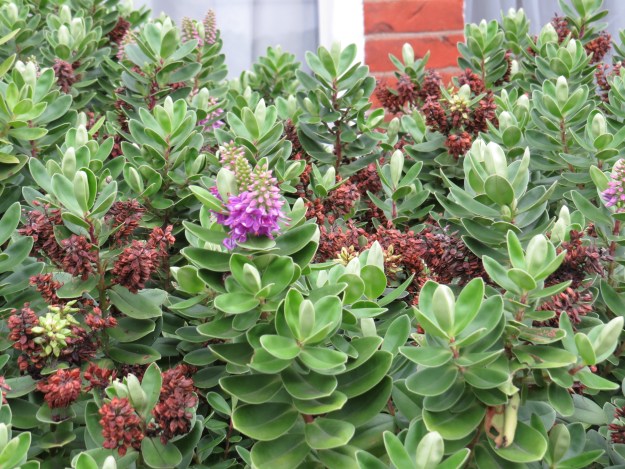
This hebe is my number one plant within walking distance if I’m looking for late or early bumblebees.

I do love an imaginative use of pots.

Tutsan is really popular around these parts: a close relative of St John’s wort, it seems to flower forever.

And there are some fine apples and crab apples starting to appear.

Then it’s across the road to the Cherry Tree estate – these houses are later (1920s and 30s) with bigger front gardens, and some of them are gorgeous.

I thought that this fabulous plant might be a rhodichiton, but I’m sure one of you lovely people can let me know for sure 🙂

And I love this garden with its pond and little willow. Trees like goat willow are very important for early pollinators – I was wondering about getting a Kilmarnock willow for the garden for this very reason.

And the hibiscus this year! This garden has a blue one and a white one, and very fine they are too, so unexpected in a suburban road in North London.

And then it’s off to Cherry Tree Wood for a quick romp around the tennis courts and back to the main road. I am intrigued by this plant, which is growing very well. I am thinking Common Orache (Atriplex patula) but will have to go in closer for a proper look at the leaves. I am always hoping to find those Old English pot herbs Good King Henry(Chenopodium bonus-henricus) or Fat Hen (Chenopodium album) but no luck yet. What excellent Wednesday Weeds they would make!

Then it’s off to my favourite weed-spotting site, the unadopted road between the wood and Baronsmere Road. One thing that is doing very well is the Russian vine (Mile-a-minute plant) Fallopia baldschuanica). Well, what can you expect of a close relative of the dreaded Japanese Knotweed? I see that it also goes by the name of Bukhara Fleeceflower. Who knew?

I spy some evening primrose flowers, beloved by moths and a member of the willowherb family.

Lots of Japanese anemones are out too, a very reliable autumn plant in these parts, and tolerant of shade too.

When I get to the High Street, I see that the traffic light on the corner has been completely demolished. Usually a passing lorry just clips it until it is at a 45 degree angle, but this must have been a rather more substantial collision. As usual we’ll just have to be careful crossing the junction -pedestrians are definitely at the bottom of the pecking order in London generally, and at this crossing in particular.

And then it’s home. The buddleia outside my house are all but finished (although every time I think about cutting them back they throw another half-dozen flowers). What they do have is lots of honeydew on their leaves, which means that our little black and yellow friends the wasps are all over the plant, licking up the sugar. Methinks the pruning is going to have to be done with a watchful eye and great care. Fortunately it’s raining at the moment, so by the time I get to it maybe the problem will have eased a bit. Otherwise, wish me luck!

Wednesday Weed – Horseradish

IMG_1750

Horseradish (Armoracia rusticana)

Dear Readers, there is a positive explosion of horseradish in the cemetery at the moment. I associate this plant with the over-grazed common land of Hackney Downs, back when I was a child: rugged ponies used to be tethered there (invariably piebald I seem to remember) and the turf was nibbled down to the roots. All that survived was great clumps of this stuff, and it seemed to me odd that something named after a horse seemed to be the only thing they wouldn’t eat.

I was therefore pleased to learn that the name probably has nothing to do with horses at all. In German, the plant is called ‘meerrettich’ (sea radish) and it’s thought that the English thought that it was called mare radish. From there, it was only a short jump to horseradish. Plus, calling anything ‘horse’ apparently used to mean that it was coarse and uncivilised, so maybe this also had something to do with the naming of this most uncompliant plant.

The plant is a member of the Brassicaceae or cabbage family, and has been grown for over 2000 years, largely as a medicinal plant – its pungent root has been used in salves for joint pain since 1500 B.C. It was also said, like many eye-watering herbs, to be useful as an aphrodisiac. Sadly, unlike the prickly lettuce  that I mentioned a few weeks ago, it doesn’t seem to have a priapic God to accompany the legend, but I do find it interesting that cabbage relatives, surely the most unromantic of plants in terms of their wind-producing aftereffects, have historically been used as a kind of sulphurous love-potion. Tastes certainly do change. 

IMG_1748

Horseradish was also said to be a diuretic (and was hence used extensively for dropsy), a vermifuge (for expelling intestinal worms) and was said to be extremely useful for treating coughs – maybe something that could come in handy what with Covid and all. A slice of horseradish root in milk is said to improve the complexion, and if combined with lemon juice it can remove freckles, though why anyone would want to get rid of those delightful attributes I have no idea.

According to my Alien Plants book (by Clive Stace and Michael Crawley), horseradish is unusual in being mostly sterile (it almost never sets seed), with all the plants we see coming from the rhizomes. Many of the plants that appear alongside roadsides are the result of people throwing out unwanted plants from their gardens. Why then, I wonder, is this one particular grave in St Pancras and Islington (pictured above) absolutely covered in horseradish? The world is full of mysteries, to be sure. All theories gladly considered.

Of course, most of us know of horseradish in association with roast beef, although from the 1600s on in the UK it was also eaten with oysters. Country inns used to grow it so that they could harvest the root and grate it on the spot, which is undoubtedly the most eye-watering way to eat it. The English in particular, having no chillies or black pepper to call their own, seem to like the pungency of ingredients like English mustard and horseradish, and are rarely happy unless their eyes are watering and their nasal passages on fire.

These days, horseradish seems to have become popular with smoked fish (maybe something of the Scandinavian influence has rubbed off), and we also regularly eat it in Austria, especially with the boiled meat dish Tafelspitz.  Personally, I find it a tricky ingredient to pair with other flavours, but do let me know what you think. Interestingly, horseradish is one of the ingredients of the Jewish Seder plate, and an American food writer mentions that she used to eat ‘Hillel sandwiches’ (named for the famous Rabbi Hillel) which consisted of matzoh, horseradish and charoset (a very sweet, sticky mixture of apples and nuts with sweet wine). She came up with a recipe for apple tart with walnut-horseradish frangipane, which looks delicious, and could possibly work if the balance is right. The recipe is here, and there’s a photo below to encourage you.

Photo One from https://food52.com/recipes/10817-apple-tart-with-walnut-horseradish-frangipane

Apple tart with walnut-horseradish frangipane (Photo One)

A quick look at Vickery’s Folk Flora pulls up a few other interesting uses for horseradish. In the Fens, one way of determining the sex of an unborn baby was for the prospective parents to sleep with a piece of horseradish under each of their pillows. If the husband’s horseradish turned black before his wife’s, the baby would be a boy, and vice versa.

Horseradish leaves (which look superficially like those of dock) can be used to treat nettle stings.

My favourite comment, though, was this:

My now ex-husband and I lived in a Steiner community near Middlesbrough for about a year. During that time he was very depressed and often angry. He was advised by a senior member of the community to wrap horseradish leaves on his feet to draw the heat from his head. It didn’t work and we divorced six months later‘.

This conjures up such a picture of domestic bliss, don’t you think?

IMG_1751

Horseradish at the front, knotweed at the back.

And finally, a poem. During the 2012 Olympics (and how long ago does that seem now?) the Scottish Poetry Library collaborated with BBC Radio to publish a poem by every country involved in the competition. Song 352 was from Ukrainian poet Oleh Lysesha, and I love the image of homely horseradish and his always hospitable hut. Horseradish is thought to come originally from the grasslands of Eastern Europe, and so I imagine it being woven into the culinary memories of people from all over this part of the world.

Song 352 by Oleh Lysheha 

When you need to warm yourself,
When you are hungry to share a word,
When you crave a bread crumb,
Don’t go to the tall trees —
You’ll not be understood there, though
Their architecture achieves cosmic perfection,
Transparent smoke winds from their chimneys..
Don’t go near those skyscrapers —
From the one-thousandth floor
They might toss snowy embers on your head..
If you need warmth
It’s better to go to the snow-bound garden.
In the farthest corner you’ll find
The lonely hut of the horseradish..
Yes, it’s here, the poor hut of a horseradish..
Is there a light on inside? — Yes, he’s always at home..
Knock at the door of horseradish..
Knock on the door of his hut..
Knock, he will let you in..

Photo Credits

Photo One from https://food52.com/recipes/10817-apple-tart-with-walnut-horseradish-frangipane